Star-Raker (1978) (2)
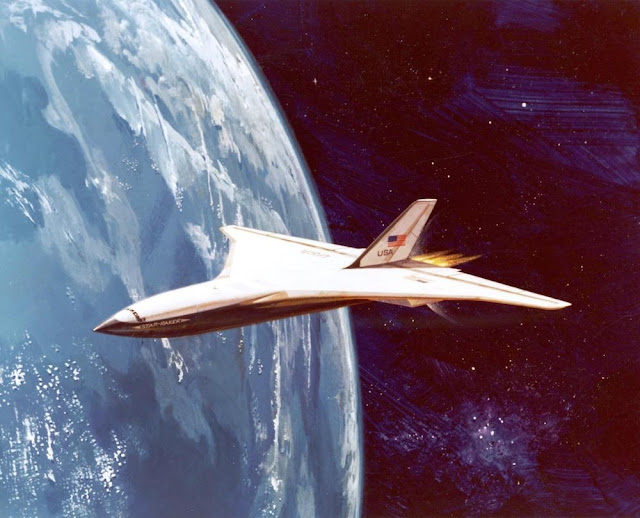 Star-Raker in low-Earth orbit. Image credit: M. Alvarez/Rockwell International.The weight of cargo Star-Raker could carry would depend on its mission profile. For the profile described here, cargo weight delivered to orbit would have amounted to only about 48.6 metric tons (53.6 U.S. tons). The aerodynamic flight to the equator under jet power, meant to steal some of the Earth's rotational energy and avoid a plane change maneuver in LEO, had under close examination turned out to be expensive.
The Rockwell team proposed improving the equatorial profile's payload performance by loading liquid oxygen at the equator, either during flight using a new-design tanker aircraft, or after a landing at an equatorial facility with an adequate runway, orbital-takeoff gear attachment and recovery capability, and ability to provide liquid oxygen. Either approach would, however, have complicated Star-Raker operations.
To unload cargo, Star-Raker would have swung its nose, which would have contained its crew compartment, sideways out of the way, exposing one end of its six-meter-high-by-six-meter-wide-by-43-meter-long (20-foot-high-by-20-foot-wide-by-141.5-foot-long) cargo bay. The bay's arched ceiling would have made it a point of structural strength, not weakness, in the Star-Raker design.
The crew would have moved to the rear of the crew compartment to assist with cargo transfer. Windows at the rear of the two-deck crew compartment would have provided a 121° field of visibility.
The Rockwell team did not describe its cargo transfer system in any detail, though it is clear that Star-Raker would not have docked in the conventional sense. Brief mention was made of a transfer rail system in the cargo bay that would have linked to equivalent rails on the space station.
Return to Earth would have begun with cargo bay closure. After moving away from the space station, the crew would have turned Star-Raker so that its tail faced in its direction of orbital motion, then would have fired its OMS engines to slow down.
Maximum deceleration during the unhurried shallow-angle reentry would have reached no more than 2.3 gravities. Star-Raker would, in general, have experienced reentry temperatures lower than the Space Shuttle Orbiter, though nose and wing leading-edge temperatures were expected be somewhat higher. The higher leading-edge temperature was attributable to its relatively blunt shape.
The Rockwell team proposed two types of reusable Thermal Protection System (TPS) for Star-Raker. Both would have been mounted on an outer facing sheet covering a honeycomb layer. The honeycomb layer would in turn have been attached to an inner facing sheet covering the honeycomb core that surrounded the propellant tanks.
The first TPS design closely resembled that baselined for the Space Shuttle Orbiter. Ceramic tiles individually molded and milled to match Star-Raker's curves would have been glued to fabric strain-isolator pads affixed to the outer facing sheet.
The second TPS design, similar to one developed for the B-1 Bomber, was more complex. Metal panels — titanium-aluminum for low-temperature areas and "superalloy" for high-temperature areas — would have been attached to the outer facing sheet using flexible standoffs. The standoffs would have permitted the overlapping panel edges to slide over each other as they grew hot and expanded or cooled and contracted. Foil-wrapped thermal insulation blankets affixed to the outer facing sheet would have provided additional thermal protection.
Both TPS designs would have included a system for detecting breaches in the TPS. The Rockwell team provided no details of its design and did not describe what the crew might do if a breach were detected. Star-Raker on approach. Image credit: M. Alvarez/Rockwell International.When Star-Raker slowed to Mach 6, it would have begun cross-range maneuvers designed to shed energy and slow it to Mach 0.85. The crew would then have opened the inlet ramps and started "some" of its jet engines.
The Rockwell team provided the space plane with enough liquid hydrogen to permit a 556-kilometer (345-mile) subsonic cruise and two powered landing attempts. Landing velocity would have been about 215 kilometers per hour (135 miles per hour). At wheels stop at an airport capable of supporting a cargo 747 or a C-5A Galaxy, Star-Raker would have weighed about 281 metric tons (310 U.S. tons).
Star-Raker weights given in this flight description are based on data the Rockwell team generated in the period spanning December 1977-January 1978. In February-March 1978, NASA MSFC and NASA Langley Research Center (LaRC) in Hampton, Virginia, reviewed the Rockwell team's Star-Raker weight numbers.
The NASA centers found that Rockwell's estimates were low if "normal" technology were assumed and high if "acceleration" (advanced) technology were assumed. Whereas Rockwell had placed Star-Raker's "dry" weight with orbital-takeoff gear at 293.5 metric tons (323.5 U.S. tons), MSFC/LaRC determined that, with normal technology and a 10% cushion for weight growth during development, Star-Raker would weigh 407.6 metric tons (449.3 U.S. tons) without propellants; with advanced technology and the cushion, it would weigh only 257.6 metric tons (284 U.S. tons).
The Rockwell team and NASA MSFC engineers met in May 1978 to try to reconcile the weight estimates. They made one important change in Star-Raker's flight profile: they abandoned the subsonic flight to the equator in favor of a KSC launch and direct climb to a 556-kilometer (345-mile) LEO inclined 28.5° relative to Earth's equator (that is, the latitude of KSC).
The NASA and Rockwell teams settled on a Star-Raker weight without propellants (but with orbital-takeoff gear and 10% cushion) of 330.4 metric tons (364.2 U.S. tons). As it began ascent to orbit on a KSC runway, the space plane would have weighed 2280.5 metric tons (2514 U.S. tons). Of this, Star-Raker's maximum weight, 89.2 metric tons (98.3 U.S. tons) would have comprised cargo for the SPS project.SourcesIndependent Research and Development Data Sheet, Project Title: Earth-to-LEO Transportation System for SPS, Rockwell International, 15 December 1978.
"Star-Raker: An Airbreather/Rocket-Powered, Horizontal Takeoff Tridelta Flying Wing, Single-Stage-to-Orbit Transportation System," SSD 79-0082, D. Reed, H. Ikawa, and J. Sadunas, North American Rockwell Space Systems Division; paper presented at the American Institute of Aeronautics & Astronautics Conference on Advanced Technology for Future Space Systems in Hampton, Virginia, 8-11 May 1979.
More Information(...)
Source:
http://spaceflighthistory.blogspot.com/2020/09/star-raker-1978.html
 Wątek: [SHB] Star-Raker (1978) (Przeczytany 1888 razy)