Rendezvous Concept for Circumlunar Gemini (1965) (2)
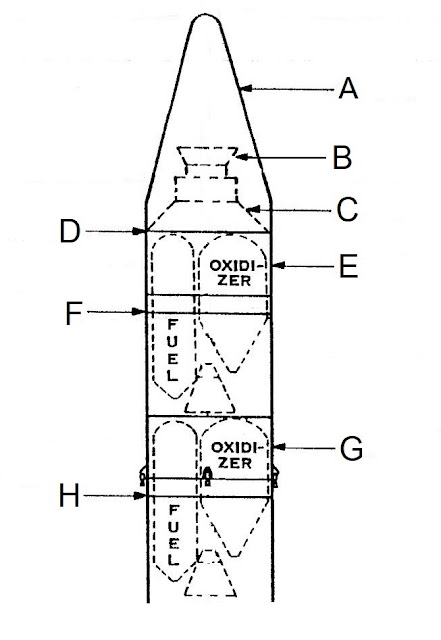 A look inside the shrouds reveals a Titan IIIC transtage and, above it, the conceptual Modified Transtage for the circumlunar Gemini mission. A = streamlined payload fairing; B = Target Docking Adapter (TDA); C = TDA transition structure; D = payload fairing separation plane; E = Modified Transtage; F = Modified Transtage separation plane; G = Titan IIIC transtage/Stage 3; H = Titan IIIC transtage/Stage 3 separation plane. Image credit: Martin Marietta
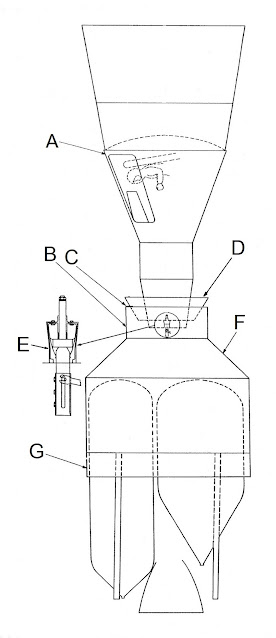 Gemini docked with Modified Transtage. A = Gemini spacecraft; B = Target Docking Adapter (TDA) support structure; C = external status display panel visible to Gemini crew; D = TDA docking cone; E = Gemini electrical umbilical and TDA receptacle; F = TDA transition structure; G = Modified Transtage. Image credit: Martin Marietta.Events would then occur rapidly. As the Gemini/Modified Transtage/Titan IIIC transtage stack orbited into the proper position to begin flight to the Moon, the crew would fire explosive bolts, severing links between the two transtages, then would ignite OAMS thrusters to pull the Modified Transtage clear of the Titan IIIC transtage. This would cause propellants in the Modified Transtage to settle toward its engines, permitting ignition.
With that, the April 1967 test would complete its main objectives. The astronauts on board the Gemini spacecraft would not ignite the Modified Transtage engines; instead, they would soon separate from the Modified Transtage and return to Earth. When time came for the actual circumlunar flight to begin in June 1967, however, the crew on board the docked Gemini would ignite the twin Modified Transtage engines within five minutes of separation from the Titan IIIC transtage, beginning the Trans-Lunar Injection (TLI) maneuver.
The Modified Transtage engines would fire for six minutes and 40 seconds, expending 22,565 pounds (10,235 kilograms) of propellants. At the start of the TLI burn, the crew would feel acceleration equal to 0.6 Earth gravities. Because they would face the Modified Transtage, they would feel as though they were falling out of their seats toward the Gemini spacecraft nose (straps would, of course, hold them firmly in place). Acceleration would mount up as the Modified Transtage expended its propellants and became lighter, reaching a maximum of five Earth gravities just before the engines shut down.
The astronauts would undock from the Modified Transtage, turn their Gemini spacecraft around, and fire the OAMS engines to move away. They would then settle in for a trip around the Moon.
The Martin Marietta/McDonnell/NASA MSC report contained few details on what the astronauts would do during their circumlunar voyage, apart from using the OAMS thrusters to carry out four course correction maneuvers. The first would take place during the period between three and 10 hours after TLI, the second and third 40,000 nautical miles (74,080 kilometers) before and after passing the Moon, respectively, and the fourth between five and 10 hours before Earth atmosphere reentry. Propulsive velocity change during the course-correction burns would total between 170 feet (51.8 meters) per second and 230 feet (70 meters) per second.
Other possible mission objectives included testing the worldwide tracking and communications system ahead of its use during Apollo lunar landing missions and lunar photography as the circumlunar Gemini passed over areas of the Moon lit by the Sun. The Martin Marietta/McDonnell/NASA MSC team estimated that about a third of the lunar farside hemisphere would be in sunlight as the spacecraft passed over it.
Flight time, maximum distance from Earth, and lunar passage distance depended on many factors and could be highly variable. For a circumlunar mission that would pass the Moon when it was near perigee and that would perform a splashdown near Cape Kennedy in daylight, the mission would last 143 hours (five days, 23 hours), would reach a distance of 221,700 miles (356,790 kilometers) from Earth, and would pass within between 660 nautical miles (1220 kilometers) and 1300 nautical miles (2410 kilometers) of the lunar surface. For a daylight splashdown near Hawaii when the Moon was near apogee, the equivalent numbers were 172 hours (seven days, four hours); 253,363 miles (407,748 kilometers); and between 800 nautical miles (1480 kilometers) and 1330 nautical miles (2460 kilometers).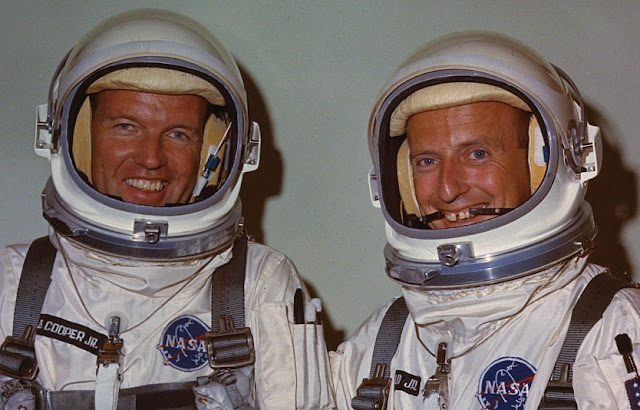 Gordon Cooper (left) and Charles Conrad: the crew of Gemini V. Image credit: NASAThis post began with U.S. Representative Olin Teague's query to NASA Administrator James Webb. Three days after the date on Teague's letter, astronaut Pete Conrad, whose enthusiasm for a circumlunar Gemini flight had helped to inspire the Martin Marietta/McDonnell/NASA MSC study, reached orbit with Gordon Cooper on board Gemini V (21-29 August 1965). They doubled the voyage duration of Gemini IV and broke the world record for time in space (seven days, 23 hours). It was the first time the U.S. held that record — and it demonstrated that a human could live in space long enough to carry out a circumlunar voyage.
On 23 August 1965, while Gemini V orbited the Earth, Webb testified before the U.S. Senate Committee on Aeronautical and Space Sciences, chaired by Clinton P. Anderson of New Mexico, another ally of President Johnson. During his testimony, which marked the start of a three-day hearing on NASA's future, Webb reviewed work accomplished in the Apollo Program and sought support for an Apollo-derived post-Apollo space program.
Without prompting, Webb briefly mentioned the circumlunar Gemini mission concept. If his aim was to elicit senatorial comment, he failed; the assembled Senators did not take the bait. The mission concept received no further mention during the three-day hearing.
On 10 September 1965, Webb responded to Teague. He explained that "insertion in our program of a circumlunar flight, using the Gemini system, would require major resources." Webb told Teague that "we are proceeding with many complex developmental, test, and operational efforts with too thin a margin of resources," adding that "if additional funds were available. . .it would be in the national interest to use these in the Apollo program." Webb included a copy of his Senate testimony with his letter.
At the end of September, Webb ordered his communications with Teague to be forwarded to Robert Gilruth, director of NASA MSC, Wernher von Braun, director of the NASA Marshall Space Flight Center, and Kurt Debus, director of NASA Kennedy Space Center, Florida. In an accompanying memorandum, Robert Freitag, director of Manned Space Flight Field Center Development at NASA Headquarters, explained that "this indicates NASA's position on possible circumlunar Gemini flights."SourcesRendezvous Concept for Circumlunar Flyby in 1967, Martin Marietta, July 1965
Letter, Olyn Teague to James Webb, 18 August 1965
National Goals for the Post-Apollo Period: Hearing on Alternative Goals for the National Space Program Following the Manned Lunar Landing, U.S. Senate Committee on Aeronautical and Space Sciences, 23-25 August 1965, U.S. Government Printing Office, 1965, p. 22
Letter with attachment, James Webb to Olyn Teague, 10 September 1965
Memorandum with attachment, Robert Freitag to various, 30 September 1965
Project Gemini: A Chronology, SP-4002, J. Grimwood, B. Hacker, and P. Vorzimmer, NASA, 1969, p. 153
On The Shoulders of Titans: A History of Project Gemini, SP-4203, B. Hacker and J. Grimwood, NASA, 1977, pp. 73-74, 200-201, 354
More Information(...)
Source:
http://spaceflighthistory.blogspot.com/2020/11/rendezvous-concept-for-circumlunar.html
 Wątek: [SHB] Rendezvous Concept for Circumlunar Gemini (1965) (Przeczytany 1850 razy)