Autor Wątek: Różne artykuły o Chinese space station (CSS)  (Przeczytany 16101 razy)

0 użytkowników i 2 Gości przegląda ten wątek.

Offline Orionid

  • Weteran
  • *****
  • Wiadomości: 28821
  • Very easy - Harrison Schmitt
Odp: Różne artykuły o Chinese space station (CSS)
« Odpowiedź #15 dnia: Lipca 05, 2021, 23:14 »
Astronauts complete first Chinese space station spacewalk
by Andrew Jones — July 4, 2021 [SN]


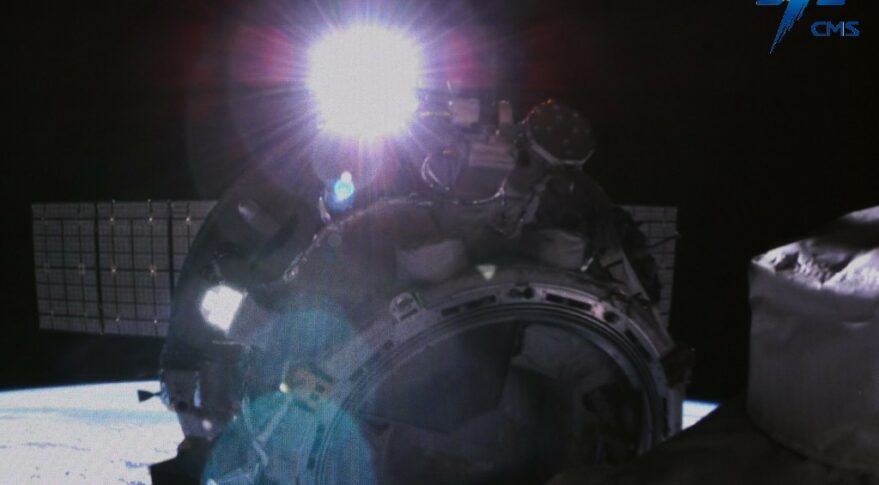
A view from outside Tianhe during the first Shenzhou-12 spacewalk, June 2021. Credit: BACC/CCTV

Hausjärvi, FINLAND — Two Shenzhou-12 astronauts conducted a spacewalk late Saturday to carry to install equipment required for the long-term operation of China’s space station.

Liu Boming opened the hatch of the Tianhe module at 8:11 p.m. Eastern July 3 and was later joined outside by Tang Hongbo. Activities were completed at 2:57 a.m. July 4, according to the China Manned Space Agency (CMSA).

Source: https://spacenews.com/astronauts-complete-first-chinese-space-station-spacewalk/

Offline Orionid

  • Weteran
  • *****
  • Wiadomości: 28821
  • Very easy - Harrison Schmitt
Odp: Różne artykuły o Chinese space station (CSS)
« Odpowiedź #16 dnia: Lipca 09, 2021, 07:00 »
Chinese astronauts complete first spacewalk outside new space station
July 7, 2021 Stephen Clark [SFN]


A Chinese astronauts outside the Tiangong space station Sunday. Credit: Xinhua

Two Chinese astronauts headed outside the country’s space station Saturday for the second-ever spacewalk in China’s space program, and the first staged from the new Tiangong complex in low Earth orbit.

Source: https://spaceflightnow.com/2021/07/07/chinese-astronauts-complete-first-spacewalk-outside-new-space-station/

Offline Orionid

  • Weteran
  • *****
  • Wiadomości: 28821
  • Very easy - Harrison Schmitt
Odp: Różne artykuły o Chinese space station (CSS)
« Odpowiedź #17 dnia: Sierpnia 20, 2021, 14:03 »
Astronauts conduct second Chinese space station spacewalk
by Andrew Jones — August 20, 2021 [SN]


Commander Nie Haisheng attached to a robotic arm during the second Shenzhou-12 spacewalk in August 2021. Credit: CNSA/BACC

HELSINKI — Chinese astronauts Nie Haisheng and Liu Boming embarked on a second Shenzhou-12 spacewalk late Thursday to carry out work on a space station robotic arm.

Shenzhou-12 mission commander Nie opened the hatch of the Tianhe module at 8:38 p.m. Eastern Aug. 19 to begin a planned near seven-hour extravehicular activity, the China Manned Space Agency (CMSA) said.

Source: https://spacenews.com/astronauts-conduct-second-chinese-space-station-spacewalk/

Offline Orionid

  • Weteran
  • *****
  • Wiadomości: 28821
  • Very easy - Harrison Schmitt
Odp: Różne artykuły o Chinese space station (CSS)
« Odpowiedź #18 dnia: Września 17, 2021, 08:41 »
China rolls out cargo mission rocket as Shenzhou-12 astronauts leave space station
by Andrew Jones — September 16, 2021 [SN]


The Long March 7 (Y4) rocket to launch Tianzhou-3 being vertically transferred to the pad, September 16, 2021. Credit: CMSA

HELSINKI — China is preparing to launch its second space station cargo mission just as its Shenzhou-12 astronauts are set to return to Earth.

The Long March 7 rocket carrying the Tianzhou-3 cargo spacecraft rolled out at the Wenchang Satellite Launch Center, south China, early September 16, China’s human spaceflight agency announced. Launch is targeted for September 20, according to local traffic restrictions.

Source: https://spacenews.com/china-rolls-out-cargo-mission-rocket-as-shenzhou-12-astronauts-leave-space-station/

Polskie Forum Astronautyczne

Odp: Różne artykuły o Chinese space station (CSS)
« Odpowiedź #18 dnia: Września 17, 2021, 08:41 »

Offline Orionid

  • Weteran
  • *****
  • Wiadomości: 28821
  • Very easy - Harrison Schmitt
Odp: Różne artykuły o Chinese space station (CSS)
« Odpowiedź #19 dnia: Września 18, 2021, 07:24 »
Shenzhou-12 astronauts return to Earth after 3-month space station mission
by Andrew Jones — September 17, 2021 [SN]


The three Shenzhou-12 astronauts outside of the return module after landing in Dongfeng, Sept. 17, 2021. Credit: CCTV/framegrab

HELSINKI — Three Chinese astronauts safely returned to Earth Sept. 17 after completing the first crewed mission aboard the Tianhe space station module.

Commander Nie Haisheng, Liu Boming and Tang Hongbo touched down inside the designated landing zone near Dongfeng in the Gobi Desert, Inner Mongolia, at around 1:34 a.m. Eastern Friday.

Source: https://spacenews.com/shenzhou-12-astronauts-return-to-earth-after-3-month-space-station-mission/
« Ostatnia zmiana: Września 21, 2021, 08:13 wysłana przez Orionid »

Offline Orionid

  • Weteran
  • *****
  • Wiadomości: 28821
  • Very easy - Harrison Schmitt
Odp: Różne artykuły o Chinese space station (CSS)
« Odpowiedź #20 dnia: Września 20, 2021, 22:43 »
Tianzhou-3 spacecraft docks with Chinese space station
by Andrew Jones — September 20, 2021 [SN]


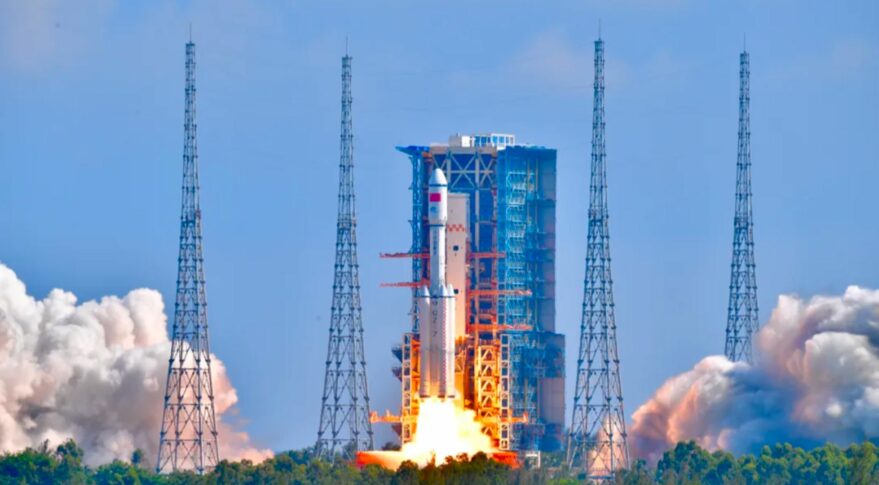
Liftoff of the Long March 7 rocket carrying Tianzhou-3 in orbit on September 20, 2021.

HELSINKI — China’s Tianzhou-3 cargo spacecraft docked in orbit with the Tianhe space station module Monday following launch from the coastal Wenchang launch center.

A Long March 7 rocket lifted off from Wenchang at 3:10 a.m. Eastern September 20. Tianzhou-3 separated from the second stage after 597 seconds, having entered orbit and on track to catch up with Tianhe.

Source: https://spacenews.com/tianzhou-3-spacecraft-docks-with-chinese-space-station/

Offline Orionid

  • Weteran
  • *****
  • Wiadomości: 28821
  • Very easy - Harrison Schmitt
Odp: Różne artykuły o Chinese space station (CSS)
« Odpowiedź #21 dnia: Października 17, 2021, 07:18 »
Shenzhou-13 heads for space station after reaching orbit
by Andrew Jones — October 15, 2021 [SN]


The Long March 2F carrying Shenzhou-13 rising against the backdrop of the moon on Oct. 15, 2021. Credit: CCTV/framegrab

HELSINKI — A second crew of three astronauts are heading for China’s Tianhe space station module after the successful launch of the Shenzhou-13 mission Friday.

A Long March 2F lifted off from the Jiuquan Satellite Launch Center in the Gobi Desert at 12:23 Eastern Oct. 15. The rocket, with four side boosters, two stages and a launch escape system, rose from the LC43/91 launch complex into the black skies above Jiuquan after midnight local time.

Source: https://spacenews.com/shenzhou-13-heads-for-space-station-after-reaching-orbit/

Offline Orionid

  • Weteran
  • *****
  • Wiadomości: 28821
  • Very easy - Harrison Schmitt
Odp: Różne artykuły o Chinese space station (CSS)
« Odpowiedź #22 dnia: Października 29, 2021, 09:35 »
Three astronauts begin half-year mission on Chinese space station
October 15, 2021 Stephen Clark [SFN]


The Shenzhou 13 crew — Ye Guangfu, Zhai Zhigang, and Wang Yaping — float inside the Tianhe core module of the Chinese space station. Credit: CMSA

Three astronauts floated into the living quarters of China’s space station Friday, hours after launching from a military-run spaceport in the Gobi Desert, moving in for a six-month mission to prepare the outpost for expansion next year.

Source: https://spaceflightnow.com/2021/10/15/three-astronauts-begin-half-year-mission-on-chinese-space-station/
« Ostatnia zmiana: Listopada 14, 2021, 08:01 wysłana przez Orionid »

Offline Orionid

  • Weteran
  • *****
  • Wiadomości: 28821
  • Very easy - Harrison Schmitt
Odp: Różne artykuły o Chinese space station (CSS)
« Odpowiedź #23 dnia: Listopada 14, 2021, 08:03 »
China’s first female spacewalker helps outfit space station robotic arm
November 9, 2021 Stephen Clark [SFN]


One of the two spacewalker on Sunday’s excursion is seen outside China’s space station, with a part of the lab’s robotic arm in the background. Credit: CMSA

Astronauts Zhai Zhigang and Wang Yaping, the first Chinese woman to perform a spacewalk, stepped outside China’s space station Sunday for an excursion lasting more than six hours to ready the orbiting lab’s robotic arm for operations.

Source: https://spaceflightnow.com/2021/11/09/chinas-first-female-spacewalker-helps-outfit-space-station-robotic-arm/

Offline Orionid

  • Weteran
  • *****
  • Wiadomości: 28821
  • Very easy - Harrison Schmitt
Odp: Różne artykuły o Chinese space station (CSS)
« Odpowiedź #24 dnia: Grudnia 27, 2021, 14:21 »
Chinese astronaut pair complete six-hour spacewalk
by Andrew Jones — December 26, 2021 [SN]


Outside view from the Tianhe space station module during the second Shenzhou-13 EVA, Dec. 26, 2021. Credit: CMSA

HELSINKI — Two Shenzhou-13 astronauts embarked on a six-hour extravehicular activity Sunday to install equipment outside China’s Tianhe space station module.

Astronaut Ye Guangfu, wearing a Fetian EVA suit with yellow markings, opened the Tianhe airlock hatch at 5:44 a.m. Eastern Dec. 26 before exiting the space station module, according to the China Manned Space Agency.

Source: https://spacenews.com/chinese-astronaut-pair-complete-six-hour-spacewalk/

Offline Orionid

  • Weteran
  • *****
  • Wiadomości: 28821
  • Very easy - Harrison Schmitt
Odp: Różne artykuły o Chinese space station (CSS)
« Odpowiedź #25 dnia: Grudnia 29, 2021, 23:53 »
China’s space station maneuvered to avoid Starlink satellites
by Andrew Jones — December 28, 2021 [SN]


An image from Tianhe panoramic camera A during the first Shenzhou-13 spacewalk in November 2021. Credit: CMSA/CCTV/Chinese Academy of Sciences

HELSINKI — China has informed the United Nations that its crewed space station twice maneuvered to avoid potential collisions with SpaceX Starlink satellites earlier this year.

Source: https://spacenews.com/chinas-space-station-maneuvered-to-avoid-starlink-satellites/

Update: Shenzhou-13 separates from Tianhe core module, to bring 3 taikonauts to Earth in 8 hours
By GT staff reporters Published: Apr 14, 2022 11:24 PM
   

Photo: courtesy of Dongfeng landing site

Carrying taikonauts Zhai Zhigang, Wang Yaping and Ye Guangfu, the Shenzhou-13 manned spacecraft has successfully separated from the Tianhe space station core module by 0:44 am Saturday morning.

The three taikonauts have lived and worked in orbit for 183 days, the longest stay in space by Chinese astronauts in a single mission, the Global Times learned from the China Manned Space Agency (CMSA).

Prior to the separation, the taikonauts had completed various works, such as setting the status of the combination of the core module and cargo spacecraft, sorting and downloading experiment data, and clearing and transferring supplies kept in orbit, with support from staff on the ground, the CMSA said.

The crew is expected to land in the designated Dongfeng landing site in the Gobi Desert, North China's Inner Mongolia Autonomous Region, in some eight hours after the separation.

The search and rescue teams at the Dongfeng landing site said they were already making preparations to receive the Shenzhou-13 crew. They have been carrying out tasks like closely monitoring weather conditions in the area and constructing systems for tracking and monitoring the flight of the spacecraft, read the latest posts by the Dongfeng site on its official WeChat public account.

"Please rest assured, the well-geared and effectively trained ground and air units would be there once the return capsule touches down," the search and rescue teams said in one post.


Photo: courtesy of Dongfeng landing site

Eyeing for frontier

Ahead of the Shenzhou-13's return, the Xinhua News Agency reported on Thursday that Chinese President Xi Jinping, during an inspection tour on Tuesday in the Wenchang Space Launch Site located in South China's Hainan Province, demanded efforts to upgrade the spacecraft launch site in the island province with world-leading standards.

Xi, also general secretary of the Communist Party of China Central Committee and chairman of the Central Military Commission, made the remarks at the Wenchang Spacecraft Launch Site. He extended his greetings to all the staff stationed at the site and asked them to shoulder their responsibility and be brave to innovate and make new breakthroughs.

After being briefed on the launch site, Xi inspected the launching tower and other facilities. He spoke highly of a series of key space missions launched from the site, including the launching of the space station core module Tianhe, the Chang'e-5 lunar mission, and the Tianwen-1 Mars probe.

Xi noted that Wenchang is the launch site of China's new-generation high thrust carrier rockets and the bridgehead of the country's deep-space exploration.

The launch site should continue to eye the frontier of global space development and the major strategic needs of China's space industry, and comprehensively improve its modern space launch capabilities, said Xi.

Xi mentioned that Wenchang staff should carefully prepare, coordinate and implement the tasks to ensure the success of missions, and take practical actions to welcome the victory of the Party's 20th National Congress.

As the youngest member of China's spacecraft launch centers, the Wenchang spaceport successfully completed its first launch mission on June 25, 2016, with the maiden flight of China's Long March-7 carrier rocket. On November 3, 2016, the Long March-5 also took its first flight from the launch site.

Staff at the Wenchang spaceport reached by the Global Times said they were greatly encouraged and inspired by the speech from the top leader and vowed to ensure the success of future missions and contribute their wisdom and strength to making China a space power.

Dubbed the "home port for China's space station building missions," Wenchang was the launching site of the Tianhe core module, the Tianzhou-2 and the Tianzhou-3 cargo spacecrafts on April 29, 2021, May 29, 2021, and September 20, 2021, respectively.

On April 11, ahead of Xi's visit, the Tianzhou-4 cargo spacecraft and the Long March-7 Y5 rocket commissioned for the launch mission arrived safely. The next launch is expected to be a third supply run to the Tianhe core module after the return of the crew of the Shenzhou-13.


Photo: courtesy of Dongfeng landing site

More than six months

The Shenzhou-13 trio of taikonauts, under the command of Zhai Zhigang, was launched to space with a Long March-2F Y13 rocket from the Jiuquan Satellite Launch Center on October 16, 2021. They were scheduled to break the record of longest in-orbit stay for a single spaceflight mission in the country's space history. They have pulled that off.

The length of stay and their physical and psychological condition in orbit have effectively verified the capability to stay in China's space station in the long term and this is another achievement that suggests China has become a strong space power, Song Zhongping, a space analyst and TV commentator, told the Global Times.

The taikonauts of the Shenzhou-13 have conducted two successful spacewalks with Wang Yaping becoming the first Chinese woman in history to perform this maneuver.

The crew also delivered two Tiangong Classroom science lectures for students on Earth, connecting with youth from Beijing, Hong Kong, Macao, and Xinjiang and Xizang autonomous regions.

They have also played a significant part in many historic moments in China in the past six months, sending their greetings and congratulations during the Chinese New Year and joining the spectators of the Beijing 2022 Winter Olympic Games from space.

The crew completed more than 20 scientific experiments in orbit, including those focused on new technologies to monitor the taikonauts' wellbeing in space, innovation, and new discoveries as well as data collection.

These studies will give us a better understanding of how the weightless environment impacts human beings, and also provide a great experiment model to contribute to the study of general public health issues such as aging and heart diseases, said Li Yinghui, deputy chief designer of the country's taikonaut training system.

Experts noted that six months is an international standard for the duration of stays. However, China is not competing and has never sought to compete with other space powers. As long as the station is properly attended to and the goal of the mission is met, the duration does not matter, and taikonauts can take shifts to allow more people in the candidate pool to have a chance, ensuring the health and safety of taikonauts in orbit, Song said.

Pang Zhihao, a senior space expert, said the average length of orbital stay for the astronauts of the International Space Station is also about six months and China could reach this level as soon as in the second mission to the country's own space station, which is a great achievement.

Analysts said the success of the first six-month mission has laid the foundation for future manned missions which would allow more room for imagination that amateur taikonauts, such as flight engineers, space scientists and even foreign astronauts would have no problem living and working in China's space station once it is fully completed.

Russian cosmonaut Anton Shkaplerov recently said in an interview that China's space program is "good and fast," and that China "knows how to do things" when it comes to manned spaceflights. He and his colleagues are willing to participate in China's space programs if China allows it, be they near-Earth orbit missions or deep-space explorations to the Moon and Mars.

Shao Limin, deputy technology manager of manned spaceship systems, told the Global Times that the Shenzhou-13 spacecraft will fly five orbits before returning to Earth, which is 13 orbits less than the Shenzhou-12 mission. It will take about seven to eight hours.

The fast-return technique requires little adjustment to the hardware and software of the spacecraft, but mainly making the flight control more compact, Shao said.

"We have prepared a day for the return of the taikonauts. Although such duration meets the standards, a day of flight in the tight cabin is uncomfortable for them, especially after they have spent six months in space. We want our taikonauts to return in a shorter time. That is why we decided to adopt the fast return technique," Shao noted.

Bai Linhou, deputy chief designer of China's space station, said in an interview that two experimental modules are expected to be launched in the second half of this year. The verification and assembly work of the modules is progressing smoothly.

Both lab modules have a length of over 17 meters and a diameter of over 4 meters.

The Wentian module is positioned to carry out space science experiments inside and outside the cabin. It has an airlock through which taikonauts can exit, and a small robotic arm which can be used alone or combined with the large mechanical arm of the space station.

It can also serve as a backup to the core cabin, Bo said. If malfunction occurs in the core cabin, the Wentian module can replace it immediately, improving the reliability of the entire station's operation.

The other lab module, the Mengtian, has a cargo airlock. The small robotic arm on the lab module can also grab payload via the airlock and install them onto the experiment platform outside the cabin.

https://www.globaltimes.cn/page/202204/1259381.shtml

"Absolutely yes": vice chief designer on whether China's Tiangong can become space post house for mankind
By Fan Wei (Global Times) 15:17, April 16, 2022

Will China's Tiangong space station become a station shared by all mankind? Bai Linhou, vice chief designer of the space station, said "absolutely yes" in an exclusive interview with the Global Times, as the space station can be expanded technically and has reserved docking hatches.

With three taikonauts returning to Earth on Shenzhou-13 on Saturday, China's space station completed its key technology verification and is in the assembly and construction phase -- the consecutive successes of China's space station development make it the new hope as the International Space Station will be retired soon.

China has showed an open and inclusive attitude repeatedly for the use of China's space station. Director of China Manned Space Engineering Office Yang Liwei said, "As always, we hold an open attitude toward international cooperation and we welcome more countries to join us in conducting research in space" at the two sessions this year.

Yang said from the engineering aspect, China has reserved resources for possible international cooperation, ranging from small experiments to large-scale cooperation at cabin level. The space station has reserved docking hatches for future international cooperation.

China is open to different countries and institutes in developing manned space cause. There are 9 experiments in cooperation with other countries at the space station and there will be more, and even joint spaceflights in the future, according to Yang.

Bai told the Global Times that China's space station is independently developed by China, but it's also an inclusive space station. It is to make Chinese contributions to the peaceful use of space.

"We are glad to have such cooperation and the space station was designed in a way that foreign astronauts can adapt to," Bai said.

Russian astronaut Anton Shkaplerov, who just returned to Earth in March this year, said in a recent interview that China's space program is "good and fast," and that he and his colleagues are willing to participate in China's space programs if China allows it.

Dmitry Rogozin, director of Russian Space Agency, also said in an interview with Chinese media that China and Russia can cooperate in the field of manned spaceflight. China and Russia can explore the construction of new modules and cabins.

For Rogozin's idea, Bai said technically China's space station can be expanded by adding more cabins. "It is workable, but needs to match current cabins."

The Global Times learned that China's space station has one core module and two experiment modules, which is an appropriate scale with room for expansion rather than a large one like the International Space Station. The decision is made based on current needs and costs.

The space station can meet demands for key scientific research but can also be expanded and be able to receive other spacecraft.

The three modules form an asymmetrical "T" and can be expanded by assembling more modules with the help of robotic arms.

Foreign astronauts have two ways to enter China's space station -- by a China-launched spacecraft, or by their own spacecraft that can dock at the space station. "But this is what we need to consider in the long-term operation. The prioritized task is to complete construction of our space station, and then to consider the deeper and wider international cooperation," Bai said.

As the International Space Station is about to retire, the China's space Station is expected to become the only space station for mankind in space for a period of time. In this regard, Bai believes that China does not pursue such "uniqueness", but aims to build the space station into a national-level space experiment platform for the world.

As for whether the Chinese space station can take on the mission of the International Space Station and become a new post house for mankind in space, Bai was confident, saying "of course."


(Web editor: Wu Chaolan, Bianji)
http://en.people.cn/n3/2022/0416/c90000-10084952.html
« Ostatnia zmiana: Kwietnia 18, 2022, 16:08 wysłana przez Orionid »

Offline Orionid

  • Weteran
  • *****
  • Wiadomości: 28821
  • Very easy - Harrison Schmitt
Odp: Różne artykuły o Chinese space station (CSS)
« Odpowiedź #26 dnia: Marca 20, 2022, 08:17 »
China aims to complete space station in another huge year in space
by Andrew Jones — January 3, 2022 [SN]


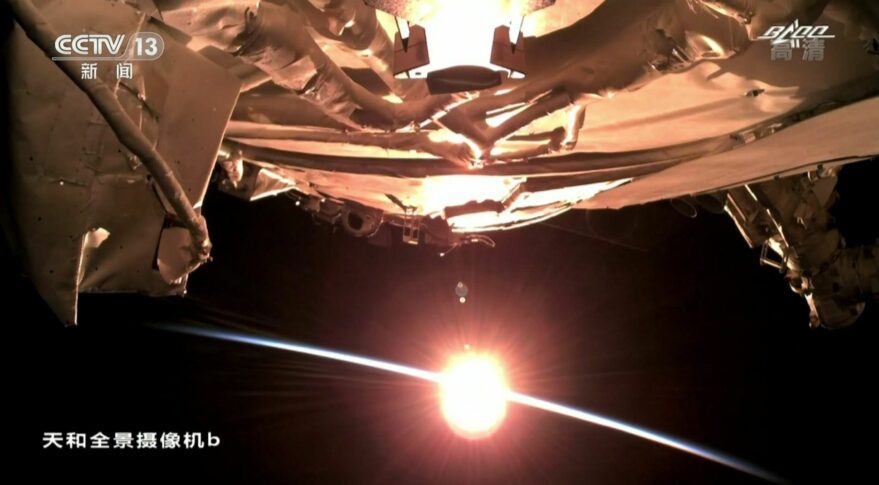
A view of the Sun on the horizon from Tianhe ahead of the Shenzhou-12 docking. Credit: BACC/CCTV/screenshot

HELSINKI — This year, China’s main space contractor will target more than 40 orbital launches, including completion of the Tiangong space station, following 48 successful launches in 2021.

The China Aerospace Science and Technology Corp. (CASC) stated on social media that it is targeting more than 40 launches, including six missions to complete the construction of the country’s space station.

Source: https://spacenews.com/china-aims-to-complete-space-station-in-another-huge-year-in-space/

China proposes formal lines of communication with U.S. on space safety
by Jeff Foust — February 15, 2022 [SN]


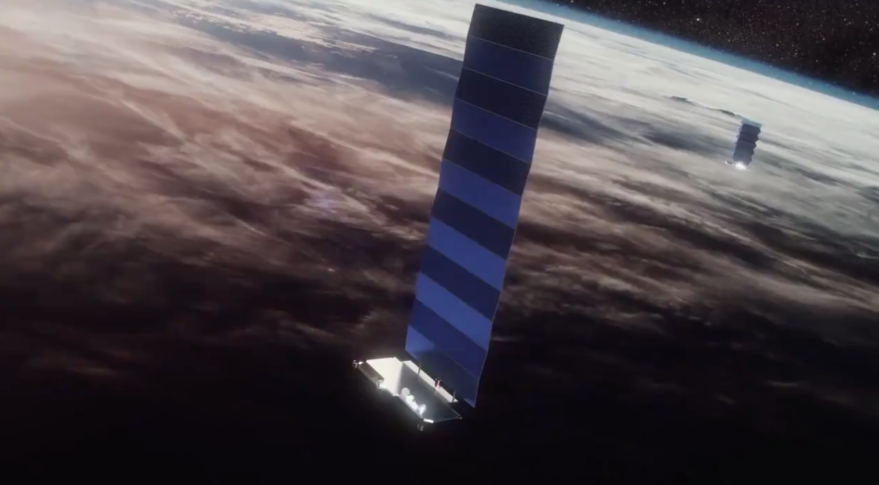
While Chinese officials said they contacted the U.S. about two close approaches of Starlink satellites with their space station, U.S. officials said they heard nothing from China about the encounters. Credit: SpaceX

WASHINGTON — The Chinese government is open to establishing formal lines of communication with the United States on space safety issues after a pair of alleged close calls of Starlink satellites with China’s space station.

At a Feb. 10 press conference, Zhao Lijian, spokesman for China’s Ministry of Foreign Affairs, reiterated claims the country made to the United Nations in December that it had to maneuver its space station twice in 2021 to avoid close approaches by SpaceX Starlink satellites.

“China was fulfilling the international obligation stipulated by Article V of the Outer Space Treaty by informing the U.N. of the Starlink satellites’ dangerous approach to the Chinese space station that threatened the safety of in-orbit Chinese astronauts,” he said according to a government transcript, adding that the “in-orbit Chinese astronauts were facing real and urgent safety threats.”
https://spacenews.com/china-proposes-formal-lines-of-communication-with-u-s-on-space-safety/

Może i Chiny przejmą z czasem kosmicznych turystów od Rosjan ? (2)

Exclusive: China looks to have foreign astronauts on board its space station some day
10-Mar-2022 Sun Ye, Cao Qingqing [CGTN]
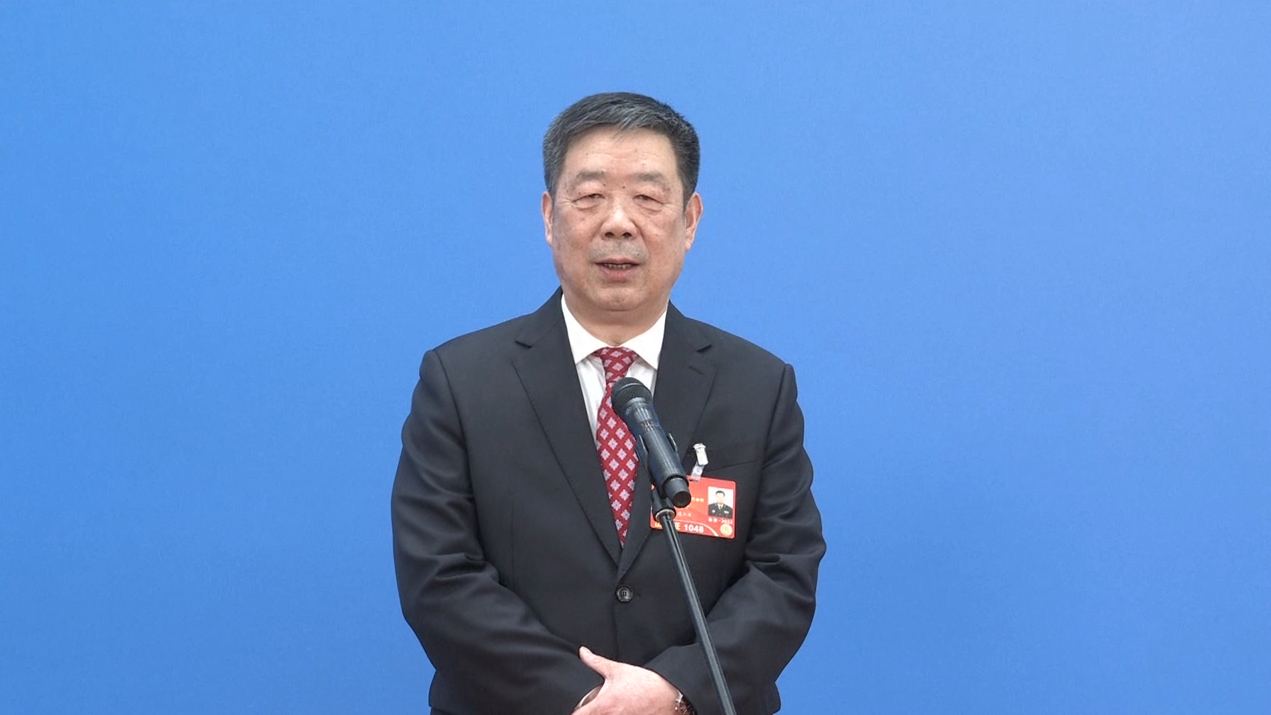


Zhou Jianping, the chief designer of China's manned space program, said he's looking forward to having foreign astronauts on board the country's space station after it is completed and can operate stably and safely.

"We would actively promote foreign astronauts' participation in the work in China's space station, which is an important part of international cooperation. You look forward to it, I look forward to it too," Zhou told CGTN in an exclusive interview on the sidelines of the Two Sessions, a key event on its annual political calendar.

China's space station, which is still in the stage of key technology verification, will enter the in-orbit construction period starting from May, according to Zhou, who's also a member of the 13th National Committee of the Chinese People's Political Consultative Conference, the country's top political advisory body.

"In the early stage of China's space station, we need to first guarantee all the key technology verification, the completion of the construction work and then the safe and smooth operation of the station," he said.

A year of work in 2021 has equipped the space station with a core module and a robotic arm that helps with astronauts' spacewalks and other unmanned assembly work.

Two crewed missions, Shenzhou-12 and Shenzhou-13, sent a total of six Chinese astronauts, or taikonauts, to the core module of the space station.

Six missions have been planned this year to complete the construction of the space station, including the launches of two cargo vessels, two manned spaceships and two lab modules.

The space expert also revealed more details about the upcoming crewed missions, the openness of the space station to international scientists, scientific projects to be conducted there, and the prospect of the private sector's participation in the program.

The following excerpts from the interview with Zhou have been edited for clarity and brevity.

CGTN: You've revealed some plans for the manned space program this year. They've been described as "closely connected and allowing for no glitch." Could you elaborate on that?

Zhou: Starting from May, we will enter a new stage with many missions. Our focus is to make sure that every launch, every rendezvous and docking, every moment in the flight of the space station to be safe, reliable, trouble-free and that each mission is a complete success.

During the Shenzhou-14 crew's stay in orbit, the two lab modules will rendezvous and dock with the core module. Not only that, the robotic arm will re-position the lab modules to different berths.

When the lab modules are in place, the basic structure of the space station will be completed.

Then, the Shenzhou-15 crew will fly to the space station, taking over the following work.

For the Shenzhou-15 crew, much of their work will turn to scientific experiments. As we have said before, setting up the space station is for scientific exploration and the development of space resources.

Of course, their tasks will also include the management and maintenance of the space station, which is complex and challenging.

CGTN: How will the changing tasks affect the makeup of future space crew?

Zhou: When the space station is completed and running, it will enter a new stage. The focus will then be shifted to scientific researches and the exploration of space resources. The space station will help us explore what is unknown in the universe.

Also, with the conditions provided by the space station and the unique environment in space, astronauts can conduct scientific experiments that will contribute to the economic development of human society. That is why we will have flight engineers and payload specialists among future crews to the space station. It will be a new phase for our manned space program.

CGTN: You said that when China's space station is up and running, there will be participation from the commercial or private sector. How will this work?

Zhou: The commercial or private sector's involvement in space programs has been big at home and abroad. This shows how the space sector has become increasingly important in economic development.

We've been actively promoting the trend. When our space station is completed and running, we will actively encourage the private sector to engage in China's manned space program in various ways.

There are many possibilities. We hope there will be competitive, cost-efficient commercial space players to participate in areas including space application and space resource development. The prospects are good.

CGTN: As we're in for more scientific explorations, at this stage, when the space station is being completed and the space lab is soon to start running, what would the "openness" you've talked about look like?

Zhou: When the space station project was approved, we were clear from the start with the goal of making the space station a national space lab. So it's built for space scientific studies and the exploration of space resources. That's our guideline. So the scientific facilities, experiment equipment were designed and put up to that end.

The facilities are high-level and good for scientific researches in different space-relevant areas. What we've sent up covers quite a few fields, including space bio-life science, material science, microgravity fluid mechanic, combustion and fundamental physics. They are quite inclusive.

So the space station will provide good experimental conditions for scientists.

I know many scientists and engineers are looking closely on the opportunities to do experiments in China's space lab. It's a great thing. The China Manned Space Engineering Office (CMSEO) has said many times that we are actively promoting the openness of China's space lab to domestic and international scientists and engineers.

Internationally, a lot has been done. For example, we have nine international projects coming from a joint recruit and selection between us and the United Nations Office for Outer Space Affairs. These projects will go up in space later and be implemented there.

The CMSEO has signed many such MOUs with other countries' space agencies.

In fact, when designing the facilities for the space station, Chinese scientists already cooperated with international scientists.

We have published the experimental conditions that can be offered in China's space station, including specifics for its interface and environment. We are also drafting standards for scientific experiments to be conducted in the space station. These standards would be national standards, and some would even be international standards.

All the work is to make international cooperation easier and smoother in China's space station.

CGTN: There are many projects hoping to make it to China's space lab. What's the selection process?

Zhou: The space station has the facilities and equipment for scientific experiments. And to use them, you first need to comply to the interface requirements. Besides, it's a manned space station, so there are requirements for reliability and safety. You need to meet medical standards. And, if you need astronauts to take part in them, you need to meet the standards in ergonomics, making sure that the operations are feasible. You also need to meet safety standards. These are the basic requirements.

Furthermore, you need to be aiming for breakthroughs, right? It's a rare opportunity to go to space, so we try to select the projects that will really boost advances in science and in application.

CGTN: When will foreign astronauts be on board China's space station?

Zhou: Foreign astronauts' participation in the program is an important part of international cooperation. I know many people, many of our international friends are interested. And we think it's very important.

But the space station is still at the stage of key technology verification, and to next embark on in-orbit construction. So in the early stage of China's space station, we need to first guarantee all the key technology verification, the completion of construction and then the safe and smooth operation of the station.

We would actively promote foreign astronauts' participation in the work in China's space station, which is an important way of international cooperation. You look forward to it, and I look forward to it too.

https://news.cgtn.com/news/2022-03-10/China-looks-to-have-foreign-astronauts-on-board-its-space-station-18i4NtoNby0/index.html

China to open space station to commercial activity
by Andrew Jones — March 11, 2022 [SN]


A view from China's Tianhe space station core module ahead of the Shenzhou-12 docking in 2021. Credit: CCTV/BACC/screenshot

HELSINKI — China is planning to open its space station to commercial missions and activities, according to a senior human spaceflight program official.

“When our space station is completed and running, we will actively encourage the private sector to engage in space through various ways,” Zhou Jianping, chief designer of China’s human spaceflight program, told China Central Television March 9.
https://spacenews.com/china-to-open-space-station-to-commercial-activity/

Chinese spacecraft reenters atmosphere ahead of new space station missions
by Andrew Jones — March 31, 2022 [SN]


TIanzhou-2 separates from the Tianhe core module on March 27, 2022. Credit: CMSA/BACC

HELSINKI — China deorbited the Tianzhou-2 cargo spacecraft Thursday after testing on-orbit docking, refueling and module transposition for the Chinese space station.

Tianzhou-2 reentered the atmosphere over the South Pacific at 6:40 a.m. Eastern March 31, China’s human spaceflight agency, CMSA, announced minutes after the event. The area of the ocean is frequently used as a “spacecraft cemetery.”

Source: https://spacenews.com/chinese-spacecraft-reenters-atmosphere-ahead-of-new-space-station-missions/

China gears up for new space station missions, record-breaking crew set to return home
by Andrew Jones — April 14, 2022 [SN]


Liftoff of the Long March 7 rocket carrying the Tianzhou-3 cargo spacecraft on September 20, 2021.

HELSINKI — A Long March rocket arrived at Wenchang spaceport Monday in preparation for a new round of space station missions starting May.

The Long March 7 rocket was delivered to Wenchang after a near week-long voyage from the northern port city of Tianjin, China’s human spaceflight agency announced April 11.

The rocket is planned to launch the roughly 13.5-metric-ton Tianzhou-4 cargo vessel next month to China’s Tianhe space station core module.

Tianzhou-4 will deliver supplies and propellant for the Shenzhou-14 crewed mission, expected to launch from Jiuquan spaceport in the Gobi Desert in June.
https://spacenews.com/china-gears-up-for-new-space-station-missions-record-breaking-crew-set-to-return-home/

Chinese astronauts undock from space station, head for landing
April 15, 2022 Stephen Clark [SFN]


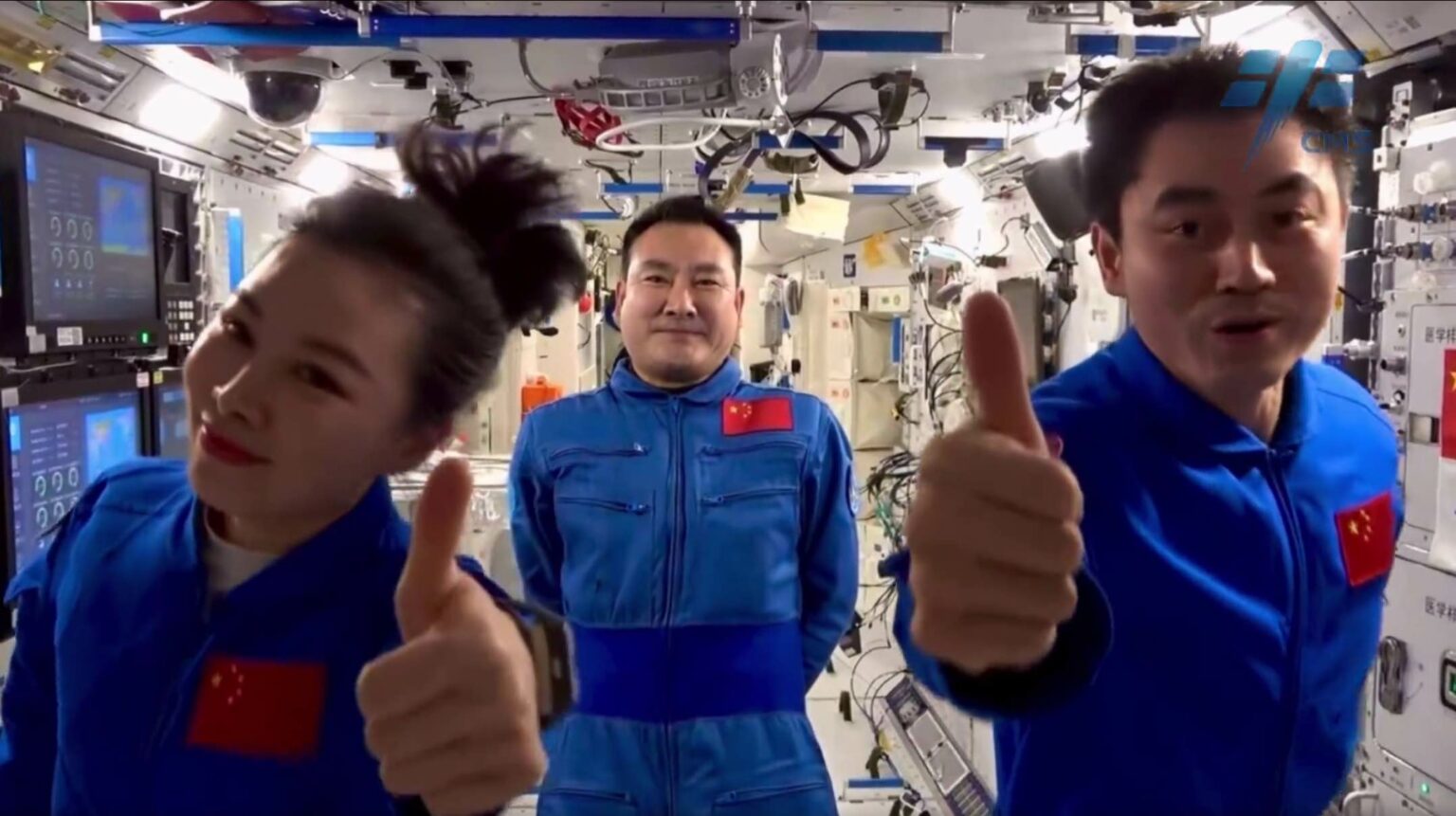
Astronaut Wang Yaping, Zhai Zhigang, and Ye Guangfu on-board the Chinese space station. Credit: CMSE

Three Chinese astronauts packed up, boarded their landing capsule, and undocked from China’s space station Friday in preparation for a return to Earth after six months in orbit.

Commander Zhai Zhigang, astronaut Wang Yaping, and crewmate Ye Guangfu are closing out a 182-day mission, the longest-ever spaceflight by a Chinese crew. They launched Oct. 15 on the Shenzhou 13 spacecraft, and docked with the space station’s Tianhe core module six-and-a-half hours later.
https://spaceflightnow.com/2022/04/15/chinese-astronauts-undock-from-space-station-head-for-landing/

Chinese astronauts return to Earth after six-month mission on space station
April 16, 2022 Stephen Clark [SFN]


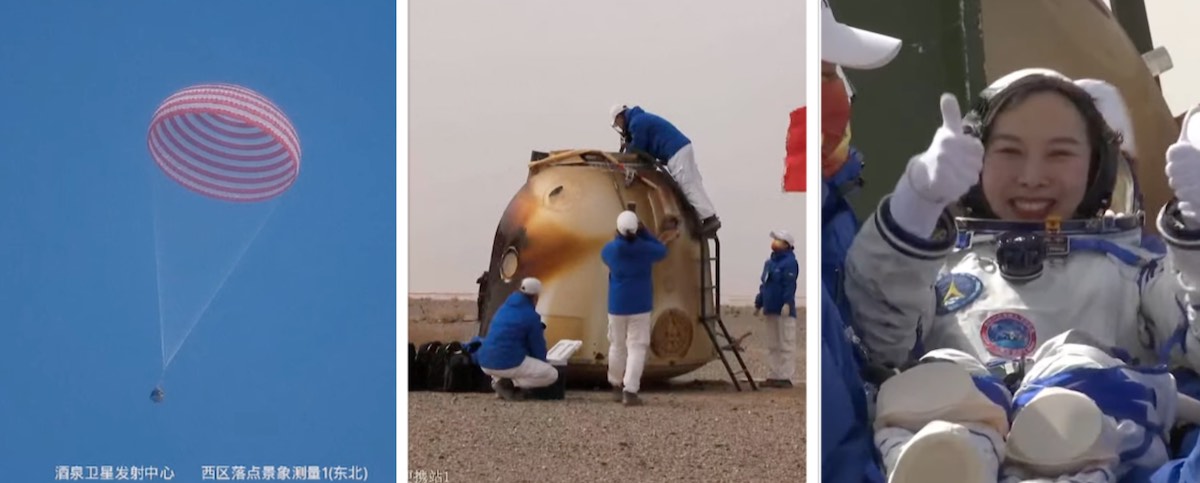
China’s Shenzhou 13 spacecraft landed in Inner Mongolia to wrap up a 182-day mission. Astronaut Wang Yaping, smiling after her exit from the spacecraft, became the most experienced Chinese space flier. Credit: CCTV / Spaceflight Now

(...) After six months performing experiments, spacewalks, and preparing the station for future expansion, the Shenzhou 13 astronauts floated into their Shenzhou 13 spacecraft and closed hatches with the Tianhe core module Friday. The spacecraft undocked from the station’s nadir, or Earth-facing, port at 12:44 p.m. EDT (1644 GMT) while the lab soared nearly 240 miles (380 kilometers) above the planet, according the China Manned Space Agency. (...)
https://spaceflightnow.com/2022/04/16/chinese-astronauts-return-to-earth-after-six-month-mission-on-space-station/

Shenzhou-13 astronauts return to Earth after 182-day mission
by Andrew Jones — April 16, 2022 [SN]


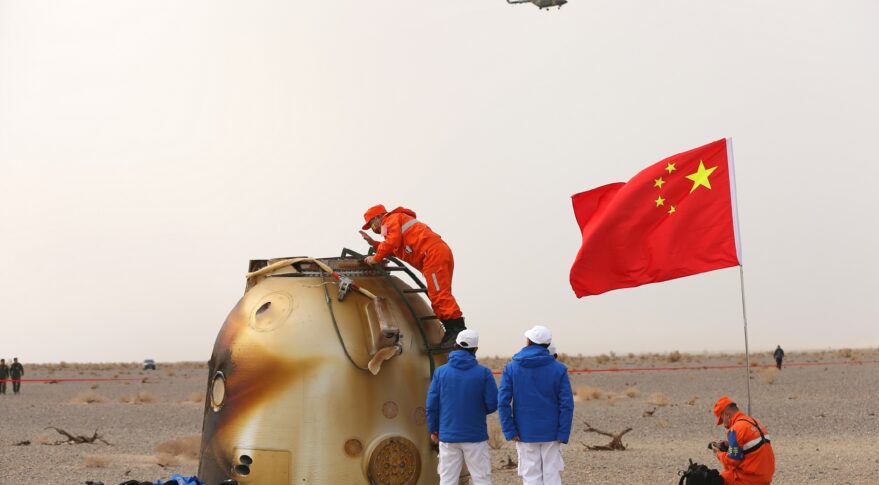
Recovery crews attend the Shenzhou-13 return capsule shortly after landing. Credit: CMSA/Li Yunxi

HELSINKI — Three astronauts safely returned to Earth April 15 after spending a national record 182 days in orbit, completing China’s second crewed space station mission. (...)

It was the first time that China had employed a “rapid return,” cutting the number of orbits after leaving Tianhe from 11 down to five. Landing nine hours after undocking.

Search and rescue teams reached the landing site soon after the capsule touched down, slowed by a main parachute and retrorockets shortly before impact. (...)
https://spacenews.com/shenzhou-13-astronauts-return-to-earth-after-182-day-mission/

China launches Tianzhou 4 cargo ship for space station
May 9, 2022 Stephen Clark [SFN]


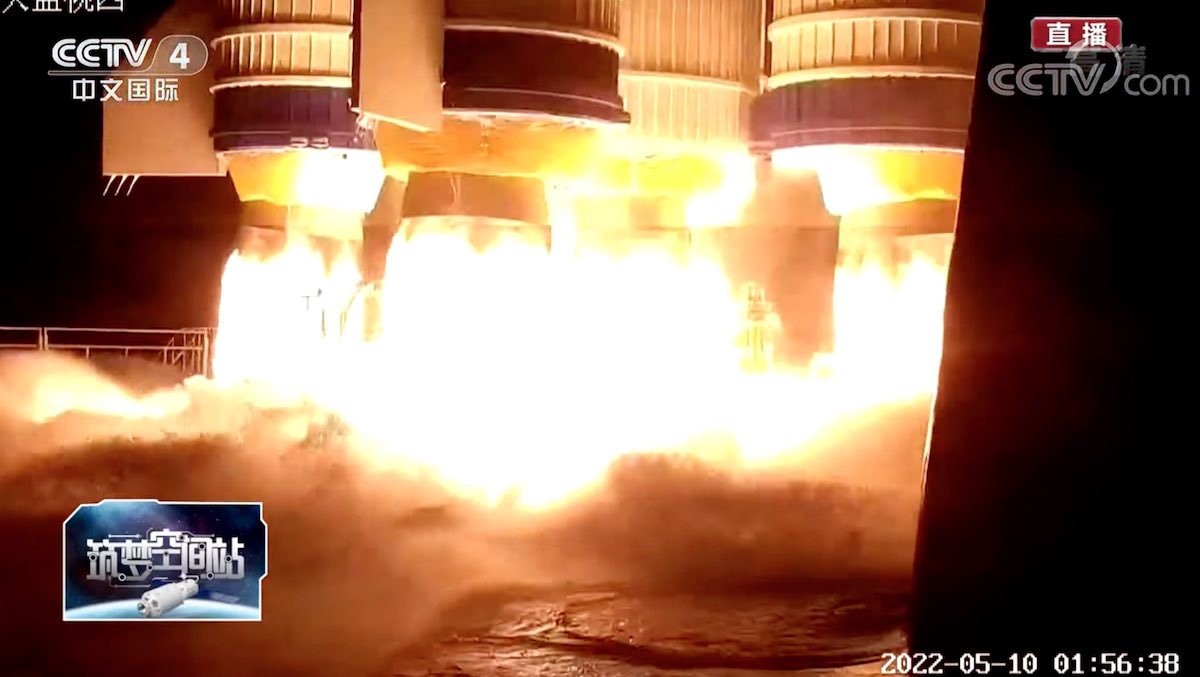
Four booster engines and two core stage engines fire to propel a Long March 7 rocket off its launch pad at the Wenchang launch base Monday. Credit: CCTV

China launched the Tianzhou 4 cargo freighter for the country’s space station Monday, beginning a resupply mission to stage hardware, propellant, and provisions at the complex before arrival of the next long-duration crew in June.

Chinese state television broadcasted the launch, which occurred at 1:56:37 p.m. EDT (1756:37 GMT) Monday, roughly the moment Earth’s rotation brought the Wenchang launch base on Hainan Island under the orbital plane of China’s space station.
https://spaceflightnow.com/2022/05/09/long-march-7-tianzhou-4-launch/

China rolls out rocket for Shenzhou-14 crewed mission
by Andrew Jones — May 29, 2022 [SN]


Rollout of the Long March 2F (Y14) on May 29, 2022, ahead of launch of Shenzhou-14 to the Chinese space station. Credit: OurSpace/CNSA

HELSINKI — China is preparing to launch three astronauts to its Tiangong space station to oversee a crucial phase of construction of the orbital outpost.

The Long March 2F rocket was rolled out to the pad at Jiuquan Satellite Launch Center in the Gobi Desert early on May 29. The 62-meter-long rocket was transferred vertically across the roughly 1,500 meters from the assembly building to the pad at no faster than 30 meters per minute.
https://spacenews.com/china-rolls-out-rocket-for-shenzhou-14-crewed-mission/

Rocket to launch China’s next space station module arrives at launch center
by Andrew Jones — May 31, 2022 [SN]


Components of the Long March 5B (Y2) to launch the Chinese space station core module at a facility in Tianjin. Credit: CMSA

HELSINKI — A Long March 5B rocket has arrived at Wenchang spaceport as China gears up to send its second space station module into orbit.

The components of the third Long March 5B heavy-lift rocket arrived at Wenchang May 29, the China Manned Space Engineering Office (CMSEO) announced (Chinese).
https://spacenews.com/rocket-to-launch-chinas-next-space-station-module-arrives-at-launch-center/
« Ostatnia zmiana: Czerwca 01, 2022, 20:27 wysłana przez Orionid »

Offline Orionid

  • Weteran
  • *****
  • Wiadomości: 28821
  • Very easy - Harrison Schmitt
Odp: Różne artykuły o Chinese space station (CSS)
« Odpowiedź #27 dnia: Czerwca 08, 2022, 07:52 »
Chinese astronauts prep for six-month space station construction flight
June 4, 2022 Stephen Clark [SFN]


A Chinese Long March 2F rocket with the Shenzhou 14 spacecraft rolled to the launch pad at the Jiuquan space center May 29. Credit: CASC

Three Chinese military pilots are ready for launch Saturday on a Long March 2F rocket to begin a six-month expedition to help expand China’s space station in low Earth orbit, a mission slated to include the arrival of two modules and multiple spacewalks.

Chinese officials publicly revealed the crew of the Shenzhou 14 mission Saturday, less than 24 hours before the astronauts are set to blast off from the Jiuquan launch base in the Gobi Desert of northwestern China.
https://spaceflightnow.com/2022/06/04/chinese-astronauts-prep-for-six-month-space-station-construction-flight/

Shenzhou-14 crewed mission arrives at Chinese space station
by Andrew Jones — June 5, 2022 [SN]


A view from the Tianhe core module after the docking of the Shenzhou-14 crewed spacecraft. Credit: CCTV/framegrab

HELSINKI — China’s Shenzhou-14 crewed spacecraft docked with the Tianhe space station module early Sunday, marking the start of a crucial six-month-long mission.

Shenzhou-14 completed a fast automated rendezvous and docking with the Tianhe module at 5:42 a.m. Eastern, June 5, marking the safe arrival of astronauts Chen Dong (commander), Liu Yang and Cai Xuzhe.
https://spacenews.com/shenzhou-14-crewed-mission-arrives-at-chinese-space-station/

Chinese crew arrives at space station for six-month construction mission
June 5, 2022 Stephen Clark [SFN]


A Long March 2F rocket lifts off with the Shenzhou 14 mission at 10:44 p.m. EDT Saturday (0244 GMT Sunday). Credit: CASC

China’s Shenzhou 14 spacecraft glided to an automated docking at the Tiangong space station Sunday, hours after launching with three astronauts to begin a six-month mission that will see the outpost triple in size with the arrival of two new 20-ton research modules.

Commander Chen Dong monitored the Shenzhou 14 spacecraft’s on-board systems throughout the rendezvous and docking with the Tiangong space station. Chen is joined on the Shenzhou 14 mission by astronauts Liu Yang and Cai Xuzhe.
https://spaceflightnow.com/2022/06/05/chinese-astronauts-arrive-at-tiangong-space-station-for-six-month-construction-mission/

China looks to launch liquid propellant rockets from the seas
by Andrew Jones — June 30, 2022 [SN]


Liftoff of the Long March 11 from a mobile platform in the Yellow Sea, June 5, 2019. Credit: China Academy of Launch Vehicle Technology (CALT).

TALLINN, Estonia — Chinese state-owned and commercial companies are developing capabilities to launch liquid propellant rockets from sea platforms to boost the country’s launch options.

China has already demonstrated the ability to launch the Long March 11 solid rocket from sea platforms. These have been facilitated by a new spaceport near Haiyang in the eastern coastal province of Shandong.

Now, private firms including Orienspace and the state-owned China Academy of Launch Vehicle Technology (CALT) are developing larger, liquid propellant Gravity series rockets and adapted Long March 8 launchers for sea launches.
https://spacenews.com/china-looks-to-launch-liquid-propellant-rockets-from-the-seas/

China prepares for July 24 launch of second space station module
by Andrew Jones — July 14, 2022 [SN]


An image from Tianhe panoramic camera A during the first Shenzhou-13 spacewalk in November 2021. Credit: CMSA/CCTV/Chinese Academy of Sciences

Hausjärvi, FINLAND — China is gearing up to send a second module to its under-construction space station with a launch from the coastal Wenchang spaceport later this month.

A Long March 5B heavy-lift rocket will launch the roughly 22-ton Wentian experiment module around 02:20 a.m. ET (0620 UTC) July 24, according to recently announced area clearance notices consistent with such a launch.
https://spacenews.com/china-prepares-for-july-24-launch-of-second-space-station-module/

China’s heavy-lift Long March 5B rocket rolls out with new space station module
July 18, 2022 Stephen Clark [SN]


The Long March 5B rocket slated to launch the Wentian module to China’s space station emerges from its assembly building Monday at the Wenchang launch base on Hainan Island. Credit: CMSE

China moved a heavy-lift Long March 5B rocket to its launch pad Monday in preparation for liftoff this weekend with a 22-ton module for the country’s Tiangong space station, a mission that could end with another uncontrolled re-entry of the Long March 5B’s large core stage.

The powerful launcher rolled from its assembly building to the launch pad Monday at the Wenchang launch center on Hainan Island in southern China. The Wentian module for China’s space station is encapsulated inside the rocket’s payload fairing.
https://spaceflightnow.com/2022/07/18/chinas-heavy-lift-long-march-5b-rocket-rolls-to-launch-pad-with-new-space-station-module/

Second module docks at China’s space station, large rocket stage tracked in orbit
by Andrew Jones — July 24, 2022 [SN]


Liftoff of the third Long March 5B rocket, carrying the Wentian space station module into orbit on July 24, 2022. Credit: CNSA/Ourspace

HELSINKI — China added a new experiment module to its space station Sunday, following a high-profile launch from the country’s coastal spaceport.

The Wentian experiment module launched atop of a Long March 5B rocket at 2:22 a.m. Eastern from the Wenchang spaceport on the southern Chinese island of Hainan, with crowds watching on from nearby public beach areas.
https://spacenews.com/second-module-docks-at-chinas-space-station-large-rocket-stage-tracked-in-orbit/

New science lab for China’s space station launches on Long March 5B rocket
July 24, 2022 Stephen Clark [SFN]


A Long March 5B rocket lifts off with the Wentian module bound for China’s Tiangong space station.Credit: CASC

China’s heavy-lift Long March 5B rocket launched Sunday with the second major element of the Chinese Tiangong space station, sending the 25-ton Wentian science module on course for docking at the orbiting outpost.
https://spaceflightnow.com/2022/07/24/long-march-5b-wentian-launch/

Wentian science module docks with China’s space station
July 24, 2022 Stephen Clark [SFN]


This illustration shows the configuration of the Tiangong space station after docking of the Wentian module (left) to the Tianhe core module (right). A Shenzhou crew spacecraft and Tianzhou cargo ship are also docked at the station. Credit: China Manned Space Agency

China’s Tiangong space station received a new room Sunday with the docking of the Wentian laboratory module, a half-day after launching on a heavy-lift Long March 5B rocket. The three-person crew on the Chinese space station later opened hatches and floated inside the new science module for the first time.
https://spaceflightnow.com/2022/07/24/wentian-science-module-docks-with-chinas-space-station/

China to complete selection of new taikonauts this year: space agency
Xinhua | Updated: 2023-05-29 16:10

JIUQUAN -- The selection of the fourth batch of taikonauts, China's new generation of astronauts, is proceeding as planned and will be completed by the end of this year, the China Manned Space Agency (CMSA) announced at a press conference on Monday.

The selection process was launched in 2022 and will result in 12 to 14 reserve taikonauts being picked, each with different specialisms, such as spacecraft pilots, flight engineers and payload specialists, said CMSA Spokesperson Lin Xiqiang.

"For the first time, the post of payload specialist is open to people from Hong Kong and Macao," Lin noted.

By March 2023, the first stage of the selection process had been completed, and more than 100 candidates then entered the second round, including more than 10 from Hong Kong and Macao.

According to Lin, candidates for the space pilot role are selected from among active military pilots, while flight engineers and payload experts are taken from industrial sectors as well as colleges and universities.

http://www.chinadaily.com.cn/a/202305/29/WS64745df9a310b6054fad59fb.html

Astronauts meet in Tiangong space station core module
By ZHAO LEI at Jiuquan Satellite Launch Center | chinadaily.com.cn | Updated: 2023-05-31 04:44


The Shenzhou XV and Shenzhou XVI crews pose in the Tianhe core module of the Tiangong space station on Tuesday, marking the start of the in-orbit crew handover, in this screen grab from the Beijing Aerospace Control Center. [Photo/Xinhua]

The Shenzhou XVI mission crew, which includes the first Chinese civilian astronaut, reached orbit on Tuesday and started work in the Tiangong space station.

Aboard the Shen­zhou XVI spacecraft, mission commander Major General Jing Haipeng, spaceflight engineer Colonel Zhu Yangzhu and Professor Gui Haichao, the mission's science payload specialist and the first Chinese civilian in space, were launched by a 20-story-tall Long March 2F carrier rocket, which blasted off at 9:31 am from the Jiuquan Satellite Launch Center in northwestern China's Gobi Desert.

After a short flight, the 8-metric-ton spaceship was placed into a low-Earth orbit about 400 kilometers above the planet and then activated the rapid rendezvous-docking mode to approach the Tiangong station.

On Tuesday afternoon, the spacecraft connected with the radial port on Tiangong's Tianhe core module.

After about two hours of preparatory work following the docking, Jing opened a hatch on the Shenzhou XVI spaceship and floated into Tianhe's connection cabin at 6:19 pm.

He was welcomed by Major General Fei Junlong, leader of the Shenzhou XV crew, who had been waiting inside the cabin.

"Let's hug! I am so happy!" Fei said as he embraced Jing.

Following Jing, Zhu and Gui moved into the connection cabin one by one, and they were also greeted and hugged by Fei.

The Shenzhou XVI trio then moved into the Tianhe module and hugged the other Shenzhou XV crew members — Senior Colonel Deng Qingming and Senior Colonel Zhang Lu — who were waiting there and recording the emotional moment on a smartphone.

The two crews chatted for a while before taking a group selfie to applause from the ground control staff.

The entire procedure was broadcast live on China Central Television.

The two teams are scheduled to stay together for about five days, and the Shenzhou XVI crew will then take over the massive orbital outpost from Fei's team, who have been in orbit for six months and will return to Earth as scheduled.

Jing and his crew members will stay in Tiangong for around five months and are scheduled to return to Earth in November. They will carry out several spacewalks during the mission to mount equipment outside the station and also conduct maintenance work, Lin Xiqiang, deputy director of the China Manned Space Agency, said at a news conference on Monday.

Other major tasks will include assisting with the docking and departure of visiting spacecraft such as cargo ships and a space-based telescope, conducting scientific experiments and demonstrations of technology, and hosting science lectures, Lin said.

The official said he expects that new scientific data in a wide range of research fields such as general relativity and the origins of life will be obtained during the Shenzhou XVI mission.

The journey is the debut flight of China's third generation of astronauts, and the first time a Chinese civilian has traveled into space.

Jing and Zhu are members of the People's Liberation Army's Astronaut Division, while Gui is a doctoral supervisor at the Department of Spacecraft and Launch Vehicle Technology of Beihang University's School of Astronautics in Beijing.

Lin said that after stringent training, all of the third-generation astronauts have passed qualification tests and have been cleared for space missions.

Moreover, the Shenzhou XVI mission is Jing's fourth spaceflight, making him China's most experienced astronaut.

According to Lin, China now has all prerequisites for sending foreign astronauts into space — a well-constructed space station, a reliable astronaut transportation system, and mature methods for astronauts' training and support.

"We are actively working on this matter. I very much welcome and look forward to foreign astronauts flying on board our space station," he said.

One of the world's largest and most advanced spacecraft, Tiangong currently consists of three major components, the Tianhe core module and the Wentian and Mengtian science lab modules, and it is connected to three visiting vessels, the Shenzhou XV and Shenzhou XVI crew craft and the Tianzhou 6 cargo ship.

http://www.chinadaily.com.cn/a/202305/31/WS647658b9a3107584c3ac2f97.html

Shenzhou XVI spaceship transports seeds for breeding experiments
Xinhua | Updated: 2023-06-01 17:00

BEIJING -- Nine varieties of seeds, selected from North China's Shanxi province, have been sent into space onboard the country's Shenzhou XVI manned spaceship, according to the Science and Technology Daily on Thursday.

The seeds will be used for space experiments on the country's space station Tiangong.

They include a type of corn seed, developed by the Shanxi Agricultural University, that has a planting area of about 4 million mu (about 266,667 hectares) in the province, with high yields and wide adaptability, according to the report.

The seeds need further improvement, especially in disease resistance, through conventional breeding methods or space breeding.

Space breeding involves exposing seeds and strains to cosmic radiation and microgravity during a spaceflight mission to mutate their genes.

Since conducting its first space breeding experiment in 1987, China has sent the seeds of hundreds of plant species into space on dozens of retrievable satellites and Shenzhou spaceships.

The Shenzhou XVI manned spaceship was launched and docked with the space station combination on Tuesday.

http://www.chinadaily.com.cn/a/202306/01/WS647856c6a3107584c3ac366f.html
« Ostatnia zmiana: Lipca 04, 2025, 21:47 wysłana przez Orionid »

Offline Orionid

  • Weteran
  • *****
  • Wiadomości: 28821
  • Very easy - Harrison Schmitt
Odp: Różne artykuły o Chinese space station (CSS)
« Odpowiedź #28 dnia: Października 04, 2023, 22:14 »
China to send 1st civilian into space aboard Shenzhou XVI
By ZHAO LEI | chinadaily.com.cn | Updated: 2023-05-30 01:27


Jing Haipeng (center), commander of the Shenzhou XVI mission, Zhu Yangzhu (right), the mission's spaceflight engineer, and Gui Haichao, the mission's payload expert, meet the media on Monday at Jiuquan Satellite Launch Center in northwestern China.WANG JIANGBO / FOR CHINA DAILY

The Shenzhou XVI spacecraft will set out on Tuesday morning to transport three Chinese astronauts to the Tiangong space station, the China Manned Space Agency said on Monday.

The journey will be the maiden flight of China's third generation of astronauts, and the first time a Chinese civilian has traveled to space.

Lin Xiqiang, deputy director of the agency, gave details of the flight at a news conference on Monday morning at the Jiuquan Satellite Launch Center in northwestern China. The crew members of Shenzhou XVI — mission commander Major General Jing Haipeng, Colonel Zhu Yangzhu and Professor Gui Haichao — will be lifted in the spacecraft by a Long March 2F carrier rocket at 9:31 am on Tuesday from the Jiuquan center in the Gobi Desert.

On Monday morning, the Long March 2F rocket began being filled with propellants at the service tower, Lin said.

After the Shenzhou XVI enters orbit, rapid rendezvous-docking mode will be activated for the spacecraft to approach and then connect with the radial port on the Tianhe core module, according to the official.

Jing's team will take over the Tiangong space station from their peers from the Shenzhou XV mission — commander Major General Fei Junlong, Senior Colonel Deng Qingming and Senior Colonel Zhang Lu — who arrived on Nov 30.

The Shenzhou XVI crew members will stay inside the Tiangong station for around five months and are scheduled to return in November. They will carry out several spacewalks during the mission to mount equipment outside the station and also conduct maintenance work, Lin said.

Other major tasks include assisting with the docking and departure of visiting spacecraft such as cargo ships and a space-based telescope, conducting scientific experiments and demonstrations of technology, and hosting science lectures, Lin said.

Jing and Zhu are members of the People's Liberation Army's Astronaut Division, while Gui is a doctoral supervisor at Beihang University's School of Astronautics' Department of Spacecraft and Launch Vehicle Technology in Beijing. All three crew members each have a doctorate.

It will be Jing's fourth spaceflight, making him China's most experienced astronaut.

Zhu, the spaceflight engineer, and Gui, the mission's science payload specialist, are the first members of the country's third generation of astronauts to enter the space.

During their stay inside the station, Jing and Zhu will be mainly responsible for operating and maintaining the entire space station and performing technological tests. Gui has been assigned to operate scientific devices and conduct experiments, Lin said.

Until the latest mission, all Chinese astronauts who have taken part in spaceflights have been members of the People's Liberation Army. The first two generations of astronauts were selected from experienced Air Force aviators.

However, the third generation of astronauts includes civilians. It is comprised of 17 men and one woman split into three groups: seven spacecraft pilots; seven spaceflight engineers; and four science payload specialists.

Yang Yuguang, a senior space industry observer and vice-chair of the International Astronautical Federation's space transportation committee, said that the inclusion of a spaceflight engineer and a scientist in the flight crew is the most important feature of the Shenzhou XVI mission.

"Professor Gui is engaged in the research of spacecraft dynamics and control technology, so I believe he has advantages when it comes to doing related experiments onboard the Tiangong station," he said.

Pang Zhihao, an expert on space exploration technology and a renowned writer on spaceflight, said: "The presence of an engineer and a scientist will enable more sophisticated experiments and tests to take place inside the space station because the new astronauts must have received more training for science and technology operations."

Lin said China will launch new modules in the future to connect with the Tiangong station to create more room and better conditions for astronauts to live and conduct scientific work. After that, Tiangong's configuration will be expanded from the current "T" shape to a cross shape.

Yang said the first of the new modules is expected to be a hub with multiple docking ports, which will allow more science labs to connect with the station.

Earlier this month, the Tianzhou 6 robotic cargo spaceship was launched from the Wenchang Space Launch Center in Hainan province to transport materials for the next manned missions. It was the first spacecraft to visit the Tiangong space station this year.

Orbiting about 400 kilometers above Earth, Tiangong on Monday consisted of three major components, the Tianhe core module and Wentian and Mengtian science lab modules, and it was also connected to two visiting craft, the Shenzhou XV crew ship and the Tianzhou 6 cargo ship.

http://www.chinadaily.com.cn/a/202305/30/WS6474e08fa310b6054fad5a7d.html

Shenzhou XVI crew looks forward to challenge
By ZHAO LEI | chinadaily.com.cn | Updated: 2023-05-30 01:30


Shenzhou XVI crew members Zhu Yangzhu (right) and Gui Haichao take part in underwater training on March 29.Xu Bu / for China Daily

Jing Haipeng, commander of the Shenzhou XVI spaceflight, said on Monday that his crew is ready and confident to make their coming mission a full success.

"We will be the first crew to live and work inside the Tiangong space station since it entered the application and development phase. My crew consists of a spacecraft pilot, a spaceflight engineer and a science payload specialist. This means that we are going to face heavier, more difficult tasks," Jing said at a briefing with reporters a day ahead of the launch of the mission at Jiuquan Satellite Launch Center in northwestern China's Gobi Desert.

He and his fellow astronauts — Zhu Yangzhu and Gui Haichao — spent a lot of time and energy during their training improving their skills in terms of space station control and analysis, decision-making and response capabilities.

"We discussed and made detailed plans for scientific experiments, spacewalks, maintenance and repair work, health management, and especially emergency response procedures, because we all know that only after we have trained to reach the best of our skills and capabilities, could we handle any possible risks or emergencies," Jing said.

Despite Jing being 20 years older than his two fellow crew members, he said there is no generation gap between them. He described his two young peers as "energetic, diligent and self-motivated".

"We respect each other, learn from each other, and encourage and support each other. We are working toward the same goal," Jing said, noting that the crew members work harmoniously together.

Zhu, the spaceflight engineer on the Shenzhou XVI mission, said that he looks forward to his first space journey and will strive to accustom himself to the space environment as soon as possible.

"I will use my energy, enthusiasm and expertise to maintain the good condition of all equipment and make the best use of each scientific experiment to produce as many scientific and technological achievement as possible," he said.

Jing added that his crew will take paintings by children from 10 African nations — Algeria, the Democratic Republic of the Congo, Egypt, Madagascar, Mali, Mauritius, Nigeria, Somalia, South Africa and Zimbabwe — to the Tiangong space station and display them. Those children are among the winners of a Chinese spaceflight-themed picture contest for youngsters around the world.

"The exploration of the universe is a shared aspiration of all people on this planet no matter where you come from, which race you belong to or how old you are. We will take the best of the children's memories, friendship and dreams to outer space. We will plant the seeds of science, friendship and dreams in our space station and wait for them to grow, blossom and bear fruit," he said, encouraging all children around the world to follow their dreams.

http://www.chinadaily.com.cn/a/202305/30/WS6474e140a310b6054fad5a87.html

China's Shenzhou XVI manned spaceship launched
chinadaily.com.cn | Updated: 2023-05-30 09:33
http://www.chinadaily.com.cn/a/202305/30/WS64755284a310b6054fad5bbd.html

Commander ready for record 4th mission
By ZHAO LEI at Jiuquan Satellite Launch Center | China Daily | Updated: 2023-05-30 10:08


The Shenzhou XVI crew (from left Zhu Yangzhu, Gui Haichao and Jing Haipeng) conducts rendezvous and docking training on Feb 28. XU BU/FOR CHINA DAILY

Interstellar veteran Jing Haipeng set to lead Shenzhou XVI team to orbiting Tiangong station

Major General Jing Haipeng, one of the first generation of Chinese astronauts, is an indisputable record-holder in China in terms of spaceflight experiences — he is the first Chinese person to return to space and the first to travel three times into orbit.

On Tuesday, he will become the first to carry out a fourth space journey through the coming Shenzhou XVI mission. He will also be a crew commander for the third time.

Born to a poor family in a village in Shanxi province's Yuncheng city, Jing is the first child of his farmer parents and has a brother and a sister.

Seeing his parents toiling day and night to raise their children, Jing studied very hard at school in the hope of going to university to get the family out of poverty and make his parents happy.

Jing recalled that because of the family's hardships, he never bought a single meal at middle school and lived on dry food and salted vegetables he brought on foot from home twice a week.

"The hard life had not only given me the guts to face difficulties and challenges, but also inspired me to pursue my dream," he said.

In his fourth year at middle school, the youngster saw in a pictorial some People's Liberation Army Air Force pilots training in their fighter jets.

"They were in aviator jackets and looked pretty cool. I wished I could be like them and become a fighter jet pilot safeguarding our motherland's blue skies," Jing said.

The opportunity soon came in March 1985 when officers from the PLA Air Force came to his school to recruit flight students. The young man applied and took part in the selection process.

Three months later, he was admitted to an Air Force flight college in Baoding, Hebei province.

After five and a half years of intense training, Jing had impressed his instructors and graduated, and was designated to a fighter jet unit at the age of 24.

"Soon after I began to serve in the unit, one of my comrades died in flight training. He played basketball with us the day before the tragedy and left forever the next day. I was very sad but I understood that from the first day we became a military member and a pilot, we should all be dedicated to the nation and must get ready for possible sacrifices," the astronaut recalled.

"I always told myself that top aviators only come from those who train the hardest."

In the years in the fighter jet unit, Jing accumulated more than 1,200 hours of flight time and was recognized as a good pilot.

In the summer of 1996, Jing was told by his commander to undergo physical examinations at a sanatorium in Zhejiang province without knowing the reason.

He soon learned that the body check was part of the selection for China's first astronauts.

Seasoned traveler

After rounds of tough tests, Jing stood out among some 1,500 peers and was picked as one of the founding members of the PLA Astronaut Division in January 1998.

Jing and his colleagues in the division were supposed to receive and pass nearly 100 training subjects in five years including physics, astronautics, astronomy, space medicine as well as spacecraft operations.

"Each of us was likely to be 'eliminated' at any time if we failed tests, which were very difficult and demanding," he said.

"During my first 10 years at the division, I spent almost all of my time studying and training. I rarely went to bed before midnight because I was aware that I was racing against time to turn myself into a qualified astronaut."

In 2005, Jing was selected as a backup crew member on the Shenzhou VI mission.

Three years later, he was chosen to be a formal member of the Shenzhou VII flight team.

In September 2008, the Shenzhou VII crew — Zhai Zhigang, Liu Boming and Jing — completed China's third manned spaceflight in their three-day orbital trip. During the mission, Jing assisted Zhai and Liu who made the country's first spacewalk.

In June 2012, Jing was named commander of the Shenzhou IX mission and embarked on his second spaceflight with two fellow astronauts — Liu Yang, who became the first Chinese woman in space through this mission, and Liu Wang.

The Shenzhou IX crew carried out the first astronaut-controlled docking between two spacecraft. They were the first Chinese astronauts to move into another spaceship in orbit.

In October 2016, Jing took part in his third space journey — on the Shenzhou XI — with Chen Dong. The pair flew 33 days in space, including 30 days onboard the Tiangong II experimental space station, performing the longest space mission by Chinese astronauts by that time.

During the monthlong flight, Jing and Chen conducted 38 scientific and technological assignments, ranging from running a trial on a robotic arm in-orbit to observing microgravity's effects on the cardiovascular system.

During this mission, they would become the first Chinese astronauts to run in space, because one task was to test a specially designed treadmill inside the Tiangong II.

"We were supposed to test the equipment's performance and obtain exercise data, because running in a weightless environment could only be done in space," Jing said.

"But as it was the first time for any Chinese astronaut to use a treadmill in space, Chen and I failed many times because we couldn't get used to the new machine."

After a long time trying, the two finally discovered some "tricks" and accumulated experience doing physical exercise that has been proved useful in following long-term orbital missions, he noted.

"During our video link with President Xi Jinping, I reported to him that China's manned space program 'has reached a new height' and we were proud of our great motherland," Jing said.

Aspiration for flight

"Each time I returned to Earth, people asked me the same question, 'Do you want to fly again?' My answer was always the same, 'I desperately want to go into space again!'" the veteran astronaut recalled.

Jing said he and his colleagues are aware that manned spaceflights are a glorious cause that is worth risking their lives for the pursuit of exploration and pioneering.

"You will know why spaceflight is deemed an adventurous cause when you are surrounded by the thunder of rocket engines. Nevertheless, this cause is one that we are willing to use our lives to pursue," he said.

"For me, I have been awarded many honors by the people and the Party. I was given an August 1 Medal by President Xi and also elected as a delegate to the Party's 19th National Congress. I think the best way for me to repay the debt I owe this nation is to try to carry out every assignment to the best of my abilities," Jing said.

He added that Chinese astronauts who have been in space share the same feeling.

"The farther we flew away from Earth, the nearer our hearts and thoughts were to the motherland. Each time we flew across China, our heartbeat would accelerate and our eyes would focus on our territories and seas.

"We want to thank all the scientists, engineers and workers who paved the way for our flights. Hundreds of thousands of them spent numerous days and nights designing, producing and testing rockets, spacecraft and equipment. They are also heroes and heroines," Jing said.

http://www.chinadaily.com.cn/a/202305/30/WS64755aada310b6054fad5c1c.html

Chiny zapowiadają rozbudowę stacji do 6. modułów o masie 180 ton ( obecne 3 moduły mają po ok. 22 ton).
Będzie to możliwe dzięki połączeniu z CSS wielofunkcyjnego modułu z sześcioma portami.
Trwają także prace nad  modułami nadmuchiwanymi.
Czyli Chiny biorą przykład z przetestowanych już gdzie indziej rozwiązań.


China to send new modules and co-orbiting spacecraft to Tiangong space station
Andrew Jones October 4, 2023 [SN]

Expansion hubs, new modules, inflatable habitats and more planned for China’s space station


Plans for expanding the Tiangong space station. Credit: Andrew Jones/SpaceNews

(...) A Hubble-class co-orbiting space telescope, named Xuntian, is planned to be launched around 2024. It will be able to dock with Tiangong for maintenance, repairs, refueling and upgrades.

Zhang’s presentation also noted that more spacecraft will “probably fly co-orbitally with CSS [Chinese space station] to receive on-orbit services.”

The CSS will gradually play an important role as a “space home port,” according to Zhang. (...)
https://spacenews.com/china-to-send-new-modules-and-co-orbiting-spacecraft-to-tiangong-space-station/

China rolls out rocket for Shenzhou-17 mission to Tiangong
Andrew Jones October 19, 2023 [SN]


The Long March 2F rocket to launch Shenzhou-17 being transferred to the pad at Jiuquan, Oct. 19, 2023. Credit: CMSEO

NEW DELHI, India — A crew of three astronauts is set to launch to China’s Tiangong space station next week for a six-month-long mission.

A Long March 2F rocket was rolled out to the pad at Jiuquan Satellite Launch Center in the Gobi Desert, northwest China, early Oct. 19. The rocket is tipped with the Shenzhou-17 crew spacecraft and a telltale escape system atop the payload fairing.
https://spacenews.com/china-rolls-out-rocket-for-shenzhou-17-mission-to-tiangong/
« Ostatnia zmiana: Lipca 04, 2025, 21:50 wysłana przez Orionid »

Offline Orionid

  • Weteran
  • *****
  • Wiadomości: 28821
  • Very easy - Harrison Schmitt
Odp: Różne artykuły o Chinese space station (CSS)
« Odpowiedź #29 dnia: Kwietnia 24, 2024, 05:34 »
China's first civilian astronaut makes history
By ZHAO LEI at Jiuquan Satellite Launch Center | chinadaily.com.cn | Updated: 2023-05-30 10:12


Gui Haichao, the first Chinese civilian on a spaceflight, reached orbit on Tuesday morning shortly after the spacecraft carrying him and another two Shenzhou XVI mission astronauts lifted off from northwestern China.

Sitting inside the Shenzhou XVI spacecraft, Gui and his commander Major General Jing Haipeng and fellow astronaut Colonel Zhu Yangzhu were launched by a 20-story-tall Long March 2F carrier rocket that blasted off at 9:31 am at the Jiuquan Satellite Launch Center in Gobi Desert.

After a short flight, the spaceship was placed into a low-Earth orbit about 400 kilometers above the planet.

Within hours of the launch, the eight-metric-ton manned craft is due to approach and dock with the Tianhe core module of the Tiangong space station.

The crew will then move into the Tiangong to meet their peers from the Shenzhou XV mission — commander Major General Fei Junlong, Senior Colonel Deng Qingming and Senior Colonel Zhang Lu — who arrived on Nov 30. The newly arrived crew will then take over the massive orbital outpost, one of the world's largest and most advanced spacecraft, from Fei's team, which will return to Earth in coming days as per schedule.


The Shenzhou XVI crew members will stay inside the Tiangong space station for around five months and are scheduled to return in November. They will carry out several spacewalks during the mission to mount equipment outside the station and also conduct maintenance work, Lin Xiqiang, deputy director of the China Manned Space Agency, said at a news conference on Monday.

Other major tasks include assisting with the docking and departure of visiting spacecraft such as cargo ships and a space-based telescope, conducting scientific experiments and demonstrations of technology, and hosting science lectures, Lin said.

The journey is the maiden flight of China's third generation of astronauts, and the first time a Chinese civilian has traveled to space.

Jing and Zhu are members of the People's Liberation Army's Astronaut Division, while Gui is a doctoral supervisor at the Department of Spacecraft and Launch Vehicle Technology of Beihang University's School of Astronautics in Beijing. All three crew members each have a doctorate.

Until the latest mission, all Chinese astronauts who have taken part in spaceflights have been military personnel. The first two generations of astronauts were selected from experienced Air Force aviators.

The third generation of astronauts, which was grouped around October 2020, includes civilians. It is comprised of 17 men and one woman split into three groups: seven spacecraft pilots; seven spaceflight engineers; and four science payload specialists.

Zhu, the spaceflight engineer in the team, and Gui, the mission's science payloads specialist, are the first members of the third-generation astronauts to enter the space.

Moreover, it is Jing's fourth spaceflight, making him China's most experienced astronaut.

Before the arrival of Shenzhou XVI spacecraft, the Tiangong currently consists of three major components, the Tianhe core module and Wentian and Mengtian science lab modules, and it was also connected to two visiting craft, the Shenzhou XV crew ship and the Tianzhou 6 cargo ship.

http://www.chinadaily.com.cn/a/202305/30/WS64755b87a310b6054fad5c22.html

Gui Haichao to be 1st Chinese civilian in space
By ZHAO LEI at Jiuquan Satellite Launch Center | China Daily | Updated: 2023-05-30 10:27


The Shenzhou XVI crew operate a medical research program during their training on March 9. XU BU/FOR CHINA DAILY

The vocation of astronaut had for a long time seemed "sacred and distant" to Gui Haichao until the researcher became a member of the Astronaut Center of China. The 36-year-old from Yunnan province will become the first Chinese civilian to fly in space.

Fifteen years ago, Gui was a senior at the School of Astronautics under Beihang University, formerly known as the Beijing University of Aeronautics and Astronautics, majoring in spacecraft design and engineering.

"When Jing Haipeng was flying onboard the Shenzhou VII spaceship in September 2008, I was still a university student. I watched the live broadcast of our nation's first spacewalk that was carried out by the Shenzhou VII crew," he said during a recent interview at the Astronaut Center of China in Beijing before heading to the Jiuquan Satellite Launch Center for his maiden flight.

"I just couldn't even imagine at that time that I would become a colleague of his and train and live in the same place. And now I am an astronaut in his crew and we will fly together to the space station," said Gui, now a professor and doctoral supervisor at Beihang University.

In the following years, Gui continued his study at Beihang and graduated in the summer of 2014 with a doctor's degree in spacecraft design.

The young researcher then spent two years in a post-doctoral program working on integrated directional and orbital control technology for sophisticated spacecraft at the Department of Earth and Space Science and Engineering at York University in Toronto.

In the summer of 2016, Gui undertook post-doctoral research on the detection of small celestial bodies and high-precision forecast technology for spacecraft movement at the Department of Aerospace Engineering at Ryerson University, which was later renamed Toronto Metropolitan University.

He returned to Beihang in September 2017 after receiving the university's invitation to teach as an associate professor at the School of Astronautics.

At Beihang, the researcher's academic interests included spacecraft dynamics, guidance, navigation and control technology for aerospace systems. He has published more than 50 journal articles and academic conference papers.

In the spring of 2018, Gui and his colleagues were told by the school's president that China's manned space authorities had decided to select the third batch of astronauts, including the first spaceflight engineers and science payloads specialists.

"The president told us that the posts of spaceflight engineer and science payloads specialist would be open to civilians working for nonmilitary research entities. He said this was a very precious opportunity and encouraged those interested to apply.

"I have been a fan of space exploration for many years and sometimes dreamed about doing my research in space, so I was excited hearing this news and immediately came to the school's administrative office to fill in the application form," the academic recalled.

After rounds of physical checks and professional tests, Gui earned a place in the elite club and started training at the Astronaut Center of China.

According to Wang Yue, a classmate and co-worker of Gui at the School of Astronautics, Gui told him privately that the physical training at the astronaut center was "intense and demanding" and posed a huge challenge to him.

"But he didn't quit and managed to pass all tests," Wang said.

Su Wenjie, Gui's first doctoral student, said the professor did not relax his attention and instruction on his students after he started training at the astronaut center.

"When his training schedule wasn't so tight, Professor Gui would read my papers and send me some articles he thought might be of help to my research," she said.

Speaking about his experience at the astronaut center, Gui said: "After joining this team, the 'heroes and heroines' I had watched on TV and in the newspaper became the training mentors, sports mates, close friends as well as co-workers of us, the new astronauts."

Thanks to his perseverance and diligence, Gui progressed rapidly in every training course and was chosen for the Shenzhou XVI mission to become the first civilian and scientist in this country to travel in orbit.

During the coming flight, Gui will be responsible for operating, maintaining and repairing science equipment. He will control experiments and collect, sort and conduct initial analysis of data.

The professor said he feels fortunate and honored to become the first Chinese science payloads specialist to fly in space.

"I am sure that with mission commander Jing's guidance and the crew members' close cooperation, we will successfully perform our duties. We will use our efforts to contribute to the great 'New Era' and meet the expectations of the Party and the people," Gui said.

http://www.chinadaily.com.cn/a/202305/30/WS64755f2fa310b6054fad5c30.html

Engineer has been fan of flight since boyhood
By ZHAO LEI at Jiuquan Satellite Launch Center | China Daily Global | Updated: 2023-05-30 10:32


Jing Haipeng, Zhu Yangzhu and Gui Haichao, three astronauts of China's Shenzhou XVI mission, in training. [Photo by Xu Bu/chinadaily.com.cn]

Zhu Yangzhu, the spaceflight engineer for the Shenzhou XVI mission, said he has loved the blue sky, aircraft and flying since he was a boy.

When he was a middle school student, Zhu recalled, he often did physical exercises on equipment designed for pilots at his school, which cooperates with the People's Liberation Army Air Force in selecting students for flight school.

"Before the national college entrance examination, I applied for a major in spacecraft systems and engineering at the National University of Defense Technology, and my second choice was a major in aircraft design and engineering at Nanjing University of Aeronautics and Astronautics. I made these choices because I wanted to learn about flight," Zhu told reporters at the Astronaut Center of China in Beijing before setting out to the Jiuquan Satellite Launch Center ahead of the Shenzhou XVI launch.

Because of his high grades, Zhu was admitted to the College of Aerospace Science and Engineering under the National University of Defense Technology in Changsha, the top educational body in the Chinese military for science and technology, in the summer of 2005 and remained there for the following decade.

At the university, Zhu was known for his dedication to study and research. He was also good at physical exercise, according to his classmates.

Peng Ke, a classmate, recalled that Zhu often ran 10 kilometers during exercises while other students usually ran 3 km. Zhu also likes cycling, Peng said, noting that one time Zhu rode for 14 hours to travel to Loudi, another city in Hunan province about 150 km from Changsha.

"He was outstanding at the university when it came to body strength," Peng said. "There was a 'flying wheel' in the university that was used to hone aviators' endurance. A lot of us tried it but we just couldn't resist the strong nausea caused by the fast spinning. But it seemed pretty easy for Zhu to use it."

At the end of 2015, Zhu graduated from the university with a doctorate and then reported to an infrastructure construction unit of the PLA to assume his first engineering post. He also took part in a post-doctoral program run by the PLA Army Engineering University in Nanjing.

In 2017, he was transferred to the PLA Strategic Support Force's Space Engineering University to help establish a mechanics laboratory.

In the summer of 2018, Zhu heard about the selection of China's third-generation astronauts and decided to throw his hat in the ring.

"I didn't make it into the Air Force to fly fighter jets in blue skies, but then came this opportunity for me to fly spacecraft outside of Earth's atmosphere, so I was determined to try my best to chase it," he recalled.

After many difficult tests, Zhu stood out among thousands of applicants and was recruited by the PLA Astronaut Division in October 2020.

http://www.chinadaily.com.cn/a/202305/30/WS64756043a310b6054fad5c35.html

China starts drilling superdeep borehole in landmark deep-Earth exploration
Xinhua | Updated: 2023-05-30 14:14


This aerial photo taken on May 30, 2023 shows the drilling project of a borehole over 10,000 meters deep for scientific exploration in Northwest China's Xinjiang Uygur autonomous region. [Photo/Xinhua]

URUMQI -- The drilling of China's first borehole over 10,000 meters deep for scientific exploration began on Tuesday in the Tarim Basin, Northwest China's Xinjiang Uygur autonomous region.

The operation started at 11:46 am on Tuesday. It represents a landmark in China's deep-Earth exploration, providing an unprecedented opportunity to study areas of the planet deep beneath the surface.

With a design depth of 11,100 meters, the borehole is located in the hinterland of the Taklimakan Desert, the largest desert in China.

During the drilling process, the equipment, including drill bits and drill pipes weighing more than 2,000 tonnes, will go deep into the Earth, penetrating more than 10 continental strata, including the Cretaceous system.

Wang Chunsheng, a technical expert who joined the operation, said that drilling a borehole over 10,000 meters deep is a bold attempt to explore the unknown territory of the Earth and expand the boundaries of human understanding.

"The construction difficulty of the drilling project can be compared to a big truck driving on two thin steel cables," said Sun Jinsheng, an academician at the Chinese Academy of Engineering.

The Tarim Basin is one of the most difficult areas to explore due to its harsh ground environment and complicated underground conditions.

http://www.chinadaily.com.cn/a/202305/30/WS64759456a310b6054fad5cde.html

Shenzhou XVI vessel docks with space station combination
By ZHAO LEI at Jiuquan Satellite Launch Center | chinadaily.com.cn | Updated: 2023-05-30 16:37


The Shenzhou XVI spacecraft docks with the Tiangong space station, on May 30, 2023. [Photo/CCTV News app]

The Shenzhou XVI spacecraft docked with the Tiangong space station on Tuesday afternoon, according to the China Manned Space Agency.

After a 6.5-hour rendezvous-docking process, the Shenzhou XVI, with three astronauts inside it, connected with the radial port of the Tianhe core module at 4:29 pm, the agency said in a brief news release.

The Shenzhou XVI mission crew - commander Major General Jing Haipeng; Colonel Zhu Yangzhu, the spaceflight engineer in the team; and Professor Gui Haichao, the mission's science payloads specialist - will enter the core module to meet their peers from the Shenzhou XV mission — commander Major General Fei Junlong, Senior Colonel Deng Qingming and Senior Colonel Zhang Lu — who arrived on Nov 30.

This will become the second time for six Chinese astronauts to gather in orbit.

The newly arrived crew will then take over the massive orbital outpost, one of the world's largest and most advanced spacecraft, from Fei's team, which will return to Earth in coming days as per schedule.

By now, the outgoing Shenzhou XV flight crew has prepared for the new team's arrival and handover work, according to the space agency.

Jing and his crew were launched by a Long March 2F carrier rocket that blasted off at 9:31 am Tuesday at the Jiuquan Satellite Launch Center in northwestern China's Gobi Desert.

They will stay inside the Tiangong space station for around five months and are scheduled to return in November.

http://www.chinadaily.com.cn/a/202305/30/WS6475b5d9a310b6054fad5d27.html

Shenzhou XVI crew docks, meets Shenzhou XV peers
By  ZHAO LEI at Jiuquan Satellite Launch Center | chinadaily.com.cn | Updated: 2023-05-30 18:26


The Shenzhou XVI mission crew has entered the Tiangong space station and met the Shenzhou XV team. [Photo provided to chinadaily.com.cn]

The Shenzhou XVI mission crew has entered the Tiangong space station and met the Shenzhou XV team.

After about two hours of preparatory work following the docking of the Shenzhou XVI spacecraft with the Tiangong space station in a low-Earth orbit of about 400 kilometers, Major General Jing Haipeng, the Shenzhou XVI mission commander, floated into the station's connection cabin at 6:19 pm.

He was welcomed by Major General Fei Junlong, leader of the Shenzhou XV crew, who had been waiting inside the cabin. "Let's hug! I am so happy!" Fei said as he embraced Jing.

Following Jing, astronauts Zhu Yangzhu and Gui Haichao moved into the connection cabin one by one and were greeted by Fei.

The Shenzhou XVI trio then entered the Tianhe core module and greeted their Shenzhou XV peers — Senior Colonel Deng Qingming and Senior Colonel Zhang Lu — who were using a mobile phone to record the emotional moment.

The two teams chatted for a while before taking a group selfie to applause from ground controllers.

The entire process was broadcast live on China Central Television.

The six astronauts are scheduled to stay together for about five days and the Shenzhou XVI crew will then take over the massive orbital outpost — one of the world's largest and most advanced spacecraft — from Fei's team, who have stayed in orbit for six months and will return to Earth on schedule.

Jing's crew set out from the Jiuquan Satellite Launch Center in northwestern China on Tuesday morning. They will stay inside the Tiangong space station for around five months and are scheduled to return in November.

The journey is the maiden flight of China's third generation of astronauts, and the first time a Chinese civilian has traveled to space.

It is also Jing's fourth spaceflight, making him China's most experienced astronaut.


The Shenzhou XVI mission crew has entered the Tiangong space station and met the Shenzhou XV team. [Photo provided to chinadaily.com.cn]
http://www.chinadaily.com.cn/a/202305/30/WS6475cf61a310b6054fad5d52.html
« Ostatnia zmiana: Lipca 04, 2025, 21:55 wysłana przez Orionid »

Polskie Forum Astronautyczne

Odp: Różne artykuły o Chinese space station (CSS)
« Odpowiedź #29 dnia: Kwietnia 24, 2024, 05:34 »