Autor Wątek: Różne artykuły o Chinese space station (CSS)  (Przeczytany 16158 razy)

0 użytkowników i 2 Gości przegląda ten wątek.

Offline Orionid

  • Weteran
  • *****
  • Wiadomości: 28869
  • Very easy - Harrison Schmitt
Odp: Różne artykuły o Chinese space station (CSS)
« Odpowiedź #30 dnia: Maja 22, 2024, 14:36 »
China discloses tasks of Shenzhou-18 crewed space mission
Source: Xinhua Editor: huaxia 2024-04-24 10:07:46
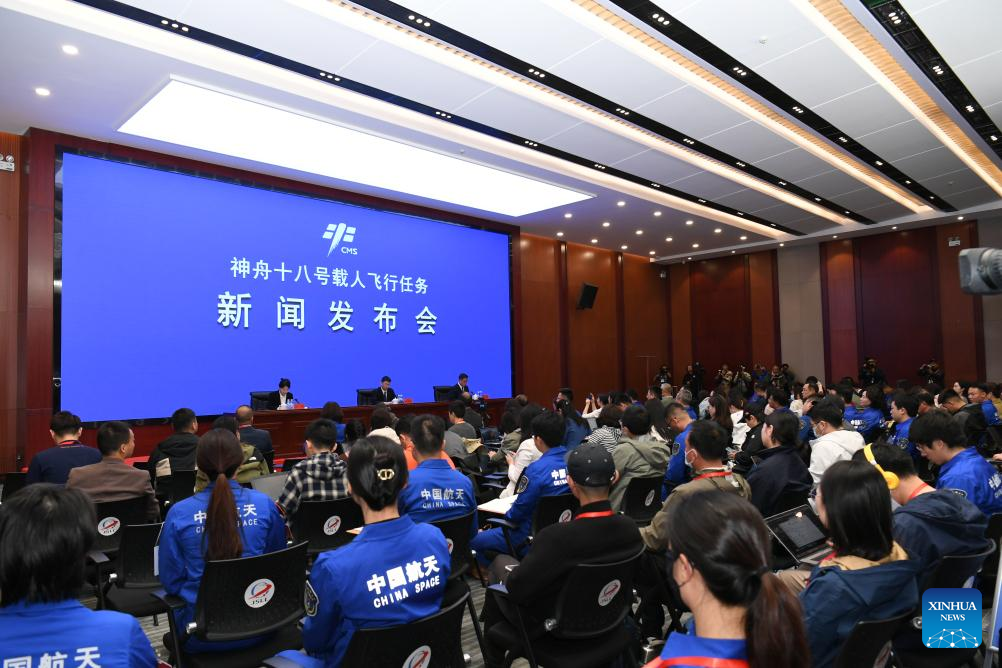

A press conference is held in Jiuquan Satellite Launch Center in northwest China on April 24, 2024. Chinese astronauts Ye Guangfu, Li Cong and Li Guangsu will carry out the Shenzhou-18 crewed spaceflight mission, and Ye will be the commander, the China Manned Space Agency announced at a press conference on Wednesday. (Photo by Wang Jiangbo/Xinhua)

(...) During the mission, the country's first in-orbit aquatic ecological research project will be implemented. Using zebrafish and goldfish algae to establish a self-cycling aquatic ecosystem in orbit, the project aims to make to a breakthrough in the cultivation of vertebrates in space, according to Lin.

The world's first in-orbit stem cell study on the plant's stem tips will be made to reveal the mechanism of plant evolutionary adaptation to gravity and provide theoretical support for space cropping, said Lin.

The Shenzhou-18 astronauts will carry out two to three extravehicular activities (EVAs), implement six cargo outbound deliveries via the station's cargo airlock module.

During the EVAs, the astronauts will install space debris protection reinforcements for extravehicular piping, cables and critical equipment, and carry out extravehicular inspections, as appropriate, to further safeguard the safety of the space station, said Lin. ■
https://english.news.cn/20240424/560ffef95eb94bdd9ef9dee957d4e224/c.html

China to launch Shenzhou-18 crewed spaceship on April 25
Source: XinhuaEditor: huaxia2024-04-24 12:05:45
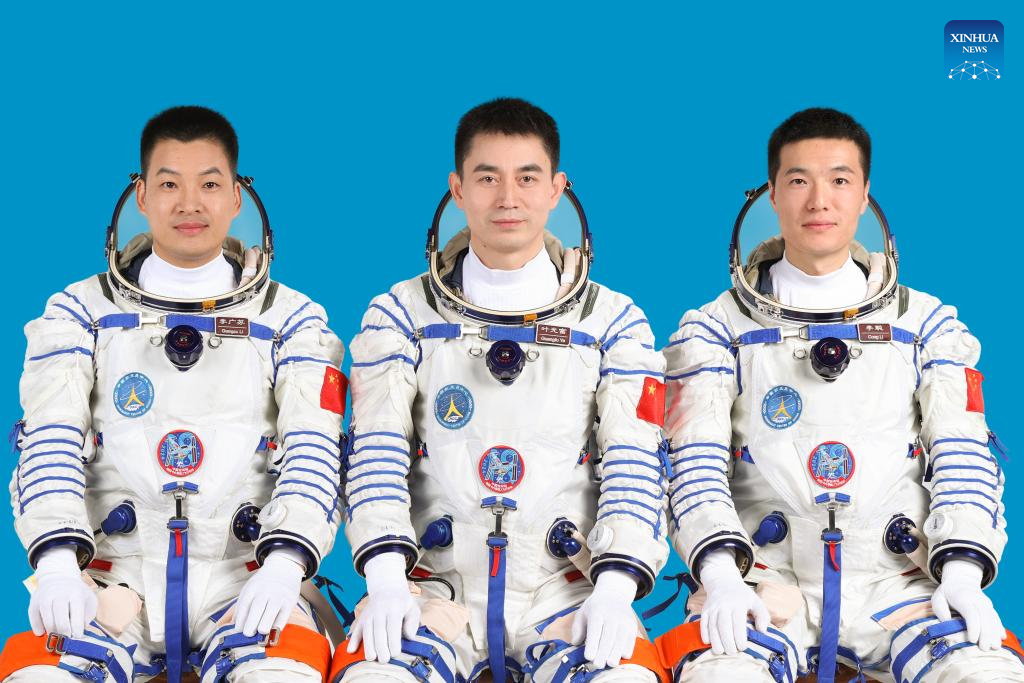

This undated photo shows Chinese astronauts Ye Guangfu (C), Li Cong (R) and Li Guangsu who will carry out the Shenzhou-18 spaceflight mission. Chinese astronauts Ye Guangfu, Li Cong and Li Guangsu will carry out the Shenzhou-18 crewed spaceflight mission, and Ye will be the commander, the China Manned Space Agency announced at a press conference on Wednesday. (Xinhua)

(...) After entering orbit, the Shenzhou-18 spaceship will perform a fast automated rendezvous and docking with the radial port of the space station core module Tianhe in about 6.5 hours, forming a combination of three modules and three spacecraft, Lin said.

During their stay in orbit, the Shenzhou-18 crew will witness the arrival of the Tianzhou-8 cargo craft and Shenzhou-19 crewed spaceship, Lin said.

The space station combination is now in a stable status with all equipment functioning well. Product qualities of the Shenzhou-18 spaceship and the Long March-2F carrier rocket are under control, Lin added.

The Shenzhou-18 crew is in good condition, while the ground system facilities are in stable operation. All preparations for the launch have been completed, Lin said. (...)
https://english.news.cn/20240424/f15be1b0171c496c98d581eb49ebc68c/c.html

Shenzhou-18 set for launch at 8:59 pm on April 25, marking China's 32nd manned flight into space
By Fan Anqi in Jiuquan Published: Apr 24, 2024 12:31 PM

(...) Compared with the previous Long March-2F used in the Shenzhou-17 mission, the new rocket has undergone 32 technical improvements, making it safer and more reliable. The reliability assessment of the rocket has been increased from 0.9896 to 0.9903, and its safety assessment has reached 0.99996, according to information shared by rocket developers with the China Academy of Launch Vehicle Technology (CALT).

Since the space station started construction, the Long March-2F rocket has entered a normalized fast-paced launch state.

In order to quickly and stably send taikonauts into space, the rocket development team has continuously explored the optimization of the launch site preparation process. Now, the preparation process of the Long March 2F rocket has been reduced from 49 days in the early stage to 30 days, according to CALT.

Moreover, the development team has also used digital means such as remote measurement and control support systems to achieve real-time interconnection of rocket test data, making data interpretation more efficient and accurate. At the same time, the number of launch site personnel has been reduced by about 40 percent, further improving work efficiency.

As the country's only active manned launch vehicle, the Long March-2F rocket has been specially designed with a unique fault detection system and escape rescue system. Over the past 20 years, it has maintained a 100 percent launch success rate. Although the escape rescue system has never been used, researchers made numerous improvements and refinements behind the scene to better safeguard the taikonauts' safety.
https://www.globaltimes.cn/page/202404/1311183.shtml

China reveals Shenzhou-18 crew for next space station mission
Holly Chik Published: 4:14pm, 24 Apr 2024

(...) Deputy director of the China Manned Space Agency Lin Xiqiang said the crew would begin China’s first in-orbit aquatic ecology project.

Lin told reporters on Wednesday that the mission would establish a stable “self-circulating aquatic ecosystem” in orbit using zebrafish and hornwort, with the goal of achieving a “breakthrough in cultivating vertebrates in space”.

Scientists view the zebrafish as a model vertebrate because of its relatively small and simple brain. With its fully sequenced genome, the tiny freshwater species has helped scientists make new discoveries and technological advancements.

Last month, for example, a Chinese research team created real-time imagery of the 100,000 neurons in a zebrafish, which could lead to advances in mind-controlled computers. (...)
https://www.scmp.com/news/china/science/article/3260183/china-reveals-shenzhou-18-crew-next-space-station-mission

Shenzhou-18 taikonauts start journey to space station for more sci-tech experiments
Source: Xinhua Editor: huaxia 2024-04-25 22:19:45
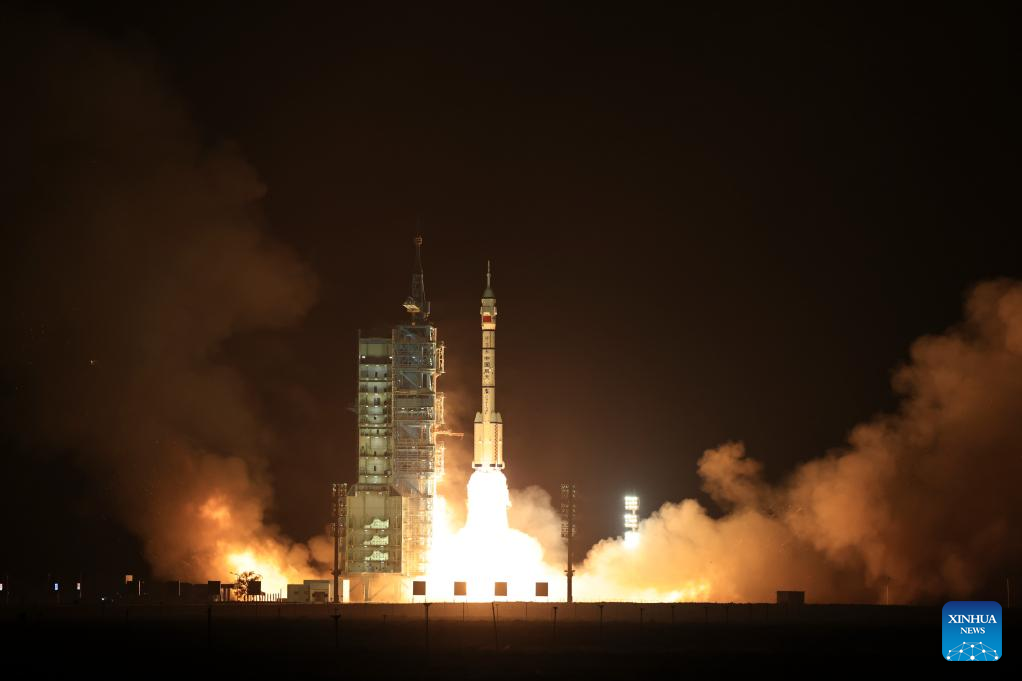

 
JIUQUAN, April 25 (Xinhua) -- China on Thursday launched the Shenzhou-18 manned spaceship that will send three taikonauts to the orbiting Tiangong space station for a six-month mission.

The spaceship, atop a Long March-2F carrier rocket, blasted off at 8:59 p.m. (Beijing Time) from the Jiuquan Satellite Launch Center in northwest China.

About 10 minutes after the launch, the Shenzhou-18 spaceship separated from the rocket and entered its designated orbit. The crew members are in good shape and the launch is a "complete success," the China Manned Space Agency (CMSA) announced. (...)
https://english.news.cn/20240425/f04070d8817a42f69f1c74dcb0a7cf32/c.html

China’s Shenzhou-18 crew arrive at Tiangong space station
Andrew Jones April 25, 2024 [SN]


A mission control representation of the Shenzhou-18 spacecraft approaching Tiangong's radial docking port, April 25, 2024. Credit: CMSEO

HELSINKI — China’s latest crew of three astronauts arrived at the Tiangong space station Thursday following launch from Jiuquan spaceport in the Gobi Desert.

The Shenzhou-18 spacecraft completed rendezvous and docking with Tiangong’s radial docking port at 3:32 p.m. Eastern (1932 UTC), April 25, China’s human spaceflight agency announced shortly after the event.

The Shenzhou-18 astronauts—commander Ye Guangfu and rookies Li Cong and Li Guangsu—will soon be greeted aboard Tiangong by the Shenzhou-17 crew upon opening of the hatch.
https://spacenews.com/chinas-shenzhou-18-crew-arrive-at-tiangong-space-station/
https://www.nasaspaceflight.com/2024/04/shenzhou-18/


Odłączenie Shenzhou-17 od CSS nastąpiło 30.04.2024 o 00:43 UTC {02:43 CEST).

China's Shenzhou-17 separates from space station combination, starts journey home
Source: XinhuaEditor: huaxia2024-04-30 10:48:00
   
JIUQUAN, April 30 (Xinhua) -- China's Shenzhou-17 manned spaceship separated from the country's space station combination at 8:43 a.m. Tuesday (Beijing Time), according to the China Manned Space Agency (CMSA).

Three astronauts aboard, Tang Hongbo, Tang Shengjie, and Jiang Xinlin, are returning to Earth after staying in orbit for about half a year.

The CMSA said that prior to the separation, the Shenzhou-17 crew, with the assistance of the ground staff, completed various tasks such as setting the status of the space station combination, processing and transmitting the experimental data, and transferring remaining supplies, and then carried out handover work with the Shenzhou-18 crew. (...)
https://english.news.cn/20240430/d53e7825a89248368115d7e91139e2ec/c.html

Zebrafish on China's space station in good condition: experts
Source: Xinhua Editor: huaxia 2024-05-19 22:57:15
   
BEIJING, May 19 (Xinhua) -- The four zebrafish kept on China's Tiangong space station, which is orbiting about 400 km above Earth, are currently in good condition, experts from the Chinese Academy of Sciences (CAS) said Sunday.

The experts revealed details of the latest developments concerning the country's first in-orbit aquatic ecological research project at a public science day event in Beijing.

On April 25, along with the three astronauts aboard the Shenzhou-18 manned spacecraft, four zebrafish and four grams of goldfish algae went into space, and these have been used to establish a self-cycling aquatic ecosystem in orbit, making a breakthrough in the field of raising of vertebrates in space.

According to Zheng Weibo, a researcher at Shanghai Institute of Technical Physics of the CAS, the astronauts have managed to collect water samples twice and have replaced the fish food box once. They found that the zebrafish were showing directional behavior anomalies, such as inverted swimming and rotary movement, in the microgravity environment on Tiangong.

Using the likes of water and fish egg samples, among others, scientists will carry out research on the impact of the space environment on the growth, development and behavior of vertebrates, as well as the material cycle of confined ecosystems in space, Zheng said.

Zebrafish, as a model animal with genetic similarity to humans, can be used for research on many human diseases, said Wang Gaohong, a researcher at the Institute of Hydrobiology of the CAS.

"Meanwhile, like astronauts, zebrafish need to pass through rounds of selection to become 'aquastronauts,'" Wang added. ■

https://english.news.cn/20240519/5094885d46be4d81b94ec40e9cec8337/c.html
https://twitter.com/wulei2020/status/1792110263178838087

Shenzhou-18 crew members complete first spacewalk
Source: Xinhua Editor: huaxia 2024-05-28 23:05:45
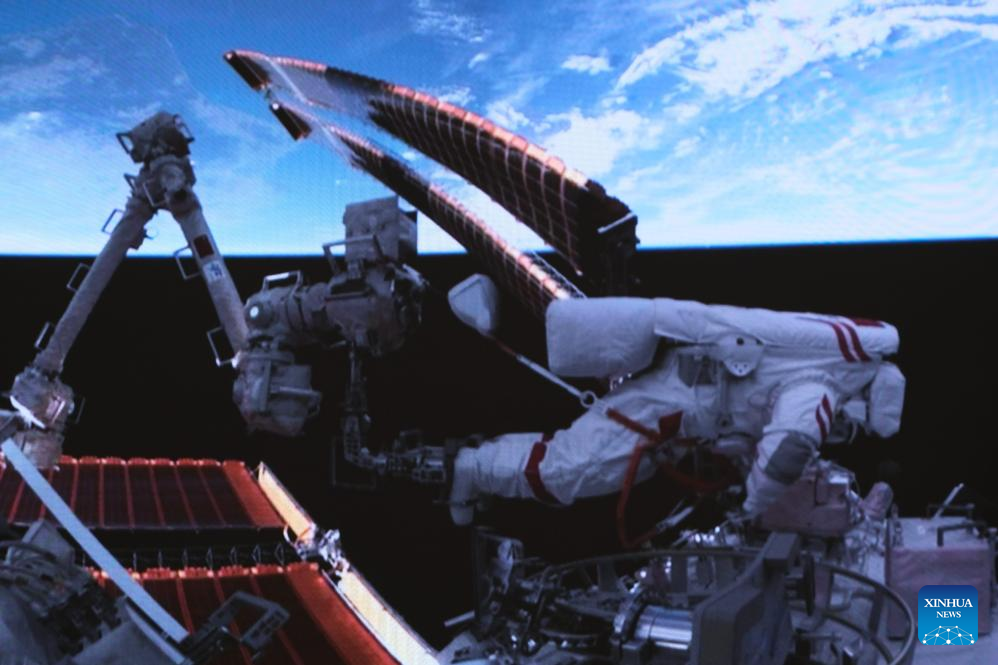
   

This screen image captured at Beijing Aerospace Control Center on May 28, 2024 shows Shenzhou-18 astronaut Ye Guangfu performing extravehicular activities. The Shenzhou-18 crew members on board China's orbiting space station completed their first spacewalk on Tuesday, according to the China Manned Space Agency. (Xinhua/Li Jie)

BEIJING, May 28 (Xinhua) -- Shenzhou-18 crew members on board China's orbiting space station completed the first spacewalk of their mission at 6:58 p.m. (Beijing Time) on Tuesday, according to the China Manned Space Agency (CMSA).

Ye Guangfu, Li Cong and Li Guangsu worked for about eight-and-a-half hours in completing multiple tasks, including the installation of space debris protection devices, and were assisted by the space station's robotic arm and a team on Earth.

The task has set a new record for the longest single spacewalk by Chinese astronauts.

Ye and Li Guangsu, the two crew members assigned the spacewalk duty, have since returned safely to the Wentian lab module.

This marked Ye's second extravehicular activity (EVA), following his initial spacewalk during the Shenzhou-13 mission, while Li Guangsu embarked on a spacewalk for the first time.

The mission will involve numerous other tasks, with the Shenzhou-18 crew set to engage in a slew of scheduled space science experiments and technical tests, while they will also undertake additional extravehicular activities and install payloads outside the space station, according to the CMSA.

So far, Chinese astronauts have successfully carried out a total of 16 EVAs. On Sept. 27, 2008, astronaut Zhai Zhigang in Shenzhou-7 mission made history as China's first person to conduct a spacewalk, which lasted approximately 19 minutes.

The Shenzhou-15 crew has achieved a milestone by performing four spacewalks, marking the highest number of EVAs by a single Chinese astronaut crew.

The Shenzhou-17 crew completed, for the first time, the in-orbit maintenance of extravehicular facilities during their second spacewalk, which lasted approximately eight hours. ■

https://english.news.cn/20240528/193b447f60db438e985a8cc6e8769195/c.html

China chooses 2 teams to develop low-cost space station cargo spacecraft
Andrew Jones October 29, 2024


A Shenzhou-15 astronaut wearing a Feitian EVA suit with red markings emerges from the Wentian module, as imaged by a camera on the Tiangong robotic arm. Credit: CMSA

HELSINKI — China’s human spaceflight agency has selected two proposals to develop spacecraft for low-cost space station resupply missions, echoing earlier moves by NASA.

The China Manned Space Engineering Office (CMSEO) opened a call last year for proposals for low-cost cargo transportation systems to serve the Tiangong space station. Four proposals from 10 submissions were chosen to enter a detailed design phase in September 2023. (...)
https://spacenews.com/china-chooses-2-teams-to-develop-low-cost-space-station-cargo-spacecraft/

China unveils Shenzhou-19 crew for space station mission
Source: Xinhua Editor: huaxia 2024-10-29 10:13:00
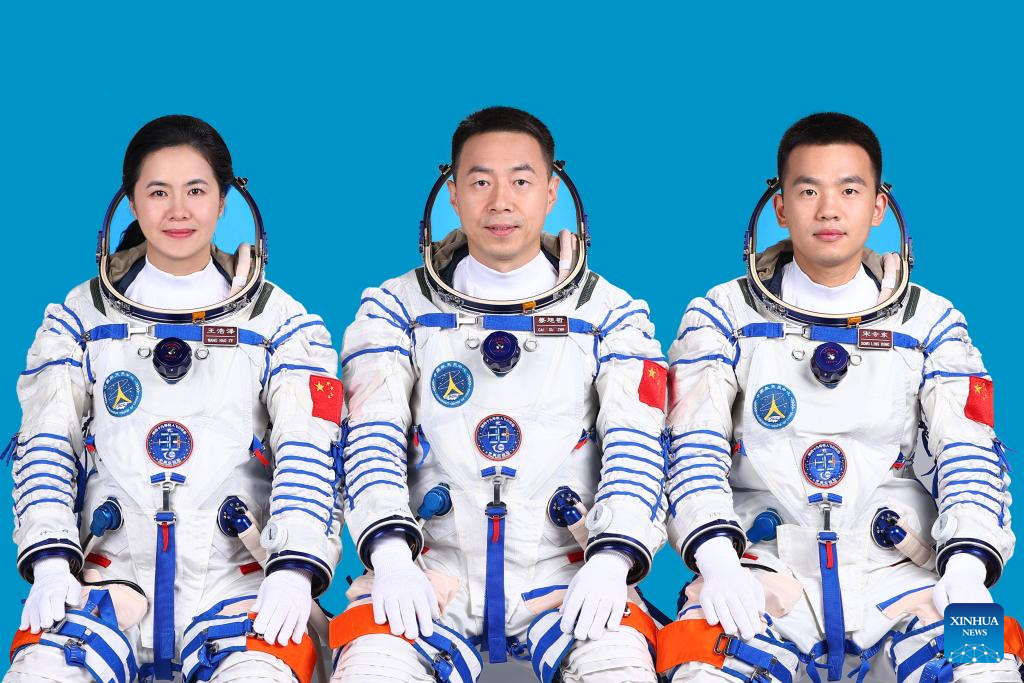

This photo shows Chinese astronauts Cai Xuzhe (C), Song Lingdong (R) and Wang Haoze who will carry out the Shenzhou-19 spaceflight mission. Chinese astronauts Cai Xuzhe, Song Lingdong and Wang Haoze will carry out the Shenzhou-19 crewed spaceflight mission, and Cai will be the commander, the China Manned Space Agency announced at a press conference on Tuesday. (Xinhua)

JIUQUAN, Oct. 29 (Xinhua) -- Chinese astronauts Cai Xuzhe, Song Lingdong and Wang Haoze will carry out the Shenzhou-19 crewed spaceflight mission, and Cai will be the commander, the China Manned Space Agency announced at a press conference on Tuesday.

The Shenzhou-19 crewed spaceship is scheduled to be launched at 4:27 a.m. Wednesday (Beijing Time) from the Jiuquan Satellite Launch Center in northwest China, said Lin Xiqiang, spokesperson of the agency.

Cai completed the Shenzhou-14 space mission in 2022. Song and Wang, among the third batch of Chinese astronauts, are newcomers to space. Both of them were born in the 1990s.

Song was a former air force pilot before being selected as an astronaut, and Wang previously served as a senior engineer at the Academy of Aerospace Propulsion Technology under the China Aerospace Science and Technology Corporation.

Wang is currently China's only female space flight engineer and will become the third Chinese woman to embark on a crewed spaceflight mission, the agency noted.

The Shenzhou-19 astronauts will complete in-orbit rotation with the Shenzhou-18 trio and stay at the space station for approximately six months, witnessing the arrival of the Tianzhou-8 cargo craft and Shenzhou-20 crewed spaceship during the mission.

Many tasks await the new crew to complete: conducting space science and application tests, performing extravehicular activities, installing protective devices against space debris, installing and recycling extravehicular payloads and equipment. They will also engage in science education, public welfare activities, and other payload tests.

The Shenzhou-19 astronauts are scheduled to return to the Dongfeng landing site in north China's Inner Mongolia Autonomous Region in late April or early May next year, according to the agency. ■
https://english.news.cn/20241029/7654ba0466cc4330a733cbb83a0afb78/c.html
« Ostatnia zmiana: Lipca 04, 2025, 21:58 wysłana przez Orionid »

Offline Orionid

  • Weteran
  • *****
  • Wiadomości: 28869
  • Very easy - Harrison Schmitt
Odp: Różne artykuły o Chinese space station (CSS)
« Odpowiedź #31 dnia: Października 30, 2024, 02:53 »
Cytuj
Start nastąpił 29.10.2024 o 21:27 CET

Xinhua Headlines: Shenzhou-19 astronauts start journey to China's space station for new endeavors
Source: Xinhua Editor: huaxia 2024-10-30 05:24:45
   

Chinese astronauts Cai Xuzhe (C), Song Lingdong (R) and Wang Haoze attend a see-off ceremony at the Jiuquan Satellite Launch Center in northwest China on Oct. 30, 2024. A see-off ceremony for three Chinese astronauts of the Shenzhou-19 crewed space mission was held early Wednesday morning at the Jiuquan Satellite Launch Center in northwest China. (Photo by Wang Jiangbo/Xinhua) ■

by Xinhua writers Zhang Dan, Wang Chenxi and Quan Xiaoshu

JIUQUAN, Oct. 30 (Xinhua) -- China launched the Shenzhou-19 crewed spaceship on Wednesday, sending three astronauts -- including the country's first female space engineer -- to its orbiting space station for a six-month mission.

The spaceship, atop a Long March-2F carrier rocket, blasted off at 4:27 a.m. (Beijing Time) from the Jiuquan Satellite Launch Center in northwest China, said the China Manned Space Agency (CMSA). (...)
https://english.news.cn/20241030/1149d79f1c114d6ca6f10262537333bd/c.html

Shenzhou-19 spacecraft arrives at Tiangong for crew rotation
Andrew Jones October 30, 2024


A view of the Shenzhou-19 spacecraft from the Tiangong space station. Credit: Ourspace

HELSINKI — China is conducting its fifth crew rotation aboard the Tiangong space station after the arrival of three astronauts aboard Shenzhou-19.

Six astronauts are now aboard the space station following the docking of the Shenzhou-19 spacecraft at Tiangong at around 11:00 p.m. Eastern, Oct. 29. The astronauts were born variously in the 1970s, 1980s and 1990s. (...)
https://spacenews.com/shenzhou-19-spacecraft-arrives-at-tiangong-for-crew-rotation/

Update: Shenzhou-19 astronauts start journey to China's space station for new endeavors
Source: XinhuaEditor: huaxia2024-10-30 04:46:17
https://english.news.cn/20241030/56ae6baa39294df88b763ba72fe5908e/c.html
Xinhua Headlines: Shenzhou-19 astronauts start journey to China's space station for new endeavors
Source: Xinhua Editor: huaxia 2024-10-30 07:56:32
https://english.news.cn/20241030/1149d79f1c114d6ca6f10262537333bd/c.html
   
Shenzhou-19 astronauts enter space station
Source: Xinhua Editor: huaxia 2024-10-30 14:43:45
   

This image captured at Beijing Aerospace Control Center on Oct. 30, 2024 shows the crew of Shenzhou-18 and Shenzhou-19 manned spaceships talking with each other. The three astronauts of China's Shenzhou-19 spaceflight mission have entered the Tiangong space station and met with another astronaut trio on Wednesday, starting a new round of in-orbit crew handover. (Xinhua/Li Jie)

BEIJING, Oct. 30 (Xinhua) -- The three astronauts of China's Shenzhou-19 spaceflight mission have entered the Tiangong space station and met with another astronaut trio on Wednesday, starting a new round of in-orbit crew handover.
https://english.news.cn/20241030/979ccf6c23f74e6f8f0b666550e1c33d/c.html

China taikonaut trio arrives at the Tiangong space station
October 29, 2024 Will Robinson-Smith [SFN]


The taikonauts of the Shenzhou-19 mission meet their counterparts from Shenzhou-18 onboard the Tiangong space station several hours after lifting off from the Jiuquan Satellite Launch Center in China. Image: CNSA via CCTV

Three of China’s taikonauts completed their journey to the Tiangong space station to begin the country’s eighth long-duration spaceflight.

Commander Cai Xuzhe led the roughly 6.5-hour Shenzhou-19 mission alongside Song Lingdong and Wang Haoze. They rode aboard a LongMarch 2F Y19 rocket, which docket with the TSS about 11 a.m. BJT on Oct. 29 (11 p.m. EDT on Oct. 29, 0300 UTC on Oct. 30).
https://spaceflightnow.com/2024/10/29/live-coverage-china-to-launch-3-taikonauts-to-the-tiangong-space-station/


Xinhua Headlines: Chinese astronauts return to Earth safely, experiencing busy, joyful space life
Source: Xinhua Editor: huaxia 2024-11-04 04:17:30


In this combo photo, astronauts Ye Guangfu, Li Cong and Li Guangsu (from L to R) are out of the return capsule of the Shenzhou-18 manned spaceship at the Dongfeng landing site in north China's Inner Mongolia Autonomous Region, Nov. 4, 2024. The three astronauts are all in good physical condition, and the mission is a complete success, according to the China Manned Space Agency. (Xinhua/Li Xin)

JIUQUAN, Nov. 4 (Xinhua) -- The Shenzhou-18 crew consisting of three Chinese astronauts returned to Earth safely in the early morning on Monday, after completing a six-month space station mission.

Shenzhou-18's return capsule, carrying astronauts Ye Guangfu, Li Cong and Li Guangsu, touched down at the Dongfeng landing site in north China's Inner Mongolia Autonomous Region at 1:24 a.m. (Beijing Time). The crew had all left the return capsule by 2:15 a.m., according to the China Manned Space Agency (CMSA).

The three astronauts, after staying in orbit for 192 days, were all in good health and the Shenzhou-18 manned mission was a success, the CMSA said.

Ye, the Shenzhou-18 mission commander, has become the first Chinese astronaut with an accumulative spaceflight time of more than a year, setting a new record for the longest duration of stay in orbit by a Chinese astronaut.

He served as a crew member in the Shenzhou-13 mission from October 2021 to April 2022.

"Chinese astronauts have flown to space in successive missions. I believe that the record of the duration in orbit will be broken in the near future," Ye said.

Li Cong, who has just completed his first-ever space adventure, said that the crew was united as one and worked closely with the ground team, which ensured the extravehicular activities implemented smoothly and the scientific research and experiments advanced successfully.

"We have all enjoyed the unique experience of weightlessness. It is exciting to return to Earth, but we are also unwilling to part the wonders of the space," said Li Guangsu, who has just returned from his first spaceflight.

At 12:34 a.m., the Beijing Aerospace Control Center issued a return command through the ground station, and the return capsule of the Shenzhou-18 manned spaceship separated from its orbiting capsule. The brake engine then ignited, and the return capsule separated from the propulsion capsule.

The ground search team arrived at the landing site soon after the return capsule landed.

INTENSIVE SCIENTIFIC TASKS

China launched the Shenzhou-18 manned spaceship on April 25, 2024. During the mission, the Shenzhou-18 crew utilized the scientific experiment cabinets and extravehicular payloads to carry out dozens of experiments in the fields of basic physics in microgravity, space material science, space life science, space medicine and space technology.

They replaced the burner for the gas experiment in the combustion experiment cabinet and test samples in the fluid physics experiment cabinet as planned. They also conducted in-orbit training on spacecraft rendezvous and docking.

The Shenzhou-18 astronauts carried out extravehicular activities twice. Their first spacewalk in May set a new record for the longest single spacewalk by Chinese astronauts.

Assisted by the space station's robotic arm and a team on Earth, they worked for about eight-and-a-half hours during their first extravehicular activities, and completed multiple tasks, including the installation of space debris protection devices.

The crew also carried out emergency decision-making research. By utilizing the computer and corresponding software, they completed a series of assessments, including tests on basic cognitive ability, risk perception, decision-making style, as well as comprehensive decision-making tasks.

The ground personnel then used the test results to thoroughly evaluate the astronauts' emergency decision-making ability in orbit and study the influence of the factors such as the duration of stay in orbit, emotional state and workload on their ability.

During the mission, the crew also conducted regular medical check-ups as required, including routine examinations and dynamic monitoring of the heart rate and blood pressure. These procedures helped comprehensively monitor the astronauts' physical state.

JOYFUL SPACE JOURNEY

During their space adventure, the Shenzhou-18 trio also experienced some special joy brought by the space "aquarium" and "garden" in the Tiangong space station.

The three astronauts created a space "aquarium" using zebrafish and algae to study how the space environment affects their growth and system balance. It was also a breakthrough in the field of raising vertebrates in space.

The astronauts discovered that zebrafish exhibited abnormal orientation behaviors in microgravity, such as upside-down swimming, spinning and circling.

Scientists will later utilize the returned water samples, fish eggs and other specimens, in conjunction with videos of the zebrafish's spatial movement behaviors, to conduct research on the impact of the space environment on the growth, development and behavior of vertebrates and to provide support for the study of material cycling in a closed space ecosystem.

The Shenzhou-18 astronauts were also busy cultivating plants in the "space garden" during their stay in orbit.

According to a video clip released by the CMSA, astronaut Li Guangsu said that they grew two types of plants -- cherry tomatoes and lettuce -- and they had harvested some lettuce leaves for food.

"Being able to eat fresh vegetables in space is truly a blessing. These green plants have also brought a touch of green and good cheer to our busy work," Li said.

Planting in space could also help analyze the changes in the function and gene expression of plant stem cells in the microgravity environment, and provide theoretical support for designing crops that can adapt to outer-space conditions.

Before their return to Earth, the Shenzhou-18 crew completed the removal of some module plants, replenishing water and other operations for the "space garden," in preparation for the new batch of plant seeds brought into space by the Shenzhou-19 astronauts.

They also planted a new batch of lettuce for the Shenzhou-19 crew, who were lifted off aboard the Shenzhou-19 spaceship and entered the Tiangong space station on Oct. 30.

In 2025, China's manned space program will launch the Shenzhou-20 and Shenzhou-21 crewed missions, and the Tianzhou-9 cargo craft for in-orbit supplies, the CMSA said. ■

https://english.news.cn/20241104/d06cc9d30b4343ba81758e8c2f6fe0c5/c.html


China Focus: Taikonauts to conduct in-orbit experiments on fruit flies
Source: Xinhua Editor: huaxia 2024-11-05 18:00:15
   
BEIJING, Nov. 5 (Xinhua) -- The newly launched Shenzhou-19 taikonauts have embarked on their six-month journey aboard China's space station. Their packed schedule includes 86 sci-tech experiments, with a particularly intriguing one - the fruit fly research, aimed at studying the growth and behaviors of these insects at a distance of 400 km above Earth.

The fruit fly is one of the model species frequently used in genetic experiments. It is small, measuring only 3 to 4 mm in length, and has a short life cycle with fast reproduction capabilities, enabling it to produce a large number of offspring within a short period, according to Zhang Wei, a researcher involved in the selection of in-orbit scientific experiments, at the Technology and Engineering Center for Space Utilization under the Chinese Academy of Sciences.

"The genes of fruit flies share many similarities with those of humans, so the study can help with understanding human genetic diseases and provide insights into how humans adapt to space environments," Zhang said in a recent interview.

He also noted that future space research plans will involve conducting experiments on mice, which are more complex life forms compared to fruit flies.

"We have planned to send mice to space for breeding on an animal platform. And some lab mice in space may be brought back to Earth for further study, which will focus on their nerves, bones, muscles and immunity," the researcher added.

This is the first time that China has taken the small insects into space, and the aim of the study seems to be exploring the deeper universe.

According to scientists, Earth provides a magnetic field as a basic guarantee for our daily lives, but Mars does not possess similar strong magnetic protection and the moon has none at all. Understanding how the human body responds to such an environment remains a major challenge in space exploration.

"So we have to conduct relevant research in advance, creating a sub-magnetic environment and observing how the fruit flies develop, grow and behave," Zhang said.

China launched the Shenzhou-19 (Magical Ship) crewed spaceship on Oct. 30, sending three taikonauts, two male and one female, to its orbiting space station Tiangong (Heavenly Palace) for a half-year stay. The trio in mid-November will witness the arrival of Tianzhou-8 (Sky Ship) cargo craft, which will send up supplies and experiment payloads, including the sub-magnetic facility with fruit flies, according to the researcher.

The previous Shenzhou-18 crew during their six-month mission also performed numerous experiments inside the national space lab, and one task was creating an "aquarium" and raising four zebra fish and four grams of goldfish algae in zero gravity, a breakthrough in the field of raising vertebrates in space.

Not only the taikonauts found joy in the space "aquarium," but it also paved the way for their future counterparts to enjoy nutritious fish from their own in-orbit harvests.

According to scientists, the water, fish eggs and other experimental samples obtained through the space "aquarium" have been brought back to Earth with the crew on Monday. These samples will provide valuable data for scientists to study vertebrate lives.

Besides life science experiments, the orbiting taikonauts will carry out research on materials, including rare earth soft magnetic materials, blade materials for gas turbines and special functional crystals. These findings will provide insights for developing advanced instruments on Earth. ■

https://english.news.cn/20241105/12ed767820e741d886c128caaf84e56d/c.html

China's Tianzhou-7 cargo craft separates from space station combination
Source: Xinhua Editor: huaxia 2024-11-10 17:54:45
   
BEIJING, Nov. 10 (Xinhua) -- The Tianzhou-7 cargo craft, tasked with carrying supplies for China's space station, separated from the station combination at 4:30 p.m. Sunday (Beijing Time) and switched to independent flight, according to the China Manned Space Agency (CMSA).

The cargo craft will re-enter the Earth's atmosphere in a controlled manner soon. Most of its components will burn up and be destroyed during the process, while a small amount of debris will fall into designated safe waters in the South Pacific, the CMSA said.

The CMSA has planned a total of two cargo supply missions in 2024, including Tianzhou-7 and Tianzhou-8.

Tianzhou-7 was launched on Jan. 17 from the Wenchang Spacecraft Launch Site in the southern island province of Hainan. Tianzhou-8 has been rescheduled for mid-November due to the impact of Super Typhoon Yagi on Wenchang. ■

https://english.news.cn/20241110/f4446d1758df499daf8b83f8c03e68d3/c.html

China prepares to launch Tianzhou-8 cargo spacecraft
Source: Xinhua Editor: huaxia 2024-11-13 18:49:45


This photo taken on Nov. 13, 2024 shows the combination of the Tianzhou-8 cargo spacecraft and a Long March-7 Y9 carrier rocket being vertically transferred to the launch area. The combination of the Tianzhou-8 cargo spacecraft and a Long March-7 Y9 carrier rocket was vertically transferred to the launching area on Wednesday.(Photo by Huang Guochang/Xinhua)

WENCHANG, Hainan, Nov. 13 (Xinhua) -- The Tianzhou-8 cargo spacecraft and Long March-7 Y9 carrier rocket combination was vertically transferred to the launch site on Wednesday.

The cargo spacecraft will be launched at an appropriate time in the near future, according to the China Manned Space Agency.

The facilities and equipment at the Wenchang Spacecraft Launch Site in China's southern island province of Hainan are all in good condition, and various pre-launch function checks and joint tests will be carried out as planned, the agency said.

The supplies aboard the spacecraft are primarily intended to support the Shenzhou-19 and Shenzhou-20 crews, and include gift packages for major Chinese holidays such as Spring Festival, Mid-Autumn Festival and Dragon Boat Festival. Personalized birthday packages have also been prepared for each astronaut who will celebrate a birthday in space.

The spacecraft will carry various equipment and materials to be used for space science experiments. For the first time, a brick made of synthetic lunar soil will be brought aboard the space station and subject to an exposure experiment to test whether it could be used to construct buildings on the moon. It is expected that the lunar soil brick will be returned to Earth by the end of next year, following the experiment. ■

https://english.news.cn/20241113/78c0edc26dc241f49759c6065bf52fc3/c.html

China's Tianzhou-8 cargo craft ready for launch
Source: Xinhua Editor: huaxia 2024-11-14 21:13:30
   
WENCHANG, Hainan, Nov. 14 (Xinhua) -- The Xichang Satellite Launch Center announced on Thursday that Tianzhou-8, China's newest cargo craft servicing its orbiting space station, is ready for launch.
https://english.news.cn/20241114/11cdbc1aa772489aa8863e1df6eb3220/c.html
« Ostatnia zmiana: Listopada 14, 2024, 21:31 wysłana przez Orionid »

Offline Orionid

  • Weteran
  • *****
  • Wiadomości: 28869
  • Very easy - Harrison Schmitt
Odp: Różne artykuły o Chinese space station (CSS)
« Odpowiedź #32 dnia: Listopada 21, 2024, 11:49 »
China Focus: Shenzhou-19 astronauts celebrate 25th anniversary of Shenzhou-1 launch with commemorative video
Source: Xinhua Editor: huaxia 2024-11-20 22:23:45
   
BEIJING, Nov. 20 (Xinhua) -- China's astronauts aboard the Shenzhou-19 crewed spaceship recorded a video on Wednesday to celebrate the 25th anniversary of the successful launch of Shenzhou-1, the country's first experimental crewed spaceship launched on Nov. 20, 1999.
https://english.news.cn/20241120/7e3b9351db964279a935f276a76ad425/c.html
https://x.com/wulei2020/status/1859245122149662776

Shenzhou-19 astronauts complete record-breaking 9-hour spacewalk
Andrew Jones December 17, 2024


Astronauts Cai Xuzhe, attached to a robotic arm, and Song Lingdong, exiting the Wentian hatch, during the first Shenzhou-19 extravehicular activity, Dec. 17, 2024. Credit: CMSEO

HELSINKI — Two Chinese astronauts completed a record-setting extravehicular activity outside Tiangong space station Tuesday.

Shenzhou-19 commander Cai Xuzhe, wearing a Feitian extravehicular activity suit marked with red, exited the Wentian experiment module hatch of the Tiangong space station at 11:51 p.m. Eastern, Dec. 16 (0451 UTC, Dec. 17).

Cai attached himself to Tiangong’s robotic arm and retrieved equipment needed for the EVA from the airlock, assisted by crewmate Song Lingdong. Song, in a suit with blue markings, exited Wentian at 1:32 a.m. Dec. 17 (0632 UTC) to perform his tasks, according to China Central Television (CCTV). Signatures from previous users of the spacesuits are visible on the Fetian primary life support systems in video of the spacewalk. (...)
https://spacenews.com/shenzhou-19-astronauts-complete-record-breaking-9-hour-spacewalk/
« Ostatnia zmiana: Grudnia 21, 2024, 19:48 wysłana przez Orionid »

Offline Orionid

  • Weteran
  • *****
  • Wiadomości: 28869
  • Very easy - Harrison Schmitt
Odp: Różne artykuły o Chinese space station (CSS)
« Odpowiedź #33 dnia: Marca 05, 2025, 21:19 »
China to train Pakistani astronaut for Tiangong space station mission
by Andrew Jones February 28, 2025 [SN]


A view of Tiangong space station taken by the departed Shenzhou-16 spacecraft crew in late October 2023. Credit: Credit: CMSEO

(...) “Pakistani astronauts will be arranged to enter the Chinese space station with Chinese astronauts to perform short-term flight missions in the next few years,” the CMSEO statement read. (...)

It is unclear how the astronaut will take part in a short-term mission. Shenzhou missions to Tiangong are typically six months long, with three crew members required to operate the station. China has stated plans exist to expand Tiangong to six modules, and send a larger new-generation crew spacecraft to Tiangong on the new Long March 10 launcher. (...)
https://spacenews.com/china-to-train-pakistani-astronaut-for-tiangong-space-station-mission/

Tiangong to welcome Pakistani astronaut
By Zhao Lei | China Daily | Updated: 2025-03-01 07:35

First foreign visitor expected to enter China's space station under agreement

(...) The agreement, signed by the China Manned Space Agency and Pakistan's Space and Upper Atmosphere Research Commission at a ceremony in Islamabad on Friday, covers the bilateral efforts to select and train Pakistani astronauts and then send some of them to China's Tiangong space station, which has been in orbit for nearly four years. (...)

After the Pakistani trainees are ready, one of them will be chosen as the first foreign crew member to fly with Chinese astronauts toward Tiangong space station and spend a short-term stay inside the colossal spacecraft, currently orbiting Earth at about 400 kilometers above the ground, the agency noted.

Until now, the highest altitude any Pakistani citizen has ever achieved is about 87.4 km, which was reached by female polar adventurer and artist Namira Salim during a 55-minute suborbital journey arranged by British-American aerospace company Virgin Galactic on Oct 6, 2023. (...)
https://www.chinadaily.com.cn/a/202503/01/WS67c24853a310c240449d7f02.html
https://www.voanews.com/a/growing-space-cooperation-between-pakistan-china-presents-risks-and-opportunities-experts-say-/7995718.html

Polskie Forum Astronautyczne

Odp: Różne artykuły o Chinese space station (CSS)
« Odpowiedź #33 dnia: Marca 05, 2025, 21:19 »

Offline Orionid

  • Weteran
  • *****
  • Wiadomości: 28869
  • Very easy - Harrison Schmitt
Odp: Różne artykuły o Chinese space station (CSS)
« Odpowiedź #34 dnia: Kwietnia 23, 2025, 12:05 »
Cytuj
Dwóch taikonautów z 4. naboru poleci w 2026 na CSS jako PS

Hong Kong, Macao astronauts set for their first spaceflight in 2026
Source: Xinhua Editor: huaxia 2025-04-23 11:52:30
   
JIUQUAN, April 23 (Xinhua) -- China has announced that its first astronauts from the Hong Kong and Macao special administrative regions, selected as payload specialists, are on track to make their inaugural spaceflight as early as 2026, a spokesperson for the China Manned Space Agency said Wednesday.

The two candidates, part of China's fourth batch of astronauts, have quickly adapted to their new working and living environments and trained tirelessly, spokesperson Lin Xiqiang told a press conference in Jiuquan in northwest China.

They are now engaged in studies and training in professional space technology, said Lin.

The training for the fourth batch covers fundamental spaceflight theory as well as a range of exercises, including psychological training and adaptation to the space environment, along with specialized training sessions, said Lin.

"Upon obtaining spaceflight qualifications, they will be included in the pool for spaceflight missions," said Lin.

The fourth batch, joining the astronaut team last August, includes 10 new members, comprising eight space pilots and two payload specialists. ■

https://english.news.cn/20250423/f7f7b4ed54b842aebb9a57a0634b0953/c.html
« Ostatnia zmiana: Kwietnia 23, 2025, 12:08 wysłana przez Orionid »

Offline Orionid

  • Weteran
  • *****
  • Wiadomości: 28869
  • Very easy - Harrison Schmitt
Odp: Różne artykuły o Chinese space station (CSS)
« Odpowiedź #35 dnia: Kwietnia 30, 2025, 13:49 »
China’s Shenzhou-19 astronauts return to Earth after six-month mission
by Andrew Jones April 30, 2025 [SN]


Astronaut Wang Haoze waves after exiting the Shenzhou-19 capsule after landing, April 30, 2025. Credit: CMSEO

HELSINKI — China’s three Shenzhou-19 mission astronauts are safely back on the ground following a six-month-mission aboard the Tiangong space station.

Astronauts Cai Xuzhe, Song Lingdong and Wang Haoze touched down in their Shenzhou reentry capsule at 1:08 a.m. Eastern (0508 UTC), April 30, within the Dongfeng landing area in Inner Mongolia Autonomous Region, near the Jiuquan Satellite Launch Center.
https://spacenews.com/chinas-shenzhou-19-astronauts-return-to-earth-after-six-month-mission/


=====
Space seeds take root in Inner Mongolia
By YUAN HUI | chinadaily.com.cn | Updated: 2023-04-14 19:50


Breeding experiments are carried out on mutant seeds from space. [Photo provided to chinadaily.com.cn]
Eighteen kinds of plants bred in space have entered the ground stage in the Inner Mongolia autonomous region.


All the experimental plants were sent to Earth by the Chang'e-5, Shenzhou-13 and Shenzhou-14 spacecraft.

Mutation breeding in space is a new technology trend. It refers to sending crop seeds or test tube seedlings into space, using the mutagenic effect of the space environment (high vacuum, and cosmic magnetic fields) to mutate the seeds, which are then returned to the ground to cultivate new varieties.

Liu Yaling, director of the Innovation and Breeding Research Institute of Mengcao Group and deputy secretary-general of the Grass Seed Technology Innovation Center in the Inner Mongolia autonomous region, said, "We have carried out space breeding experiments on 18 breeding materials including wild barley, couchgrass, red fescue and yellow flower alfalfa on space missions.

Through the experiment of sowing the mutated varieties and control varieties at the same time, plants with excellent characteristics were selected for the cultivation of new varieties.

http://www.chinadaily.com.cn/a/202304/14/WS64393deca310b6054facdbbe.html


China's space station achieves 100% regeneration of oxygen resources
Xinhua | Updated: 2023-04-14 09:56


This simulated image captured at the Jiuquan Satellite Launch Center on Nov 30, 2022 shows China's Shenzhou XV manned spaceship having conducted a fast automated rendezvous and docking with the combination of the space station Tiangong. [Photo/Xinhua]

BEIJING -- China's space station, with the Shenzhou XV crew now in orbit, can produce 100 percent of its oxygen supply through its onboard regeneration system, according to a space technology conference in Harbin, capital of China's northernmost Heilongjiang province.

The development reflects that fundamental transformation of the environmental control and life-support system for China's manned spacecraft from "replenishment" to "regeneration," said Bian Qiang, director of the environmental control and life-support engineering office under the Astronaut Center of China.

As a key technology for China's manned space missions, the environmental control and life-support system creates basic living conditions and builds a liveable working environment for the astronauts, thus ensuring their health and safety.

The system comprises six regeneration subsystems for the following processes: oxygen production by water electrolysis; carbon dioxide removal; harmful gas removal; urine treatment; water treatment; and water production with carbon dioxide and hydrogen.

"At present, the six systems are in stable operation, with 100 percent of the oxygen resources regenerated and 95 percent of the water resources recycled. This reduces the amount of supplies from the ground by six tonnes every year," said Bian, addressing the third national manned spaceflight environmental control and life-support technology conference on Thursday.

He noted that the technology applied in the environmental control and life-support system ranks among the best in the world.

Over the past 55 years, experts have successfully developed three generations of environmental control and life-support system for China's manned spacecraft, as well as relevant products for Shenzhou spacecraft, extra-vehicular spacesuits and the three-module space station complex, according to Bian.

He added that, since the launch of China's space station mission, experts have successively tackled many technical difficulties faced by the world, and have realized the fundamental transformation of the system from "replenishment" to "regeneration," making outstanding contributions to the construction of China's space station.

The Shenzhou XV crew sent a video specially for the conference. Commander Fei Junlong said that he felt honored to witness the transformation of the environmental control and life-support technology on the space station, compared with the Shenzhou VI mission 17 years ago. He felt good about working and living in space for more than 100 days.

http://www.chinadaily.com.cn/a/202304/14/WS6438b2e2a31057c47ebba160.html


Shenzhou-20 astronauts complete first spacewalk
Xinhua | Updated: 2025-05-22 16:54

BEIJING -- The Shenzhou-20 crew on board China's orbiting space station completed their mission's first series of extravehicular activities on Thursday, according to the China Manned Space Agency (CMSA).

The astronaut trio -- Chen Dong, Chen Zhongrui and Wang Jie -- worked for about eight hours and completed the task at 4:49 pm (Beijing Time), assisted by a team on Earth.

Chen Dong and Chen Zhongrui, tasked with conducting spacewalk operations, exited through the node cabin of the Tianhe core module. This marked the first time that astronauts had exited via the node cabin since the space station transitioned into its application and development phase.

The astronauts installed a debris protection device at its designated location. The device had been previously deployed outside through the cargo airlock and temporarily positioned by the robotic arm.

Also, external equipment was inspected and maintained. They have since returned to the core module safely, according to the CMSA.

https://www.chinadaily.com.cn/a/202505/22/WS682ee65ca310a04af22c0fc3.html


China Focus: China launches Tianzhou-9 cargo craft to send space station supplies
Source: Xinhua Editor: huaxia 2025-07-15 15:04:30
   
WENCHANG, Hainan, July 15 (Xinhua) -- China launched the cargo spacecraft Tianzhou-9 in the early morning of Tuesday to deliver supplies for its orbiting Tiangong space station, according to the China Manned Space Agency.

The Long March-7 Y10 rocket, carrying Tianzhou-9, blasted off at 5:34 a.m. (Beijing Time) from the Wenchang Spacecraft Launch Site in the southern island province of Hainan, the agency said.

After about 10 minutes, Tianzhou-9 separated from the rocket and entered its designated orbit. Its solar panels soon unfolded. The agency declared the launch a complete success.

At 8:52 a.m. (Beijing Time), Tianzhou-9 successfully docked at the rear docking port of Tianhe, the core module of China's space station Tiangong. The Shenzhou-20 crew members onboard the space station will enter the cargo craft and transfer the payloads as scheduled.

Tianzhou-9, measuring 10.6 meters in length and 3.35 meters at its maximum diameter, is tasked with delivering supplies to the crews of the Shenzhou-20 and Shenzhou-21 missions.

It is loaded with essential supplies, totaling approximately 6.5 tonnes, including consumables for the orbiting crew, propellant, and equipment for application experiments and tests. This is the largest amount of cargo since Tianzhou-6.

Notably, two new sets of independently developed extravehicular spacesuits are onboard the craft. Their design lifespan has been significantly increased from 15 extravehicular activities (EVAs) within three years to 20 EVAs within four years, according to the reports from the state broadcaster CCTV.

Among the supplies carried by the Tianzhou-9 cargo craft is a new core muscle exercise device, helping astronauts avoid muscle atrophy in the microgravity environment of space.

Long-term spaceflight has specific impacts on astronauts' bodies, including muscle atrophy and decreased cardiovascular function. China has already equipped its space station with devices for running, cycling, and microgravity resistance exercise.

On this basis, to meet the needs of future long-term missions, the core muscle exercise device was developed. It can enhance the core muscle function of astronauts, prevent atrophy of the paraspinal muscles, and alleviate muscle pain after returning to Earth.

A brain organoid chip is also onboard the Tianzhou-9 cargo craft. It is capable of simulating the complex microenvironment and functions of the human brain.

Studies have shown that astronauts who stay in space stations for extended periods often experience issues such as dizziness, sleep disorders, and changes in cognitive function, according to CCTV.

Sending these brain-simulating organ chips to the space station can help scientists study the mechanisms through which the space environment impacts the human brain. This will provide new strategies and interventions for long-term survival and health maintenance in space.

Furthermore, brain organoid chips can also provide important support for the research of brain diseases such as Alzheimer's disease.

The relay terminal onboard Tianzhou-9 can autonomously acquire and track the Tianlian relay satellites, establishing a communication link from the cargo craft to the relay satellites and then to the ground, ensuring real-time bidirectional information transmission.

Tuesday's mission is the fourth cargo resupply flight of China's manned space program since the space station entered the application and development phase. It is also the 584th mission of the Long March rocket series.

The Long March-7 rocket, with a total length of 53.1 meters and a diameter of 3.35 meters, is a new-generation medium-lift launch vehicle in China, characterized by its high reliability, high safety, and environmentally friendly design. The rocket has a low-Earth orbit payload capacity of up to 14 tonnes. ■

https://english.news.cn/20250715/647e2631a3e0435e91ba46a1c9a21826/c.html

Shenzhou-20 taikonauts complete fourth series of extravehicular activities
Source: Xinhua Editor: huaxia 2025-09-26 10:39:45


This screen image captured at Beijing Aerospace Control Center on Sept. 25, 2025 shows Shenzhou-20 astronaut Wang Jie performing extravehicular activities outside China's orbiting space station. The Shenzhou-20 crew aboard China's orbiting space station completed their mission's fourth round of extravehicular activities on Friday, according to the China Manned Space Agency (CMSA). (Xinhua/Li Minggang)

BEIJING, Sept. 26 (Xinhua) -- The Shenzhou-20 taikonaut crew on China's orbiting space station completed their mission's fourth round of extravehicular activities on Friday morning, according to the China Manned Space Agency (CMSA).

The trio -- Chen Dong, Chen Zhongrui and Wang Jie -- worked for approximately six hours and had completed all tasks by 1:35 a.m. (Beijing Time), assisted by the space station's robotic arm and ground-based researchers.

Chen Zhongrui and Wang Jie, tasked with conducting spacewalk operations, completed the installation of space debris protection devices and the inspection of external equipment, the CMSA said.

The agency noted that this marked the first time that two members of China's third batch of taikonauts had jointly carried out a spacewalk.

To date, the orbiting Shenzhou-20 crew has completed four rounds of extravehicular activities -- making it one of the two Chinese crews to have conducted the most extravehicular missions.

The Shenzhou-20 crew has been in orbit for more than 150 days. As planned, they will also carry out a large number of scientific experiments and technological tests.

The three taikonauts will celebrate the upcoming National Day (Oct. 1) and Mid-Autumn Festival (Oct. 6) on the Chinese space station Tiangong, the agency said. ■ (...)

https://english.news.cn/20250926/b0fae042f8d54913a4d84180375f4edb/c.html
« Ostatnia zmiana: Października 06, 2025, 09:54 wysłana przez Orionid »

Offline Orionid

  • Weteran
  • *****
  • Wiadomości: 28869
  • Very easy - Harrison Schmitt
Odp: Różne artykuły o Chinese space station (CSS)
« Odpowiedź #36 dnia: Października 22, 2025, 11:53 »
Cytuj
Osiągnięto nowy rekord temperatury podczas podgrzewania stopu wolframu.

China’s space station heats tungsten alloy to over 3100 C, setting a world record
By Global Times Published: Aug 24, 2025 03:10 PM


Photo: Screenshot from CCTV News

Chinese space scientists and taikonauts have achieved breakthrough in China's space station Tiangong by successfully heating tungsten alloy to over 3100 C in the container-free material science laboratory cabinet, setting a world record, China Central Television (CCTV) reported on Sunday. (...)

Now, this laboratory has heated tungsten alloy to over 3,000 C - nearly half the temperature of the sun's surface. This extraordinary achievement reflects breakthroughs in two key technologies.

On Earth, molten metal under gravity either sticks to containers like syrup or separates into layers of different densities separating into layers like oil and water - making it impossible to form a uniform alloy. (...)
https://www.globaltimes.cn/page/202508/1341600.shtml

China prepares to launch Shenzhou-21 crewed spaceship
Source: Xinhua Editor: huaxia 2025-10-24 19:15:45


This photo taken on Oct. 24, 2025 shows the combination of the Shenzhou-21 crewed spaceship and a Long March-2F carrier rocket to be transferred to the launching area. The Shenzhou-21 crewed spaceship will be launched at an appropriate time in the near future, the China Manned Space Agency (CMSA) said on Friday. The combination of the spaceship and a Long March-2F carrier rocket has been transferred to the launching area, according to the CMSA. All facilities and equipment at the launch site are in good condition, while various pre-launch function checks and joint tests will be carried out as planned. (Photo by Wang Jiangbo/Xinhua)
https://english.news.cn/20251024/686c0b7002db423596651ee9bfdbedab/c.html

Pakistani astronaut to enter Chinese space station as payload specialist
Source: Xinhua Editor: huaxia 2025-10-30 14:58:00
   
JIUQUAN, Oct. 30 (Xinhua) -- Two Pakistani astronauts will undergo training alongside Chinese astronauts, and one of them will be selected to participate in a short-duration spaceflight mission as a payload specialist, the China Manned Space Agency announced at a press conference on Thursday.

The selection process for Pakistani astronauts has officially commenced following a cooperation agreement between China and Pakistan signed in February this year, said Zhang Jingbo, spokesperson for the agency.

Similar to the selection process for Chinese astronauts, this process is divided into three stages: preliminary selection, second round of selection and final selection. The preliminary selection is currently being conducted in Pakistan, while the second round and final selections will take place in China.

Preparations for the second round of selection are already underway, including developing training programs, preparing teaching materials and equipment, and ensuring logistical support during the training period, Zhang said.

Following the final selection, two Pakistani astronauts will undergo training alongside Chinese astronauts as planned. One Pakistani astronaut will be chosen to join a short-duration space mission as a payload specialist and conduct scientific experiments for Pakistan, as well as perform routine crew duties during the flight.

Since its inception, China's manned space program has consistently adhered to the principles of peaceful utilization, equality, mutual benefit and shared development, Zhang noted.

China actively recruits foreign astronauts to participate in its space station missions, promotes international cooperation and exchange in its manned space program, advances space technology development, and works to benefit all humankind, he said.

"We welcome our global counterparts to join the flight missions of the Chinese space station," Zhang added. ■

https://english.news.cn/20251030/fb0f8d9aa21a46a1909793d42a98f377/c.html

Hong Kong, Macao astronauts in good health after completing rigorous training
Source: Xinhua Editor: huaxia 2025-10-30 14:57:00
   
JIUQUAN, Oct. 30 (Xinhua) -- The two astronauts from Hong Kong and Macao are in good health and have successfully completed a series of rigorous training sessions, the China Manned Space Agency announced on Thursday.

They have quickly integrated into the astronaut team, and all aspects of their work are progressing smoothly, said Zhang Jingbo, spokesperson for the agency, at a press conference.

They have completed their studies in space-related theory and foundational training in physical fitness, psychology and adaptation to the space environment as scheduled, Zhang said, adding that they are now undertaking specialized spaceflight training.

The two astronauts have completed challenging training items such as desert survival and launch site emergency evacuation. Their mission skills have steadily improved, and their overall mental and physical capabilities have been significantly strengthened, Zhang said.

Subsequent training will focus on mission-specific tasks to ensure they meet all spaceflight requirements. "We look forward to their remarkable debut," Zhang said. ■

https://english.news.cn/20251030/01ca3f0472ab41ae9ab72628604bc979/c.html

New extravehicular spacesuits offer astronauts greater comfort, convenience: official
Source: Xinhua Editor: huaxia 2025-10-30 15:58:30
   
JIUQUAN, Oct. 30 (Xinhua) -- Two new extravehicular spacesuits are able to provide astronauts with greater comfort and convenience during spacewalk activities, according to the China Manned Space Agency (CMSA) on Thursday.

These two new suits, delivered to orbit in July 2025 by the Tianzhou-9 cargo spacecraft, feature improvements in thermal comfort, human-machine interface capability and operational safety, while maintaining high standards of reliability, Zhang Jingbo, spokesperson for the CMSA, said on Thursday at a press conference focused on the upcoming Shenzhou-21 crewed spaceflight mission.

Notably, one in-orbit spacesuit, which was used more than 20 times, exceeding its original design of 15 uses within three years, will retire from future extravehicular missions.

Zhang said it is the first Chinese spacesuit to undergo in-orbit lifespan assessment and extended use -- validating the accuracy of health monitoring and evaluation models and methods for extravehicular spacesuits.

He added that further tests will be carried out on the suit's key materials and characteristic parameters. It is scheduled to be returned to Earth via a new-generation spacecraft at a later stage. ■

https://english.news.cn/20251030/d598694d3cb04fa29564e7b2b54ce4b9/c.html

China discloses new space mission tasks, highlighting mice experiment
Source: Xinhua Editor: huaxia 2025-10-30 15:19:15
   
JIUQUAN, Oct. 30 (Xinhua) -- The Shenzhou-21 crew will bring 4 mice to the country's space station for scientific study, a highlight among a variety of new science and application projects to be carried out during their six-month stay in orbit, the China Manned Space Agency (CMSA) said on Thursday.

This will be the first time China conducts a scientific experiment involving rodent mammals in space, CMSA spokesperson Zhang Jingbo said at a press conference held one day prior to the launch of the Shenzhou-21 mission.

The mice, two males and two females, will be raised in orbit, and the study will focus on examining the effects of space conditions, such as microgravity and enclosed space, on the behavior of these animals, Zhang said.

Subsequently, the mice will return to Earth via a spaceship, and further scientific research will be carried out to explore the stress response and adaptive changes of multiple tissues and organs of mice in the space environment, Zhang added.

The four mice were chosen after more than 60 days of rigorous training in physical fitness and cognitive ability. They will be part of scientific experiments in space for five to seven days, helping to close a gap in small mammal research aboard China's Tiangong space station.

Previous animal experiments conducted on the Chinese space lab involved zebra fish and fruit flies.

The Shenzhou-21 crewed spaceship is scheduled to be launched at 11:44 p.m. Friday (Beijing Time) from the Jiuquan Satellite Launch Center in northwest China. Taikonauts Zhang Lu, Wu Fei and Zhang Hongzhang will carry out the Shenzhou-21 mission.

The 27 new in-orbit experiments awaiting the trio cover areas including space life sciences and biotechnology, space medicine, space materials science, microgravity fluid physics and combustion, and new space technologies.

The CMSA also outlined planned in-orbit studies on the relationship between the origin of genetic codes and chirality, lithium-ion batteries for space applications, and intelligent computing platforms.

Notably, crew member Zhang Hongzhang, a payload specialist, is a researcher in the field of new energy and new materials at the Dalian Institute of Chemical Physics under the Chinese Academy of Sciences.

During the Shenzhou-21 mission, his ideas from the ground are expected to bear fruit in the orbital lab, as the experiments he designed will be conducted on the space station.

He will be responsible for conducting experimental procedures, performing observations, acquiring data, and carrying out data processing and analysis.

"I feel truly honored that the experiment project I have contributed to will be conducted in space," the scientist-turned-taikonaut told media. ■

https://english.news.cn/20251030/fbad831fe37046d184dd7e82e4a35fd0/c.html

China Focus: China unveils Shenzhou-21 crew for more diversified space sci-tech experiments
Source: Xinhua Editor: huaxia 2025-10-30 18:14:30
   
JIUQUAN, Oct. 30 (Xinhua) -- Chinese astronauts Zhang Lu, Wu Fei and Zhang Hongzhang will carry out the Shenzhou-21 crewed spaceflight mission, and Zhang Lu will be the commander, the China Manned Space Agency announced at a press conference on Thursday.

The Shenzhou-21 crewed spaceship is scheduled for launch at 11:44 p.m. Friday (Beijing Time) from the Jiuquan Satellite Launch Center in northwest China, said Zhang Jingbo, spokesperson of the agency.

The three astronauts are a space pilot, a flight engineer, and a payload specialist, respectively, representing the three types of Chinese astronauts in service, he added.

Zhang Lu was a crew member of the Shenzhou-15 mission. Wu Fei and Zhang Hongzhang, both from the third batch of Chinese astronauts, will carry out the spaceflight mission for the first time.

Before being selected as an astronaut, Wu Fei was an engineer at the China Academy of Space Technology under the China Aerospace Science and Technology Corporation, and Zhang Hongzhang was a researcher at the Dalian Institute of Chemical Physics under the Chinese Academy of Sciences.

It has been two years since Zhang Lu last went into space. He told the press on Thursday that his heart is now "filled with excitement and anticipation." He has readjusted to the high-intensity training since the end of the Shenzhou-15 mission, engaging in extensive learning and research focused on the new characteristics of the space station mission.

Zhang Lu revealed that during their six-month stay in orbit, the crew is going to celebrate the Spring Festival in a more surprising and interactive way.

"I hope to use a brand-new method to integrate traditional Chinese culture with aerospace technology," he said, hoping their festival greetings will display the romantic side of Chinese astronauts, aside from their meticulousness.

Wu Fei is the youngest among the Shenzhou-21 crew. As a spaceflight engineer, his responsibilities include looking after the space station, managing its daily affairs, and handling equipment maintenance, repair and upgrades.

"I believe in the saying 'the harder you work, the luckier you get.' Integrating my dream into the country's great space endeavor is the best luck bestowed upon me by the times," he said.

Zhang Hongzhang, a payload specialist, will be in charge of sci-tech application research tasks, involving aerospace medicine, space life science, space material science, space microgravity physics, space new technology and application, and other fields.

He will conduct experimental procedures, perform observations, acquire data, and carry out data processing and analysis.

He has long been engaged in the research on new energy and new materials. Additionally, he will be able to work on his own research project during the mission. "It is a long-cherished dream of every payload specialist to bring self-designed experiments to the space station," he said.

There will be 27 new science and application projects for the new crew to do in the space station, covering space life sciences and biotechnology, space medicine, space material science, microgravity fluid physics and combustion, and new space technologies.

The mission also planned in-orbit studies on lithium-ion batteries for space applications, and intelligent computing platforms.

The mission is the sixth manned flight mission since the space station entered the application and development phase, and the 37th flight of China's manned spaceflight program.

The Shenzhou-21 astronauts will complete in-orbit rotation with the Shenzhou-20 crew. They will also perform extravehicular activities (EVAs) and cargo handling, install space debris protection devices, deploy and recover extravehicular payloads and equipment.

They will participate in science education and public welfare activities as well.

During their stay in orbit, the Shenzhou-21 crew will welcome the Tianzhou-10 cargo spacecraft and the Shenzhou-22 crewed spaceship.

The Shenzhou-20 crew has been in orbit for 188 days and is expected to set a new record for the longest stay in orbit by a Chinese astronaut crew. During the period, the crew fulfilled a total of four EVAs and seven payload entry and exit tasks.

The Shenzhou-20 crew will return to the Dongfeng landing site in north China's Inner Mongolia Autonomous Region after completing the in-orbit handover with the Shenzhou-21 crew, the spokesperson added. ■

https://english.news.cn/20251030/f2582379b9a14955a69eb4e32ba6696b/c.html

China to launch new-generation crewed spaceship in 2026
Source: Xinhua Editor: huaxia 2025-11-01 22:11:15


This photo taken on June 17, 2025 shows a scene during an escape flight test on China's new-generation manned spacecraft Mengzhou at zero altitude in northwest China. (Photo by Wang Heng/Xinhua)
   
JIUQUAN, Nov. 1 (Xinhua) -- China will launch the new generation of crewed spaceship Mengzhou-1 in 2026, according to the China Manned Space Agency (CMSA).

Mengzhou is developed through a comprehensive upgrade from the Shenzhou crewed spaceship. It adopts a modular design, comprising a return capsule and a service capsule, and it will provide transport between Earth and the space station.

The Mengzhou-1 crewed spaceship will make its maiden flight atop the Long March-10A carrier rocket from the Wenchang Space Launch Site in southern Hainan Province, and dock with the radial port of the space station's core module.

It will verify the performance of the spaceship's overall systems, while delivering environmental assessment instruments and supplies, technology demonstration payloads, crew necessities, and experiment devices for applied-science tests.

China will also launch the Shenzhou-22 and Shenzhou-23 crewed spacecraft from the Jiuquan Satellite Launch Center in northwest China next year. Each mission will carry a crew of three astronauts.

The Shenzhou-22 spacecraft will dock with the radial port of the space station's core module, while Shenzhou-23 will dock with the front port.

One astronaut of the Shenzhou-22 crew will stay in orbit for a long-duration residency experiment lasting more than one year.

The tasks of the two crewed spaceflight missions will also include conducting extravehicular activities (EVAs), delivering and retrieving payloads through the cargo airlock, continuing space science experiments and technology tests, managing space station systems, carrying out crew-support tasks, and performing education-outreach activities.

Moreover, China plans to launch the Tianzhou-10 cargo spacecraft from the Wenchang Space Launch Site in 2026. It will dock with the backward port of the space station's core module.

The main tasks of the cargo spacecraft include delivering crew supplies and EVAs suits, maintenance spares and propellant to keep the station safe and operational, as well as payloads and experiment samples for applied-science projects. When it deorbits, the cargo spacecraft will dispose of the waste from the space station.  ■

https://english.news.cn/20251101/6750d59982b8496e98d4d444be35db77/c.html
« Ostatnia zmiana: Listopada 02, 2025, 16:34 wysłana przez Orionid »

Polskie Forum Astronautyczne

Odp: Różne artykuły o Chinese space station (CSS)
« Odpowiedź #36 dnia: Października 22, 2025, 11:53 »