Falcon Heavy to launch Europa Clipperby Jeff Foust — July 24, 2021 [SN]
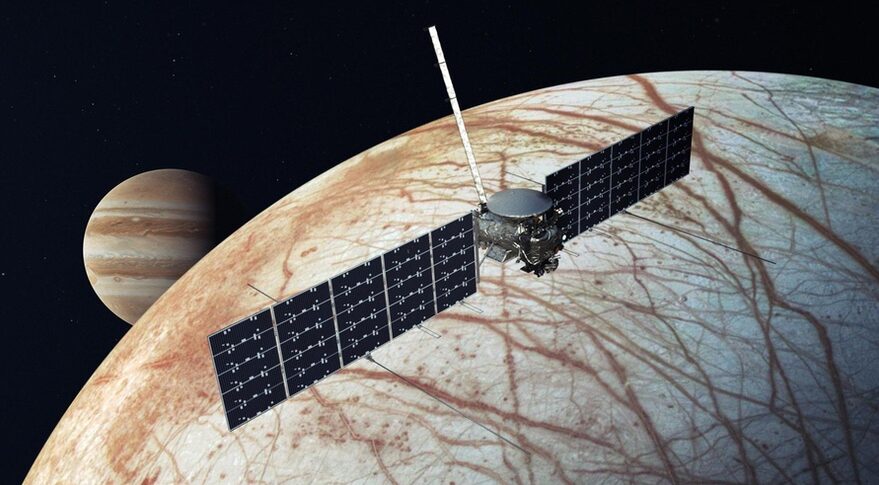 NASA's Europa Clipper will arrive at Jupiter and its icy moon Europa in 2030, five and a half years after its October 2024 launch on a Falcon Heavy. Credit: NASA/JPL-CaltechWASHINGTON — NASA has selected SpaceX’s Falcon Heavy to launch its Europa Clipper mission to a potentially habitable moon of Jupiter, a choice that appeared inevitable once NASA was no longer required to use the Space Launch System.
NASA announced July 23 that it awarded a launch services contract to SpaceX for the October 2024 launch of Europa Clipper on a Falcon Heavy rocket. The contract is valued at $178 million.
Source: https://spacenews.com/falcon-heavy-to-launch-europa-clipper/
End-run around radiation – The saga and surprise vulnerabilities of Europa Clipper
by Leonard David March 3, 2025

Europa Clipper will arrive at Jupiter in April 2030, to perform repeated close flybys of one of giant Jupiter’s enigmatic moons, Europa. Credit: NASA/JPL-Caltech
GOLDEN, Colorado — NASA’s Europa Clipper, now en route to Jupiter, departed with less-than-satisfactory and vulnerable devices that are susceptible to Jupiter’s intense radiation.
The spacecraft’s liftoff on October 14, 2024, in many ways, was arguably a fingers-crossed undertaking.
But the coincidental way that the Europa Clipper team learned about the spacecraft’s vulnerabilities and devised solutions about problems has resulted in new lessons learned for future civilian missions bound for harsh high-radiation space destinations. Those lessons learned include the degree of testing necessary, beyond simply counting on “military specification” (Mil-Spec) standards to assure hardware is radiation-resilient enough for flight.
Mil-Spec is short for “military specifications,” a set of criteria and standards promulgated by the U.S. Department of Defense and established to assure quality, reliability, and compatibility of parts used in aerospace.
Europa Clipper is to reach Jupiter in April 2030, then perform repeated close flybys of one of Jupiter’s enigmatic moons, Europa, which appears to harbors an internal ocean that may have conditions suitable for life. From the beginning of the project in 2015 through its prime mission ending in June 2034, the lifetime investment made into Europa Clipper is a cool $5.2 billion. SpaceX Falcon Heavy rocket topped by Europa Clipper spacecraft departed NASA’s Kennedy Space Center on October 14, 2024. Credit: SpaceXTiger Team traumaManaged by Caltech in Pasadena, California, NASA’s Jet Propulsion Laboratory (JPL) led the development of the Europa Clipper mission in partnership with the Johns Hopkins Applied Physics Laboratory (APL) in Laurel, Maryland.
But getting Europa Clipper off Earth and en route to its destination is a tale of last-minute hand-wringing by a quickly assembled “Tiger Team” of experts to ensure the spacecraft could carry out its mission.
Europa Clipper is hauling flawed metal-oxide-semiconductor field-effect transistors. In space-shortened electronic lingo they are called MOSFETs. They play an essential role in electronic circuits to enable applications like amplification, switching and signal processing. Roughly 1,500 n-channel MOSFETS are embedded within Europa Clipper.
JPL never would have known the MOSFETs were faulty if it wasn’t for hallway chatter at an early May 2024 gathering of specialists, when an individual from a company that does testing on behalf of the Department of Defense queried a JPL attendee as to how JPL was handling a problem.
The issue: MOSFETs were found to fail at a considerably lower radiation total dose than originally claimed by their producer.
“So probably the person who hinted it to us assumed that we knew already,” recalled Søren Madsen, a JPL veteran and chief engineer in the organization’s planetary science directorate. “We just hadn’t heard about it,” he told SpaceNews, “so it was a little bit by coincidence.”
But the revelation led to a big question, Madsen said: “I wonder whether we have a problem?”
Data analysis and modelingFinding the answer spurred a rapid-fire creation of a large Tiger Team leadership group led by Madsen, that included JPL, NASA, and APL experts.
In short order, they pulled together a full list of Europa Clipper’s parts. “We knew all of the MOSFETs that we had on the spacecraft and in instruments. We then replicated the test results that showed, yes … we had a problem,” said Jordan Evans, project manager of the Europa Clipper mission.
Curtis Chen, a Tiger Team member, said “it was definitely different than my day job,” as a JPL engineer that has worked on radars for Mars landers and is engaged in Earth-science instruments. “It was definitely an interesting challenge to try and figure out what was going on,” he told SpaceNews, and solving what was “clearly a giant problem.”
Chen became immersed in data analysis and modeling, radiation testing transistors available at JPL, as well as looking at data from the MOSFET vendor — a supplier that JPL declined to identify but which also worked with Tiger Team members to dive into the problem.
“There was not a simple, clean solution that we originally were hoping for. That didn’t turn out to be the case,” said Chen. “We had an army of people looking at circuit diagrams and running simulations just to figure out what would happen if the transistor performance wasn’t quite what we wanted it to be. Would that be okay … or no?”Survey testingTiger Team leader Madsen said within a few days in early May “we suddenly realized that we got results that we didn’t expect. In some cases, it wasn’t quite as bad as we thought. But there were also a couple of cases where it was worse than we thought,” he said.
The unidentified subcontractor of the problematic MOSFETs, while not part of the Tiger Team, was very open and constructive, said Madsen. “Obviously, we wished that we’d never had the problem in the first place.”
Making the Tiger Team task more daunting was the realization early on that the team only had about one-third of the parts in stock at JPL for testing purposes, raising questions about whether components installed on Europa Clipper would perform the same as those in storage.
“Sometimes we had the same part number. But different lot date codes would perform differently,” Madsen said, that is, some faring better with doses of radiation, others doing worse.Race to the finish lineIn the meantime, as the Tiger Team continued their testing, trouble-shooting, and deliberations, Europa Clipper was flown to the Kennedy Space Center on May 23, to undergo final preparations for its October sendoff to Jupiter atop a SpaceX Falcon Heavy Block 5.
“It was a race to the finish line,” said Madsen. Europa Clipper’s electronics are protected from Jupiter’s harsh radiation environment within a specially-designed vault. Credit: NASA/JPL-CaltechNearly all of Europa Clipper’s flight system and instrument system electronics, and other key items are enclosed in a vault with walls made of 1/3-inch thick (9.2-mm) sheets of aluminum-zinc alloy. That vault protects vulnerable circuits and other crucial components from Jupiter’s intense radiation.
“If we had to open that main vault, it would have been a huge deal,” said Madsen, explaining that they may have had to haul the spacecraft back to JPL, replace questionable MOSFETs with better ones, and redo flight qualification testing.
“Whether that means a two-year [launch window] slip, I’m not the right person to ask. But in any scenario, it would be a big deal,” Madsen observed.Mitigation stepsIn the end, the Europa Clipper Tiger Team found a way to green-light the interplanetary probe’s departure by mitigating the problem without opening the protective vault
The solution involved annealing the components, or using the spacecraft’s circuitry to heat them up during periods of low radiation exposure in order to harden them for bouts of higher radiation conditions.
The harsh radiation level is a very strong function of how close you are to Jupiter. The further the spacecraft is from Jupiter, the radiation dosage drops dramatically. So the team developed a solution of turning on parts and circuits to warm them up when they are not being irradiated, said Madsen. “By heating them up it accelerates the annealing process.” Technicians work on the main body of NASA’s Europa Clipper in the Spacecraft Assembly Facility at NASA’s Jet Propulsion Laboratory. Credit: NASA/JPL-CaltechThat turn it on, turn it off strategy was evaluated on Europa Clipper circuitry replicated for ground tests under irradiated conditions. About 200 unique circuits were analyzed. But a handful of those, concluded mitigation team members, would not make it without help, Madsen advised. It was determined that Europa Clipper could deliver the extra power, he said, to selectively heat circuitry when required, and with ample margin to aid the annealing process.
“We ended up with really good decision criteria that everybody respected. We didn’t have any dissent,” said Madsen, who on March 21 will be awarded the National Space club & Foundation’s Norman L. Baker Astronautics Engineer Award for his technical leadership of the Europa Clipper MOSFET tiger team.Go to proceedThe appraisal of the MOSFET radiation hardness risk (and associated nail-biting) was wrapped up toward the end of August.
JPL Europa Clipper mission and Tiger Team leadership reviewed their work with NASA officials on August 27. There was unanimous agreement that the risk to the planned science to be performed by the spacecraft was acceptably low. The green light to proceed with launch preparations was given.
As for lessons learned, Madsen rolls out his soap box. “We have found out that Mil-Spec standard testing is not well-suited for civilian satellites,” he said.
Similar in view is Evans, JPL project manager of the Europa Clipper mission.
In order to meet Mil-Spec requirements, MOSFET wafers are manufactured, cut in pieces to produce MOSFET packages, said Evans They are given a high dose rate of radiation and sit for 100 hours at room temperature, and then okayed for use.
“That is the Mil-Spec,” said Evans.
“In our case, we ordered them out of the catalog based on qualified wafers,” Evans added. “Now that we understand that there are ways the wafers can degrade over time, doing missions like ours, going to Jupiter with an intense radiation environment, we have to rethink whether we should buy those parts that are Mil-Standard.” They don’t meet the team’s needs after being packaging and sitting on a shelf for a while, Evans explained.
Evans said that Europa Clipper’s circuits can tolerate more than Mil-Spec. “We went through circuit by circuit. That’s how we found our way through this.”
The takeaway message from Evans: “If you feel you have a vulnerability to the Mil-Spec method of qualification, look at doing additional testing of those parts to see if they meet your environmental requirements and the circuits that you’ll be using them in.”
And once Europa Clipper is on duty at Jupiter, “I have every reason to believe that we will have a healthy spacecraft at the end of the prime mission,” Evans said.
Meanwhile, Europa Clipper is on track for a March 1 flyby above the surface of Mars for a gravity assist toward Jupiter, during which the team will get to test several of its instruments — then the long haul to Jupiter is ahead.Editor’s note (March 4, 2025): This article has been updated to reflect the correct cost of Europa Clipper. The article originally cited the $5.2 billion investment in Europa Clipper as the cost from launch through the end of its prime mission, not the lifetime cost.
https://spacenews.com/end-run-around-radiation-the-saga-and-surprise-vulnerabilities-of-europa-clipper/
 Wątek: Artykuły o Europa Clipper (Przeczytany 1739 razy)