Autor Wątek: [ESA] Parastronaut feasibility project  (Przeczytany 3322 razy)

0 użytkowników i 1 Gość przegląda ten wątek.

Offline Orionid

  • Weteran
  • *****
  • Wiadomości: 29405
  • Very easy - Harrison Schmitt
[ESA] Parastronaut feasibility project
« dnia: Lutego 23, 2021, 00:36 »
Parastronaut feasibility project


Astronaut selection: parastronaut feasibility project

In a first for ESA and human spaceflight worldwide, ESA is looking for individual(s) who are psychologically, cognitively, technically and professionally qualified to be an astronaut, but have a physical disability that would normally prevent them from being selected due to the requirements imposed by the use of current space hardware.

ESA is ready to invest in defining the necessary adaptations of space hardware in an effort to enable these otherwise excellently qualified professionals to serve as crew members on a safe and useful space mission.

There are many unknowns ahead of us, the only promise we can make today is one of a serious, dedicated and honest attempt to clear the path to space for an astronaut with disability.

In parallel to the selection of astronauts with disabilities we are launching a study to work internally, with our international partners and with crew vehicle providers to identify potential adaptations to eventually enable an astronaut with disability to fly to space.

This project will open an opportunity of flight for one or more individuals. Along the way, it will bring innovations and other benefits to the safety and efficiency of future crews.

The power of inclusion

Because we believe that exploration is the matter of a collective effort, we need to extend the pool of talents we can rely on in order to continue progressing in our endeavour. One effective way of doing this is to include more gifted people of different genders, ages and backgrounds, but also people with special needs, people living with physical disabilities.

Right now we are at step zero. The door is closed to persons with disabilities. With this pilot project we have the ambition to open this door and make a leap, to go from zero to one.

Two aspects are critical to us: the mission should be as safe, and as useful, as any other mission of any other professional astronaut.

Because physical disabilities have up until now been avoided in space, we had to start from somewhere. To do this, we looked to the expertise of the International Paralympics Committee and used the table they have developed to categorise the different kinds and degrees of impairments – especially the list of eligible impairments.

We have then done a very simple thing: we have assessed each category against our own expertise and knowledge of the prerequisites to the tasks of a safe and useful space mission. We have then given three types of marks:

1)    Red: when the kind and degree of disability was not or not safely compatible with the task.
2)    Green: when the kind and degree of disability can be compatible with the task.
3)    Yellow: when the kind and degree of disability could become fully compatible with the task with some adjustments, modifications or innovations.

As part of the parastronaut feasibility project, our staff are further assessing what is needed to ensure a nominal level of individual and collective safety for such a mission. With this project we will do everything to foster these changes in cooperation with spaceflight providers and international partners.

What needs to happen for an astronaut with a physical disability to fly?

Concretely, we have started a project with the task to shed light on the many unknowns and clarify the prerequisites for a safe and useful space mission of an astronaut with disabilities. We have several tools for this: technical studies, space simulations, analogue missions, and discussions with international partners and spaceflight providers.

When these prerequisites are clarified, and when adaptations, and maybe innovations have been implemented, we hope to pave the way to allow these astronaut(s) to fly.

We know there are many unknowns in this endeavour. At this time, we also do not know if we can identify answers to all of the questions. However, it takes courage to start, to make the first step, and that is what we are doing today.

What kind and degree of disability is being considered through the parastronaut feasibility project?

The pilot aspect of this project means that we start by opening a vacancy notice for people with all qualifications for the astronaut job and the following disabilities:

- Persons who have a lower limb deficiency (e.g. due to amputation or congenital limb deficiency) as follows:

      - single or double foot deficiency through ankle (lisfranc amputation)

      - single or double leg deficiency below the knee

 - Persons who have a leg length difference (missing or shortened limbs at birth or as a result of trauma)

 - Persons of short stature (<130 cm)

Is ESA considering mental disability?

For the parastronaut feasibility project ESA is looking for individual(s) who are psychologically, cognitively, technically and professionally qualified to be an astronaut.

Why is ESA intending to select and fly an astronaut with physical disabilities?

Inclusiveness: if there is one thing we have learned by working on the International Space Station (ISS), it is that there is great value in diversity. Including people with special needs also means benefiting from their extraordinary experience, ability to adapt to difficult environments, and point of view.

Responsibility: we have the strong conviction that there is a way to enable this level of inclusiveness in the astronaut corps, and in space, and that calls to our responsibility to at the very least, try it.

Leading by example: it is our hope to push the envelope on the topic of disability at work, and inspire people with special needs to apply to other jobs at ESA and in the space sector.

Learning from our differences: our astronauts perform a large number of life science experiments in space, and having people with disabilities carry out such experiments could bring some new, astonishing results in the field of life sciences for the benefit of even more people back on Earth.

Why now?

In the decade since the last selection of ESA Astronauts in 2008-09, the expectations of society towards diversity and inclusivity have changed. The high cost of the human spaceflight programme (which is funded by European taxpayers) means that ESA cannot and does not want to ignore these changes. Fair representation of all parts of society is a high focus of action for governments, institutions and business alike. This is visible in the space sector and strongly expressed by national delegations to ESA. ESA needs and wants to embrace change in order to remain relevant and accessible, especially to younger generations.

Is a flight guaranteed?

ESA is not in the position today to guarantee a flight for the selected individual(s). Very much like any exploration journey, the answer is not written at the back of any book but we can commit to trying as hard and seriously as we can.

ESA has already initiated a special project aimed at speaking with spaceflight providers and international partners to analyse the measures that must be taken to clear the path and include the person(s) to be selected to fly, not as simple tourists, but as fully-fledged crew members of a space mission. Clearing the path in collaboration with international institutional and commercial partners will also likely foster a great deal of innovation in the field of procedures and technology for human spaceflight training, launch, on-board activities and landing.

Lastly, it stands to reason that having qualified individuals who we would like to fly will place a much higher relevance to our attempts to clear the eventual way for a person with disabilities to do so.

How will ESA ensure safety during training, launch, on-board and landing?

ESA will work with the providers and international partners to ensure that all safety requirements are met, either by adapting hardware or developing specific operational procedures.

What technical adaptations will be required?

This is a valid question that the parastronaut feasibility project will aim to answer.

Why are the other partners not inviting people with disability to become an astronaut?

Again here, as ever when doing something for the first time, there is no guarantee of success. We are prepared for a difficult project, with many unknowns but we are truly convinced of the value for ESA and society as a whole. The Agency is therefore committed to do its utmost to convince its partners and stakeholders.

What is the cost of the parastronaut selection and the mission of the selected person(s)?

It is clear that for this very innovative project not all expertise is available within ESA. ESA will have to work with experts in the field. At this point, it is difficult to estimate the amount of resources required. However, in view of the need to adequately engage with multiple stakeholders and the project duration, ESA will commit an initial budget of 1M€.


Source: https://www.esa.int/About_Us/Careers_at_ESA/ESA_Astronaut_Selection/Parastronaut_feasibility_project

Offline Orionid

  • Weteran
  • *****
  • Wiadomości: 29405
  • Very easy - Harrison Schmitt
Odp: [ESA] Parastronaut feasibility project
« Odpowiedź #1 dnia: Maja 04, 2023, 21:59 »
Disabled man joins European Space Agency's astronaut programme
23 November 2022 By Jonathan Amos, BBC Science Correspondent, Paris

A disabled British man has been chosen for astronaut training by Europe's space agency, a world first.

John McFall, 41, joined 16 men and women selected for the European Space Agency's (Esa) first new class of astronauts in 13 years.

His right leg was amputated after a motorcycle crash when he was 19. He became a professional athlete and represented Team GB at the Paralympics.
https://www.bbc.com/news/science-environment-63730022

Riding the 'vomit comet' with first disabled astronaut John McFall
April 28 2023 By Rebecca Morelle Science Editor, BBC News
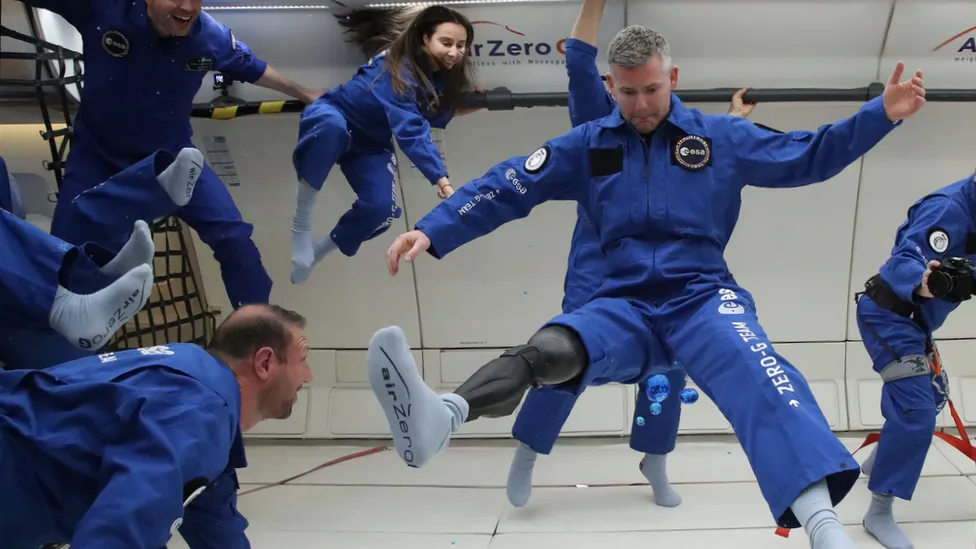

John is investigating how his disability could affect life and work in space

John McFall is the European Space Agency's first ever para-astronaut, selected to study how feasible it is for someone with a physical disability to live and work in space. BBC News joined him on board a parabolic flight, where he experienced weightlessness for the first time.

One minute John McFall is lying on the floor of a plane. The next, he starts to float upwards, still horizontal, seemingly levitating towards the ceiling.
https://www.bbc.com/news/science-environment-65380263

https://twitter.com/esa/status/1628763630203293698
https://twitter.com/ESA_fr/status/1764548849912119619
https://twitter.com/Astro_Alex/status/1671910648937336832
« Ostatnia zmiana: Kwietnia 30, 2024, 23:17 wysłana przez Orionid »

Offline Orionid

  • Weteran
  • *****
  • Wiadomości: 29405
  • Very easy - Harrison Schmitt
Odp: [ESA] Parastronaut feasibility project
« Odpowiedź #2 dnia: Maja 10, 2024, 13:54 »
John McFall: Para-astronaut on a mission to open up space
May 09 , 2024 By Rebecca Morelle and Alison Francis , BBC News Science


Every trainee astronaut has to take a spin in a giant centrifuge

Former Paralympian John McFall is working with the European Space Agency on a ground-breaking study to see if it's feasible for someone with a physical disability to live and work in space. BBC News has been following his progress as he undergoes astronaut training.

It's a test that any budding astronaut has to go through. But it's not for the fainthearted - or the claustrophobic.

With a clang, the door slams shut, enclosing John McFall in the darkness of a coffin-sized metal box.

The spinning begins.

He's in a giant centrifuge, being whizzed around and around, to mimic the extreme gravitational forces of a rocket launch - and the even more extreme G-Forces of coming back down.

"The faster it spins, the higher the G load," John explains.

"And today we're going to be going up to about 6 Gs - so six times the force of gravity. It replicates what it would be like during re-entry into the atmosphere in a Soyuz capsule."


The machine mimics the extreme gravity astronauts would feel during lift off re-entry

The test is part of John's training programme with the European Space Agency.

In 2022 he was selected as their first astronaut candidate with a physical disability, to work on a ground-breaking study to see if he could go to space safely.

John's an amputee, he lost the lower part of his right leg in a motorcycle accident when he was 19.

He usually wears a hi-tech prosthesis. But he's taken it off to test the effects of the centrifuge on his upper-leg.

ESA flight surgeon Maybritt Kuypers is monitoring him.

"It's the first time we have had an amputee in the centrifuge," she explains.

"The astronaut is basically lying on their back in a sort of seated position, so this influences the blood flow - also in the leg. We were curious to see how that would affect him, but it went really well."


John wears a special blade for running

John's paused his career as an orthopaedic surgeon to take a leap into the unknown of astronaut training.

He's moved from the UK to the European Astronaut Centre in Cologne, Germany.

He isn't guaranteed a space flight, but this study will see what needs adapting to make it possible - the spacecraft, spacesuits or his various prosthetic legs.

Today he's assessing his running blade.


John McFall won bronze at 2008's Paralympic Games in China

Sport is a big part of his life, John's a former medal-winning Paralympic sprinter. And keeping fit in space is crucial to maintain muscle mass and bone density.

John's using a special anti-gravity treadmill, which recreates the weightless conditions on the International Space Station (ISS). A pocket of air lifts him slightly, artificially making him lighter.

He explains how his body weight pushes his blade into the ground, compressing it so it bounces back up again to give him a natural spring to propel him forward.

But the treadmill lightens him to about 80% of his body weight, so his blade doesn't work as well.

"I notice that the blade is too stiff," he explains. "That's because I'm lighter and putting less force into the blade, so it's bending less, and therefore giving me less spring back."

He thinks he'd need a bendier blade - but there's more.


A parabolic flight gave John the chance to see how his prosthetic leg would fare

On a parabolic flight last year, where John experienced weightlessness for the first time, he found his day-to-day, hi-tech, microprocessor prosthetic leg would need recalibrating.

In fact, John thinks he might need several prosthetic legs on the ISS.

"There would be a prosthesis for running, a back up for the microprocessor prosthesis, and then there's the mechanical one, which will probably need to be worn inside the spacesuit for launch and return," he explains.

"I'll need a bit of a wardrobe of prosthetic hardware."

ESA is the first space agency to carry out a project like this.

Until now, John's disability would have prevented him from becoming an astronaut. But Frank De Winne, the head of the European Astronaut Centre, wants to change that.

"We think this is a great opportunity because we have so many great talents - people that have a disability, like we see with John," he says.


John's family has moved to Germany for the study

"Why should we not try to harvest this talent for great missions like astronaut missions?"

The move to Germany is a big change for his wife Sonia, a former Olympic gymnast, and their three young children Fin, Isla and Immy.

Around the dinner table, they talk about their dad's new job. Their friends think it's "cool". Fin can't believe his dad has swapped being a doctor for a job where he might be sent "into the big black void" of space.

Sonia says John's new career is 100% right for him.

"It's a big thing in our family that you go for every opportunity," she says. "And for me, this was an opportunity and he's gone and taken it. I hope he gets the reward for it, which is eventually going to space and showing people that it's possible."

The World's First Para-astronaut

From a taste of space on a parabolic flight to taking a spin in a giant centrifuge, follow ESA astronaut John McFall as he studies whether it's possible for someone with a disability to go into space.

Back at the centrifuge, it slows to a stop and the door clangs open. John gives a thumbs up.

"It was brilliant," he says with a grin.

"And do you know what? I didn't actually notice my right leg at all throughout the whole thing. It was probably the most comfortable part of me throughout the whole process. And that's really good to know for this flight study."

John's about halfway through the project and so far hasn't found anything that would stand in the way of a mission.

And every taste of space is confirming to John he's made the right choice, because this could change people's perceptions.

"I like to think that it will broaden their horizons and their knowledge of what someone with a physical disability is capable of," he says.

"But I also hope that they see me as just John. Because I am just John and I want to be an astronaut and I happen to have a physical disability. This is the message that we're trying to deliver."

https://www.bbc.com/news/science-environment-68939004
« Ostatnia zmiana: Maja 12, 2024, 00:27 wysłana przez Orionid »

Polskie Forum Astronautyczne

Odp: [ESA] Parastronaut feasibility project
« Odpowiedź #2 dnia: Maja 10, 2024, 13:54 »