Kolejny GOES 01.03. o 21:38 z Cape Canaveral wystartowała RN Atlas-5/541. Wyniosła ona na orbitę o parametrach: hp=8876 km,
ha=35278 km, i=9,416° satelitę GOES-T (GOES-18).
http://lk.astronautilus.pl/n220301.htm#01
 Atlas V launches GOES-Thttps://twitter.com/ulalaunch/status/1498781715552251909https://www.ulalaunch.com/missions/next-launch/atlas-v-goes-t
ROCKET: Atlas 5 (AV-095)
MISSION: GOES-T
PAYLOAD: GOES-T weather satellite for NOAA and NASA
LAUNCH SITE: SLC-41, Cape Canaveral Space Force Station, Florida
LAUNCH DATE: March 1, 2022
LAUNCH WINDOW: 4:38-6:38 p.m. EST (2138-2338)
WEATHER FORECAST: 80% chance of acceptable weather; Primary concerns are cumulus clouds and liftoff winds
BOOSTER RECOVERY: None
LAUNCH AZIMUTH: East
TARGET ORBIT: Apogee of 21,925 miles (35,286 kilometers); Perigee of 5,515 miles (8,876 kilometers); Inclination of 9.4 degrees
LAUNCH TIMELINE:T-00:00:02.7: RD-180 ignition
T+00:00:01.0: Liftoff
T+00:00:05.3: Begin pitch/yaw maneuver
T+00:00:35.3: Mach 1
T+00:00:48.0: Maximum aerodynamic pressure (Max-Q)
T+00:01:50.7: Solid rocket booster jettison
T+00:03:30.2: Payload fairing jettison
T+00:04:22.8: Atlas booster engine cutoff (BECO)
T+00:04:28.8: Atlas/Centaur stage separation
T+00:04:38.7: Centaur first main engine start (MES-1)
T+00:12:05.6: Centaur first main engine cutoff (MECO-1)
T+00:23:39.1: Centaur second main engine start (MES-2)
T+00:28:14.3: Centaur second main engine cutoff (MECO-2)
T+03:28:28.4: Centaur third main engine start (MES-3)
T+03:30:07.3: Centaur third main engine cutoff (MECO-3)
T+03:32:56.3: GOES-T spacecraft separation
MISSION STATS:674th launch for Atlas program since 1957
375th Atlas launch from Cape Canaveral
263rd mission of a Centaur upper stage
240th use of Centaur by an Atlas rocket
509th production RL10 engine to be launched
39th RL10C-1 engine launched
98th flight of an RD-180 main engine
92nd launch of an Atlas 5 since 2002
22nd NASA use of an Atlas 5
3rd NOAA weather satellite launched on an Atlas 5
10th-13th GEM-63 solid rocket boosters flown
76th launch of an Atlas 5 from Cape Canaveral
2nd Atlas 5 launch of 2022
134th Evolved Expendable Launch Vehicle flight
149th United Launch Alliance flight overall
84th Atlas 5 under United Launch Alliance
107th United Launch Alliance flight from Cape Canaveral
34th 500-series flight of the Atlas 5
8th Atlas 5 to fly in the 541 configuration
103rd launch from Complex 41
76th Atlas 5 to use Complex 41
9th orbital launch overall from Cape Canaveral in 2022
https://spaceflightnow.com/2022/03/01/atlas-5-av-095-goes-t-mission-status-center/Next GOES weather satellite installed atop Atlas 5 rocketFebruary 19, 2022 Stephen Clark
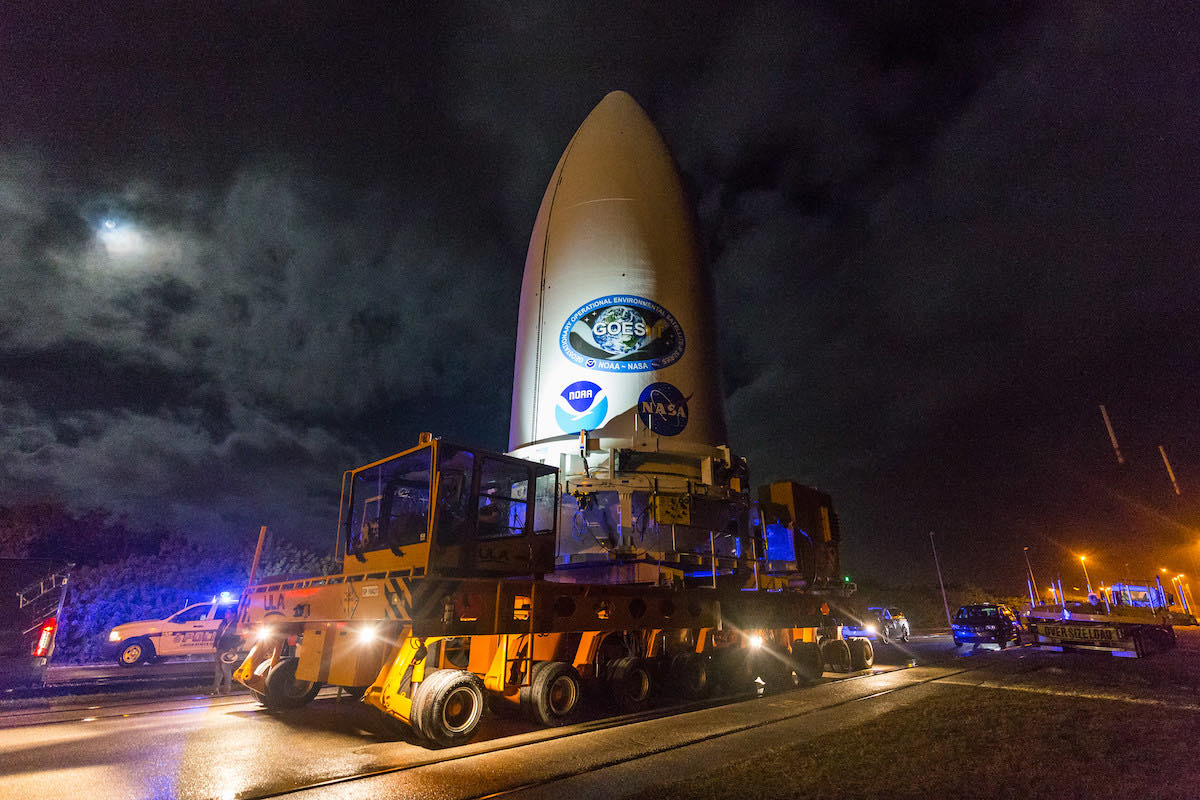 NOAA’s GOES-T weather satellite, encapsulated inside its payload shroud, was transferred to ULA’s Vertical Integration Facility on Thursday for lifting atop an Atlas 5 rocket. Credit: United Launch Alliance
(...) NOAA’s Geostationary Operational Environmental Satellites take regularly-updated images of clouds and storm systems, providing real-time views of tropical cyclones and severe weather. The first GOES satellite launched in 1975, and NOAA maintains two operational GOES spacecraft — one covering the Pacific and Western United States, and another over the East Coast, the Caribbean, and the Atlantic Ocean.
NOAA’s weather satellites in polar orbit gather data for medium and long-term forecasts. (...)
https://spaceflightnow.com/2022/02/19/next-goes-weather-satellite-installed-atop-atlas-5-rocket/Atlas 5 rocket rolls to launch pad with weather satelliteFebruary 28, 2022 Stephen Clark
United Launch Alliance rolled out an Atlas 5 rocket to its launch pad at Cape Canaveral on Monday, moving the launcher into position for liftoff Tuesday afternoon with a NOAA weather satellite destined to cover the Western United States and the Pacific Ocean.
The move began at 10:16 a.m. EST (1516 GMT) with the emergence of the Atlas 5 from its Vertical Integration Facility at Cape Canaveral Space Force Station. (...)
https://spaceflightnow.com/2022/02/28/atlas-5-goes-t-rollout/NOAA weather satellite ready for launch after repairs to main cameraFebruary 28, 2022 Stephen Clark
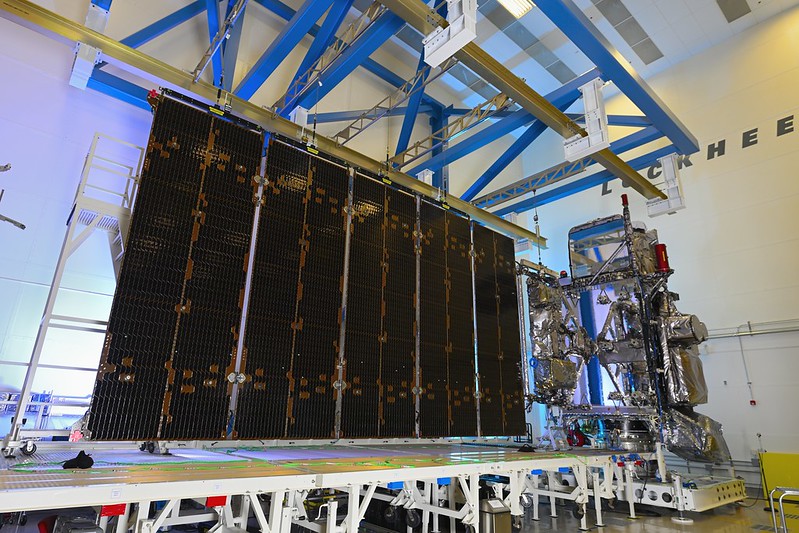 The GOES-T weather satellite undergoes a solar array deployment test. Credit: Lockheed Martin
(...) The GOES-T satellite will launch with modifications to its main imaging camera, changes designed to avoid a minor cooling system problem that afflicted NOAA’s previous geostationary weather monitor sent into space four years ago. (...)
https://spaceflightnow.com/2022/02/28/noaa-weather-satellite-ready-for-launch-after-repairs-to-main-camera/Atlas 5 launches GOES-T weather satelliteby Jeff Foust — March 1, 2022
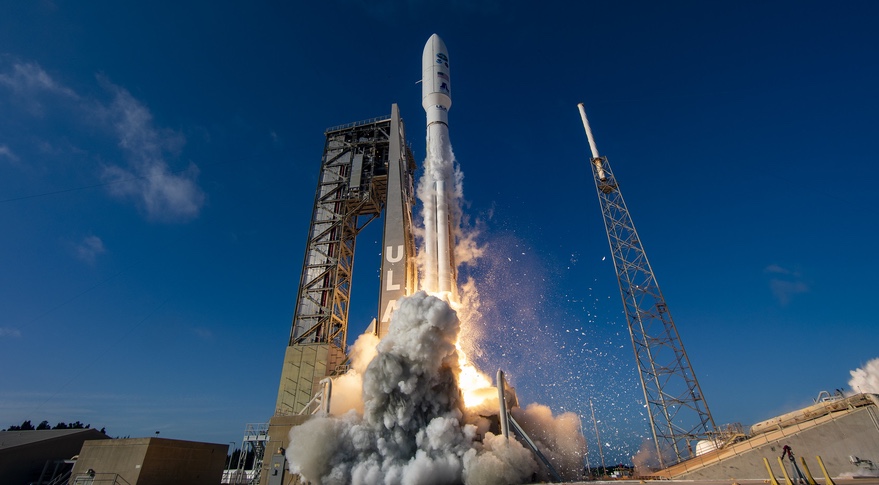 An Atlas 5 541 lifts off March 1 carrying the GOES-T weather satellite. Credit: ULA
(...) The Centaur performed three burns to place the spacecraft in a transfer orbit with a higher perigee, in this case nearly 8,900 kilometers, than a typical geostationary transfer orbit. That is intended to shorten the time and reduce the propellant needed to reach geostationary orbit. (...)
The spacecraft, which the National Oceanic and Atmospheric Administration will rename GOES-18, will initially be checked out at 89.5 degrees west in GEO. The spacecraft will then drift to 136.8 degrees west, the GOES-West slot, by August for final testing. It will take over as the operational GOES-West satellite in early January of 2023, said Candace Carlisle, flight project manager for the GOES-R series of satellites at NASA’s Goddard Space Flight Center, during a Feb. 25 briefing.
GOES-18 will take over for GOES-17, which launched as GOES-S on an Atlas 5 exactly four years ago. (...)
The fourth, GOES-U, is scheduled to launch in 2024 on a SpaceX Falcon Heavy. (...)
https://spacenews.com/atlas-5-launches-goes-t-weather-satellite/https://spacenews.com/goes-t-nears-launch-as-nasa-plans-studies-of-next-generation-weather-satellite/ULA’s Mighty Atlas Launches Long-Delayed GOES-T Geostationary Earth-Watcherby Ben Evans March 1, 2022
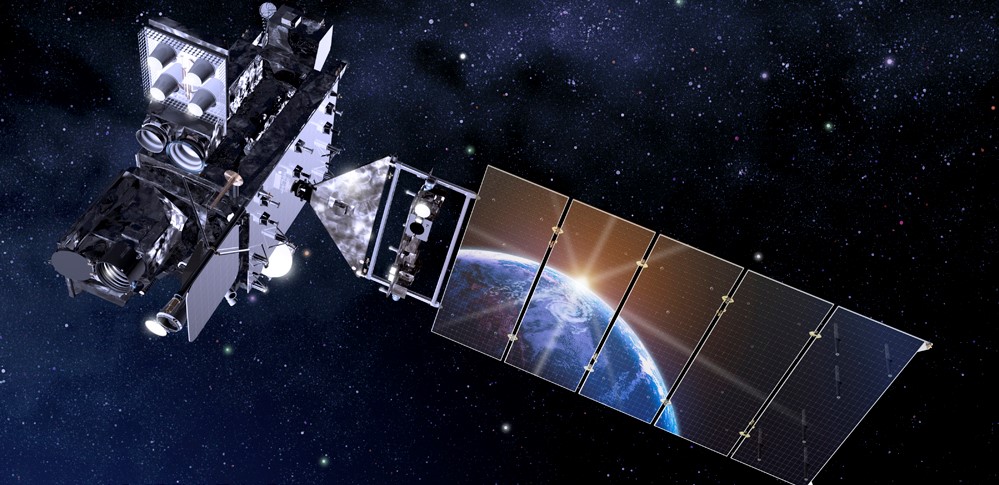 Artist’s concept of GOES-T as it will appear fully deployed in orbit. Image Credit: NASA
(...) Operated by the National Oceanic and Atmospheric Administration’s (NOAA) National Environmental Satellite, Data and Information Service (NESDIS), the multi-spacecraft GOES network is responsible for weather forecasting, storm tracking and meteorological research from geostationary orbit. It became customary for each satellite to be alphabetically identified before launch and renamed with a number after entering service. As such, GOES-T will be redesignated “GOES-18” when it commences operations.(...)
Contracts to fabricate instruments for this latest incarnation of GOES were awarded back in 2006 and Lockheed Martin was selected by NASA in December 2008 to build and integrate an initial pair of spacecraft, each with an option for one additional spacecraft, at an total cost (including exercised options) of $1.09 billion. Those spacecraft—GOES-R and GOES-S—were launched atop ULA Atlas V boosters in November 2016 and March 2018. (...)
https://www.americaspace.com/2022/03/01/ulas-mighty-atlas-launches-long-delayed-goes-t-geostationary-earth-watcher/GOES-T weather satellite resumes orbit-raising after minor snagMarch 10, 2022 Stephen Clark
A new NOAA weather satellite that launched from Cape Canaveral last week has resumed orbit-raising after the spacecraft aborted its first major post-launch maneuver, moving toward its operational geostationary orbit more than 22,000 miles over the equator.
The GOES-T weather satellite’s main engine was supposed to complete the first in a series of orbit-raising burns March 3, but NOAA said the maneuver cut off prematurely. John Leslie, a NOAA spokesperson, said the spacecraft automatically shut down the engine.
A temperature sensor in the satellites liquid apogee engine was set with an incorrect threshold, Leslie said.
GOES-T is the third in a series of four spacecraft in NOAA’s current generation of weather-monitoring satellites in geostationary orbit. NOAA’s fleet of Geostationary Operational Environmental Satellites, or GOES program, tracks hurricanes, severe storms, wildfires, dust storms, and other weather events in real-time, giving forecasters a minute-by-minute glimpse of evolving conditions. (...)
https://spaceflightnow.com/2022/03/10/goes-t-resumes-orbit-raising-after-minor-snag/https://www.nasa.gov/subject/14118/goest/https://blogs.nasa.gov/kennedy/2022/03/01/goes-t-separates-from-rocket-continues-on-journey-to-save-lives/https://spectrumlocalnews.com/nc/triad/weather/2022/02/24/goes-t-weather-satellite-scheduled-for-launch-march-1https://www.washingtonpost.com/weather/2022/03/01/nasa-noaa-weather-satellite-launch/https://www.nasaspaceflight.com/2022/03/goes-t-launch/https://www.nesdis.noaa.gov/current-satellite-missions/goes-18-launchhttps://en.wikipedia.org/wiki/GOES-18https://space.skyrocket.de/doc_sdat/goes-r.htmEDIT 02.03.23
https://twitter.com/NASA_LSP/status/1630933283046404097
 Wątek: Starty rakiet (I kwartał 2022 roku) (Przeczytany 38320 razy)