Design flaw blamed for failed debut of South Korea’s new satellite launcherby Park Si-soo — January 3, 2022 [SN]
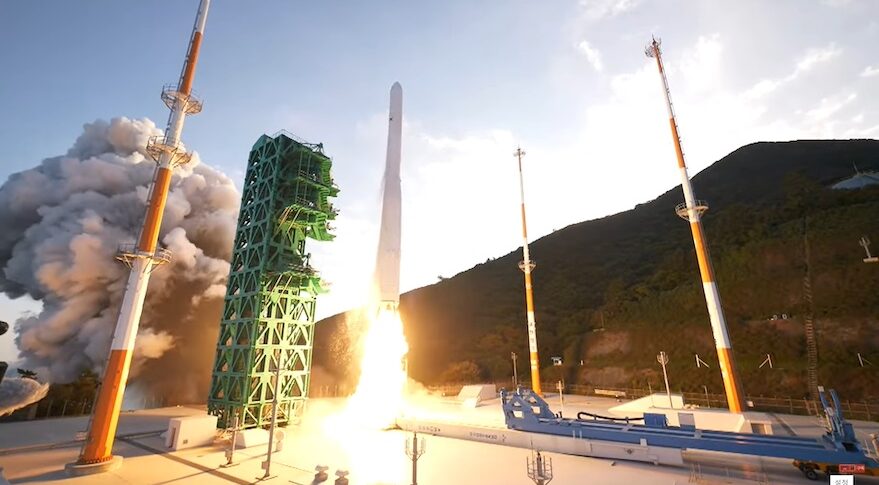 KSLV-2 blasts off from the launchpad at Naro Space Center in Goheung, Oct. 21, 2021. Credit: Korea Aerospace Research Institute
SEOUL, South Korea — The failed October debut of South Korea’s KSLV-2 rocket is being blamed on improperly anchored helium tanks inside the three-stage rocket’s upper stage.
The kerosene and liquid oxygen-fueled KSLV-2, South Korea’s first entirely domestic rocket, performed well during the early phases of the Oct. 21 test flight but released its dummy payload into an unsustainable orbit when its upper-stage engine shut down 46 seconds early.
https://spacenews.com/design-flaw-blamed-for-failed-debut-of-south-koreas-new-satellite-launcher/India’s space program looks to bounce backby Jeff Foust — January 4, 2022 [SN]
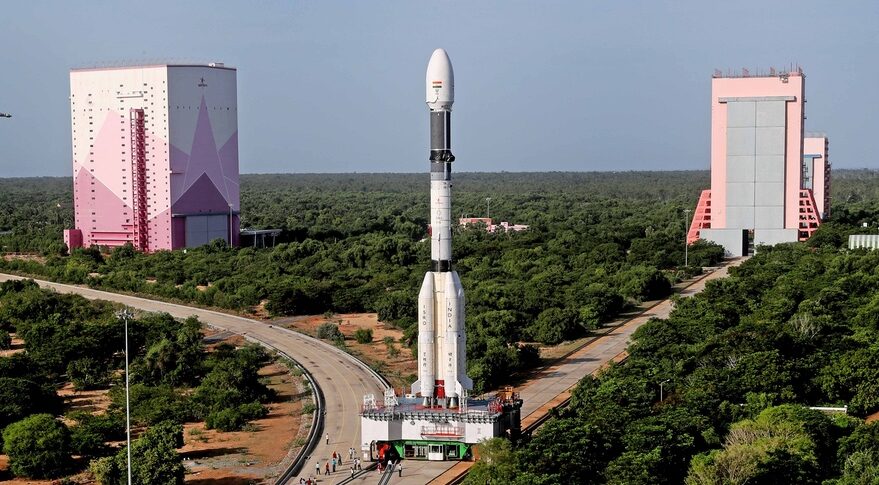 India conducted only two launches in 2021, including one of its GSLV rocket (above) that failed to reach orbit because of an upper stage malfunction. Credit: ISRO
WASHINGTON — After a year marked by little launch activity and one high-profile failure, the head of India’s space program says he expects much more in 2022, including an uncrewed test flight for its human spaceflight program.
In a New Year’s message published Jan. 3, K. Sivan, chairman of the Indian space agency ISRO, acknowledged that 2021 was something of a lost year for the agency but expressed optimism for the coming year.
https://spacenews.com/indias-space-program-looks-to-bounce-back/Japan’s H3 rocket further delayed by engine woesby Ayano Akiyama and Brian Berger — January 24, 2022 [SN]
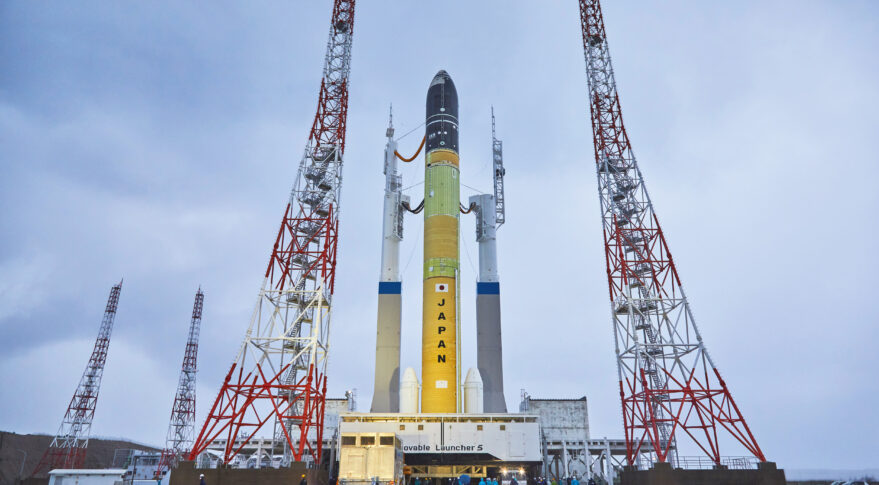 JAXA conducted a wet dress rehearsal at the Tanegashima Space Center in March 2021. Credit: JAXA
TOKYO — The launch of Japan’s new workhorse H3 rocket has been postponed again as engineers continue to wrestle with engine problems first uncovered in 2020 during qualification testing.
After spending most of 2020 and all of 2021 struggling with the expendable H3’s novel LE-9 main engine, officials with the Japan Aerospace Exploration Agency (JAXA) told reporters last week that the H3 will not be ready to launch by the end of March as previously hoped.
https://spacenews.com/japans-h3-rocket-further-delayed-by-engine-woes/Japan’s ArkEdge Space closes $18.7 million Series A for nanosatellite projectsby Park Si-soo — April 5, 2022 [SN]
 The ArkEdge Space team poses for a photo. The Tokyo startup aims to build a multi-functional nanosatellite constellation by 2025. Credit: ArkEdge Space
SEOUL, South Korea — Japanese startup ArkEdge Space has raised $18.7 million since this year to continue developing nanosatellite technologies needed for building an Earth-to-moon communication system and a multi-functional smallsat constellation.
The Tokyo-based company, which raised $13.5 million in January, said March 29 that it raised an additional $5.2 million to close a Series A round. Including a March 2021 seed round, the company has raised $22 million. Investors include Incubate Fund, Real Tech Fund, Mitsui Sumitomo Insurance Capital, SPARX Innovation for Future Corporation, and Pavilion Capital PTE.
https://spacenews.com/japans-arkedge-space-closes-18-7-million-series-a-for-nanosatellite-projects/Sony putting camera in orbit for shutterbugs, not scientistsby Park Si-soo — January 19, 2022 [SN]
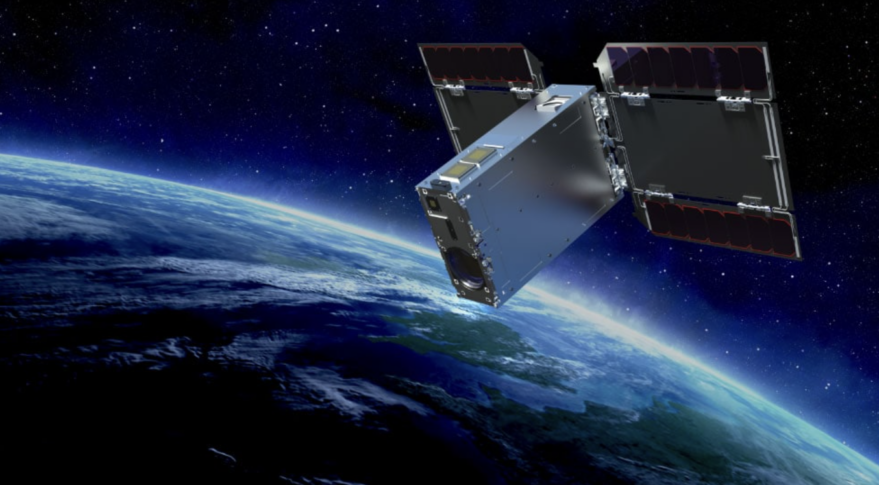 Artist’s concept of the 6U cubesat Sony is building to house one of its full-frame cameras. The cubesat is scheduled to launch to LEO between October and December. Credit: Sony
SEOUL, South Korea — Sony plans to launch a six-unit cubesat with a full-frame camera later this year as part of its Star Sphere project that seeks collaboration with artists, entertainers and educators.
The Japanese tech giant built the satellite — whose mockup was exhibited during CES 2022 in Las Vegas earlier this month — in cooperation with the University of Tokyo and the Japan Aerospace Exploration Agency (JAXA). While Sony developed the spacecraft’s key components, operating system and built-in camera, the university and JAXA provided a satellite bus and technical advice, respectively.
https://spacenews.com/sony-putting-camera-in-orbit-for-shutterbugs-not-scientists/PSN orders Indonesia-focused satellite from Boeing for 2023 launchby Jason Rainbow — March 23, 2022 [SN]
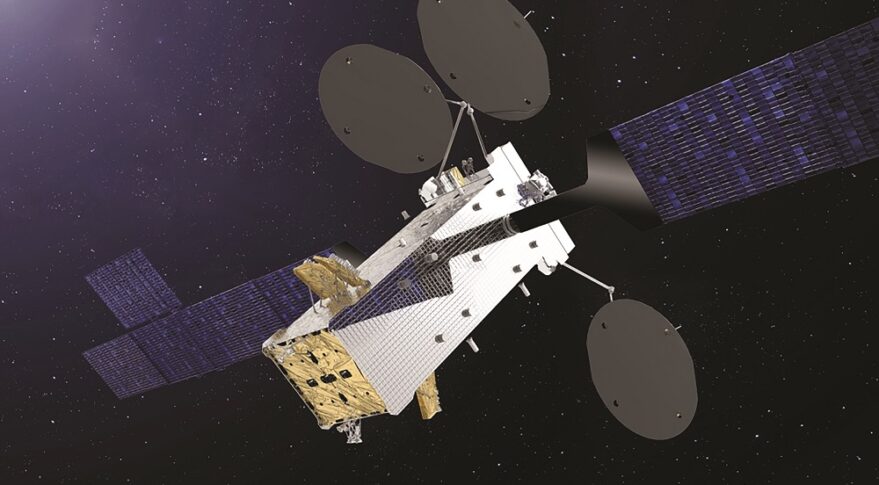 Indonesia said in 2021 it has secured $545 million in partially ECA-backed funding for the SATRIA broadband satellite. Credit: Thales Alenia Space
WASHINGTON — Indonesia’s Pasifik Satelit Nusantara (PSN) said March 23 it has ordered a high-throughput satellite from Boeing to launch on a SpaceX Falcon 9 in 2023.
The Nusantara Lima Satellite aims to deliver 160 gigabits per second (Gbps) of capacity across the Indonesian archipelago and surrounding countries.
PSN said the satellite will augment capacity on the SATRIA-1 satellite Thales Alenia Space is building for a launch in 2023, which together would make it one of the biggest satellite capacity providers in Asia.
https://spacenews.com/psn-orders-indonesia-focused-satellite-from-boeing-for-2023-launch/US, India agree to cooperate on space situational awarenessby Park Si-soo — April 12, 2022 [SN]
 U.S. Defense Secretary Lloyd Austin, right, and Secretary of State Tony Blinken, second from right, stand with their Indian counterparts in a joint press conference held after their April 11 joint meeting in Washington in this image captured from YouTube.
SEOUL, South Korea — The United States and India have agreed to cooperate on space situational awareness, a deal that the U.S. Department of Defense said would “lay the groundwork for more advanced cooperation in space.”
https://spacenews.com/us-india-agree-to-cooperate-on-space-situational-awareness/South Korea’s Innospace schedules December test launch carrying Brazilian military payloadby Park Si-soo — May 3, 2022 [SN]
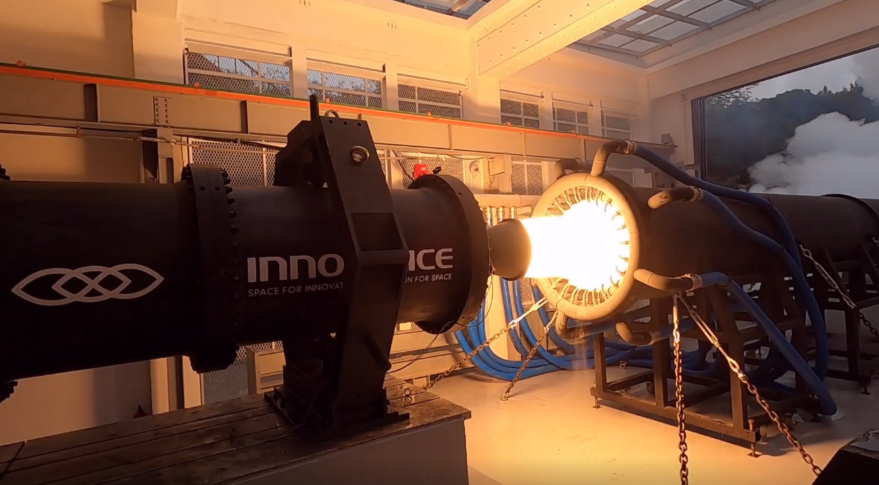 Caption: Innospace’s 15-ton-thrust hybrid engine undergoes a hot-fire test at its test facility in Geumsan, South Korea. Credit: Innospace
SEOUL, South Korea — South Korean rocket startup Innospace announced May 3 that it will conduct its first suborbital test launch of flight hardware in December from the Alcântara Space Center in Brazil, carrying a Brazilian military payload.
https://spacenews.com/south-koreas-innospace-schedules-december-test-launch-carrying-brazilian-military-payload/NaraSpace Technology closes $7.88 million Series A for nanosatellite projectby Park Si-soo — May 4, 2022 [SN]
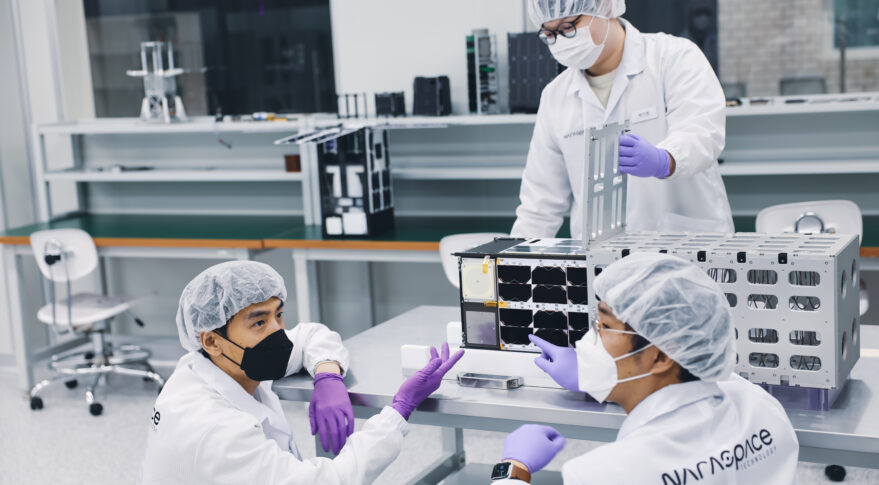 NaraSpace Technology engineers check a satellite at its production facility in Busan, South Korea. Credit: NaraSpace Technology
SEOUL, South Korea — South Korean startup NaraSpace Technology said May 3 it had raised 10 billion won ($7.88 million) in a Series A financing round to pursue the development of optical remote-sensing nanosatellites.
Including 3.5 billion won ($2.76 million) raised in pre-Series A in August 2020, the Busan-based company has raised 13.5 billion won ($10.65 million) since its establishment in 2015. Investors include Korea Development Bank, Hana Ventures, Kolon GLotech, BNK Venture Capital, Posco Capital, and Hi Investment Partners.
https://spacenews.com/naraspace-technology-closes-7-88-million-series-a-for-nanosatellite-project/South Korea’s new president seeks independent space agency, deeper US space cooperationby Park Si-soo — May 9, 2022 [SN]
 : South Korea’s newly elected president Yoon Suk-yeol speaks in this March 10 photo. He will take office May 10, with a set of ambitious space projects aimed at making the country a major space power by 2035. Credit: The presidential transition team.
SEOUL, South Korea — South Korea’s newly elected president Yoon Suk-yeol will take office May 10 with a set of ambitious space projects aimed at making the country a major space power by 2035.
https://spacenews.com/south-koreas-new-president-seeks-independent-space-agency-deeper-us-space-cooperation/India, France agree to cooperate on secure access to outer space, space-based challengesby Park Si-soo — May 10, 2022 [SN]
 Indian Prime Minister Narendra Modi, right, sits next to French President Emmanuel Macron at Elysee Palace in Paris, May 4, in this video still captured from YouTube.
SEOUL, South Korea — India and France have agreed to cooperate to tackle “contemporary challenges that have arisen in space,” including secure access to outer space.
The pledge was part of a broader set of economic and security agreements reached between Indian Prime Minister Narendra Modi and his French counterpart Emmanuel Macron during their May 4 summit in Paris.
https://spacenews.com/india-france-agree-to-cooperate-on-secure-access-to-outer-space-space-based-challenges/Uzbekistan woos Starlink, OneWeb to bring satellite broadbandby Park Si-soo — May 17, 2022 [SN]
 Ben MacWilliams, right, Starlink market access manager, is in talks with officials of Uzbekistan’s space agency in the country’s capital, Tashkent, May 9. Credit: Uzbekistan’s space agency
SEOUL, South Korea — Uzbekistan is trying to woo Starlink and OneWeb to bring their satellite broadband services to Central Asia’s most populous country. The overture is part of the Uzbek government’s efforts to strengthen the nation’s information technology competitiveness and provide better communications services to underserved remote areas.
Ranking officials recently met with the Starlink and OneWeb representatives in the country’s capital, Tashkent, asking for their satellite broadband services to be made available in Uzbekistan. They also called on the two companies to open an office there to explore further cooperation.
https://spacenews.com/uzbekistan-woos-starlink-oneweb-to-bring-satellite-broadband/Biden vows to expand space cooperation with South Korea, Japanby Park Si-soo — May 23, 2022 [SN]
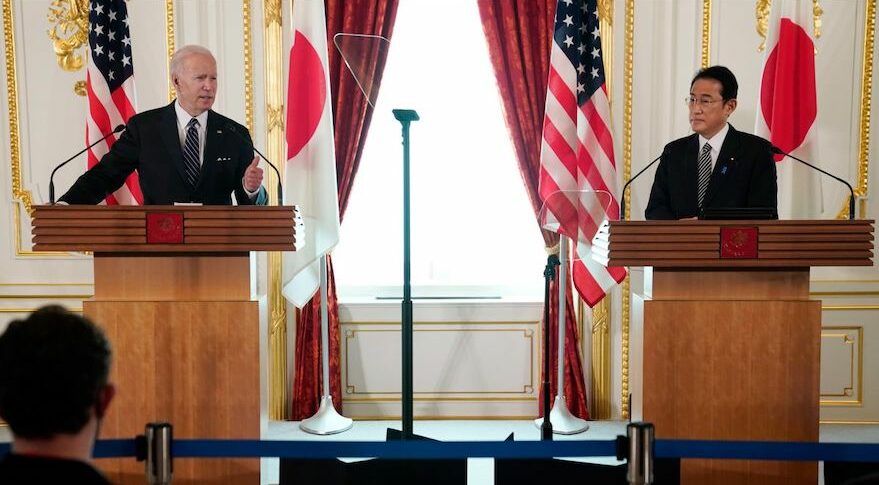 U.S. President Joe Biden, left, stands next to Japanese Prime Minister Fumio Kishida during their post-summit joint press conference in Tokyo, May 23, in this video still captured from YouTube.
SEOUL, South Korea —U.S. President Joe Biden promised to expand space cooperation with Japan and South Korea during back-to-back summits with the leaders of two East Asian allies.
During a May 23 summit with Japanese Prime Minister Fumio Kishida in Tokyo, Biden agreed to work to put the first Japanese astronaut on the moon as part of the NASA-led Artemis program. In a May 21 summit with South Korea’s president Yoon Suk-yeol in Seoul, Biden agreed to strengthen the alliance “across all sectors of space cooperation.”
In a joint statement issued following the May 23 summit, Biden and Kishida announced “progress in collaboration on the Artemis program,” including their “shared intention to include a Japanese astronaut on [the lunar] Gateway and on human and robotic lunar surface missions,” with a goal of signing an implementation agreement this year.
https://spacenews.com/biden-vows-to-expand-space-cooperation-with-south-korea-japan/Quad nations unveil satellite-based maritime monitoring initiativeby Park Si-soo — May 24, 2022 [SN]
 From left, Australian Prime Minister Anthony Albanese, U.S. President Joe Biden, Japanese Prime Minister Fumio Kishida and Indian Prime Minister Narendra Modi wave hands ahead of the Quad leaders’ meeting in Tokyo, May 24. Credit: The Prime Minister’s Office of Japan
SEOUL, South Korea — Leaders of the United States, Japan, India and Australia have agreed to launch a satellite-based initiative to help countries in the Indo-Pacific region track illegal fishing and other suspicious maritime activities.
The maritime monitoring pledge is part of a broader set of peace, security, science and technology agreements reached during the four-nation Quadrilateral Security Dialogue’s May 24 summit in Japan’s capital, Tokyo. Because the Quad is a U.S.-led security forum aimed at countering China, the monitoring effort is likely to focus on China’s maritime activities in the region.
https://spacenews.com/quad-nations-unveil-satellite-based-maritime-monitoring-initiative/India’s Bellatrix Aerospace raises $8 million Series A for in-space propulsion projectby Park Si-soo — June 6, 2022 [SN]
 Rohan M Ganapathy, left, Bellatrix Aerospace’s co-founder and CEO, stands with Yashas Karanam, co-founder and chief operating officer. Credit: Bellatrix Aerospace
SEOUL, South Korea — Indian space startup Bellatrix Aerospace said June 1 that it had raised $8 million in a Series A funding round to pursue the development of in-space propulsion systems. Including $3 million raised in pre-Series A in June 2019, Bellatrix has raised $11 million since its establishment in 2015. Investors include StartupXseed, Pavestone Capital, Mankind Pharma family office, Survam Partners and Karsemven Fund. Several angel investors and family offices joined the latest funding round, the company said in a June 1 statement.
https://spacenews.com/indias-bellatrix-aerospace-raises-8-million-series-a-for-in-space-propulsion-project/South Korean ground station operator Contec raises Series C round for global expansionby Park Si-soo — June 14, 2022 [SN]
 Contec’s radio-frequency ground station in Ireland. Credit: Contec
SEOUL, South Korea — Contec said June 10 that it had raised 61 billion won ($47.3 million) in a Series C funding round to pursue its goal of building a global ground station network and operating its own Earth observation satellites.
Including 13.6 billion won raised in the two previous funding rounds, the South Korean company has raised 74.6 billion won ( or nearly $58 million) since it was founded in 2015 as a spin-off from the Korea Aerospace Research Institute. Contec is planning to go public next year, recently hiring Daeshin Securities to manage the IPO.
https://spacenews.com/south-korean-ground-station-operator-contec-raises-series-c-round-for-global-expansion/South Korean rocket’s second launch rescheduled for June 21by Park Si-soo — June 17, 2022 [SN]
 KSLV-2 is seen being rolled out to the launch pad at the Naro Space Center in Goheung, South Jeolla Province, June 15. Credit: Korea Aerospace Research Institute
SEOUL, South Korea — The second launch of South Korea’s first domestically built rocket is set for June 21, a delay of a week due to strong winds and a technical glitch.
“We convened a meeting of the launch management committee and decided to pursue the second launch on June 21,” Kwon Hyun-joon, a senior science ministry official, said June 17 in a live-streamed media briefing.
Kwon said the kerosene and liquid oxygen-fueled three-stage rocket KSLV-2 was lying horizontally in a hangar at the Naro Space Center, after a malfunctioning sensor in the first-stage booster was replaced with a new one.
https://spacenews.com/south-korean-rockets-second-launch-rescheduled-for-june-21/South Korean rocket puts satellites in orbit for the first time in second flightby Park Si-soo — June 21, 2022 [SN]
 KSLV-2 blasts off from the launchpad at Naro Space Center in Goheung, June 21. Credit: Ministry of Science and ICT
SEOUL, South Korea — South Korea’s homegrown rocket KSLV-2 successfully put satellites into low Earth orbit for the first time in its second flight June 21. A performance test satellite, deployed from the rocket about 14 minutes after liftoff, exchanged its first signals with a ground station associated with South Korea’s research center in Antarctica about 42 minutes after liftoff, according to the science and technology ministry. The satellite will deploy four smaller satellites developed by domestic universities in the coming days.
https://spacenews.com/south-korean-rocket-puts-satellites-in-orbit-for-the-first-time-in-second-flight/South Korea’s all-domestic satellite launcher reaches orbit for first timeJune 21, 2022 Stephen Clark [SFN]
(...) The Nuri rocket is a medium-class launcher standing nearly 155 feet (47.2 meters) tall and measuring around 11.5 feet (3.5 meters) in diameter. The Nuri, which means “world” in Korean, is designed to place a payload of up to 3,300 pounds (1,500 kilograms) into an orbit more than 372 miles (600 kilometers) in altitude. (...)
Four CubeSats were stored on the PVSAT spacecraft for deployment later. The largest of the CubeSats was the 21.2-pound (9.6-kilogram) STEP Cube Lab 2 satellite from Chosun University, with a suite of miniaturized electro-optical mid-infrared and loogwave infrared Earth observation cameras.
The SNUGLITE 2 nanosatellite, from Seoul National University, will demonstrate GPS radio occultation measurements using attenuation of satellite navigation signals to gather data on Earth’s atmosphere. The MIMAN CubeSat was developed at Yonsei University, and carries an instrument for atmospheric dust monitoring.
The fourth CubeSat on the Nuri launch was RANDEV, which hosts a hyperspectral camera to image volcanoes, coastal regions, and clouds. RANDEV was developed at the Korea Advanced Institute of Science and Technology. (...)
https://spaceflightnow.com/2022/06/21/south-koreas-all-domestic-satellite-launcher-reaches-orbit-on-test-flight/
 Wątek: Artykuły o Asian space program (Przeczytany 3149 razy)