Mars smallsat mission bumped from launchby Jeff Foust — September 18, 2020 Updated Sept. 22 with NASA clarification of launch vehicle procurement. [SN]
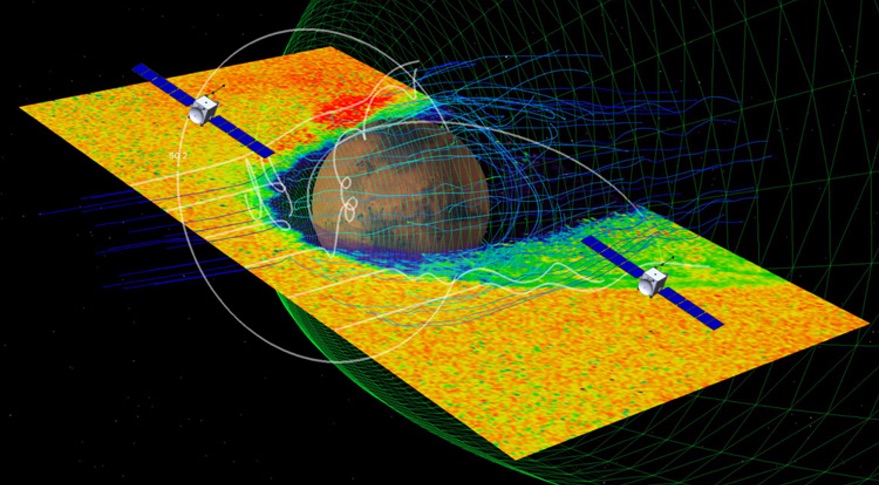 The EscaPADE mission would fly two smallsats to Mars, studying how the planet's atmosphere interacts with the solar wind. Credit: Univ. of California Berkeley
WASHINGTON — A smallsat mission to study the atmosphere of Mars is looking for a new ride after being removed as a secondary payload on the launch of a NASA asteroid mission.
The Escape and Plasma Acceleration and Dynamics Explorers, or EscaPADE, mission, was one of three smallsat missions selected by NASA in 2019 for initial studies as part of the agency’s Small Innovative Missions for Planetary Exploration (SIMPLEx) program. EscaPADE features twin spacecraft that would orbit Mars to study how the planet’s atmosphere interacts with the solar wind, and how those processes lead to the escape of gases from the atmosphere.
https://spacenews.com/mars-smallsat-mission-bumped-from-launch/NASA selects two heliophysics missionsby Jeff Foust — February 10, 2022 [SN]
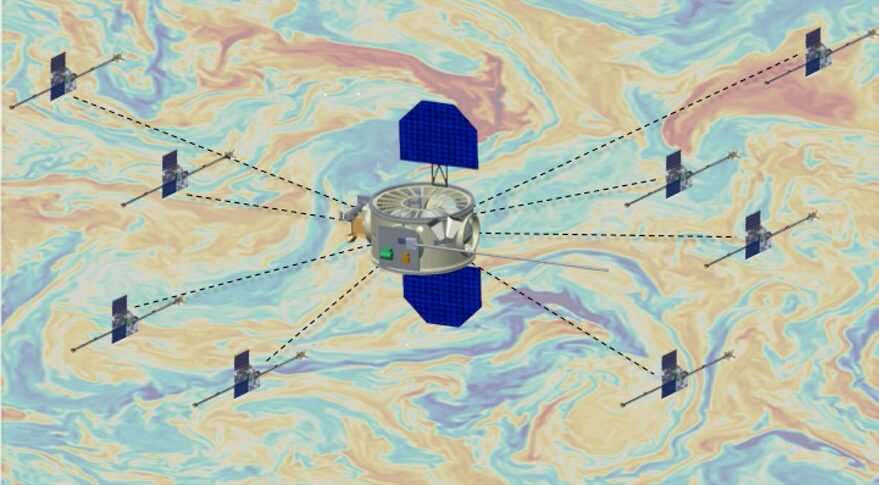 HelioSwarm features a hub spacecraft and eight smaller ones that will work together to measure solar wind turbulence. Credit: Univ. of New Hampshire
MOUNTAIN VIEW, Calif. — NASA has selected a spacecraft to study the sun’s corona and a cluster of smallsats to monitor turbulence in the solar wind as its next Explorer-class heliophysics missions.
NASA announced Feb. 10 it selected the Multi-slit Solar Explorer (MUSE) and HelioSwarm as its next two heliophysics Medium-Class Explorer, or MIDEX, missions. The two came from a set of five proposals NASA awarded study contracts for in August 2020 to refine their mission designs.
MUSE will operate in Earth orbit, observing the sun at extreme ultraviolet wavelengths to better understand the mechanisms that heat the corona, the tenuous upper atmosphere of the sun, to temperatures in excess of one million degrees Celsius. MUSE will also be able to observe solar flares and coronal mass ejections that contribute to the corona’s high temperature.
https://spacenews.com/nasa-selects-two-heliophysics-missions/Foust Forward | Maintaining Mars madnessby Jeff Foust — February 19, 2022 [SN]
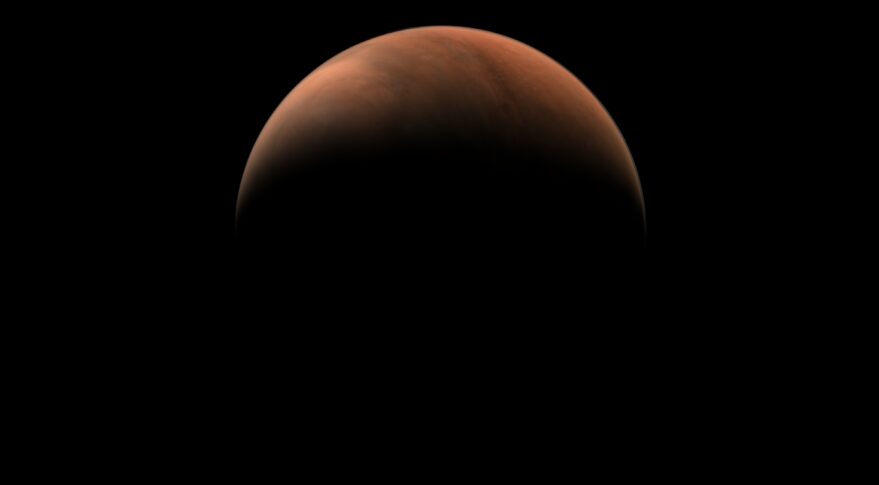 A crescent of the northern hemisphere of Mars taken by Tianwen-1's medium-resolution camera in March 2021. Credit: CNSA/PEC
Compared to 2020, this will be a quiet year for launching Mars missions. The last time the once-every-26-months Mars launch window opened, NASA launched the Perseverance rover, China its Tianwen-1 mission and the United Arab Emirates the Hope orbiter. When the next window opens this fall, the only mission scheduled to launch is Europe’s ExoMars, and that mission was postponed from 2020 because of technical problems and the pandemic.
https://spacenews.com/foust-forward-maintaining-mars-madness/Mars scientists look to less expensive missionsby Jeff Foust — April 18, 2022 [SN]
 NASA's fiscal year 2023 budget proposal would cut the International Mars Ice Mapper mission, the only large Mars mission the agency has under development outside of Mars Sample Return. Credit: NASA
WASHINGTON — On the eve of the release of the planetary science decadal survey likely to place a decreased emphasis on Mars, scientists and NASA officials are planning how to continue exploration of the planet with less expensive missions.
The National Academies is scheduled to release the latest decadal survey for planetary sciences April 19. The report will set priorities for planetary science and astrobiology missions for 2023 through 2032.
The previous planetary science decadal survey, released in 2011, recommended as its top priority for large, or flagship, missions a rover that could cache samples for later return to Earth. NASA ultimately implemented that recommendation as Mars 2020, with the Perseverance rover currently collecting those samples.
https://spacenews.com/mars-scientists-look-to-less-expensive-missions/Robotic mission to Uranus receives top priority in decadal surveyApril 19, 2022 Stephen Clark [SN]
 NASA’s Voyager 2 spacecraft, the only mission to visit Uranus up close, recorded this view of the planet as it approached on Jan. 14, 1986. Credit: NASA/JPL-Caltech
In a long-awaited report released Tuesday, a panel of planetary scientists recommended NASA prioritize development of a flagship robotic mission that would orbit Uranus, a distant world with 27 known moons that has not been explored since a fleeting visit by the Voyager 2 spacecraft 36 years ago.
The planetary science decadal survey report, released by the National Academies of Sciences, Engineering, and Medicine, provides NASA with a roadmap for the next decade of solar system exploration. The U.S. agency has a long-standing policy of following the recommendations from the once-in-a-decade reports.
https://spaceflightnow.com/2022/04/19/robotic-mission-to-uranus-receives-top-priority-in-decadal-survey/Planetary science decadal endorses Mars sample return, outer planets missionsby Jeff Foust — April 19, 2022 [SN]
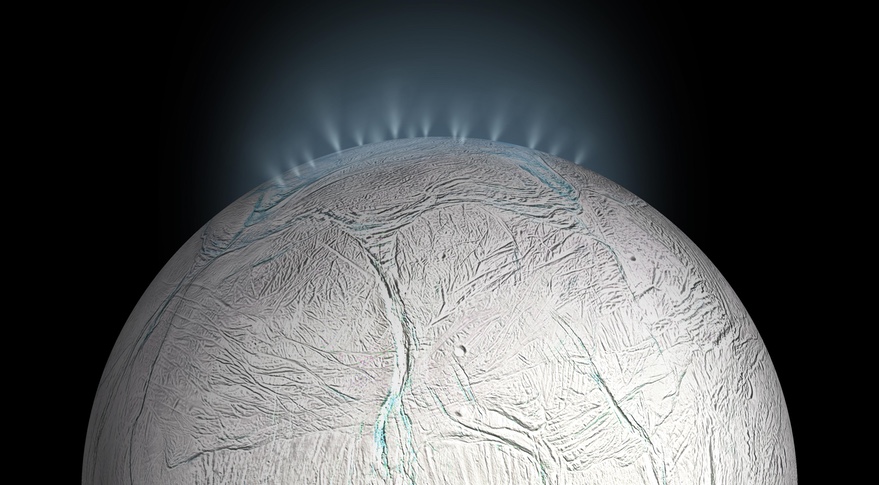 One recommended mission in the planetary science decadal survey would send a mission to Enceladus, an icy, potentially habitable moon of Saturn with a subsurface ocean and plumes. Credit: NASA/JPL-Caltech
WASHINGTON — A study outlining priorities in planetary science for the next decade backs continued efforts to return samples from Mars while recommending NASA pursue missions to the planet Uranus and an icy moon of Saturn.
The final report of the planetary science decadal survey, developed by a committee of the National Academies and released April 19, also recommended work on a space telescope to track near Earth objects, a Mars lander to look for evidence of life and a lunar rover to collect samples that would be returned by astronauts.
https://spacenews.com/planetary-science-decadal-endorses-mars-sample-return-outer-planets-missions/China to conduct asteroid deflection test around 2025by Andrew Jones — April 24, 2022 [SN]
 An artist's conception of a near Earth object making a close approach to Earth. Credit: ESA/P.Carril
HELSINKI — China will aim to alter the orbit of a potentially threatening asteroid with a kinetic impactor test as part of plans for a planetary defense system.
China is drafting a planetary defense plan and will conduct technical studies and research into developing systems to counter the threats posed by near Earth asteroids, Wu Yanhua, deputy director of the China National Space Administration (CNSA), told China Central Television (CCTV).
https://spacenews.com/china-to-conduct-asteroid-deflection-test-around-2025/Ice giants and icy moons: The planetary science decadal survey looks beyond Mars to the outer solar systemby Jeff Foust — May 19, 2022 [SN]
 A global infrared mosaic of Saturn’s moon Enceladus created using a complete dataset from the Cassini spacecraft. Credit: NASA/JPL-CALTECH/UNIVERSITY OF ARIZONA/LPG/CNRS/ UNIVERSITY OF NANTES/SPACE SCIENCE INSTITUTE
The last time the planetary science community came together to conduct a decadal survey, Mars was ascendant. NASA had flown a series of Mars missions and was working on its most ambitious rover yet, Curiosity. The decadal survey endorsed continuing that Mars exploration strategy by backing a mission to collect samples as the first step to returning those samples to Earth.
The situation is somewhat different in the latest planetary science decadal survey, published April 19 by a National Academies committee. While Mars is still at the center of much of present-day planetary science at NASA, the planetary decadal makes the case that the future is further out in the solar system, among distant planets as well as icy moons that could harbor life.
https://spacenews.com/ice-giants-and-icy-moons-the-planetary-science-decadal-survey-looks-beyond-mars-to-the-outer-solar-system/House committee questions proposed delay in NASA asteroid missionby Jeff Foust — May 31, 2022 [SN]
 NASA's fiscal year 2023 budget proposal would delay the launch of the NEO Surveyor space telescope by two years, although the planetary science decadal survey recommended a "timely launch" of the mission. Credit: NASA/JPL
WASHINGTON — Members of the House Science Committee used a hearing about the planetary science decadal survey to criticize a proposal in NASA’s budget request to delay work on a space telescope to track near Earth objects (NEOs).
The fiscal year 2023 budget request, released March 28, proposed just $39.9 million for NEO Surveyor, compared to the request of $143.2 million for the mission in 2022. NASA had projected spending $174.2 million on the mission in 2023 in the runout included in its fiscal year 2022 budget request.
https://spacenews.com/house-committee-questions-proposed-delay-in-nasa-asteroid-mission/Startups raise millions for lunar rovers and asteroid miningby Jeff Foust — June 1, 2022 [SN]
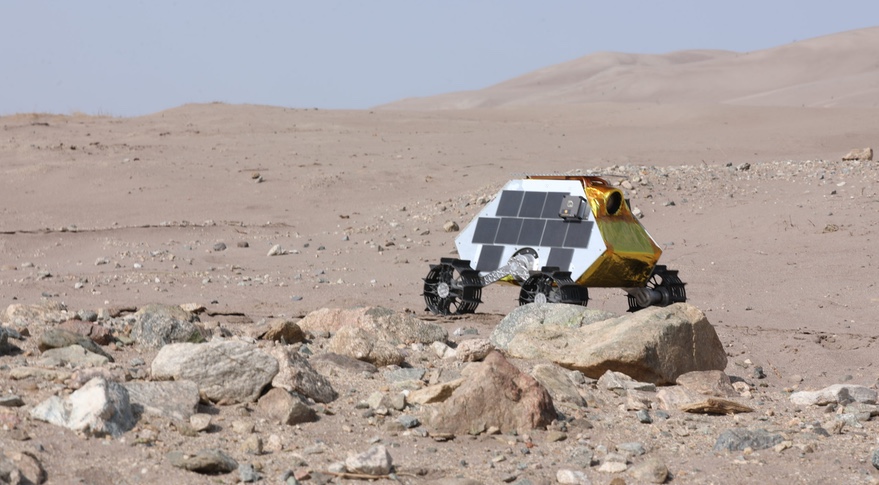 Lunar Outpost, testing its MAPP lunar rover on Earth, plans to use a funding round to support work on a larger rover. Credit: Lunar Outpost
WASHINGTON — Two startups recently raised a combined $25 million in seed rounds to advance plans for lunar and asteroid missions, showing continued interest in space startups despite broader market uncertainty.
Lunar Outpost announced May 24 it raised a $12 million seed round from several investors. Explorer 1 Fund led the round with participation from Promus Ventures, Space Capital, Type 1 Ventures and Cathexis Ventures.
Golden, Colorado-based Lunar Outpost will use the funding to further development of a line of robotic lunar rovers. The company is working on its first rover, the Mobile Autonomous Prospecting Platform (MAPP), that will go on Intuitive Machines’ IM-2 lunar lander launching in 2023. A second rover will launch on another Intuitive Machines lander in 2024, both part of NASA’s Commercial Lunar Payload Services program.
https://spacenews.com/startups-raise-millions-for-lunar-rovers-and-asteroid-mining/South Korea cancels Apophis probeby Park Si-soo — June 7, 2022 [SN]
 Radar images of asteroid Apophis captured by NASA in 2012. South Korea planned to launch a spacecraft to probe the space rock when it passes near Earth in April 2029, but it recently scrapped it due to a “lack of technical capabilities.” Credit: NASA/JPL-CalTechCancelation follows NASA decision to send OSIRIS-Rex on extended mission to encounter Apophis after dropping off Bennu samples
SEOUL, South Korea — Citing a “lack of technical capabilities,” South Korea has dropped the plan of developing a robotic spacecraft to escort asteroid Apophis during its 2029 close encounter with Earth.
The science ministry, which manages state-funded space programs, recently ruled the mission “unfeasible” and decided not to request the $307.7 million budget it initially sought for the mission. The mission involved launching a robotic spacecraft between July 2026 and January 2027 to accompany Apophis as it whips by Earth in April 2029. The probe would observe and map Apophis the whole way, looking for changes in its structure due to its close encounter with Earth and the planet’s gravitational forces. In March 2021, then-President Moon Jae-in of South Korea said the mission, if executed, would help “cement the foundation of the nation’s space industry and advance related capabilities.”
https://spacenews.com/south-korea-cancels-apophis-probe/China aims to bring Mars samples to Earth 2 years before NASA, ESA missionby Andrew Jones — June 20, 2022 [SN]
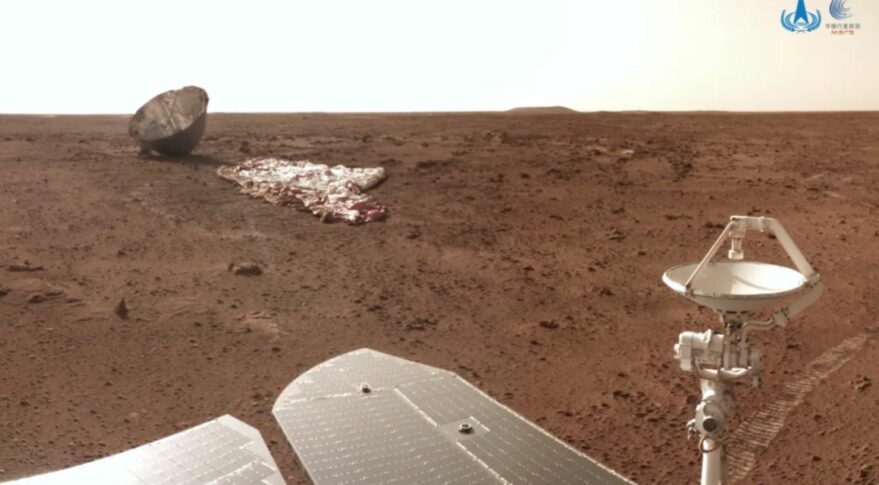 China's Zhurong images its own parachute from a distance of 30 meters, July 12, 2021. Credit: CNSA/PEC
HELSINKI — China’s Mars sample return mission aims to collect samples from the Red Planet and deliver them to Earth in 2031, or two years ahead of a NASA and ESA joint mission.
Sun Zezhou, chief designer of the Tianwen-1 Mars orbiter and rover mission, presented a new mission profile for China’s Mars sample return during a June 20 presentation in which he outlined plans for a two-launch profile, lifting off in late 2028 and delivering samples to Earth in July 2031.
https://spacenews.com/china-aims-to-bring-mars-samples-to-earth-2-years-before-nasa-esa-mission/China to target near-Earth object 2020 PN1 for asteroid deflection missionby Andrew Jones — July 12, 2022 [SN]
An artist's conception of a near Earth object making a close approach to Earth. Credit: ESA/P.CarrilHELSINKI — China has set its sights on near-Earth object 202 PN1 as the target for a combined asteroid deflection and observation test mission due to launch in 2026.
The new details of the near-Earth asteroid defense system demonstration and verification test mission were presented by Long Lehao, chief designer of China’s Long March rocket series, in a recent “Science and Innovation China” series lecture (video in Chinese).
https://spacenews.com/china-to-target-near-earth-object-2020-pn1-for-asteroid-deflection-mission/Impulse and Relativity announce proposal for joint Mars landing missionby Jeff Foust — July 20, 2022 [SN]
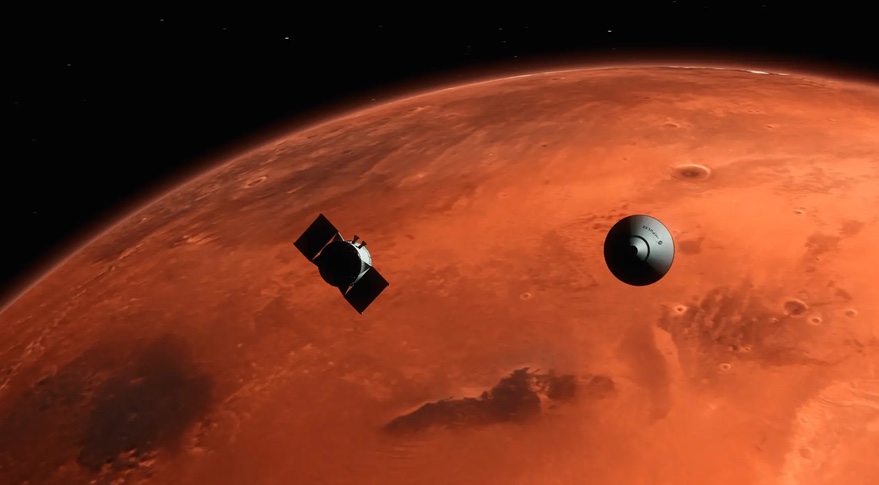 An illustration of a Mars lander, within its entry capsule, separating from its cruise stage upon arrival at Mars. Impulse Space would build the lander and Relativity Space would launch it. Credit: Impulse Space
WASHINGTON — Two startups, each yet to fly their first missions, said July 19 they are collaborating on a Mars lander mission they claim could launch as soon as 2024.
Launch vehicle startup Relativity Space and in-space transportation company Impulse Space jointly announced July 19 they are working on a robotic Mars lander they anticipate launching as soon as the late 2024 window for missions from Earth to Mars.
https://spacenews.com/impulse-and-relativity-announce-proposal-for-joint-mars-landing-mission/Mapping the Sky: Finding asteroids requires a combination of toolsby Debra Werner — July 22, 2022 [SN]
“A single strike could reshape our world, and the only thing that can stop it is science.”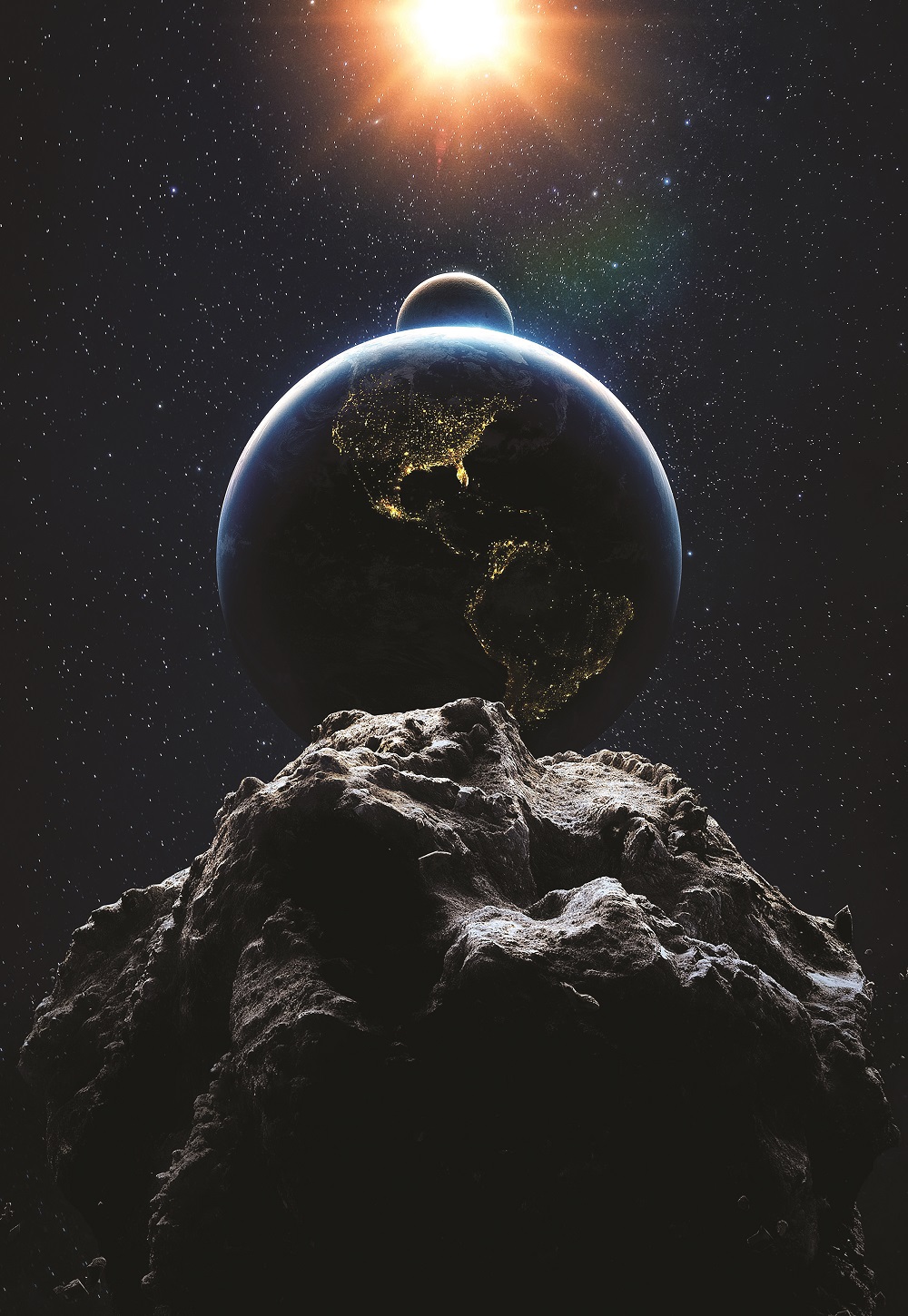 Credit: IMAX
Those are the opening lines of “Asteroid Hunters,” an IMAX film narrated by Daisy Ridley of Star Wars fame. If a June 17 screening near the NASA Ames Research Center is any guide, “Asteroid Hunters” achieves its goal of underscoring the threat asteroids pose and the opportunity to deflect a dangerous one headed toward Earth.
https://spacenews.com/mapping-the-sky-finding-asteroids-requires-a-combination-of-tools/
 Wątek: Artykuły o Space missions to the Solar System (Przeczytany 1763 razy)