« Odpowiedź #1 dnia: Lipca 21, 2024, 12:00 »
Parę współczesnych fotek byłego astronauty.
3:04 AM · Dec 6, 2021
Look who I bumped into on the 20th anniversary of our first launch! @CaptMarkKelly and I were the rookies on STS-108 so it’s an important moment in both our lives. Great to see him tonight.
https://twitter.com/Astro_Tani/status/146767632270095974711:51 PM · Jul 19, 2024
2 shuttle missions, 1 ISS expedition, 5 space walks, 130 days in space. We were *super* lucky to have my buddy @Astro_Tani speaking at the UCL Festival of Engineering today, inspiring the next generation of engineers. Thanks again Dan!!
https://twitter.com/Kevin_Fong/status/1814417860347023732Moroccan YouTuber Interviews US NASA AstronautMar. 05, 2019
Moroccan YouTuber Najib El Mokhtari walked his viewers through the life of retired NASA astronaut Daniel Tani.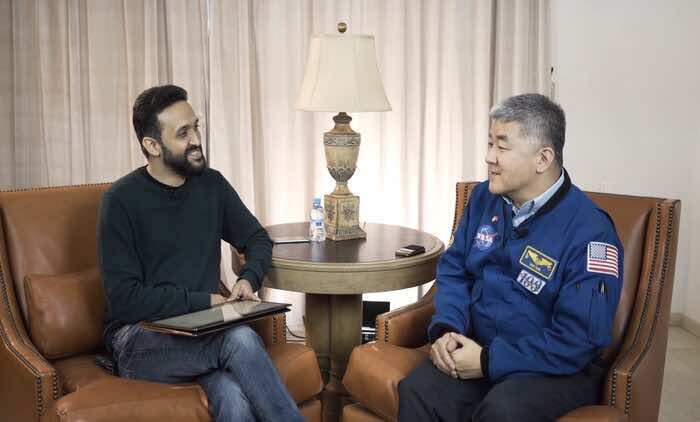
Will Morocco go to the moon?
Tani expressed his delight at the interview with El Mokhtari and his time in Morocco, tweeting, “I was privileged to visit Morocco and I had a great interview with Najib - a famous personality in Morocco. We covered a lot of topics and had a wonderful time.”
The interview was not limited to space trips and explorations; El Mokhtari and Tani also touched on the education system. Tani’s piece of advice was that he wishes Moroccan schools would integrate non-educators specializing in fields like accounting, law, etc., to come and explain, for example, “the basics of numbers” to bring a “different experience, a wealth of experience” to students.
https://www.moroccoworldnews.com/2019/03/267205/moroccan-youtuber-interviews-us-nasa-astronautFormer Astronaut Discusses Space Travel and Its Future With StudentsOctober 31, 2023
Daniel Tani traces his love of engineering and space exploration to his childhood.
As a young boy, Tani loved playing with model rockets. He would use the money he made delivering newspapers to buy and build them.
“I was enthralled by the magic of the power of my thumb, making something go so fast and so high,” Tani recently told students of professor Giovanni Zanalda’s space economics class. “We were astronaut crazy in the 1960s. I never thought it would be a reality.”
Zanalda, professor of the practice in economics and history with the Social Science Research Institute at Duke, as well as co-chair of the Space Diplomacy Lab and director of the Rethinking Diplomacy Program, moderated the discussion.
It wasn’t until Tani was around 25 and working in the aerospace industry that he met an astronaut and decided to fulfill his childhood dream.
“It lit the lightbulb in my head to think maybe there was a path for me,” he said.
Tani applied to NASA’s space program and was accepted in 1996. He spent 16 years working for the agency. During that time, he flew on two space missions, spent 120 days in space and on the International Space Station and took part in six spacewalks.
Now director of business development operations, human exploration operations at Northrop Grumman, Tani shared inspiring stories of his experiences in space.
One student asked what it was like to return to Earth after spending time in zero gravity. “There was lots of walking into walls, very entertaining for your kids,” he said. “I couldn’t drive until a week after I got back. I could navigate a left turn but no right turns.”
And what were space walks like?
“It’s so scary you are going to go out to the vacuum of space. You know it’s just you and your buddy, but there are 100 people at NASA watching you, you are so consumed with getting the right bolt in the right place,” he said.
Space Then and Now
Tani also presented a timeline of human space flight – beginning with Russia’s successful launch of Sputnik 1 in 1957 – through today’s privatized Space X program founded by Elon Musk.
He voiced his disappointment about the lack of U.S. government funding and enthusiasm for space travel that existed in the early days of the space race.
“I would have hoped that we would see some sort of exponential kind of growth in the number of people that we can put into space,” Tani lamented.
Instead, NASA's budget peaked during the Apollo program in the 1960s. With just a fraction of the government’s total spending budget, NASA is charged with returning astronauts to the moon by 2025, addressing the global climate crisis via research, supporting the existing International Space Station program, advancing robotic exploration of the Moon and Mars and creating industry partnerships.
When asked about space tourism, Tani suggested it has its limitations.
“You get some celebrities to fly. And it's inspiring, and it's cool. But … can you really have a long-term business plan there? God forbid there's a bad outcome on one of those things. You could see that thing drying up pretty quickly,” he said.
At the same time, he is excited about smaller space companies.
“I am optimistic about small space companies, that can be agile, raise their own capital and take on risks that bigger companies aren’t willing to do,” Tani said.” The innovation happens at the small company level.”
With plans to retire the International Space Station in 2030, NASA is looking to private industry to move the needle on space flight. The agency recently selected seven companies to advance space capabilities. For its part, NASA will provide technical expertise, assessments, lessons learned, technologies and data.
Tani noted that relying on private industry for space research will present “growing pains” that will have to be figured out. For example, he asked: “If you are a commercial space station and your job is to make money – what is your corporate obligation and your obligation to this country? These are all very complicated, good questions.”https://today.duke.edu/2023/10/former-astronaut-discusses-space-travel-and-its-future-students#HappyBirthday to ASE member @Astro_Tani, who flew in space twice between 2001 and 2008 (STS-108 and STS-120) as part of trips and expeditions to the @Space_Station (Expedition 16)!
https://twitter.com/ASE_Astronauts/status/1753161516679897420
« Ostatnia zmiana: Lutego 07, 2026, 08:10 wysłana przez Orionid »

Zapisane
 Wątek: DM Tani - 01.02.1961 (Przeczytany 1376 razy)