Return To Space: An Interview with NASA Astronaut Tracy Caldwell Dysonby Tyler Hines | 2024-03-13
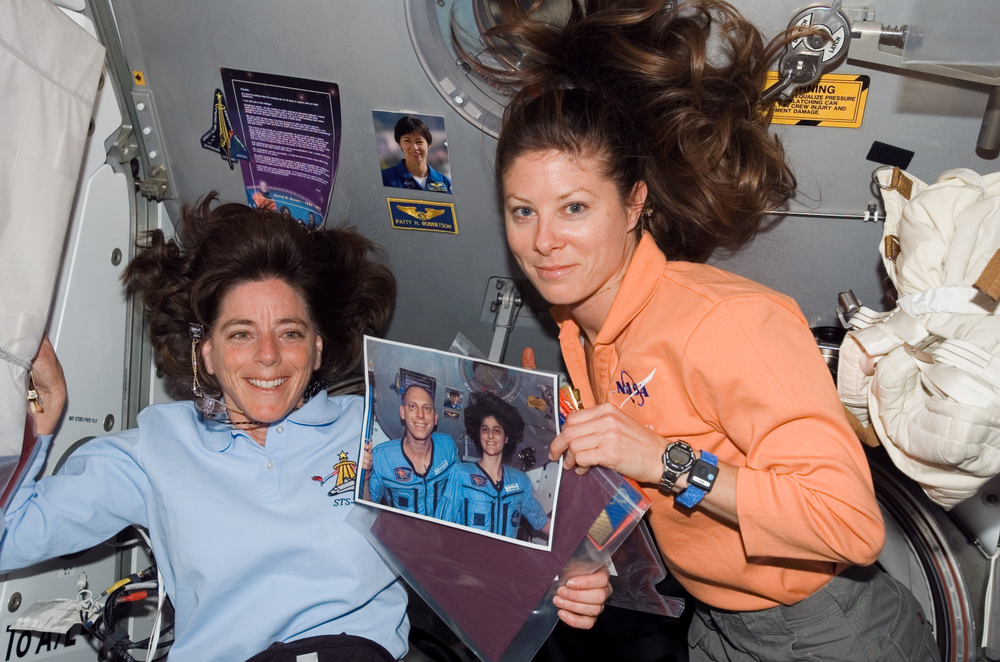 Astronauts Barbara R. Morgan (left) and Tracy Caldwell, both STS-118 mission specialists, pose with a photo of astronauts Clay Anderson and Sunita Williams, both Expedition 15 flight engineers, near a hatch on the International Space Station. Credit:NASA
During her more than 25-year career as a NASA astronaut and a two-time spaceflight veteran, Tracy Caldwell Dyson now sets her sights on returning to space later this month aboard the International Space Station as a crew member of Expedition 70/71. Prior to launch, we had the chance to sit down and talk with Tracy directly and ask about her unique perspectives on life, experiences, and time as an astronaut.
https://roundupreads.jsc.nasa.gov/roundup/2333Aggie Alum and Astronaut Tracy C. Dyson to Travel to Space for Third Timeby Greg Watry January 05, 2024
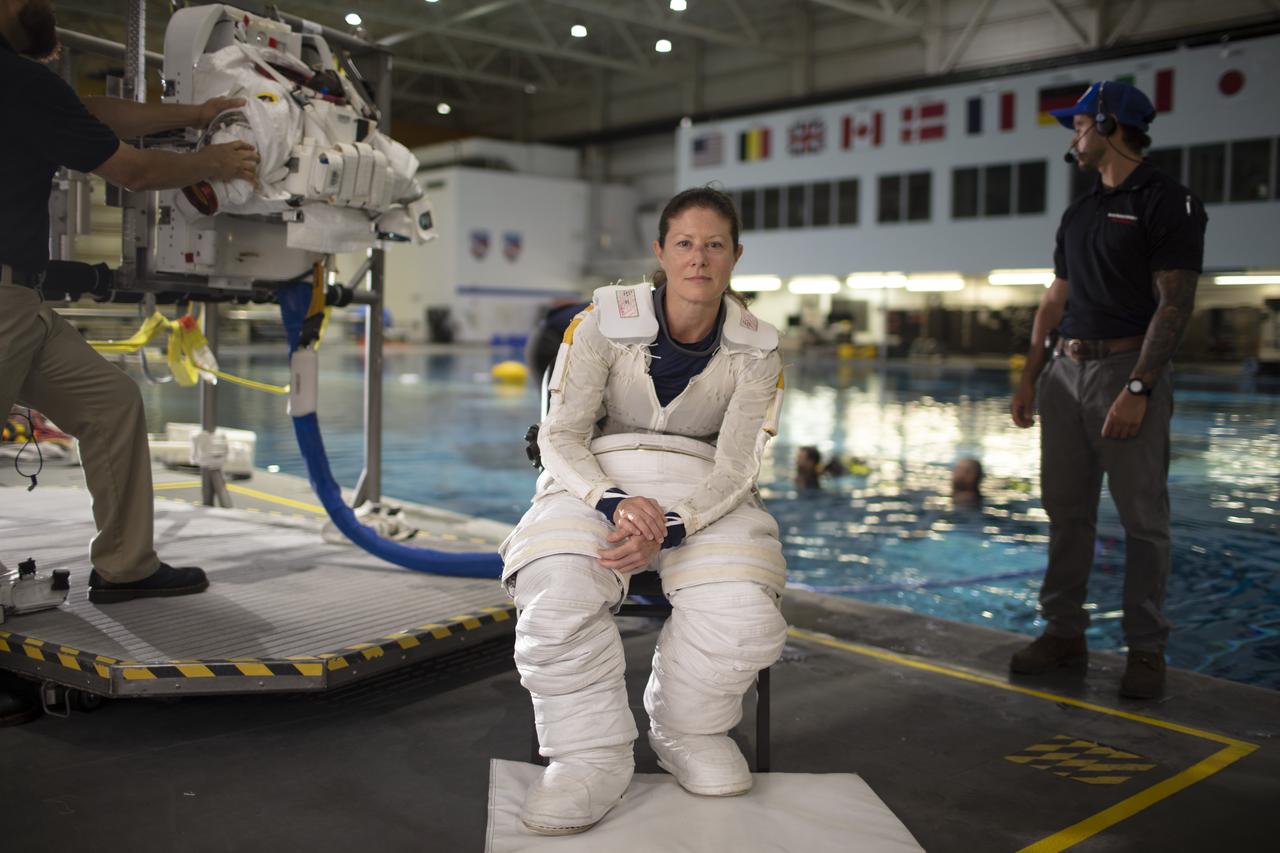 Tracy Caldwell Dyson pauses for a portrait while donning her spacesuit and going under water in the Neutral Buoyancy Lab. (NASA/Bill Ingalls)
(...) Her mechanistic mind and love for working with tools were further forged by her father, an electrician. Around age 16, Dyson learned about NASA’s plan to send schoolteacher Christa McAuliffe to space. Dyson’s own schoolteachers were enormously influential in her life. They weren’t just educators; they were counselors and coaches. Inspired, Dyson started learning about McAuliffe and what it takes to become a NASA astronaut. (...)
https://lettersandscience.ucdavis.edu/news/aggie-alum-and-astronaut-tracy-c-dyson-travel-space-third-timeTRACY DYSON
One of the most prominent women in the United States space agency NASA, Tracy Caldwell Dyson is an American chemist and astronaut, selected by NASA following her groundbreaking research into molecular level surface reactivity.
As Mission Specialist #1, Caldwell Dyson flew on Space Shuttle Endeavour in a successful mission to help assemble the International Space Station in 2007. Three years later, Caldwell Dyson launched from Kazakhstan on a Russian Soyuz rocket to join Expedition 23 and spent 176 consecutive days on the International Space Station, celebrating her 38th birthday in space. Inspiring women and girls everywhere to shoot for the stars, Caldwell Dyson is the host of NASA TV series StationLIFE, and is fluent in both American Sign Language and Russian. Caldwell Dyson is rising from a California poppy, the state flower of California where she was born, studied, and lived until she was selected as a NASA astronaut. With cup-shaped petals, the California poppy blooms in an array of colors, symbolizing Caldwell Dyson’s achievements in various fields.
Tracy Caldwell Dyson's incredible bronze statue has found a permanent home at the Griffis Sculpture Park & The Essex Art Centre and will be available for public viewing from mid-June 2021.
https://statuesforequality.com/pages/tracy-dysonAlumna Interview from SpaceBy Russ L. Hudson
Tracy Caldwell Dyson Speaks from the International Space StationSept. 1, 2010 Interview with Cal State Fullerton alumnus Tracy Caldwell Dyson
Russ Hudson (RH): Station, this is Russ Hudson with Cal State Fullerton. How do you hear me?
Tracy Caldwell Dyson (TCD): Reads you loud and clear. How us?
RH: Very good. Good morning. Good morning for us anyway. Tracy, you've had an eventful career as an astronaut. First, for quite awhile you were the youngest person to become an astronaut. You're still the first person born after the Apollo 11 moon walk. You've had some firsts since you arrived at the space station in April as well. I'd like to ask you about those. Within a week of arriving at the space station, you were one of four women in space at the same time for the first time. What did that signify for you and the space programs worldwide?
TCD: Well, I'll tell you in two parts, Russ. First, it's always a fantastic thing to be a part of history and to have my name associated with something like that with those other three women, who I think are spectacular. I'm very proud to be a part of that group. But the other part of this is that I hope that becomes the norm and doesn't become such an interesting factoid that we have more than one woman in space at the same time. So I'm looking forward to that being a normal situation.
RH: Anything on that you want to say to aspiring girls and women?
TCD: I wish Shannon and I had our baseball caps on right now, because they have a nice message that says, "Women fly." And I think I can speak for all the ladies in the astronaut corps that we hope that more ladies will take on the challenge of flying in space and also helping to build our space program. You know there's a whole lot more to do than just flying in space. There's a lot of spectacular, exciting stuff going on the ground, helping to build space ships, helping to manage them and to direct the flights from the ground up. So there are a lot of opportunities out there, and I think girls just need to start seeing themselves in these positions and seeing it as a normal, everyday occurrence to have women in these kind of roles.
RH: Thank you. OK, the space walks. There were three difficult ones. NASA characterized them as one of the most challenging repairs ever attempted. All three of you were working on those. Tracy, I'd like to ask you first, how did you prepare? How challenging was that for you personally, both physically and mentally?
TCD: I tell you what, Russ, I didn't have a whole lot of time to think about it before we went outside the door. So I think for me the challenge was getting prepared in a short period of time. We already were ready to go out the hatch to perform a separate EVA that had nothing to do with the pump module failing, and one that we had practiced before together. And the task that we were about to do was one that we had practiced once before separately and had some familiarity with. But the whole choreography was going to be a little on the fly. And so I think for myself it was just to go out there on my very first space walk, do all the things that I'd been trained to do, listen to the ground and also, like everyone told me, "Have fun!"
RH: There are some questions, Tracy, from your friends and mentors at Cal State Fullerton, I'd like to ask you. They each have a question for you. First would be your chemistry professor John Olmstead. And he asks, Did your training in physical chemistry at Cal State Fullerton prepare you for wrestling with the bulky ammonia pump?
TCD: Oh, I love Dr. Olmstead. Well, I would have to say that what my physical chemistry prepared me for with the pump module is to understand the dangers of ammonia in a vacuum. Especially if you, in a space suit, are right in line with that ammonia line as a QD (quick disconnect) is being demated. I learned a lot from Dr. Olmstead, I wish I had a lot of time to talk about it, but one of the things he introduced me to was hardware. As a physical chemist, you spend as much time with a wrench in your hand and fixing lasers and pumps than you do with a beaker and liquid chemicals. So, what I learned a lot from Dr. Olmstead and P-Chem was how to handle hardware.
RH: Thank you. The next question is from your biochemistry professor, Scott Hewitt, and he would like to know what it was like to be outside the space station for the first time, on your first space walk.
TCD: All right. Well, Scott is such a good friend and also a great mentor. He has to know that it was a very exciting time and a very emotional time for me as I've wanted to do a space walk for well over a decade and trained for it as well. I would say that the only thing that it really rivals is the moment that Scott set up our laboratory the night before I left to go on to graduate school and he made our equipment rack look exactly like, as much as he could, the cockpit of a shuttle. He turned off all the lights in the lab and left all the lights on the equipment on, blinking, sat me in front of it and asked me what it reminded me of. I didn't know at the time but he said, "Doesn't it look a lot like the Shuttle cockpit?" I'll never forget that. So, that was a very touching moment for me, knowing Scott believed in me and the dream that I had, and going out there and walking in space was the fulfillment of a dream.
RH: Thank you. I think he'll like to hear that too. Sue Fisher, former campus radiation officer (now emergency management coordinator) and later your friend, and she asked, and I bet you can guess this one, "What shielding is on the space station to protect you from radiation?"
TCD: I love Sue! Back when I was working for Sue I was called "Gamma Girl," and it was my job to go around and test all the laboratories, wipe them down and put them in a scintillation counter see if there was any radiation that had escaped. It was our job to help control that. I haven't been doing such delicate work here on the space station. We leave that to a group of folks on the ground, our radiation group that monitors the space radiation environment, and they're in close contact with our flight surgeons who notify us if there's any danger. I'd say the best thing is I do wear my dosimeter every day and as well when Doug and I went out on our spacewalk we wore our dosimeters. Actually, we wore two of them and we are constantly being updated on the space environment and if it gets too bad I will let Sue know! Thank you.
RH: Thank you. A final question from your friend and mentor Dave Reid from Cal State Fullerton Public Affairs and a family friend. He wants to know, when you were working at an electrician job with your father, in your wildest dreams did you think you'd be doing something similar in space?
TCD: I'll tell you what, nice to hear from Dave. There's a lot of time in my spacewalk where I thought about the work I did while working with my father. I've been going to job sites since, I think, before I could talk. There were definitely times on the job when I was put in situations that were a little hairy. Going up on the rooftops of malls and fixing equipment that was in strange places, having to use a ladder and sometimes dad would use me to climb into the crawl spaces and the attics because nobody else would, for some reason. Without a doubt working for my father, both as his electrician and his daughter, has prepared me extremely well for the kinds of challenges that you face on a spacewalk as well as the kind that Doug and Shannon and I faced up here with spacewalks. Then everyday around space stations, inside and out, we're always having to use our human minds to help solve problems that can't always be predicted and a lot of the work that I did for my father, a lot of the training that I got from him, has served me well in an environment like this.
RH: I'm sure he appreciates that! I guess we're running out of time. I certainly thank all three of you. I appreciate it very much and so does Cal State Fullerton, and Tracy, and I think I'll be going now. Thank you very much. Have a great rest of voyage.
TCD: Hey Russ, thank you very much and "Go Titans!"
NASA Tech: Station, this is Houston ACR. That concludes the event. Thank you.https://calstate.fullerton.edu/spotlight/2010/caldwell-dyson-transcript.aspWonder of Science @wonderofscience 5:42 PM · Aug 9, 2024
Astronaut Tracy Caldwell Dyson looking at Earth from the International Space Station.
https://twitter.com/wonderofscience/status/1821934965363470639NASA's Johnson Space Center @NASAJohnson 5:22 PM · Aug 14, 2024
Houston we have a Birthday 🥳
Floating through another year-- join us in wishing @NASAAstronauts Tracy Dyson a Happy Birthday from the
@Space_Station!
#NASA #Astronaut #HappyBirthday #SpaceStation
https://twitter.com/NASA_Johnson/status/1823742073583137193Learn With NASA @LearnWithNASA 4:05 PM · Aug 14, 2024
It's @NASA_Astronauts Tracy Dyson's birthday! (Does the crew celebrate with cake in space?🤔🎂)
Learn more about Tracy and the other astronauts on the @Space_Station with the "Now in Space" interactive feature in the NASA Kids' Club!
https://nasa.gov/specials/kidsclub/nowinspace/index.html
https://twitter.com/NASASTEM/status/1823722496597557615
 Wątek: TE Caldwell-Dyson - 14.08.1969 (Przeczytany 1448 razy)