Matthew Stuart Dominick został wyselekcjonowany w ramach
NASA grupa 22 (2017).
Jest 612. człowiekiem w kosmosie.
Obecnie odbywa lot w ramach Ekspedycji 71 na ISS.
Rozpoczął lot kosmiczny jako dowódca misji
SpX - Crew-8.
Do tej pory ma 175 dni nalotu za sobą.
20.09.2024 osiągnie 200 dni nalotu wraz z pozostałymi załogantami Crew-8.Będzie to bezprecedensowa sytuacja, kiedy astronauci, którzy wystartowali na pokładzie załogowego Dragona, osiągną taką długość lotu.
Również bezprecedensową sytuacją będzie to, że 9. astronautów i kosmonautów, którzy wystartowali lub wystartują w 2024 spędzi na orbicie co najmniej 200 dni.
(
Crew-8,
Barry Eugene 'Butch' Wilmore,
Sunita Lyn 'Suni' Williams,
Sojuz MS-26)
W przypadku 6. załogantów stanie się tak za sprawą komplikacji związanych z lotem testowym Starlinera.
19.09.2024 C206 Endeavour osiągnie 666 dni nalotu.Matthew Dominick jest absolwentem Podyplomowej Szkoły Marynarki Wojennej, uzyskując tytuł magistra inżyniera systemów.
Podczas studiów ukończył program Korpusu Szkolenia Oficerów Rezerwy (ROTC).
2005 po ukończeniu studiów zaciągnął się do Marynarki Wojennej Stanów Zjednoczonych.
Ukończył szkolenie lotnicze w Pensacola na Florydzie i w 2007 został lotnikiem marynarki wojennej.
2007 został przydzielony do
Strike Fighter Squadron 106 w NAS Oceana w Wirginii, gdzie odbył przeszkolenie na samolocie F/A-18E.
Po przeszkoleniu został przydzielony do
Strike Fighter Squadron 143, z którym odbył dwa tournée bojowe na Morzu Arabskim, brał udział w operacji Enduring Freedom i miał 61 misji bojowych.
01.05.2012 znalazł się na liście 162. półfinalistów aplikujących do 21. grupy astronautów, ale nie został przyjęty do dalszej selekcji.
2013-2016 pełnił funkcję pilota doświadczalnego w
Air Test Evaluation Squadron 23.
Latał na samolotach F/A-18A, F/A-18B, F/A-18C, F/A-18D, F /A-18E Super Hornet, F/A-18F Super Hornet i EA-18 Growler.
Celem tych lotów było zapewnienie precyzyjnego podejścia i lądowania na lotniskowcu.
2016 rozpoczął służbę w
Strike Fighter Squadron 115 w ramach Wysuniętych Sił Morskich w bazie Atsugi w Japonii.
25.05.2017, kiedy został poinformowany o swoim wyborze do grupy astronautów NASA, odbywał rejs lotniskowcem USS Ronald Reagan (CVN 76).
27.06.2019 został mianowany Dowódcą Marynarki Wojennej Stanów Zjednoczonych.
10.01.2020 podczas ceremonii w Johnson Space Center
otrzymał kwalifikacje astronauty09.12.2020 na posiedzeniu amerykańskiej Narodowej Rady Kosmicznej ogłoszono, że został włączony do grupy astronautów przygotowujących się do załogowych wypraw na Księżyc w ramach programu Artemis.
04.08.2023 według SPACE.com NASA zatwierdziła załogę misji Crew-8.
Do połowy 2017 jego łączny nalot wyniósł ponad 1600 godzin na 28 typach samolotów, wykonał 400 lądowań regularnych i prawie 200 próbnych na lotniskowcu.
https://www.nasa.gov/humans-in-space/astronauts/matthew-dominick/http://www.spacefacts.de/bios/astronauts/english/dominick_matthew.htmhttps://www.worldspaceflight.com/bios/d/dominick-m.phphttps://mek.kosmo.cz/bio/usa/00612.htmhttp://www.kozmo-data.sk/kozmonauti/dominick-matthew-stuart.htmlhttps://www.astronaut.ru/index/in_pers3/13_2212.htmhttps://www.april12.eu/usaastron/dominick612ru.htmlhttps://en.wikipedia.org/wiki/Matthew_DominickMatthew Dominick/NASA 2017 Astronaut CandidateExpedition 71 Crew Prepares for Spacewalks Outside of Space StationMeet NASA Astronaut Matthew Dominick, Crew-8 CommanderMeet the Crew - SpaceX Crew-8 Commander Matthew DominickMeet Artemis Team Member Matthew DominickNasa astronaut captures incredible moonrise from unique angle in spaceBy Web Desk| August 26, 2024
https://www.geo.tv/latest/561007-nasa-astronaut-captures-incredible-moonrise-from-unique-angle-in-spacehttps://issuu.com/universityofsandiego/docs/56600_usd_spring_magazine_lowres_singlepages/s/18011509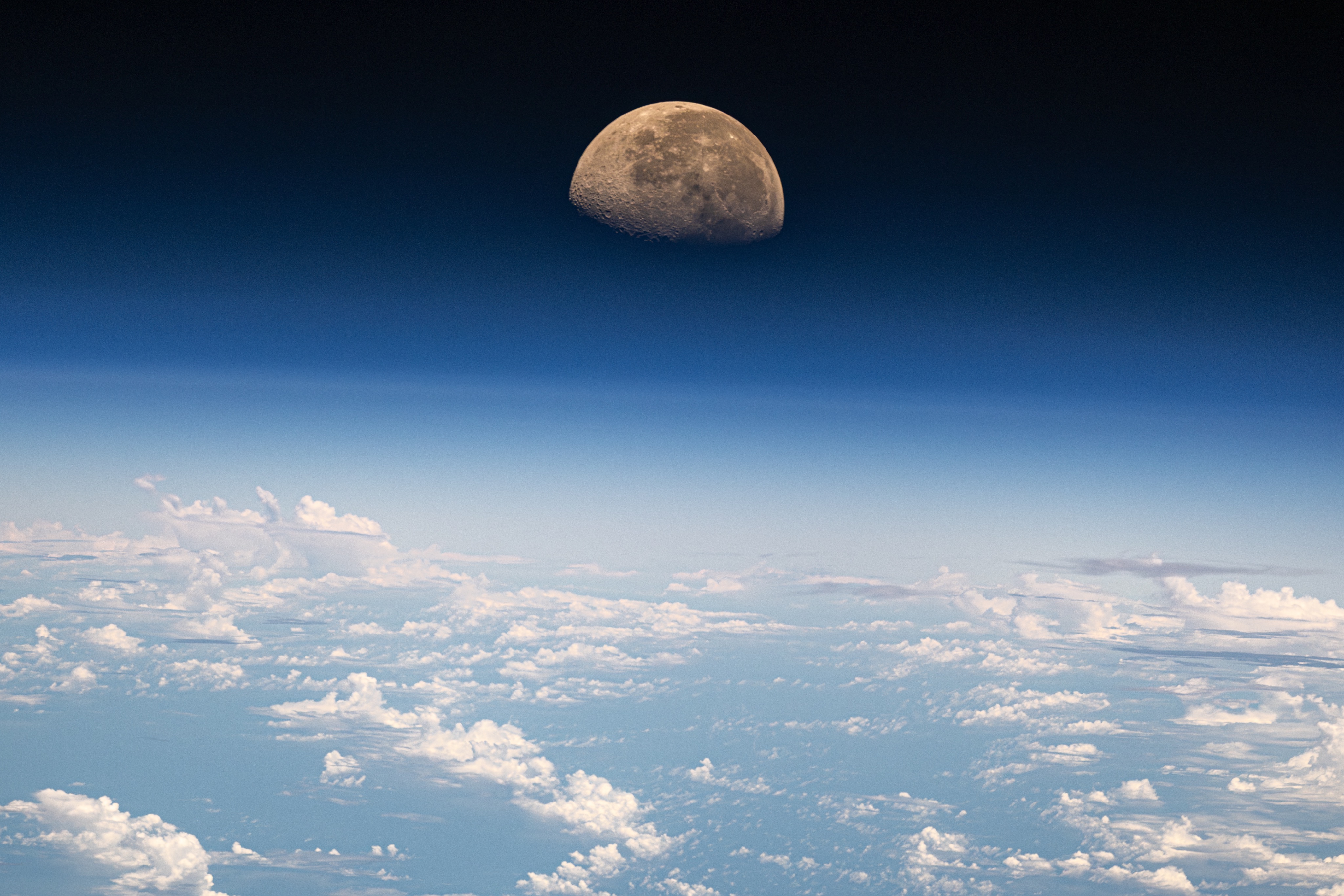
The moon setting over the Pacific.
Went to the cupola to shoot Tropical Storm Hone near Hawaii but right after we passed by the storm the moon started to set.
400mm, ISO 500, 1/20000s shutter speed, f2.8, cropped, denoised.
https://x.com/dominickmatthew/status/18274919369969218062)
So many cool little things in this short timelapse . . .
* a cosmonaut turns off the lights inside the Soyuz
* the lights of San Francisco reflect off the Soyuz solar arrays before we see San Francisco
* San Francisco Bay Area
* different layers of the atmosphere are seen in green and orange
* Milky Way core
I got greedy with ISO to see Milky Way core and the cities ended up being way over exposed.
28mm, f1.4, ISO12800, 0.8s exposure, timelapse 1 sec intervals.
https://twitter.com/dominickmatthew/status/18296678615995721013)
A timelapse of solar arrays reflecting aurora and city lights as they align themselves for the impending sunrise.
The solar array light reflections were so mind blowing that I stayed up till 1AM to shoot a few more sunrises. Luckily we get sunrises every 90 minutes.
One of the techniques I have learned over the past few months to get great still photos is to setup lots of timelapses to find great lighting. With a timelapse the camera takes a RAW photo on a time interval that is typically every 0.5s and saves the image. Our camera has an option to automatically create a video from the sequence of images. We then watch the video afterwards to find what part of the of the orbit amongst thousands of individual images has the best lighting or subject matter to either go back later to the same part of an orbit and take a still image or pull the still image saved from the timelapse process.
Yesterday the moon was not up during the night portions of our orbits so I knew I had a shot at getting the Milky Way core and some aurora. The timelapse was setup in a module we call МИМ2. It has a great view of the service module solar arrays. There are were so many great still shots in the timelapse series but the ”dance” the solar arrays do reflecting aurora and city lights is so cool to see with a timelapse video. A still image does not fully capture it.
1.6s, 15mm, T1.8, ISO 6400, 2s intervals. Exposure and a few items adjusted on a few hundred individual frames simultaneously before making a 15fps timelapse.
https://twitter.com/dominickmatthew/status/1830327598821380224Mind officially blown
https://x.com/Astro_Woody/status/1830841787419681267
2:21 AM · Sep 1, 2024
Reds and greens from the aurora as well as city lights reflect off the service module solar arrays with the Milky Way core behind the space station. The solar arrays and service module are bathed in a light horizon blue from a sun about to rise behind the camera.
Single image taken from a timelapse (will post timelapse video soon).
15mm, T1.8, 1.6s, ISO 6400, denoised
https://x.com/dominickmatthew/status/18300383156989217814)
I showed this to a couple of friends yesterday to see what they thought. They both thought it was a meteor exploding in the atmosphere - a rather bright one called a bolide. Timelapse is slowed down to one frame per second for you to see it streaking and then exploding.
If you know about these type of meteors please chime in. I am curious to know more.
I will post the longer timelapse over the Nile river later.
Timelapse was setup over Northern Africa where it was very dark with lightning. I got greedy with ISO (25600) and when the timelapse got to Cairo the cities were overexposed. I was greedy because I wanted the Milky Way Core. When I went to review the shots afterwards I found the bolide.
1/2s exposure, ISO 25600, 15mm, T1.8, 1/2s intervalometer, 1 fps for the timelapse playback
For those asking about date and time for meteor tracking: The meteor exploded on 2 Sept 2024 at 20:12:20 GMT based on the clock in the camera which may be off by 30s or so either side.
https://twitter.com/dominickmatthew/status/18311085005182403445)

2:37 AM · Aug 17, 2024
Lightning at night over India.
When trying to capture lighting in an image I use burst mode and hope lighting strikes in the frame. I was super happy when this lightning strike ended up in the middle of the frame. No crop needed.
1/5s, 85mm, f1.4, ISO 6400
https://x.com/dominickmatthew/status/18246064166167757646)
4:28 PM · Sep 6, 2024
We recently received some neutral density filter films that temporarily go over the windows in the cupola. They act like sunglasses for the windows. These filters allow us to shoot video and photos from inside the cupola that are exposed for both the inside and outside. For camera nerds, the filters are ND 1.2 dimming the outside light by four full stops (4 EV). We got to test it out with the interview below. I am digging up a comparison video as well where one window has a filter and the other does not.
https://youtube.com/watch?v=wTPnvNGNmnY
https://x.com/dominickmatthew/status/1832063224084156419
 Wątek: MT Dominick - 07.12.1981 (Przeczytany 1105 razy)