#OTD 10 December 2006, launch of ESA astronaut Christer Fuglesang on Space Shuttle STS-116 Discovery to the International Space Station on his 12-day #Celsius mission, becoming the first Swedish citizen in space.
https://bsky.app/profile/eurospacehistory.bsky.social/post/3lcxja3khb22whttps://x.com/ESA_History/status/1733780593404457054STS-116 Space Shuttle Discovery Scrubbed Launch Attempt - Full Countdown‘Lighting Up the Nighttime Sky’: 10 Years Since STS-116 Brought Power to the Space Station (Part 1)by Ben Evans december 10, 2016
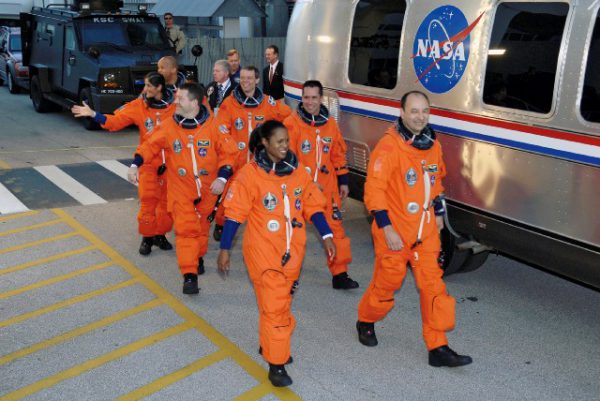 Commander Mark Polansky leads the STS-116 crew out to the pad on 9 December 2006. Photo Credit: NASA
(...) Docking at Pressurized Mating Adapter (PMA)-2, at the forward-facing end of the U.S. Destiny lab, occurred at 5:12 p.m. EST. A little over 90 minutes later, following customary pressurization and leak checks, the hatches were opened and Polansky’s crew floated aboard the orbiting outpost, creating a crew of 10 astronauts and cosmonauts from four sovereign nations, the United States, Russia, Germany, and Sweden. After the customary safety briefings, Sunita Williams transferred her custom seat liner over to the Soyuz TMA-9 spacecraft, docked at the aft end of the station. This would provide Lopez-Alegria, Tyurin, and Williams with an escape vehicle in the event that an emergency forced them to evacuate the ISS. In tandem, Reiter officially became a member of Discovery’s crew for the return to Earth, later in December. (...)
https://www.americaspace.com/2016/12/10/lighting-up-the-nighttime-sky-10-years-since-sts-116-brought-power-to-the-space-station-part-1/‘A Lot of Cheers on the Ground’: 10 Years Since STS-116 Brought Power to the Space Station (Part 2)by Ben Evans 11 December, 2016
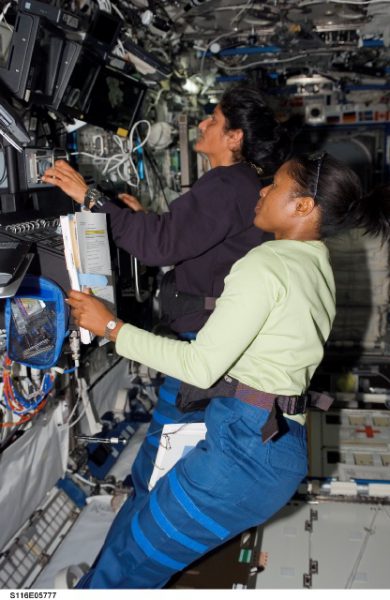 Joan Higginbotham (foreground) and Sunita Williams at work aboard the space station during STS-116. Photo Credit: NASA
(...) Also during those final days, the STS-116 astronauts deployed a trio of coffee-cup-sized satellites for the Department of Defense’s Space Test Program (STP). First was the Microelectromechanical System-Based PICOSAT Inspector (MEPSI) to evaluate the capabilities of low-power satellites to observe larger spacecraft for damage assessment, followed by the Radar Fence Transponder (RAFT), which housed a range of U.S. Naval Academy student experiments for space surveillance and communications. Finally, Fuglesang and Higginbotham deployed the twin microsatellites of the Atmospheric Neutral Density Experiment (ANDE) to examine the effects of atmospheric drag in low-Earth orbit. (...)
https://www.americaspace.com/2016/12/11/a-lot-of-cheers-on-the-ground-10-years-since-sts-116-brought-power-to-the-space-station-part-2/https://www.nasa.gov/mission/sts-116/KHW
https://www.forum.kosmonauta.net/index.php?topic=800.msg172192#msg172192ACF
https://www.forum.kosmonauta.net/index.php?topic=4457.msg160647#msg160647
 Wątek: 10.12.? (Przeczytany 2057 razy)