Gravity Assist: Meet a Webb Scientist Who Looks Back in Time (2)
Jul 29, 2022
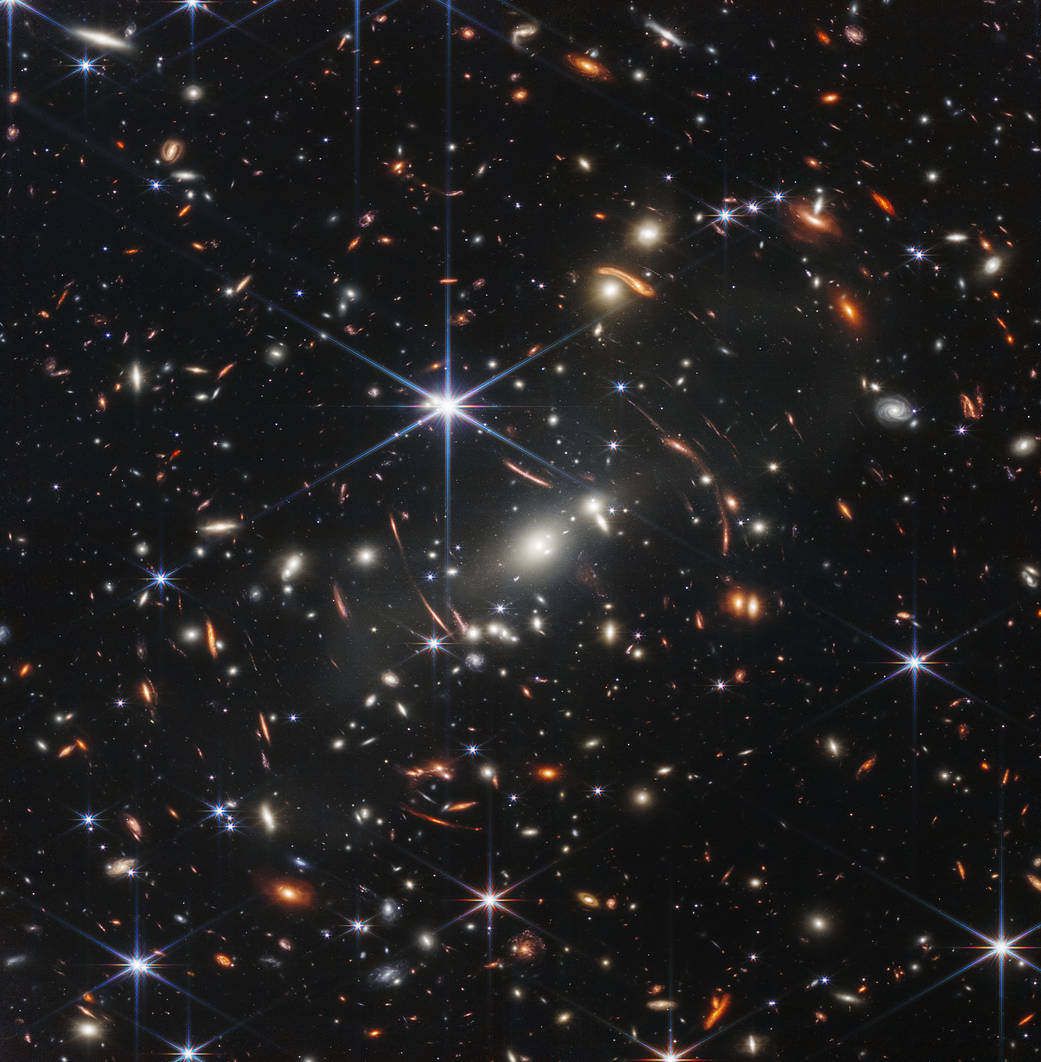 NASA’s James Webb Space Telescope delivered the deepest and sharpest infrared image of the distant universe so far. Webb’s First Deep Field is galaxy cluster SMACS 0723, and it is teeming with thousands of galaxies – including the faintest objects ever observed in the infrared. Credits: NASA, ESA, CSA, and STScIhttps://www.nasa.gov/webbfirstimagesJim Green: Yeah, I know!
John Mather: So there we are. The Stephan’s Quintet showed yes, yes, you can see, as much far back towards the beginning of time, as we said. There's a black hole in one of them. And you can study the black hole, called an active galactic nucleus. There's a galaxy that's closer than the others in the picture. And we can see that it's all sort of pimply because you're seeing individual stars.
Jim Green: I know, that just blew me away when I saw that, yeah.
John Mather: That's a category of stars that jumps out because they're red. And so the infrared telescope picks them up very well. Then we got the picture of the Carina Nebula, where stars are being born as we speak, and there are hundreds of them being born inside that cloud. And so you need a tour guide to be able to find all the cool things in that one. And so anyway, we are so thrilled that it's not only working on doing the science, but it's pretty to look at.
Jim Green: It is. You know, to me, the beauty in the images, in all of them are in the details, the ability to then zoom in, I mean, the deep field image, where the distant galaxies are just popping out all over the place, is really startling. Now, what surprised me about that, in these early galaxies, is many of them have already evolved into a spiral- like or flat, flattened, wheel-like surface, as it is rotating around their center. What were your thoughts about the deep field?
John Mather: Oh, well, number one, it's what we said it would be. There are galaxies everywhere.
Jim Green: (laughs) There are galaxies everywhere. (laughs)
John Mather: When we said the Hubble picture, the Hubble Deep Field was great, but not far enough, what we expected was the things that are the farthest away the hardest to see, they're just going to be the tiniest little infrared specks. And now the Webb telescope can see them and say what's in them? What are the chemical constituents of those little specks? As well as how far back are they in time? The tiny red specks -- well, even the Webb telescope can't see their shapes very much. But we can see that they're there and see what they're made of. We can count them, and see how many.
John Mather: So our current story is that our Milky Way galaxy, with its beautiful spiral shape is probably made of maybe 1,000 little bits that were pulled together over time. And we've still got two that are falling in, the Magellanic Clouds, right. But it's really hard to work out the archaeology of the galaxy that we live in. So sometimes you can learn things by looking at other people's galaxies, other people…. Really, we don't really know that there's anybody out there.
Jim Green: (laughs)
John Mather: But why wouldn't there be?
Jim Green: (laughs) Yeah, right! Of course, of course.
Jim Green: Are you on some teams right now studying certain aspects of what JWST is doing?
John Mather: Actually, I'm not I did not propose to observe with the telescope. You know, what I'd love to do is imagine new ways to build equipment. And so I'm onto what's the next kind of equipment to build?
Jim Green: Wow, I did not know that. (laughs)
John Mather: Yeah, so I’ve got a couple of things in mind, started off about four years ago with an idea to make an orbiting starshade. So a starshade is conceived so you can see planets around other stars. And the problem that's to solve is that the stars are incredibly bright compared to the planets. So there's a huge amount of glare, so you can't do it. So what do you do, you either have to build a perfect telescope and put a coronagraph in it in space, or put up a starshade with a less perfect telescope and cast a shadow of the star onto the telescope without blocking the planets.
John Mather: So this is a good hard problem. And I thought, when I heard about it, well, first, can we do it with the Webb telescope? And the answer was, well, that's too hard right now. But what about the telescope on the ground? We have enormous telescopes coming on the ground, the biggest one is 39 meters across.
Jim Green: Wow.
John Mather: it’s six times as big as the Webb.
Jim Green: Wow.
John Mather: So we got to find a way to use it for that. So the upshot is, you could do this, if you could do a starshade 100 meters in diameter, and put it 170,000 kilometers away from Earth, so it can cast a shadow of the star onto the telescope. And then you have to line it up and keep it there for a while. So this is a good hard engineering problem, and it is not impossible. I am working on that. In fact, I got a nice support from Headquarters through the NIAC, this NASA Institute of Advanced Concepts,
Jim Green: Right.
John Mather: …to study what I'm calling the “hybrid observatory of Earth like exoplanets.” So we currently have a design challenge open on GrabCAD, GrabCAD.com. You can sign up and send us a drawing of how you think you could solve our problem.
Jim Green: That sounds fantastic, John. Yeah, those next new steps are really critical. And I find that the engineering community working with a scientific community are coming up with some really spectacular concepts. In fact as you say, that starshade has a very specific shape. And, it had to be determined by I guess, supercomputers or other methods of computation to determine that shape. Were you involved in some of that activity then, too?
John Mather: That initial work was a long time ago. We know what shape we need to build, but it's just really hard to build it because it is so immense. 100 meters is bigger than the whole lot my house is on.
Jim Green: (laughs)
John Mather: So that's hard, and it has to be pretty lightweight, which makes a good challenge. So that’s pretty cool.
John Mather: So that's what I like to do. I love inventing things.
Jim Green: Well, that sounds fantastic. And as we can do these next generation telescopes, the ability to get to smaller planets is going to enable us to perhaps find something that's more like Earth than we've ever seen before. So I'm tremendously excited about that.
Jim Green: And of course, what James Webb Space Telescope is going to be doing is helping us understand what that next generation telescopes will be, because it's gonna be taking spectra of planets. And in fact, one of those first images was a spectrum of a Jupiter sized planet. That really got me excited.
Jim Green: I mean, this was just an exciting opportunity to then really tease out what the chemical composition is of an atmosphere.
Jim Green: The concept of being able to look at those exoplanets is critical, and also compare them with our own planets here in our solar system. So one of the first images in the solar system that have been released, of course, was of Jupiter, and its moon, actually several moons, but the one that was really exciting with a shad ow cast on the planet was Europa.
Jim Green: How'd you like that one, wasn't it fantastic?
John Mather: Well it was lovely. It was, you know, we took that picture to just make sure the telescope would do that kind of picture. Because Jupiter's incredibly bright, how are we going to know that we can see faint things next to bright things that the guide star system is going to work and all that. So that was a really important thing to prove that we could even make those observations. And then it's so beautiful, because you see Europa you see Metis and other little satellites out there. So Europa is especially important for people because as you especially know, we're sending a probe out there to pay more attention because it could have life in the ocean under the ice. So we're going to be watching that one, especially from here. And you could even see with the telescope, it has a shape, it's not just a little dot. And so we'll be watching the places where the water comes spitting out of the cracks between the ice blocks to see is there anything interesting in the molecules coming out, and then it'll be even better to fly through the plumes with a probe. But this is pretty cool.
John Mather: We'll be looking at Titan too, I guess. Titan is an exciting thing to me. Because you know, people are always asking me, Are you sure the kind of life that we're looking for is the right kind to look for? And so here on Earth, it's all carbon based in liquid water solvent? Well, on Titan, there are an awful lot of geological or, Titanological things that are similar to here on Earth. They've got rain, and clouds and weather and rivers and lakes, and, but they're made out of hydrocarbons, ethane, and methane, especially. So if it's geologically possible for life to exist in a circumstance like that, well, that's a pretty good place to look. So we'll be watching that one to do the chemistry from a distance with our infrared spectroscopy. And the surface may have different chemistry in different places. And as we are really thrilled to do NASA is going to send a probe out there to land on this lovely satellite in a helicopter.
Jim Green: Yeah, in addition to that, all those other missions that we talked about, like the Europa Clipper, that'll be launched in a few years, make it to Europa and do these fabulous studies up close and personal, while JWST is looking at the context. And also for Dragonfly, which will be launched at the end of this decade and make it to Titan, a moon of Saturn, that will also be observing and running around on Titan at the same time JWST will be observing it. So the overlap of these missions to me is just excitingly important, and in it really enables Webb to be so versatile. But are you excited more about one set of science than any other on Webb?
John Mather: I'm excited about two things that I think we really could get surprises from one is the very early universe because we've never seen that stuff at all. Something could be going on that just doesn't fit the standard story. And we would never know if we don't look. So the Webb telescope is going to look, is looking. And the other place we could get a big surprise is about all those planets. It could be an interesting surprise or a disappointment either way, what we have in the catalog, several dozen planets to observe through the transit technique to get their atmospheric characteristics. Well, the big ones are guaranteed to have atmospheres because that's what they are. The little ones little rocky bodies size of Earth and the temperature of Earth -- well, maybe they're they're rocks, and maybe they have atmosphere. And that's a big number one question.
Jim Green: Yeah.
John Mather: And it tells us something about whether there could be life out there, we have a hope of seeing the signs of water on some little rocky planet. And on the other hand, it could be that, nah, nothing there. We have to build a different telescope to find out.
Jim Green: Right!
John Mather: Because Earth is actually a very special place. In our solar system, it's the only place which we like. You couldn't possibly live on Venus. Mars would require engineering support from home forever.
Jim Green: (laughs)
John Mather: And so what else you're going to do? Earth is special. And we're kind of disappointed and surprised that no other solar system like ours has turned up yet.
John Mather: Now it's hard to find them anyway. But here we have in the solar system four little rocky planets near the sun and one of them's the nice place for us. One of them might have been in the past, maybe the other one was too, Venus and Mars might have been habitable before. But then we got a gap and then we got four gaseous planets that are all chilly. So nothing like that’s turned up in the rest of the planetary systems we’ve found. So how come? So maybe Earth really is more special than we ever thought.
Jim Green: So John, I always like to ask my guests to tell me, you know, that person place or event that happened to them that really propelled them forward to become the scientist they are today. And I call that event a gravity assist. So John, what was your gravity assist?
John Mather: Well, I think back on my trajectory, of bouncing off various gravitational forces, and as far back as I can remember, I wanted to be a scientist. Even in third grade, I knew of scientists. I knew about Darwin and Galileo and I thought they did heroic things. People didn't always like what they said. But that just proved to be how important it was. So my parents and my school system gave me many opportunities to try and expand my interests. So I grew up in the countryside, on an experimental farm, actually, of a university in New Jersey, Rutgers University. So I was a little bit exposed to science because my dad was a scientist, but he didn't understand the physics part. He was studying dairy cows. So that was pretty remarkable. At any rate, I had many opportunities from family, from school, to try hard things.
John Mather: So sometimes I tried them and I succeeded. And that gave me a little bit of a boost to say, okay, maybe Galileo and Darwin could do great things. Maybe I could do something too. So somehow I got enough encouragement to think well, maybe you can't do it, maybe you can, but why not try. So I put my heart into becoming a scientist all along, starting quite young.
John Mather: Quite a lot of the time of a scientist is thinking about things that are not working, we have to be very tolerant of, “gee, I haven't solved this problem yet.” And, gee, somebody else might be ahead of me. And a lot of other things like that, that seem intimidating. But it is part of being in the process of organized curiosity. So in the end, you get to see huge results. When you look at the house that you might live in, you say, “where did this all come from?” This is based on scientific principles, implemented by engineers and society. So but it's still nice to be able to say, you know, that paint on the wall, those elements came from stars. The wall itself came from inside stars. The chemical elements in my body came from inside stars. And how did that all work? Well, let's find out.
Jim Green: Thanks, John, for joining me and discussing how you got involved in this fabulous JWST. It was really quite an honor to have this opportunity to chat with you today.
John Mather: Thank you, Jim. I never could have imagined this whole trajectory, no matter how many gravity assists there are. It was fun talking with you.
Jim Green: Well, join me next time as we continue our journey to look under the hood at NASA and see how we do what we do. I'm Jim Green, and this is your gravity assist.Credits
Lead producer: Elizabeth Landau
Audio engineer: Manny Cooper
Last Updated: Jul 29, 2022
Editor: Gary Daines
Source:
https://www.nasa.gov/mediacast/gravity-assist-meet-a-webb-scientist-who-looks-back-in-time
 Wątek: Astronomy Picture of the Day (Przeczytany 5070 razy)