Wywiad z astronautą przed pierwszym lotem.Personality Spotlight;NEWLN:Mark C. Lee: Atlantis astronaut
UPI Archives May 4, 1989
Mark Lee, making his first space flight aboard the shuttle Atlantis, is responsible for launching a half-billion-dollar spacecraft to Venus, a responsibility the 36-year-old astronaut takes very seriously indeed.
'On board, you can kill the spacecraft,' he said in an interview. 'If you don't do it right, you can kill it. So it's not a nice thing to do. The challenge is to know more about the vehicle than you ever need to know.'
Lee, an Air Force major, and four veteran shuttle fliers are scheduled to blast off aboard Atlantis to launch a robot probe to Venus called Magellan. The spacecraft was designed to map the planet with an imaging radar system capable of penetrating the thick clouds that perpetually block the planet's surface from view.
'He's highly focused on doing this deploy right and he's studied the inner workings and the hidden mechanisms of the booster and the payload to the point that he can usually solve a problem ... in his head quicker than we can get information from the ground,' Atlantis skipper David Walker said. 'A true expert in the best sense of the word and just a lot of fun to have around.'
Magellan is the first American interplanetary probe to be launched in 11 years and one that Lee, a jet pilot who holds a master's degree in engineering, feels can help scientists learn more about Earth's fragile environment.
'We don't hardly understand our own planet,' he said. 'Last year we had the drought in the midwest and we worry about ozone depletion and things like that that affect our planet. It makes me wonder, say a million or two billion years ago, what was Venus like?
'It would be nice to know if there was something that impacted that planet we can understand. It's a terrible atmosphere now. Maybe we can learn something about our solar system and maybe eventually save our own planet from destruction.'
But Lee cautions against 'overselling' Magellan based on what it might reveal about Earth.
'It could be sold on its scientific merits alone,' he said. 'But it's sort of piggybacked on the fact that there's this runaway greenhouse effect on Venus. So the mission's being sold a little bit from the standpoint that we don't want Earth to end up like Venus. And that's maybe a little bit of scare tactics.'
Born in Viroqua, Wis., Lee received a bachelor of science degree in civil engineering from the U.S. Air Force Academy in 1974, and a master's degree in mechanical engineering from the Massachusetts Institute of Technology in 1980.
After graduating from the Air Force Academy, Lee completed pilot training at Laughlin Air Force Base, Texas, and spent 2.5 years at Okinawa Air Base in Japan with the 25th Tactical Fighter Squadron flying F-4 'Phantom' jets.
At MIT he studied lightweight materials useful in aircraft design and then was was assigned to Hanscom Air Force Base, Mass., in the Airborne Warning and Control System -- AWACS -- program office.
In 1982, he began flying F-16 fighters and was serving as flight commander in the 4th Tactical Fighter Squadron at Hill Air Force Base, Utah, at the time of his selection as a NASA astronaut in May 1984.
Married to the former Deidre Ann O'Brien of Oklahoma City, Okla., Lee is an avid outdoorsman who enjoys golf, jogging and swimming. He also lists carpentry and furniture refinishing as hobbies.
Like his crewmates, Lee takes special pride in playing a role in the launch of the Magellan probe.
'Nobody talks about, well I was on the Syncom 4 mission. But we're the Magellan mission. You identify with the payload, which has probably never been done before except for Spacelab. So from our standpoint, it's really nice to identify with a payload rather than being a number.
It is clear that the deployment of Magellan, and its two-stage 'Inertial Upper Stage' -- IUS -- will be the highlight of the mission for Lee.
'I just want the deploy to go right. I've been working on IUS so long and I've been working with the people at Sunnyvale (an Air Force control station for the IUS in Califonria) and I just want to step through it exactly the way we've briefed it and talked about it and once it's gone, then we'll get into a lot of the middeck experiments.'
Earth photography is a major part of the crew's activity plan in orbit, which Lee said was an important aspect of any shuttle mission because it helps point out 'those areas around the world that could be trouble spots, where we're maybe making a mistake from an ecological standpoint.'
'If the shuttle gets that message across to people, or the space program gets it across, that it's a very delicate world. Right now, we have the capability of getting press out about the state of the world and I hope that continues, I hope it doesn't become old hat. I hope people see it and we eventually take action.'
https://www.upi.com/Archives/1989/05/04/Personality-SpotlightNEWLNMark-C-Lee-Atlantis-astronaut/1149610257600/Flying Free With Meade and Lee: Remembering STS-64, 25 Years On (Part 1)by Ben Evans 6 years ago
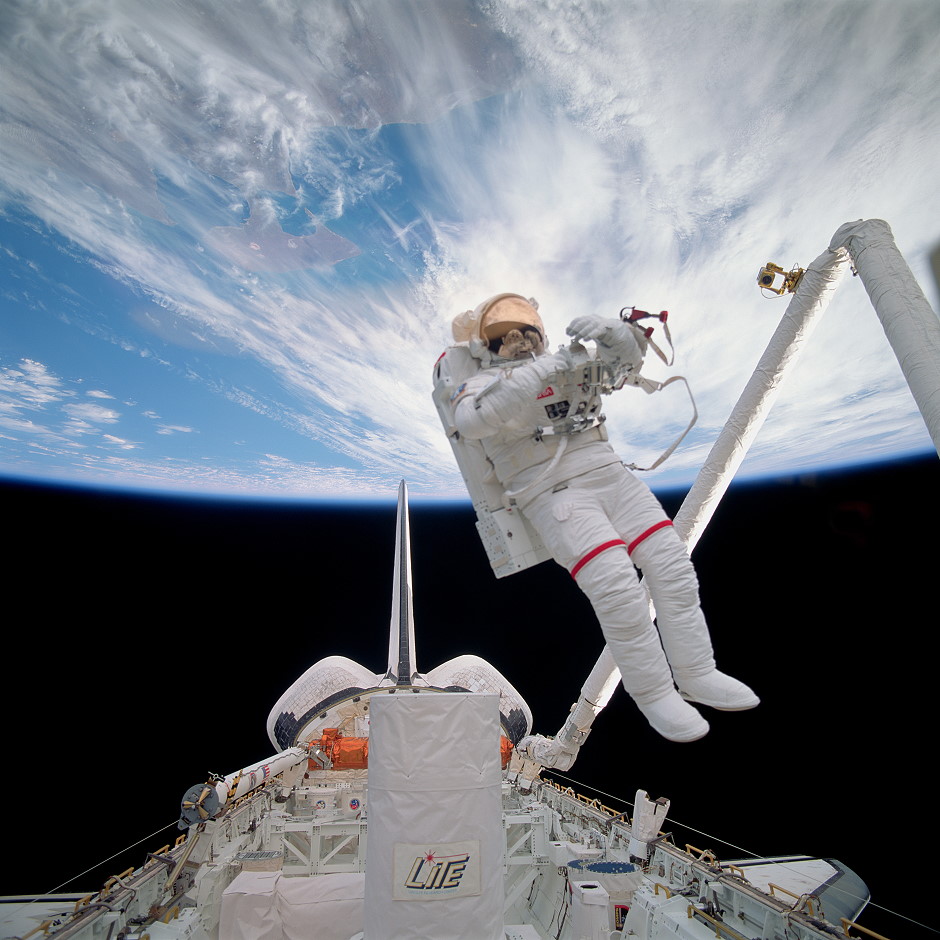 Twenty-five years ago, this month, STS-64 astronauts Mark Lee (pictured here) and Carl Meade performed the first untethered spacewalk with the Simplified Aid for EVA Rescue (SAFER). Photo Credit: NASA
On 123 occasions between March 1965 and September 1994, astronauts and cosmonauts had clambered outside their spacecraft and maneuvered themselves around in the harsh and unforgiving vacuum of space. They had used handhelds, tethers and specialized backpacks to prevent them from losing physical contact with their vehicles and inadvertently floating away into the void. But when STS-64 astronauts Mark Lee and Carl Meade ventured outside shuttle Discovery’s airlock on the morning of 16 September 1994—a quarter-century ago, this month—they wore something quite different and wholly new on their space suits. Known as the Simplified Aid for EVA Rescue (SAFER), it provided a self-rescue tool for its wearer and its descendants are today routinely used by spacewalkers aboard the International Space Station (ISS). (...)
https://www.americaspace.com/2019/09/08/flying-free-with-meade-and-lee-remembering-sts-64-25-years-on-part-1/EVAs and More on ‘Sixty-Four: Remembering STS-64, 25 Years On (Part 2)by Ben Evans 6 years ago
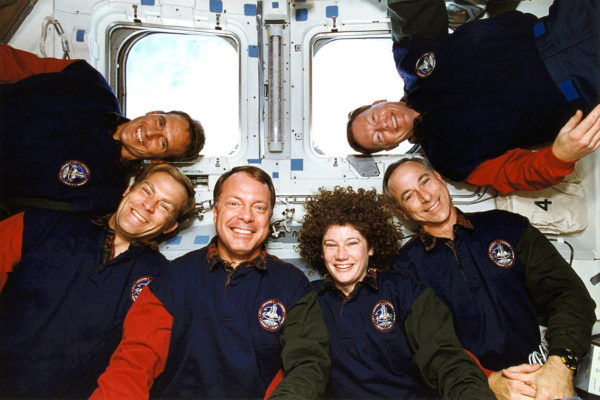 The STS-64 crew pose on Discovery’s flight deck. From left are Jerry Linenger, Mark Lee, Blaine Hammond, Susan Helms, Carl Meade and Dick Richards. Photo Credit: NASA
(...) Yet the high-visibility nature of the spacewalk was only one facet of STS-64. When the bulk of the crew was named almost a year before launch, the core objectives of the flight were the deployment and recovery of the Shuttle Pointed Autonomous Research Tool for Astronomy (SPARTAN)—which would bring a suite of solar physics instrumentation to bear on our nearest star, the Sun—and operations with the Lidar In-Space Technology Experiment (LITE). The latter was tasked with directing narrow pulses of laser light in the atmosphere and utilizing a telescope to measure the reflectance qualities of clouds, suspended aerosol particles and the surface itself.
Developed by NASA’s Office of Advanced Concepts and Technology and Mission to Planet Earth, the usefulness of lidar as a remote-sensing tool derived from the fact that it could obtain very high vertical and horizontal resolutions and LITE marked the first occasion on which lidar had ever been employed in space for atmospheric observations. More than 43 hours of data were gathered and Discovery’s relatively low altitude of 160 miles (260 km) and high inclination of 57 degrees to the equator enabled LITE to cover a broad swathe of the Home Planet. (...)
https://www.americaspace.com/2019/09/15/evas-and-more-on-sixty-four-remembering-sts-64-25-years-on-part-2/https://loftyambitions.wordpress.com/2013/10/02/interview-mark-c-lee/https://www.reddit.com/r/spaceporn/comments/1fi1991/astronaut_mark_c_lee_tested_the_new_simplified/http://www.collectspace.com/sightings/sightings-lee.htmlhttp://www.collectspace.com/collection/autographs-lee.htmlNASA History Office @NASAhistory 2:45 PM · Aug 14, 2014
#Happybirthday to astronaut Mark Lee, who flew on 4 Shuttle missions: STS-30, 47, 64, & 82
https://twitter.com/NASAhistory/status/499899543140302848NASA History Office @NASAhistory 4:30 PM · Sep 9, 2024
Look, Mom! I'm floating!
On STS-64, launched 30 years ago today, Astronauts Mark C. Lee (pictured here) and Carl J. Meade performed the first untethered US spacewalk in 10 years to test the SAFER system. SAFER was a jetpack system meant for emergency use only.
https://twitter.com/NASAhistory/status/1833150876556357888Association of Space Explorers @ASE_Astronauts 4:01 PM · Aug 14, 2025
#HappyBirthday to ASE Life Member Mark Lee, who flew to space four times between 1989 and 1997 (STS-30, STS-47, STS-64, and STS-82)!
https://twitter.com/ASE_Astronauts/status/19559932639675106132024
https://x.com/ASE_Astronauts/status/1823722319774159176
 Wątek: MC Lee - 14.08.1952 (Przeczytany 297 razy)