Opowieść astronautkiFuture Space – To Boldly GoSydney Science Festival 2022 With astronaut Mary Ellen Weber
‘When you step foot on Mars, will you invite me so I can sit in your audience and I can watch your video and hear your stories?’ Mary Ellen Weber, NASA Astronaut
 As you can imagine, astronauts get to do some very cool things. The most cool thing that we get to do is, every once in a while, we get to fly into space. For me, the very second best thing about being an astronaut is actually having the chance to share the experience and the promise and the future of space with people all over the world, not just my friends and family. But that's why I'm so excited to be here tonight. And what a treat for me to help open Science Week here and the Sydney Science Festival. Now, I am going to share with you my own personal journeys and my experiences in space, but I also am going to take a little bit of time after to talk about where we're going, because we are going to some very exciting places and doing some very exciting things. And no matter how fortunate I've been to experience what I've experienced, what lies ahead for the young people that are here tonight is even so much greater.
Now, before I talk about what it’s like to be in space and about my own missions, I want to take a minute and talk about how it is that we get to space, because very many people don’t quite understand this. They think that to go into space means you go up really high, that if you go really high, there you are in space. And I guess that’s technically true.
You will be in space, but it will only be for a very brief time because this big force of gravity that allows me to stand here in front of you instead of float, this big force of gravity would pull anything up high, would pull it right back down to the ground. So we don’t go into space by going high. We go there by going fast, crazy, crazy, fast.
So think about it, if you’ve ever thrown a ball before in your life in a straight line, you know exactly what it does. It starts out in a straight line. But then that force of gravity will pull it back to earth in a curve, in an arc. The slower that ball is going, the steeper that curve is. But the faster that ball goes, the shallower that curve gets. So you could imagine that you could throw a baseball or a spaceship or an astronaut so fast that that curve, while they’re falling towards Earth, is so shallow that it's actually larger than the size of the Earth. It's still falling towards earth. Gravity is still there, but it's going around and around the world. It's missing the earth while it falls towards it.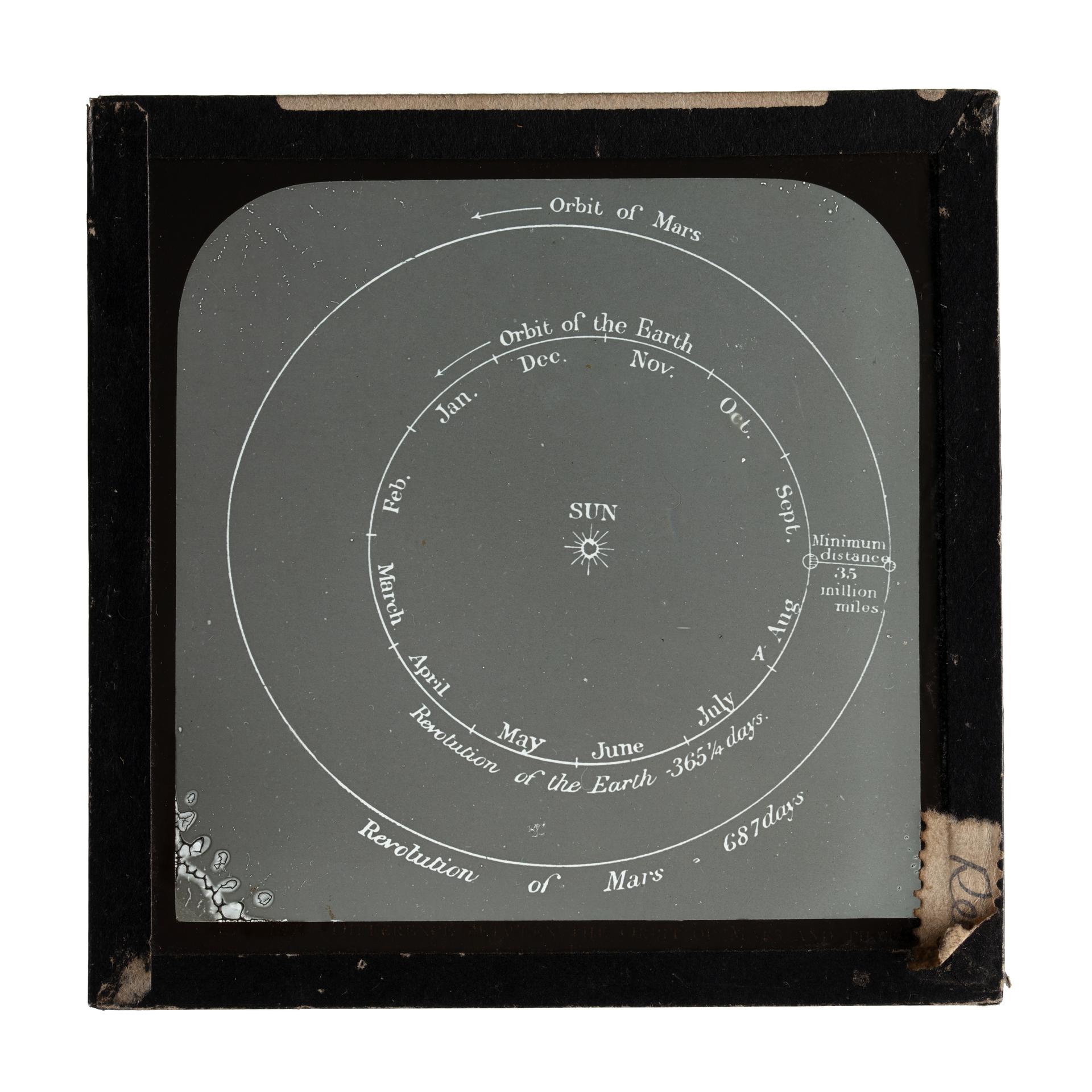 Photograph, glass plate slide, 'orbits of Mars & Earth', glass / paper, photographer unknown, used at Sydney Observatory, Sydney, New South Wales, Australia, c. 1900-1950 Object No. 85/59-26/19So how fast do you need to go to stay in space and go around and around the world? The answer is 25 times the speed of sound, 17,500 miles per hour. I haven't converted that into kilometres per hour, but it's crazy fast. It is so fast that when you are in space, you go all the way around the world in just one and one half hours. And it's very unforgiving. In fact, when we want to come home, all we do is slow down by 1%. That is the difference between staying in space and not staying in space. So, you know, everybody says you have to give it 100%. There is no better example of that than when you're actually trying to go into space. The reason why I think it's important to understand how we go into space is because, that need for speed defines everything about going into space. It's very, very difficult to get anything going that fast – you need crazy amounts of power. Crazy amounts of power. That's why we have huge rocket engines with enormous amounts of fuel, to get anything going that fast. When a crew walks out to their spaceship, they're walking out to a bomb. With the space shuttle, with the launch tower in Florida, even the rescue crews were three miles away. If our explosives went off, the blast zone would be so far that in order to protect them, the rescue crews had to be three miles away. It makes everything about going into space not just risky, but also very time sensitive. If you have a problem going into space, things are changing very rapidly. You start out still and in just mere minutes you're going 25 times the speed of sound.
‘When we want to come home, all we do is slow down by 1%. That is the difference between staying in space and not staying in space. So, you know, everybody says you have to give it 100%. There is no better example of that than when you’re actually trying to go into space.’
Mary Ellen Weber, NASA Astronaut
That means things are changing very, very rapidly. Every second, every minute, things are changing. So what do you do if you have a malfunction, how much time do you have? The answer is 5 seconds. So think about it. The master alarm starts going off, blaring at you. One, two, three, four, five. That's it. That's all the time you have to figure out what's wrong, to figure out what you want to do, confirm what you want to do and do it, or else you're not coming home. And so astronauts, why do we spend years training to be astronauts? It's because of that need for speed, that five second decision time window. We have to have the answers at our fingertips.
Yes, we have checklists. They're prepared both for the normal procedures and in case something goes wrong. But we have to be able to use them very, very quickly. And also, they only protect us for one failure. The saying goes, there's only two ways that you can get in trouble as an astronaut with your checklist. The first is if you don't follow the checklist exactly to the letter. The second way is if you follow the checklist exactly to the letter. Because what if you have two failures? Those checklists won't help you. And that's why to train to be an astronaut, there is some physical training. They want you to be healthy. But really, it's about what you know. It is about knowing every wire, every system, every computer algorithm, all the details, so that if multiple things go wrong, such as in the case of Apollo 13, in which many things happened all at once, the crew knows enough to try to save themselves.
So how risky was it to go into space and how risky is it today, you might be wondering? Well, when I went into space, my first flight was 1995 and they handed me a sheet of paper and they said, okay, here are your chances of not coming home. And it was one in 100. My second flight, they had made some upgrades to some of the rocket engines, so it was a little better. It was about one in 200. In reality, it was probably closer to one in 100, because all of those calculations are only the things we know, the reliability of every component, and what is the likelihood that they will fail. The things that took down the two shuttles that we lost, those malfunctions weren't even in that equation. We didn't even know about those things. So at any rate, what do those numbers mean? One in 100, one in 200? I did the math. And if you look at how many airline flights fly every single day, it turns out that if airlines crashed at that same rate at one in 100, there would be 1000 airline crashes every single day. Every single day. That would have to be a pretty important business trip for you to get on that plane to go to. I mean, I know you love your family and everything, but 1000 crashes every single day…you might do a Zoom call instead.
‘When I went into space, my first flight was 1995 and they handed me a sheet of paper and they said, okay, here are your chances of not coming home. And it was one in 100’
Mary Ellen Weber, NASA Astronaut
And so, as you're preparing to go into space, as you're preparing, thinking about all the systems, thinking about your checklist, thinking about your crewmates, thinking about the hundreds and thousands of people that have worked on that mission, that they are all relying on you. I mean, your worst fear, and no joke, your worst fear is not that you won't come home. It's that you won't come home because of a mistake that you made. You do spend a fair amount of time preparing not to come home. Ironically, NASA's life insurance excludes spaceflight. But NASA takes care of you. They set up an appointment for you with Lloyd's of London so that you can buy your own life insurance. So as you're preparing for all this, this great adventure, the adventure of a lifetime, you're also putting your own things in order and saying goodbye to those that you might not have a chance to say goodbye to later.
But with all that said, people have said, ‘Well, how can you take on that much risk? And aren't you just petrified and scared?’ At some point you put it behind you. You do all that you can and you think about the successful mission in the same way that when you get in your car, you put on your seatbelt, you don't text, you put away your phone, you do all the things to make it as safe as possible. And then you think about where you're headed. You don't think about what terrible things might happen to you on the crazy streets of Sydney or wherever you may be driving. I think that's the way all astronauts look at the risk of going into space.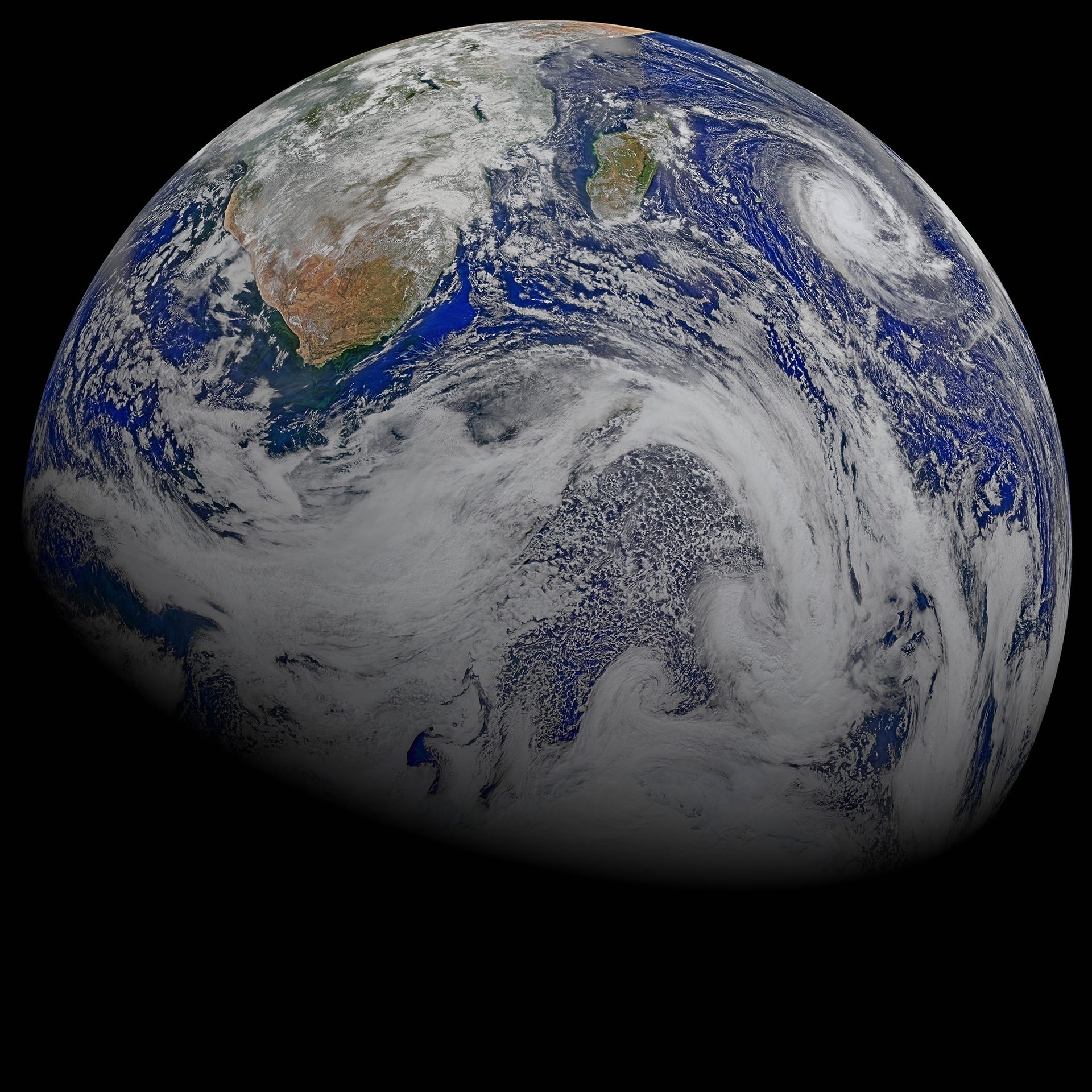 There's a couple of things I'll start out and just tell you, you know, the floating around. There is still gravity but all of that gravity is keeping your whole spacecraft in orbit around the Earth, within your spacecraft you're floating. And there's a couple of very cool things about that. There is no ceiling, there is no floor. It's all in your mind. As I'm standing here right now talking to you, if I were in space, I could very easily switch in my own mind the frame of reference, and I can envision that we are all floating from the ceiling right now with our feet plastered against the ceiling. It's a mental thing that we all do. We decide what is the floor and what is the ceiling.
The other thing that's interesting about floating in space is how annoying it is, how much time people spend trying to deal with the fact that you can't just stand there. We have little foot loops all around, these little pieces of cloth that are there for us to hook our feet into so that we can sort of stand and be stable. But even the simplest task, much less trying to replace a battery with 40 different bolts, with two different kinds of wrenches and a checklist that won't stay open to the page you need it to stay open to, something complicated like that – you can imagine how annoying floating in space is. But even as something as simple as brushing your teeth, which when you do in the morning, you don't even think about it. You turn on the water, you get your toothpaste, you're done. A minute later, you're done. In space, you're floating over your crewmate who's exercising, you're banging into the wall, you open up your locker, everything comes floating out. You're trying to herd it back in there. You get your toothpaste out and your toothbrush and you go to put it down. Except you can't actually put it down now, can you? You put it there. And then you go over and you get the water spigot that has the water that you're going to rinse your mouth out with and you get the towel and you take your toothpaste, you take the cap off and you can't put it down. You can put it there and you get distracted. You turn away. And now everything has floated away and it's gone. And then you spend a great deal of time trying to find it and you eventually find it. Most people don't appreciate just how many hours, even on a shuttle flight, a nine or ten day shuttle flight like mine, how much time all of us spent looking for things that floated away and hid from us. Even today on the space station, crew members will report finding a piece of equipment or something small that had been missing, no joke, for eight years. So that's a little bit about floating in space. Globe, wood / paper, maker unknown, place of production unknown, acquired 1969 Object No. H8544‘There is no ceiling, there is no floor. It's all in your mind as I'm standing here right now talking to you. If I were in space, I could very easily switch in my own mind the frame of reference, and I can envision that we are all floating from the ceiling right now with our feet plastered against the ceiling.’
 Mary Ellen Weber, NASA Astronaut
The other really cool thing is, of course, looking at the earth from space. The thing that I really noticed is that as we prepare for this flight, or even as we go through school, every image we see, every map we see, it's always what boundary is where, what country is where, what are the dividing lines? And when you're in space, when you look at the earth, it looks like a planet. It is a mass of blue water and land masses. And there are no boundaries. I mean, you truly feel like an earthling. You feel like you're looking back at a planet, and you really get the sense that we are all in this together as we are trying to create this space faring civilisation.
You can see meteorites going into the atmosphere below you. If you’ve ever seen a shooting star, understand that’s 50 miles above your head. And that may seem like a long way away. If you’re in space and you see a shooting star going across the edge of the atmosphere that’s 300 miles away. That is when I really knew I was no longer part of the planet, that I was off the planet. There’s one city that looks different from every other city in the world. It’s a different colour. Las Vegas. Las Vegas, of all things.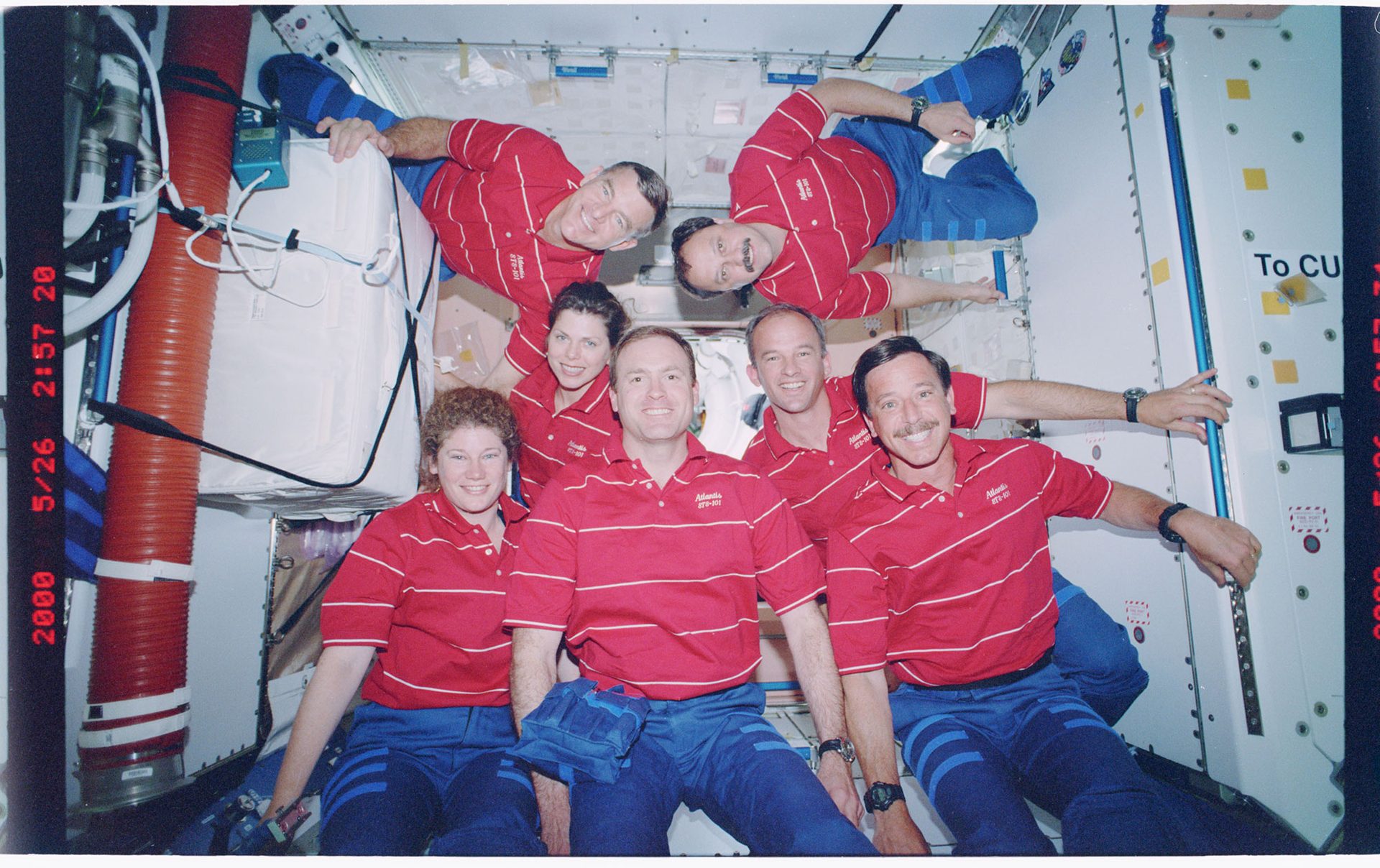 Now, this is the magnificent space shuttle. It is no longer flying. I call it magnificent because it truly, truly was. There is nothing flying today. There’s nothing being built today that had the capability of this spaceship. Now, the thing that went around and around the world is the thing on the white. That’s the space shuttle. It’s off to the left there. Most of that is trunk space. It’s a little bit like having a massive transporter van as a car. You have a little tiny space for a bus driver to be up front and the rest of it is for cargo. And that’s what our space shuttle was like.
The very tip of the space shuttle, the very tip of it, was the crew compartment was about the size of a walk-in closet. That’s what’s being launched today with astronauts. Those rockets are much, much smaller because all they’re doing is launching the very tip of that space shuttle. The space shuttle could not only carry seven astronauts for more than two weeks at a time, we could put laboratories in that trunk space in that cargo bay. We could put a satellite like the one I took up on my first mission, or we could bring up pieces of a space station so that we could assemble them piece by piece in what I think is the greatest engineering endeavour ever undertaken in humankind, to create the International Space Station.
Now, to get that thing going 25 times the speed of sound, we had three engines, rocket engines that were mounted at the very bottom of the space shuttle itself. Those engines burned liquid hydrogen and liquid oxygen. You know, we breathe oxygen and hydrogen is just like oxygen. It's a gas normally. But if you cool it down and make it really, really cold, it becomes liquid. They both become liquids that we can combine together explosively in magnificent engines that are so efficient, so powerful. They're being used today, they are part of the next rocket that is going to take humans back to the moon and one day on to Mars. More about that to come. Now, that liquid hydrogen and that liquid oxygen was all stored in that orange fuel tank that we were strapped to or connected to, and that helped us go 25 times the speed of sound. But even that wasn't enough. We needed more power. And so we had two white pointy things strapped to that orange tank. They're called solid rockets. There's one that you see on the front, and there's an opposite one on the other side. Those two solid rockets provided even more power. They're called solid rockets because the fuel was solid. The trick about solid rockets is that once you light them, you cannot turn them off. You are committed. There was no escaping the shuttle, if we had any problem, if we had an engine failure right after launch and we couldn't make it into orbit, we still had to go into space, use up all of those solid, use up all of that explosive material, before we could come turn around and come back and try maybe to land in Florida or perhaps across the ocean in Spain or Africa or Morocco. Now, that's the shuttle.
 Wątek: ME Weber - 24.08.1962 (Przeczytany 306 razy)