Pierwszy astronauta pozarządowyCharles D. Walker: The First Commercial AstronautLearn about Charles D. Walker, the trailblazing first commercial astronaut who paved the way for private sector involvement in space exploration.Imagine being the first person to represent the commercial sector in space! That's exactly what Charles D. Walker achieved when he became the first commercial astronaut. Born on August 29, 1948, in Bedford, Indiana, Walker's journey to the stars began with his education in aeronautical and astronautical engineering at Purdue University. His groundbreaking spaceflight took place in 1984 when he flew aboard the Space Shuttle Discovery on mission STS-41-D. This mission marked a significant milestone in space exploration, as it was the first time a non-governmental astronaut participated in a NASA mission. Walker's role was to operate the Continuous Flow Electrophoresis System (CFES), a device developed by McDonnell Douglas, his employer, to manufacture pharmaceuticals in microgravity. This mission was a pivotal moment in demonstrating the potential for commercial activities in space, paving the way for future private sector involvement in space exploration.
Walker’s involvement in the space program was not just a one-time event. He flew on two more shuttle missions, STS-51-D and STS-61-B, in 1985, further solidifying his place in history as a pioneer of commercial spaceflight. His work with the CFES was crucial in understanding how microgravity could be harnessed for industrial processes, which has implications for the future of manufacturing and research in space. Walker's contributions have inspired countless others in the commercial space industry, highlighting the importance of collaboration between government and private entities in advancing human space exploration.
Beyond his flights, Walker has been an advocate for space exploration and the commercialization of space. He has worked with various organizations to promote the benefits of space technology and its applications on Earth. His legacy continues to influence the growing field of commercial spaceflight, as companies like SpaceX and Blue Origin build on the foundation laid by early pioneers like Walker. His story is a testament to the power of innovation and the endless possibilities that await humanity as we continue to explore the final frontier.https://aurica.ai/en/article/martin-sparks/charles-d.-walkerCharles Walker: the first commercial astronautSeptember 4, 2019 12:23 pm Robert Zimmerman
Last night I attended another one of the monthly Arizona Space Business Roundtable events held here in Tucson to bring together the business-oriented space community of this city.
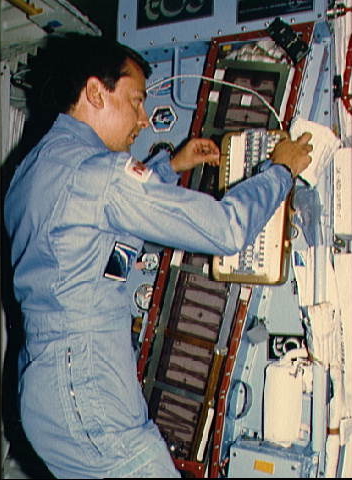 The speaker was Charles Walker, who had flown three shuttle missions in 1984 and 1985, but not as a NASA-employed astronaut but as an employee of McDonnell-Douglas, making him the first astronaut to fly in space under the employ of a private commercial company.
Walker’s job then was to monitor and maintain a drug-processing unit designed to produce large quantities of pure biological hormones that on Earth were simply not possible. Gravity polluted the process, while weightlessness acted to purify things. If successful the hormone produced could be sold to fight anemia, especially in individuals taking radiation treatments. The image on the right shows him on his third and last shuttle mission, launched November 26, 1985. He is working with a handheld protein crystal growth experiment, with the larger hormone purifying experiment on the wall behind this.
According to Walker’s presentation yesterday, this third flight in November 1985 demonstrated the process worked and could produce as much as one liter of hormone, enough to easily make back the cost of the project and leave room for an acceptable profit. They were thus ready for fullscale production on future shuttle flights, only to have the entire project die when the Challenger shuttle was lost on January 28, 1986. With that failure President Reagan declared that the shuttle would no longer be used for commercial flights.
Their business plan had been dependent on the artificially low launch prices NASA had been charging them for shuttle flights. Without the shuttle there was then no affordable alternative for getting into orbit.
The process is still viable, and the need for these drugs still exists. Whether they could now be flown on the new cheaper private rockets, on board future private space stations like Bigelow’s B330, remains unknown. A new company would have to pick up the pieces, as McDonnell-Douglas no longer exists, having been absorbed into Boeing.
I personally suspect there is real money to be made here, should someone decide to go for it.
What struck me most while watching Walker speak was the same thing that has struck me whenever I have seen or interviewed any astronaut: He appeared to be such an ordinary down-to-earth human being. He could have been anyone you meet anywhere.
What made him stand out, as he described his upbringing and how he became an astronaut, was not his intelligence or any physical attribute, but his clear willingness to stay focused on his goals, to work has hard as possible to make them come true. What made him succeed was an unwavering commitment. He wanted to get to space, and by gum he was going to do it!
The speaker was Charles Walker, who had flown three shuttle missions in 1984 and 1985, but not as a NASA-employed astronaut but as an employee of McDonnell-Douglas, making him the first astronaut to fly in space under the employ of a private commercial company.
Walker’s job then was to monitor and maintain a drug-processing unit designed to produce large quantities of pure biological hormones that on Earth were simply not possible. Gravity polluted the process, while weightlessness acted to purify things. If successful the hormone produced could be sold to fight anemia, especially in individuals taking radiation treatments. The image on the right shows him on his third and last shuttle mission, launched November 26, 1985. He is working with a handheld protein crystal growth experiment, with the larger hormone purifying experiment on the wall behind this.
According to Walker’s presentation yesterday, this third flight in November 1985 demonstrated the process worked and could produce as much as one liter of hormone, enough to easily make back the cost of the project and leave room for an acceptable profit. They were thus ready for fullscale production on future shuttle flights, only to have the entire project die when the Challenger shuttle was lost on January 28, 1986. With that failure President Reagan declared that the shuttle would no longer be used for commercial flights.
Their business plan had been dependent on the artificially low launch prices NASA had been charging them for shuttle flights. Without the shuttle there was then no affordable alternative for getting into orbit.
The process is still viable, and the need for these drugs still exists. Whether they could now be flown on the new cheaper private rockets, on board future private space stations like Bigelow’s B330, remains unknown. A new company would have to pick up the pieces, as McDonnell-Douglas no longer exists, having been absorbed into Boeing.
I personally suspect there is real money to be made here, should someone decide to go for it.
What struck me most while watching Walker speak was the same thing that has struck me whenever I have seen or interviewed any astronaut: He appeared to be such an ordinary down-to-earth human being. He could have been anyone you meet anywhere.
What made him stand out, as he described his upbringing and how he became an astronaut, was not his intelligence or any physical attribute, but his clear willingness to stay focused on his goals, to work has hard as possible to make them come true. What made him succeed was an unwavering commitment. He wanted to get to space, and by gum he was going to do it!https://behindtheblack.com/behind-the-black/essays-and-commentaries/charles-walker-the-first-commercial-astronaut/“A Lot Higher at MECO”: Remembering the Shuttle’s First Pad Abort, 40 Years Onby Ben Evans about a year ago
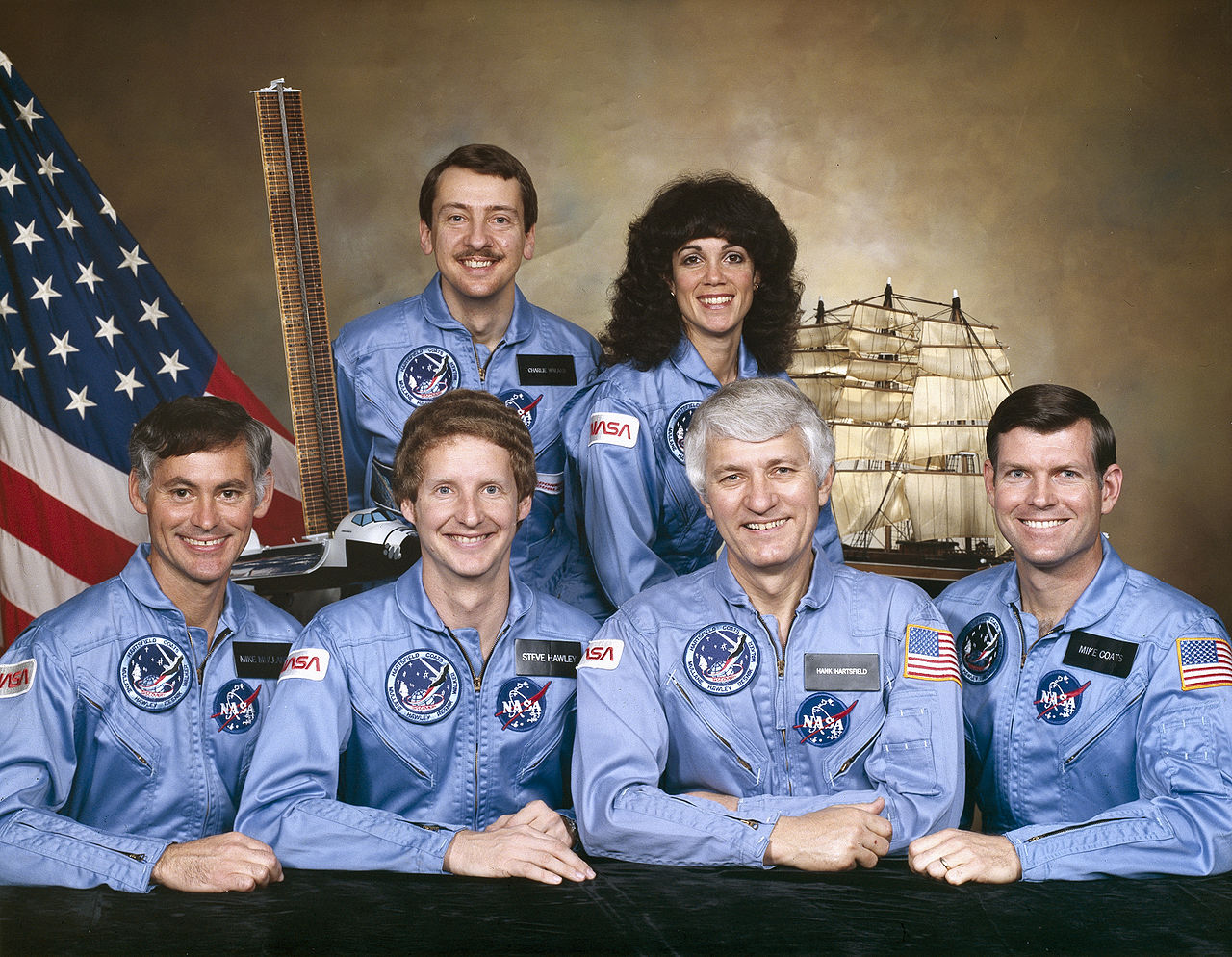 The crew of STS-41D boasted the commercial industry’s first astronaut, Charles Walker. He is pictured at top left (next to Judith Resnik). At bottom, crew members Mike Mullane, Steve Hawley, Hank Hartsfield and Mike Coats smile for the camera. Photo Credit: NASA
(...) Originally, they were designated “STS-12” and tasked with launching the third Tracking and Data Relay Satellite (TDRS-C)—part of a network of geostationary-orbiting sentinels to provide near-continuous voice and data coverage between shuttle astronauts and ground stations—but an Inertial Upper Stage (IUS) booster malfunction during the TDRS-A flight in April 1983 forced NASA to place all future TDRS missions on hold. TDRS-B (planned for STS-8) and TDRS-C on Hartsfield’s flight were thus deleted from the manifest.
Yet there were other payloads to fill the void. By the early spring of 1984, Hartsfield’s mission gained Syncom 4-1, the large-format camera, OAST-1 and a Canadian communications satellite, Anik-C1. However, the Canadian satellite disappeared quickly from the payload roster and was reassigned to another flight. (...)
https://www.americaspace.com/2024/06/26/a-lot-higher-at-meco-remembering-the-shuttles-first-pad-abort-40-years-on/Association of Space Explorers @ASE_Astronauts 12:00 AM · Aug 30, 2023
#ASEspotlight: Charles Walker 💫
In April 1985, ASE Life Member Walker (left) trained with fellow Life Member and U.S. Senator Jake Garn (right) in the middeck of @NASA_Johnson's crew compartment trainer.
Fun fact: He enjoys hiking and bonsai!
Happy 75th birthday, Charlie! 🎉
https://twitter.com/ASE_Astronauts/status/16966440658218969532024
https://x.com/ASE_Astronauts/status/1829262966014857678Association of Space Explorers @ASE_Astronauts 7:01 PM · Aug 29, 2025
#HappyBirthday to ASE Life Member Charles Walker, who flew to space three times between 1984 and 1985 (STS-41-D, STS-51-D, and STS-61-B)!
https://twitter.com/ASE_Astronauts/status/1961474245772329183
 Wątek: CD Walker - 29.08.1948 (Przeczytany 524 razy)