79//77/72/5-4)
1. start RN Atlas V 551 w 2026
1. start wykonany przez ULA w 2026.
5. start z satelitami operacyjnymi przeprowadzony przez ULA dla Amazona.
9. start dla konstelacji Amazon (1 - Ariane 6, 3 - Falcon 9).
Potwierdzono rozmieszczenie kolejnych 29 satelitów Leo.
Misja ta była największym i najcięższym ładunkiem wyniesionym na orbitę przez rakietę Atlas 5 do tej pory.
Poprzednie cztery misje Amazon Leo, wystrzelone rakietami Atlas 5, wynosiły po 27 satelitów.
Misja otrzymała nazwę Amazon Leo 5 (ULA) i Leo Atlas 5 (LA-05) (Amazon).
29 satelitów Amazon Leo zostało wypuszczonych około 21 minut po starcie.
Odbyło się 10 sekwencji rozmieszczania, które zakończyły się około 17 minut później.
Silnik RL10C-1-1 w górnym stopniu Centaur 3 został ponownie uruchomiony około 55 minut po starcie w celu zakończenia misji.Kolejny start dla konstelacji Amazona 04.04. o 05:46:00 z Cape Canaveral wystrzelona została RN Atlas-5/551, która wyniosła na orbitę 29 satelitów Amazon Leo (misja LA-05).
http://lk.astronautilus.pl/n260401.htm#05https://forum.nasaspaceflight.com/index.php?topic=64450.0Views from Space // Atlas V Amazon Leo 5Amazon Leo @Amazonleo 9:01 AM · Apr 4, 2026
Deployment confirmed: Another 29 Leo satellites have been successfully deployed in low Earth orbit, making it the heaviest payload ever launched on Atlas V.
Thanks to @ulalaunch for a successful fifth mission together.
https://twitter.com/Amazonleo/status/2040323798730232176ULA @ulalaunch 9:01 AM · Apr 4, 2026
United Launch Alliance advances @AmazonLeo constellation with successful Leo 5 launch. Atlas V precisely delivered 29 broadband satellites dedicated to connecting the world.
https://newsroom.ulalaunch.com/releases/united-launch-alliance-advances-amazon-leo-constellation-with-successful-leo-5-launch
https://x.com/ulalaunch/status/2040323936424964214Jacqmans@1972 🇳🇱🇪🇺🇺🇦 @Jacqmans1972 8:24 AM · Apr 4, 2026
@ulalaunch Atlas-V launch this morning as seen from Titusville, Florida. @Amazonleo mission 5 with an Atlas rocket.
📸 Me for @ROOM__Space
https://twitter.com/Jacqmans1972/status/2040314634519908625ULA’s Atlas 5 rocket launches its heaviest payload ever with fifth Amazon Leo missionApril 3, 2026 Will Robinson-Smith
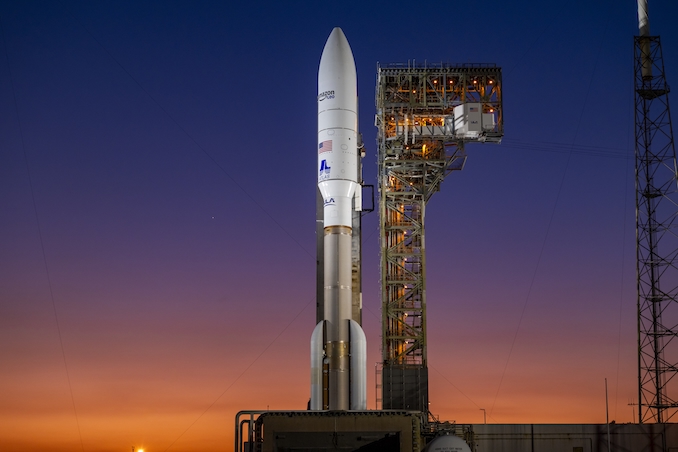 The United Launch Alliance (ULA) Atlas 5 rocket sits on Space Launch Complex 41 (SLC-41) at Cape Canaveral at sunset. This will be ULA’s fifth launch for the Amazon Leo broadband satellite constellation.
United Launch Alliance launched its latest Atlas 5 rocket, which carried a batch of 29 Amazon Leo satellites to low Earth orbit. The mission was the largest and heaviest payload carried to orbit by an Atlas 5 rocket to date, according to ULA.
The mission was called Amazon Leo 5 by ULA and Leo Atlas 5 (LA-05) by Amazon. This was the fifth launch of operational satellites by ULA and the ninth for the constellation, which included one flight by Arianespace’s Ariane 6 rocket and three flights on SpaceX Falcon 9 rockets.
Liftoff of LA-05 happened Saturday, April 4, at 1:46 a.m. EDT (0546 UTC). The rocket headed out on a north-easterly trajectory upon leaving the launch pad. U.S. Space Force meteorologists predicted a 90 percent chance of acceptable weather for the launch.
After completing its launch readiness review on March 26, the following morning, ULA began rolling out its 62.5-meter-tall (205 ft) rocket from its Vertical Integration Facility out to the pad at Space Launch Complex 41. The move began around 10 a.m. EDT (1400 UTC) and ULA reported a “hard down” at the pad at 11:16 a.m. EDT (1516 UTC).
However, with high winds forecast for the rocket’s original launch date of March 29, ULA was forced to push back the launch until the next available launch date at Cape Canaveral after NASA’s Artemis 2 launch.
The Atlas 5 rolled back to its hangar on Tuesday and returned to the pad Thursday.
The 29 Amazon Leo satellites were released starting about 21 minutes after liftoff. There were 10 deployment sequences, which ended about 17 minutes later. The RL10C-1-1 engine on the Centaur 3 upper stage then reignited about 55 minutes after liftoff for a disposal burn, which will end the mission.
The previous four missions for Amazon Leo launched on by Atlas 5 rockets carried 27 satellites each. ULA and Amazon Leo were able to increase the payload stack to 29 as “a result of detailed engineering work between ULA and Amazon,” according to ULA.
Amazon pointed to ULA’s use of the RL10C-1-1 engine on the rocket’s upper stage as a key reason why they were able to add two more satellites to the mission.
“While the engine has flown on previous missions, LA-05 marks the first time the program has completed the extensive engineering and safety analysis required to use it with our larger payload,” Amazon said in a blog post. “Our engineering teams capitalized on the additional performance margin, adding a fourth level to the previous three-tier dispenser configuration for Atlas 5.”
https://spaceflightnow.com/2026/04/03/live-coverage-ulas-atlas-5-rocket-to-launch-its-heaviest-payload-ever-with-next-amazon-leo-mission/ Wątek: Atlas V 551 | Amazon Leo LA-05 | 04.04.2026 (Przeczytany 2768 razy)