Footsteps to Mars (1993)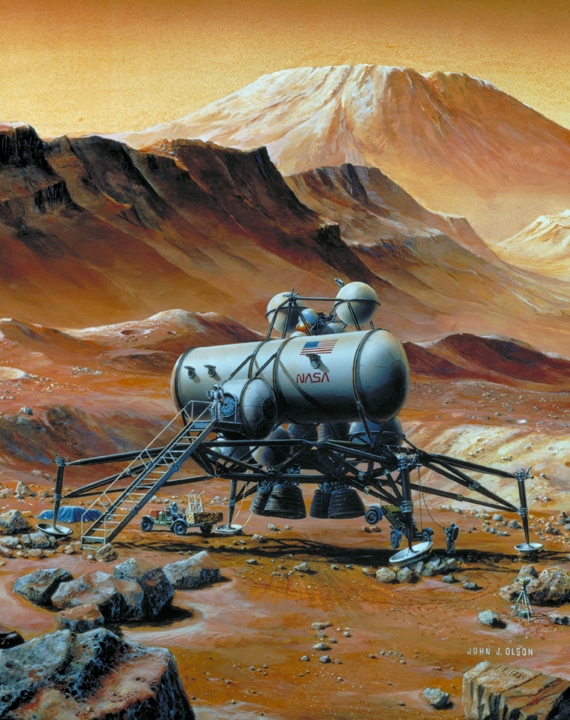 |
| The ungainly contraption pictured above is a piloted Mars lander based partly on planned Space Station Freedom hardware. Boeing proposed the design in 1990 as part of President George H. W. Bush's failed Space Exploration Initiative. Image: Boeing/NASA |
The Space Exploration Initiative (SEI), launched by President George H. W. Bush amid great fanfare on the steps of the National Air and Space Museum on the 20th anniversary of the Apollo 11 moon landing (20 July 1989), was seen by many space supporters as a new Apollo Program. Nothing, however, could have been farther from the truth.
Apollo fulfilled a perceived national need: specifically, to assert U.S. technological primacy in the Cold War with the Soviet Union. SEI, by contrast, seemed to fulfill no purpose commensurate with its projected cost. President John F. Kennedy called for Apollo at the Cold War's height; Bush proposed SEI as the Eastern Bloc disintegrated. Though Bush, a Republican, apparently felt genuine enthusiasm for space exploration, he distanced himself from SEI by the beginning of 1991, when it had become an obvious political liability.
The initiative continued with minimal funding until Democratic President William Jefferson Clinton took office in January 1993. By May of that year, when the Case for Mars V conference convened in Boulder, Colorado, NASA's moon and Mars exploration planning apparatus was in the process of being dismantled. The Case for Mars V became SEI's wake.
Geoffrey Landis, a NASA Lewis Research Center (now NASA Glenn Research Center) engineer and award-winning science-fiction author, presented a plan for recovery from SEI at The Case for Mars V. He subsequently published it in The Journal of the British Interplanetary Society. He began his paper by declaring that SEI was "politically dead" - it had, he wrote, come to be "viewed as an expensive Republican program with no place in the current era of deficit reduction." Landis then asked, "how can we advocate Mars exploration without appearing to be attempting to revive SEI?"
Landis's solution was a new piloted Mars program that would take into account lessons taught by Apollo ("If you accomplish your goal, your budget will be cut") and the Space Shuttle ("if you do the same thing over and over, the public will focus on your failures and forget your successes"). Landis's program was a 14-year series of incremental "footsteps" which, he said, would be in keeping with NASA Administrator Dan Goldin's "faster, better, cheaper" philosophy of spaceflight (at the time of The Case for Mars V, this philosophy was still in its infancy). The footsteps would, he argued, provide a series of interesting milestones that would maintain public enthusiasm for the program at least until a piloted Mars landing took place.
Landis's first footstep, which he optimistically asserted could occur "immediately," was a piloted Mars flyby mission based on existing U.S. and Russian launch vehicles and space station hardware. The 18-month mission would test a potential design for a piloted Mars transfer vehicle and demonstrate long-duration interplanetary flight and high-speed Earth-atmosphere reentry.
While close to Mars, the astronauts would take advantage of short radio signal travel time to teleoperate a rover on the planet. The rover would be launched to Mars on a separate launch vehicle ahead of the piloted flyby spacecraft. Teleoperations would enable planetary quarantine to be maintained until the debate over whether life exists on Mars could be resolved.
The second footstep in Landis's plan would be a piloted landing on Deimos. Landis noted that, with the possible exception of a few near-Earth asteroids, Mars's outer moon was the most accessible object beyond Earth orbit in terms of the amount of energy required to reach it. The mission would demonstrate Mars orbit insertion, Mars orbital operations, and Mars orbit departure. Deimos, Landis added, might contain water that could be split using electricity into hydrogen and oxygen, which could serve as chemical rocket propellants.
The third footstep was a piloted landing on Phobos, Mars's inner moon. "From Phobos," Landis declared, "the view of Mars will be spectacular." He proposed that an unmanned version of the piloted Mars lander be test-landed on Mars during the Phobos expedition. The lander might be used to collect a Mars surface sample and blast it back to Phobos for recovery by the astronauts and return to Earth laboratories for analysis.
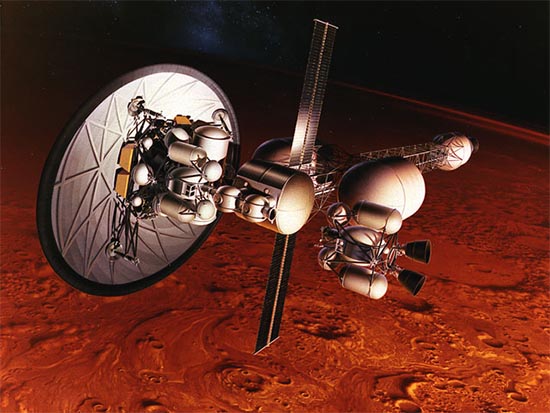 |
| Boeing design for a nuclear-thermal-propulsion piloted Mars spacecraft based on Space Station Freedom hardware heritage. The large round bowl at left is the heat shield for one of the mission's two piloted Mars landers, which nestles in the bowl. The lander is depicted on the surface of Mars in the image at the top of this post. An ascent stage from another Mars lander is about to dock. The ascent stage is shown in more detail in the image near the bottom of this post. Boeing proposed this inelegant design during 1990 for President George H. W. Bush's abortive Space Exploration Initiative. Image: Boeing/NASA |
Landis's fourth footstep would encompass several piloted Mars lander tests in Earth orbit and on the moon (incidentally returning Americans to the moon for the first time since Apollo 17 in December 1972). This would set the stage for the fifth footstep, a piloted landing during summer on one of Mars's polar ice caps.
Landis wrote that the martian ice caps contained readily accessible water that could be melted and split into hydrogen and oxygen propellants. In addition, the summer pole would receive continuous sunlight. Landis, a space power system engineer, noted that this would make highly efficient the use of electricity-generating solar arrays. Because the Sun would not set, the expedition would need neither batteries nor the extra solar arrays required to charge them for periods when the Sun was below the horizon.
The Mars temperate landing, the sixth footstep, would mark the culmination of Landis's program. Successfully accomplishing a landing in the martian mid-latitudes would, Landis predicted, result in budget cuts and Mars program cancellation within two years.
His seventh footstep was, thus, designed to postpone the inevitable. He argued that a landing in Valles Marineris, Mars's equatorial "Grand Canyon," would provide a spectacular coda exciting enough to forestall program cancellation.
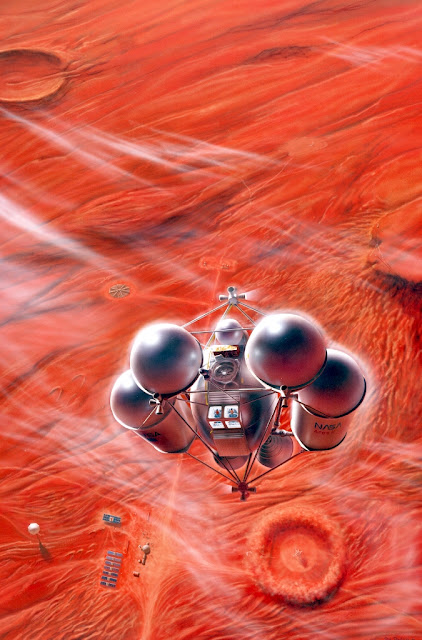 |
| Liftoff from Mars - time to slash the Mars program budget. Painted by Pat Rawlings for NASA, this image depicts the ascent stage of the Boeing-designed piloted Mars lander shown at the top of this post. Though Geoffrey Landis expected that Americans would support only two or three piloted Mars landing missions before they lost interest, this optimistic Space Exploration Initiative-era painting hints at an on-going piloted Mars program: shown on the surface are habitats, solar arrays, a tethered research balloon, and a nuclear plant. |
Landis wrote that finding easily exploitable resources on Deimos, Phobos, and Mars might lower costs, enabling piloted Mars exploration to continue on "a shuttle-scale budget." He echoed science popularizer and planetary scientist Carl Sagan when he proposed that Mars replace the Cold War as a driver for Western aerospace, adding that the Soviet Union's collapse in 1991 had made available Russia - with its Energia heavy-lift rocket, Mir space station modules, and long-duration spaceflight experience - as a cooperative partner. Landis concluded by urging an immediate start to his Mars program, arguing that "despite indications, there is no better time to act."
Source
"Footsteps to Mars: An Incremental Approach to Mars Exploration," Geoffrey Landis, Journal of the British Interplanetary Society, Vol. 48, September 1995, pp. 367-372; paper presented at The Case for Mars V conference in Boulder, Colorado, 26-29 May 1993
More Information
After EMPIRE: Using Apollo Technology to Explore Mars and Venus (1965)
Space Race: The Notorious 1962 Plan to Launch an Astronaut on a One-Way Trip to the Moon
Making Rocket Propellants from Martian Air (1978)
A Forgotten Pioneer of Mars Resource Utilization (1962-1963)
Bridging the Gap Between Space Station and Mars: The IMUSE Strategy (1985)
Source: Footsteps to Mars (1993)
 Wątek: [Spaceflight History Blog] Footsteps to Mars (1993) (Przeczytany 2598 razy)