SpaceX @SpaceX 6:07 AM · Jul 22, 2026
View of Earth from Falcon 9's second stage
https://twitter.com/SpaceX/status/2079780239270621577Northrop Grumman’s Mission Robotic Vehicle Launches, Ushering in a New Era of In‑Space ServicingJuly 22, 2026
First-of-its-kind satellite servicing vehicle and three life extension “jetpack” spacecraft enhance resilience and sustainment of assets in spaceCAPE CANAVERAL, Fla. – July 22, 2026 – Northrop Grumman’s (NYSE: NOC) Mission Robotic Vehicle and three Mission Extension Pods launched successfully, enhancing the resilience, mobility and sustainability of our nation’s assets in space.
Northrop Grumman’s significant investment and partnership with the Defense Advanced Research Projects Agency (DARPA) resulted in an innovative, autonomous, multi-function space robotics platform. The MRV will expand customer options for satellite servicing and enable new in-space operations including robotic satellite inspection, relocation, repair, debris removal, upgrades, experimentations and in-space assembly.
First-of-its-kind Robotic Servicing. The MRV integrates DARPA’s robotics payload developed by the U.S. Naval Research Laboratory, featuring two fully articulated robotic arms and specialized tools for unprecedented space missions.
Life-Extension. The MEPs serve as “jetpacks” to provide supplemental propulsion to extend a satellite’s life and allow for maneuvering.
Refuelable. The MRV launches with the first Passive Refueling Module (PRM), a Space Force-approved docking and refueling interface standard that enables MRV to be refueled on orbit and perform future sustained space maneuver missions.
Artificial Intelligence. MRV launched with the advanced processing needed to support future AI-powered operations. Northrop Grumman uses AI to increase reliability, reduce costs, increase mission assurance, and soon, enable never-before-seen in‑space servicing on future MRV operations.
https://news.northropgrumman.com/launch/northrop-grummans-mission-robotic-vehicle-launches-ushering-in-a-new-era-of-in-space-servicingSpaceX launches novel geosynchronous robotic servicing satellite on decade-long missionJuly 21, 2026 Will Robinson-Smith
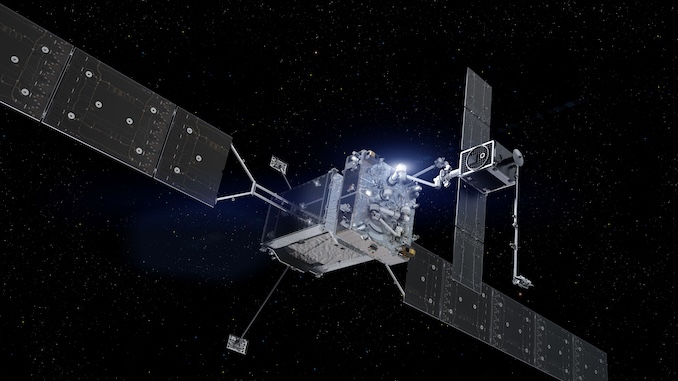 Following its launch in summer 2026, Northrop Grumman’s Mission Robotic Vehicle (left) will install Mission Extension Pod (right) jetpacks to extend the lives of client satellites in geosynchronous orbit. MRV also can perform inspection, relocation, repairs, upgrades, and other missions yet to be imagined. Illustration credit: Northrop Grumman
(...) The MRV is equipped with the Robotic Servicing of Geosynchronous Satellites (RSGS) payload, a pair of robotic arms with an array of tool attachments developed at the U.S. Naval Research Laboratory with financial backing from the Defense Advanced Research Projects Agency (DARPA). (...)
Decades in the makingThe concept behind the RSGS goes back more than 20 years when the NRL began examining the possibility of two uncrewed spacecraft performing autonomous rendezvous and docking operations. In the early 2000s, that evolved into a study called ‘RescueSat’, looking at how to recover a satellite stuck in the wrong orbit, and eventually the Spacecraft for the Universal Modification of Orbits (SUMO) program.
“The SUMO mandate was daunting. DARPA challenged us to design a robot that could dock with any satellite in space,” said Glen Henshaw, Ph.D., NRL Lead Space Roboticist for RSGS in a prelaunch statement.
“We then realized a universal truth—every satellite got to space on a rocket! By targeting the sturdy ‘launch vehicle interface plane’—the structural ring or explosive bolt holes that attach a spacecraft to a rocket for launch—we determined that a robotic arm could safely grapple almost any spacecraft without damaging delicate instruments.”After proving the concept was possible, by 2005 the SUMO program shifted to the Front End Robotics Enabling Near-term Demonstration (FREND). That program would go onto develop spaceflight worthy robotic arms through a commercial vendor. (...)
https://spaceflightnow.com/2026/07/21/live-coverage-spacex-to-launch-novel-geosynchronous-robotic-servicing-satellite-on-decade-long-mission/Robotic Servicing Mission Launches with NASA SupportGoddard Digital Team Jul 22, 2026
https://www.nasa.gov/technology/robotic-servicing-mission-launches-with-nasa-support/This is the world’s most advanced robotic servicing satellite—that we know aboutStephen Clark – Jul 24, 2026 17:23
“These are things that tend to be really hard.”(...) The Mission Robotic Vehicle is arguably the most advanced servicing satellite ever launched. It’s certainly the most sophisticated orbiting servicer we know anything about. China launched a satellite with a robotic arm into geosynchronous orbit in 2016. Another launch in 2021 deployed the Shijian-21 or SJ-21, spacecraft on a “space debris mitigation” mission. SJ-21 linked up with a defunct Chinese navigation satellite and moved it to a higher altitude for disposal before returning to the geosynchronous belt. (...)
https://arstechnica.com/space/2026/07/this-is-the-worlds-most-advanced-robotic-servicing-satellite-that-we-know-about/ Wątek: Falcon-9 B1069.32 | MRV-1 | 21.07.2026 (Przeczytany 2088 razy)