Astronaut C. Gordon Fullerton, 1936–2013by Emily Carney August 21,2013
 Space shuttle astronaut Gordon Fullerton has passed away. Photo Credit: NASAhttps://www.americaspace.com/2013/08/21/astronaut-c-gordon-fullerton-1936-2013/https://www.americaspace.com/2013/08/22/astronaut-at-the-edge-the-life-and-legacy-of-gordon-fullerton/Gordon Fullerton, space shuttle test pilot, dies at 76
August 21, 2013 — Gordon Fullerton, an Apollo-era NASA astronaut who was among the first test pilots to fly the space shuttle, died on Wednesday (Aug. 21), three years after suffering a stroke that left him partially paralyzed. He was 76.
One of four astronauts who flew NASA's original prototype orbiter on atmospheric test flights, Fullerton launched into space twice. He piloted the shuttle program's third mission in 1982 and, three years later, was commander when an engine shutdown ended in the shuttle's only inflight abort. (...)
http://www.collectspace.com/news/news-082113b-gordon-fullerton-space-shuttle-astronaut-obituary.htmlhttp://www.collectspace.com/ubb/Forum38/HTML/001685.htmlC. Gordon Fullerton, Early Space Shuttle Pilot, Dies at 76By Douglas Martin Aug. 22, 2013
Col. C. Gordon Fullerton, an astronaut who performed the first flight test of a space shuttle in 1977, then piloted two shuttle missions — including one in which an engine failed shortly after takeoff — died on Wednesday in Lancaster, Calif. He was 76.
The National Aeronautics and Space Administration said in a statement announcing the death that Colonel Fullerton had a severe stroke in 2009, after which he had lived in a nursing home in Lancaster.
As a test pilot for both the Air Force and NASA, Colonel Fullerton logged about 15,000 hours flying more than 130 different types of aircraft. In his two shuttle missions, he was the commander on board the Challenger and one of two pilots on the Columbia.
Both spacecraft failed in later flights with disastrous results, the Challenger breaking apart on its ascent over Florida in 1986 and the Columbia disintegrating in 2003 as it re-entered Earth’s atmosphere over Louisiana and Texas, both crews perishing.
Perhaps the most harrowing moment of Colonel Fullerton’s career came on July 29, 1985, when the Challenger lost one of its three main engines 5 minutes and 45 seconds after the launch. Colonel Fullerton ordered his crew to unstrap their flight harnesses in case they had to make a quick escape.
But with the help of technicians, astronauts and other NASA personnel, he was able to continue the mission and guide the shuttle and its six crew members into orbit, where they completed most of their scheduled scientific experiments.
“We breathed a great sigh of relief to get into orbit at all,” Burton Edelson, NASA’s associate administrator, said after the mission. “We all had our fingers crossed.”
The engine failure came after the flight had been delayed on July 12 because of engine problems.
Colonel Fullerton was chosen as an astronaut in the late 1960s but waited more than 15 years for his turn to fly a spacecraft. When that chance came, however, his first assignment did not take him out the Earth’s atmosphere.
Rather, on Aug. 12, 1977, he teamed up with Fred W. Haise, a civilian pilot, in the first flight of the shuttle Enterprise, a vehicle that was built purely for approach and landing tests and was incapable of flying into orbit.
The shuttle was the first reusable spacecraft: it was launched into space vertically like a conventional rocket and then orbited the Earth while scientific tasks were performed. It landed horizontally like an airplane. The first mission was in April 1981 and the last in July 2011.
For the Enterprise test flight, the shuttle was flown to 24,000 feet on the back of a Boeing 747, then cut loose over the Mojave Desert. The pilots descended and landed it as a powerless, giant glider at Edwards Air Force Base where it was greeted by scientists, movie stars and families in campers. The pilots brought the shuttle in at an 11-degree angle, more than three times the steepness of a commercial airliner’s angle of attack.
“We were doing stuff that there wasn’t any procedure for,” Colonel Fullerton said at the time. “We were writing the procedure and then flying it for the first time.”
Colonel Fullerton and Mr. Haise flew two more prototype missions, including the fifth and final one in October 1977. This time, they landed the shuttle on a hard-surface runway, not the smooth dry lake that surrounds the Edwards air base. Prince Charles of Britain attended.
“At no time were we concerned about loss of control,” Colonel Fullerton said.
In March 1982, Colonel Fullerton was piloting the Columbia when weather conditions forced the landing to be postponed. The usual spot, the Edwards base, had been washed out by rain, and an alternate site, in White Sands, N.M., proved unusable when a fierce sand storm kicked up. NASA officials waved off the New Mexico landing just 39 minutes before Colonel Fullerton and the commander, Col. Jack R. Lousma, were to fire the engines that would have dropped the craft out of orbit. It was the first time in 20 years that an American spaceflight landing had been postponed.
The shuttle continued orbiting and touched down smoothly in New Mexico the next day.
“The spacecraft performed magnificently,” Colonel Fullerton said. “Everything was better than my wildest dreams could imagine.”
Charles Gordon Fullerton was born on Oct. 11, 1936, in Rochester, N.Y. His family moved to Portland, Ore., when he was in the first grade. He earned bachelor’s and master’s degrees in mechanical engineering from the California Institute of Technology and worked for the Hughes Aircraft Company before joining the Air Force in 1958.
Colonel Fullerton was a bomber test pilot before being selected for the Air Force Manned Orbiting Laboratory program in 1965. After the program was canceled in 1969, NASA accepted him into its astronaut corps, and he was part of the support crew for several lunar missions.
He left the astronaut corps in 1986 and worked as a NASA test pilot and executive. He retired from the Air Force in 1988 and from NASA in 2007.
His survivors include his wife, the former Marie Jeanette Buettner; a daughter, Molly Marie; and a son, Andrew.
Of all the experiments carried out on space shuttle missions, one of the least successful was to determine whether Coca-Cola or Pepsi was best for space travelers. On the 1985 Challenger mission, Colonel Fullerton and his crew found both unrefrigerated, carbonated beverages unpleasant and did not state a preference.
Colonel Fullerton often spoke of the beauty encountered in space and the joys of weightlessness. After the Columbia disaster in 2003, he said the seven crew members who died on the mission had probably not considered themselves heroes but rather simply “the luckiest people on earth.”
“Columbia was a magnificent machine,” he said. “She carried us to the greatest adventures of our lives.”Corrected on Aug. 27, 2013: An obituary on Friday about the astronaut C. Gordon Fullerton, who in 1977 performed the first flight test of a space shuttle, misstated the date of that flight. It was Aug. 12 of that year, not Aug. 13.
https://www.nytimes.com/2013/08/23/us/c-gordon-fullerton-early-space-shuttle-pilot-dies-at-76.htmlGordon Fullerton: Skilled, Kind, Humble…and FunnyNASA Aug 28, 2013
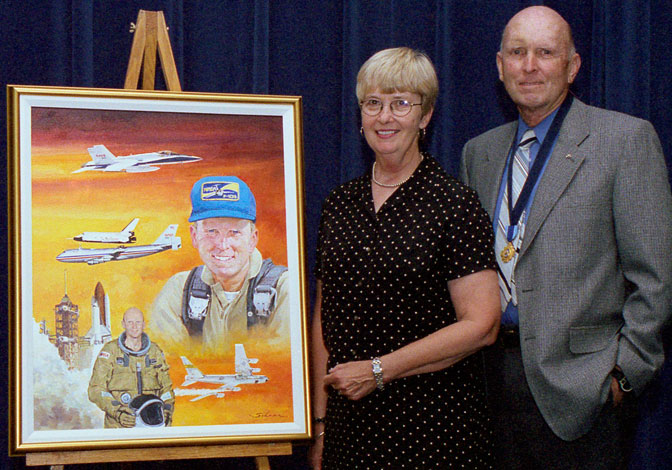 Fullerton and his wife Marie were presented a painting honoring his career as a NASA astronaut and research pilot at the NASA Honor Awards ceremony at NASA Dryden in 2003. ED03-0195-23
NASADryden employees, family, and friends celebrated a life well lived August 26, 2013 as they honored the late NASA astronaut and research pilot Gordon Fullerton—or to those who knew him, Gordo—at a Celebration of Gordo’s Life.
Family and friends described Fullerton as a humble family man, who was very kind, unflappable, smart, and who had a great sense of humor. He died August 21 at age 76. Fullerton had flown in 135 different types of aircraft and logged more than 16,000 flight hours during his flying career. His resume also included two space shuttle missions, including one as commander.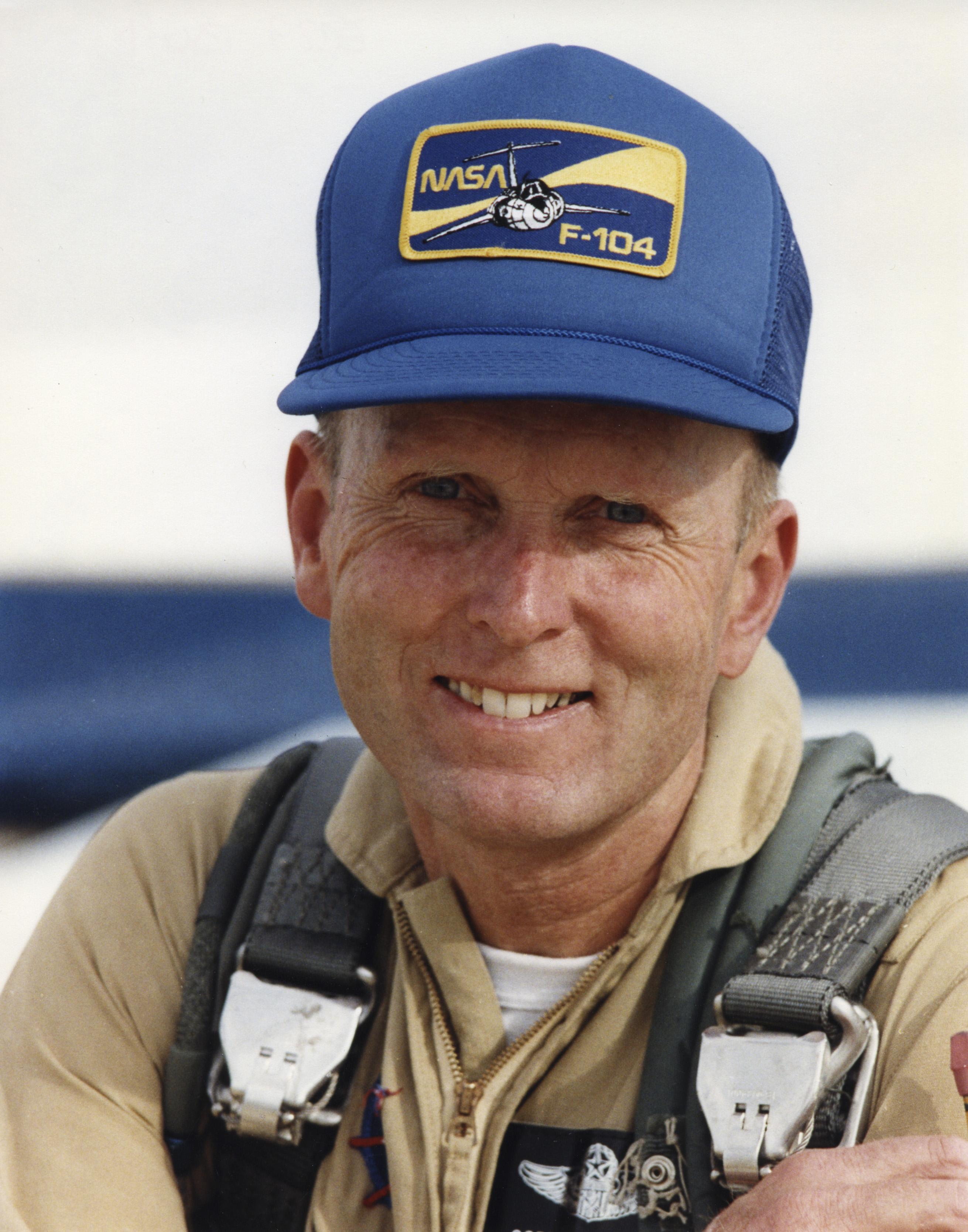 As this candid portrait taken in 1989 attests, Gordo was often happiest when he was flying high-performance jets like one of NASA’s now-retired F-104s. EC89-0136-01 NASADryden center director David McBride said Fullerton inspired people to pursue careers in science, technology, engineering, and mathematics with his work on programs like Apollo, the space shuttle, and accomplishments as an Air Force test pilot and a NASA Dryden research pilot.
“Those activities were accomplished by great engineering,” McBride said. “They were accomplished by courageous and very skilled crews and Gordo was one of those who made it work. Gordo was one of those few who took the risk that inspired the next generation. Thank you, Gordo.”
In addition, McBride read a statement from NASA administrator Charlie Bolden about Fullerton.
“Gordo was a mainstay of NASA for many years,” Bolden said. His support of the Apollo program, the shuttle program, and his accomplishments in breaking new ground in aeronautics will not be forgotten. He will be missed, but his legacy will continue to thrive. We will build on all that he gave to NASA and our nation’s space and aeronautics programs.”
Jim Ross, Dryden’s photo chief, recalled flying with Fullerton.
“Every flight with Gordo was a once in a lifetime opportunity,” he said. “I had 57 once-in-a-lifetime opportunities with him.”
Ross recalled his first flight. He was in a G-suit and feeling like Tom Cruise in Top Gun.
“Gordo had this puzzled look on his face and then he said, ‘We don’t use a G-suit in the T-38.’ I embarrassed myself. I had no idea how the whole thing worked,” Ross explained. Fred Haise and Gordon Fullerton, both of whom worked as research test pilots at NASA Dryden at different times in their careers, made up one of the two crews who flew the approach and landing tests of the Space Shuttle Enterprise in 1977. NASAHe didn’t fly with Fullerton until later and the first flight was rough for the first-time flier.
“The first person in the locker room after my flight was Gordo. He was excited and asked how the flight went. I had my back toward him and he could tell when I turned around that it didn’t go well. It took two months before I flew again. Consensus of all the pilots was you can’t base your ability to fly from one flight. All of them encouraged me and I eventually flew with Gordo.”
Because Ross and camera colleagues Carla Thomas and Lori Losey didn’t have a broad base of experience with pilots and airplanes, Fullerton worked to boost their knowledge. One flight made Ross anxious.
“I am having a heart attack, grab the stick and fly,” Fullerton told Ross. “You fly with old pilots so this could really happen.”
“It felt like I was the one having a heart attack,” Ross recalled, “but I had a great time flying with Gordo.”
Karol “Bo” Bobko, who served as an astronaut with Fullerton in the U.S. Air Force Manned Orbiting Laboratory program in 1966 and later became a space shuttle astronaut with NASA, shared his recollections of Fullerton, commenting that Gordo was unflappable during jungle survival training.
In a potentially life-threatening position following a thunderstorm that made a river swell and a whirlpool formed and threatened them, Fullerton looked at him and said, “I don’t think this is survival training anymore.”
The two men went deep into the river to escape the whirlpool and lived to tell the tale, Bobko said.
“Gordo would have told you that story, but he wouldn’t tell you about his mission on Space Shuttle Challenger when it lost one engine on launch, but made it to orbit,” Bobko said. “If he was here, I’d wish him 17,000 mph (the speed required to achieve orbit). Now that he’s on the other side, I wish him Godspeed.” Fullerton was honored by the City of Lancaster, his home for more than 26 years, when he was inducted into the city’s Aerospace Walk of Honor along Lancaster Boulevard in 2000. EC00-0288-04 NASALarry Schilling, former Dryden associate center director for operations, offered another view of Fullerton, who after retirement was active with family and friends until a stroke a few years into retirement challenged him. The challenges were great, but so too was Fullerton’s spirit. He didn’t feel sorry for himself and worked hard to regain his body and mind. His sense of humor returned and he enjoyed his grandchildren and frequent visits from friends.
Unfortunately, that progress began slowed and his condition worsened. But still, Fullerton maintained his sense of humor calling the Schillings “the Pesos” when he began to study Spanish.
“That shows real depth of character after the stroke to fight to recover. He loved his family and they loved him,” Schilling said.
Many will remember Fullerton as a hero, a family man and a great pilot. Aviation Week writer Guy Norris explained that Fullerton also was down to Earth.
“He was a nice guy who always had time for a chat with me at Society of Experimental Test Pilot meetings. He was the first astronaut I ever talked to who could truly describe the awesome experience of space flight in an accessible way,” he said.
Former Dryden center director Ken Szalai said Fullerton was “one of the best of the best.” As such, he instantly gave credibility to projects he supported. One example Szalai cited was the Convair 990 work at Dryden that dealt with excessive brake and tire wear on the shuttles that resulted in changes that benefited the program.
Other examples included the Propulsion Controlled Aircraft that looked at using only propulsion to compensate for damaged aerodynamic controls on an aircraft and supersonic transport work that involved working with the Russians, becoming one of just two Americans to ever fly the Russian supersonic Tu-144.He was kind, humble, and smart. He was top tier at everything he did. You don’t replace a Gordon Fullerton. Ken Szalai Former NASA Dryden Flight Research Center DirectorFullerton’s son Andy and daughter Molly Mansubi offered their assessments of Gordo as well.
Molly said best advice Dad gave her was “Love what you do and never work a day in your life,” she recalled.
Fullerton’s widow Marie spoke best of the man who was her greatest love and best friend as she was his through 45 years of marriage.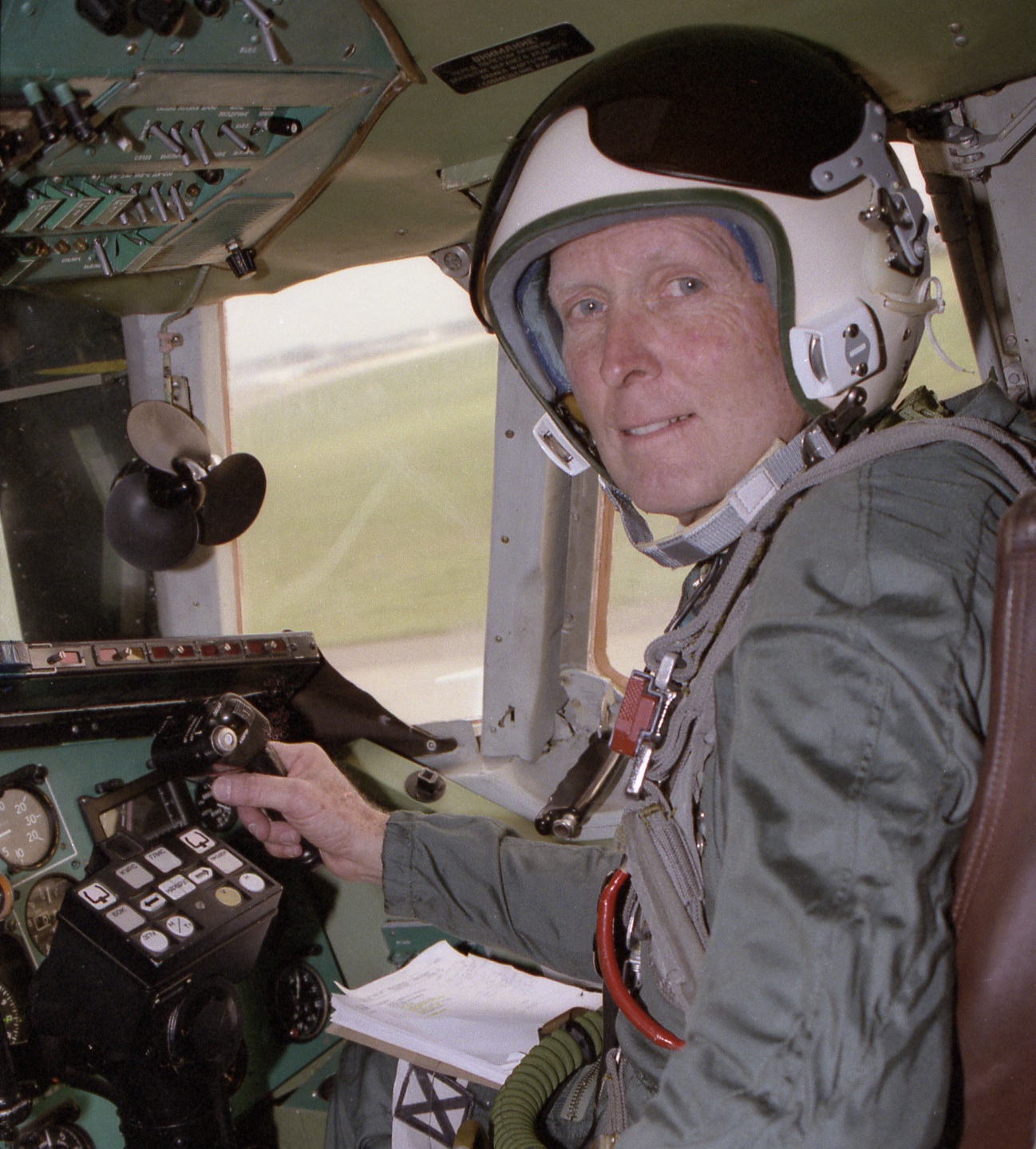 Fullerton, shown here in the flight deck of the Tupolev Tu-144LL, became one of only two non-Russian pilots to ever fly the supersonic transport during a NASA-funded high-speed research program in Russia in 1998. EC98-44749-27
NASAShe recalled the day they met at a party. She was a nurse and he was a test pilot who drove a Porsche, which she said she didn’t know what that was then. “You must be Gordy,” she said. “Gordon is the name,” he replied. They dated every day after that first meeting and later married in Ohio.
“He loved his 17 years at Johnson Space Center and he loved and respected all of you here. When he came home and something on the plane didn’t work, he knew it would be OK and safe to fly (when he returned to the cockpit). He had only kind things to say about Dryden and the environment here. You were his other family,” she said.
Gordon Fullerton also was a believer in education, she added.
“He loved to talk about space and flying. He never turned down an opportunity to talk to children unless he really couldn’t make it,” Marie Fullerton said.
The event fittingly ended with a flyby and “missing man” pull-up of a NASA F-15 aircraft.
If you heard a sonic boom on Aug. 21 and didn’t see a plane, that was him. Runway 22 in heaven was preparing for his arrival—once he finished some supersonic barrel rolls, of course.https://www.nasa.gov/centers-and-facilities/armstrong/gordon-fullerton-skilled-kind-humbleand-funny/Gordon Fullerton's Career in ReviewNASA Armstrong Flight Research Center 13.07.2017
Fred Haise & Gordon Fullerton Pilot Space Shuttle Enterprise (August 12, 1977)Quentin Melson 13.04.2023
 Wątek: Charles Gordon Fullerton (1936-2013) (Przeczytany 4069 razy)