Zmarł Don Williams BY MICHAŁ MOROZ ON 28 LUTEGO 2016
 Astronauta Don Williams / Credits: NASA
W wieku 74 lat zmarł amerykański astronauta Don Williams. Brał udział w dwóch misjach wahadłowca: STS-51D oraz STS-34.
Don Williams był pilotem doświadczalnym amerykańskiej marynarki wojennej, który w 1978 roku został wybrany do ósmego naboru astronautów NASA. Pierwszy lot odbył w 1985 roku. Był pilotem misji STS-51-D Discovery, która wyniosła dwa satelity telekomunikacyjne: Telesata-I oraz Syncom-IV 3. Podczas misji wykonano pierwszy nieplanowany spacer kosmiczny w historii lotów wahadłowców. Członkowie załogi przechwycili satelitę Syncom, którego awaria silnika uziemiła na niskiej orbicie okołoziemskiej. Przechwyconego satelity nie udało się jednak uruchomić. Tego dopiero dokonano podczas misji STS-51-I.
Don Williams był również dowódcą misji STS-34 wahadłowca Atlantis. Głównym celem lotu z 1989 roku było wyniesienie sondy Galileo, która następnie udała się w kierunku Jowisza. Swój cel osiągnęła w w 1995 roku.
Williams w 1990 odszedł z korpusu astronautów i kontynuował prace w sektorze prywatnym. Był osiemdziesiątym dziewiątym Amerykaninem w kosmosie. Łącznie na orbicie przebywał niemal 12 dni.
https://kosmonauta.net/2016/02/zmarl-don-williams/#prettyPhotoNASA astronaut Don Williams, led mission to launch Jupiter probe, dies at 74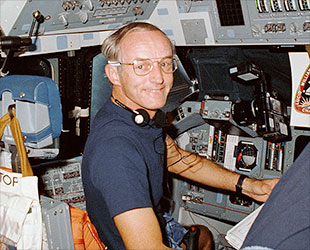 NASA astronaut Don Williams, seen here on space shuttle Atlantis' flight deck in 1989, died on Feb. 23, 2016 at the age of 74. (NASA)
Feb. 27, 2016 — Donald Williams, a NASA astronaut who commanded a space shuttle mission that launched the first probe to orbit Jupiter, died Tuesday (Feb. 23). He was 74.
Williams' death was confirmed by the Association of Space Explorers, a society of astronauts and cosmonauts.
"We are sad to pass along the news that former astronaut Don Williams has passed away," the organization wrote on Facebook. "Fair skies and following seas, Cap'n."
Selected with the Thirty-Five New Guys, NASA's first class of space shuttle candidates chosen in 1978, Williams flew into space twice logging 11 days, 23 hours and 34 minutes off the Earth.
His first launch on April 12, 1985 was as pilot of the space shuttle Discovery's fourth mission.
"I looked out the window for the first time ... [and] the first thing I saw was the horizon and blackness of space and the thinness of the atmosphere and everything blue on the Earth," he recalled in a 2002 NASA oral history. "And I just said to myself, 'Wow!'"
'Like Apollo 13, except in smaller scale'During the week-long mission, Williams and his crewmates deployed two communication satellites, though the second failed to initiate after being released from the orbiter. The problem resulted in Williams and Discovery's commander, Karol "Bo" Bobko, flying a rendezvous with the Syncom IV-3 satellite and then astronauts Jeffrey Hoffman and David Griggs performing NASA's first unscheduled spacewalk.
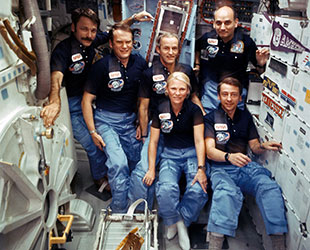 STS-51D pilot Don Williams (center) with crewmates David Griggs, Bo Bobko, Rhea Seddon, Charlie Walker and Jake Garn. (NASA)
"Bo and I are thinking to ourselves, 'Great, we are going to get to do something we weren't planning on doing,'" said Williams. "Never in the history of the [shuttle] program had there been
an unplanned spacewalk."
At the direction of ground controllers in Houston, the crew assembled a "fly swatter," a makeshift device that Hoffman and Griggs would attach to the end of Discovery's robotic arm to be used to trigger the satellite's activation system.
"This was like in Apollo 13 almost, except a much smaller scale, because they got a group of people together over a weekend, and by the time Sunday evening came, we had a full-blown plan to do this thing," Williams said.
The spacewalk was successful but they were unable to get the satellite to deploy its antenna, leaving its activation to a later space shuttle mission.
'Rat Stuff' and a 'big bang'Before returning to Earth, Williams took part in conducting experiments, including the first Toys In Space educational demonstration, which filmed the astronauts using a yo-yo, jacks and a paper airplane, among other small playthings, to teach children the basic physics of microgravity.
"I picked a paddle ball, which is something I'd fiddled with because I was curious as to whether there would be any difference," Williams said. "I [also] ended up with this little plastic flipping mouse. You wind [it] up and you sit him on the table and he does back-flips."
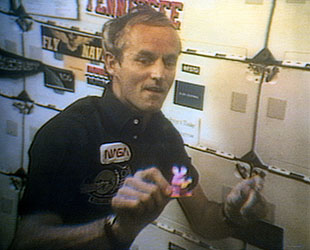 STS-51D pilot Don Williams with "Rat Stuff," a wind-up mouse that was part of the "Toys in Space" educational payload. (NASA)
"[The mechanical mouse] became our unofficial mascot for that mission, and we called him 'Rat Stuff,'" he said.
Six days and 23 hours after leaving the planet, Bobko and Williams flew the shuttle to a landing at NASA's Kennedy Space Center in Florida. The touchdown and rollout down the runway went smoothly, until there was a "big bang."
"We're down to maybe just almost walking speed, maybe 5 knots or something like that, and there was this big "bang, thump, thump, thump, thump," Williams described. "I knew right away what it was. It was a blown tire."
"It turned out not to be a big deal," he added, though as a result, future shuttle missions were restricted to landing in California until nose wheel steering could be added to the orbiters.
A lasting programWilliams second flight – his first as commander – launched on Oct. 18, 1989 on board space shuttle Atlantis to deploy the Galileo space probe to the planet Jupiter.
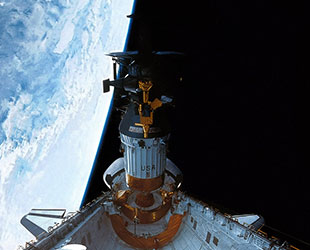 The Galileo spacecraft is deployed from the space shuttle Atlantis' payload bay by the STS-51D crew in October 1989. (NASA)
"I really enjoyed that mission, probably even more so than the first, because it was my goal to command a mission, first of all, and I got to do that. But secondly, because we knew that Galileo was going to be a lasting program," said Williams.
"The [Galileo probe] was going to end up in orbit around Jupiter several years later and then there [were] going to be several years of data and images sent back," Williams said. "It was going to be a living, ongoing program, and we got to be a part of it. That was a really unique experience."
Galileo became the first spacecraft to orbit Jupiter in 1995 and operated for eight years in the Jovian system.
In addition to Galileo, the five-day STS-34 mission flew an ozone-measuring device in the payload bay, a student ice crystal growth experiment and
an IMAX camera. Diverted by poor weather in Florida, Williams landed space shuttle Atlantis at Edwards Air Force Base in California.
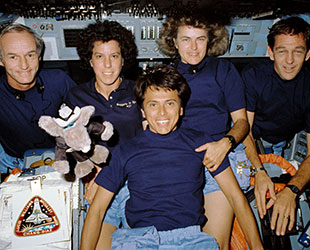 STS-34 commander Don Williams with Ellen Baker, Franklin Chang Diaz, Shannon Lucid and Michael McCulley in 1989. (NASA)
"When your feet get back on the ground you [think], 'Hey, we did it and it worked,' Williams said. "It was a successful mission, and I look back on that with quite a lot of pride."
'What time do you want me to be there?'Donald Edward Williams was born in Lafayette, Indiana on Feb. 13, 1942. He received a bachelor of science degree in mechanical engineering from Purdue University in 1964 and completed his U.S. Navy flight training two years later.
Williams made four Vietnam deployments aboard the USS Enterprise with Attack Squadrons 113 and 97, completing 330 combat missions and 745 aircraft carrier landings. He also served as an instructor at Naval Air Station Lemoore in California.
Williams graduated from the U.S. Naval Test Pilot School at Patuxent River in Maryland in 1974, and was assigned to the Naval Air Test Center's Carrier Suitability Branch of Flight Test division. From 1976 to 1977, Williams was the head of the Carrier Systems Branch for the Strike Aircraft Test Directorate.
Williams was assigned to Attack Squadron 94 when he got the call from NASA.
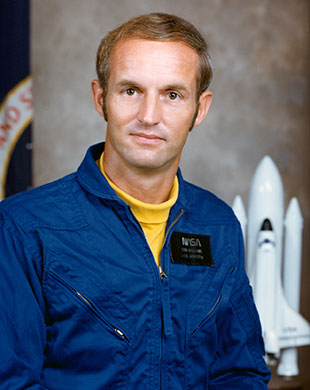 1978 NASA astronaut portrait of Donald E. Williams. (NASA)
"One day, it was about 6:30 or so in the morning, between 6:30 and 7:00, I was shaving, I had about a half a face of shaving cream on, and the phone rang, and I went, 'Who'd call me this time of the day?'" he recalled. "It turned out it was [NASA's] Director of Flight Crew Operations."
"He says, 'Well you know, we're thinking that maybe, if you wanted to, we'd like for you to come and join us here,'" Williams recounted. "[And] I went, 'What time do you want me to be there?'"
Reached his goalBefore Williams flew in space and in the time between his two missions, he worked in the
Shuttle Avionics Integration Laboratory as a test pilot and at Kennedy Space Center in Florida participating in shuttle orbiter test, checkout, launch and landing operations.
From 1982 to 1983, he was served in the National Space Transportation System Program Office as deputy manager for operations integration at Johnson Space Center. From 1985 through 1986, he was the deputy chief of the aircraft operations division at Johnson and from 1986 to 1988, he was chief of the Mission Support Branch in the Astronaut Office.
Soon after returning from his second shuttle flight, Williams announced he was retiring from NASA. In March 1990, he left the space agency and resigned from the Navy with the rank of Captain.
"I reached my goal as a pilot — which was to command a mission," Williams said in a statement about his departure from NASA. "Now it's time to go on to other challenges."
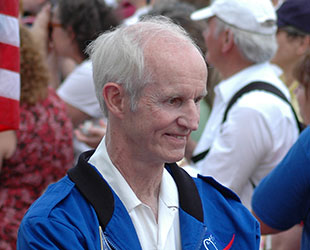 NASA astronaut Don Williams, seen in 2007 at the Kennedy Space Center Visitor Complex in Florida. (collectSPACE)
Williams took a position as a program manager at Science Applications International Corp. (SAIC) in August 1990. He worked there until his retirement in 2006.
A recipient of the Legion of Merit and Distinguished Flying Cross, Williams was awarded NASA medals for his space flights, outstanding leadership and exceptional service.
Williams married the former Linda Jo Grubaugh of Sturgis, Michigan and together they had two children.
http://www.collectspace.com/news/news-022716a-astronaut-don-williams-obituary.htmlhttp://www.jsc.nasa.gov/history/oral_histories/WilliamsDE/WilliamsDE_7-19-02.htmEDIT 14.02.23
https://twitter.com/ASE_Astronauts/status/16252839327773286401989 Space Shuttle Atlantis Launch NBC October 181989: STS-34 Atlantis, Galileo (NASA)Delay of at Least 5 Days Seen for Shuttle MissionBy John Noble Wilford, Special To the New York Times Oct. 12, 1989
This is a digitized version of an article from The Times’s print archive, before the start of online publication in 1996. To preserve these articles as they originally appeared, The Times does not alter, edit or update them.
Occasionally the digitization process introduces transcription errors or other problems; we are continuing to work to improve these archived versions.
Technicians began removing a faulty engine control unit from the space shuttle Atlantis today as officials predicted that the craft would be launched no earlier than next Tuesday.
The National Aeronautics and Space Administration announced that there was a ''50-50 chance'' of completing the necessary repair work in time for a launching Tuesday afternoon. A decision will be made Saturday.
The Atlantis had been scheduled to lift off this Thursday afternoon and send the Galileo spacecraft on a six-year journey to Jupiter. The delay is not expected to affect plans for Jupiter exploration but will almost certainly cause Galileo to forgo one of its two asteroid encounters on the way, mission scientists said.
Shuttle officials said the replacement of the electronic controller for one of the three rocket engines should be completed by Sunday. If so, they said, there is a chance that Atlantis could be launched Tuesday afternoon.
An apparent malfunction in the 230-pound control unit, detected during tests Monday night, forced shuttle officials to halt countdown preparations Tuesday night. The problem showed up as spurious signals from a fuel-pump sensor. These were picked up by the backup computer in the control unit.
Engineers repeated the test five times, but the anomalous signals did not recur. Baffled and unable to identify the trouble, officials decided to replace the suspect unit.
Each of the three main engines has a control unit that includes redundant computers. These units monitor all aspects of engine performance in the eight and a half minutes in which the shuttle is climbing toward orbit, and they can shut down an engine that seems to be malfunctioning. Engineers were concerned that the spurious signals could have misled computers into ordering a premature engine shutdown, which could have aborted the mission.
Capt. Donald E. Williams of the Navy, the astronaut commanding the shuttle mission, said: ''The crew's obviously a little disappointed. We concur wholeheartedly in the decision.''
The five astronauts returned to their homes in Houston to await the decision on when the mission would be rescheduled. The other astronauts are Comdr. Michael J. McCulley of the Navy; Dr. Shannon W. Lucid, a biochemist; Dr. Franklin R. Chang-Diaz, a physicist, and Dr. Ellen S. Baker, a physician.
William J. O'Neil, science and mission design manager for Galileo at the Jet Propulsion Laboratory, said in an interview that the spacecraft could be sent on its journey to Jupiter anytime before Nov. 21 without sacrificing ''our science objectives at Jupiter.''
But each week of delay, he said, would force Galileo to consume more propulsion fuel on course-changing maneuvers. Flight controllers want to conserve as much fuel as possible for use when Galileo is orbiting Jupiter, beginning in December 1995.
''It's quite unlikely we'll be able to undertake the planned second asteroid encounter,'' Mr. O'Neil said. A Roundabout Route
As planned, Galileo's voyage to Jupiter will follow a roundabout route looping Venus and making two close passes of Earth to build up momentum from the gravity of the two planets. Then Galileo is scheduled to fly within 600 miles for the first close-up photography of an asteroid, a 10-mile-wide object named Gaspra. A similar fly-by of another asteroid, Ida, is planned 16 months later.
Mr. O'Neil said the encounter with Ida might require more fuel for maneuvering than the mission could afford and still have ample reserves for making at least 10 orbits of Jupiter and repeated photographic encounters with the four largest Jovian moons, Io, Europa, Ganymede and Callisto.
Lisa Malone, a spokeswoman at the Kennedy Space Center, said the delay would probably disrupt schedules for two subsequent shuttle liftoffs. The next mission after Atlantis is the flight of Discovery, which had been scheduled to lift off Nov. 19 with a secret Defense Department payload. The shuttle Columbia had been set for launching Dec. 18 to retrieve a test platform orbiting since 1985.A version of this article appears in print on Oct. 12, 1989, Section A, Page 21 of the National edition with the headline: Delay of at Least 5 Days Seen for Shuttle Mission.
https://www.nytimes.com/1989/10/12/us/delay-of-at-least-5-days-seen-for-shuttle-mission.html
 Wątek: Donald Edward Williams (1942-2016) (Przeczytany 3517 razy)