SEI Swan Song: International Lunar Resources Exploration Concept (1993) (2)
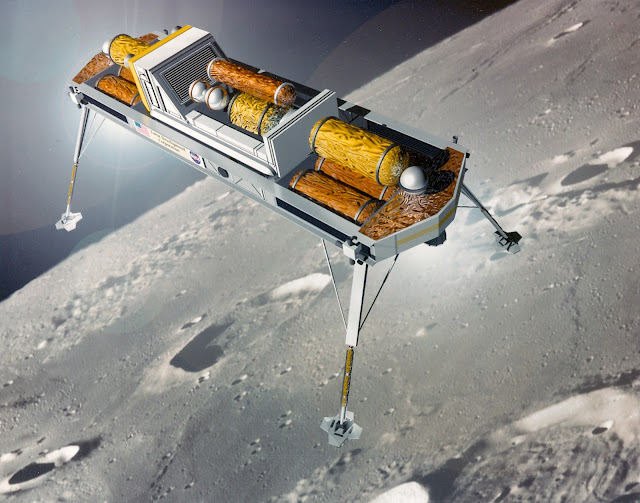 Following launch on an Energia rocket, translunar injection, and an Earth-moon voyage lasting up to about a week, a U.S.-built cargo lander bearing a self-deploying LUNOX regolith processing payload descends toward the lunar surface on a direct-descent trajectory. The lander is arranged horizontally, not vertically, to reduce the risk of tipping and, as important, to provide the astronauts who will follow it to the moon with easy access to its cargo. Image credit: NASA
 After touchdown, the LUNOX regolith processing payload pivots into vertical operational position and deploys ramps so that teleoperated regolith hauler rovers (two are shown on the left side of the image) can reach its screen-covered input hopper. Meanwhile, a teleoperated tanker rover (right) collects and stores LUNOX in preparation for the arrival of a piloted ILREC spacecraft. Image credit: NASA
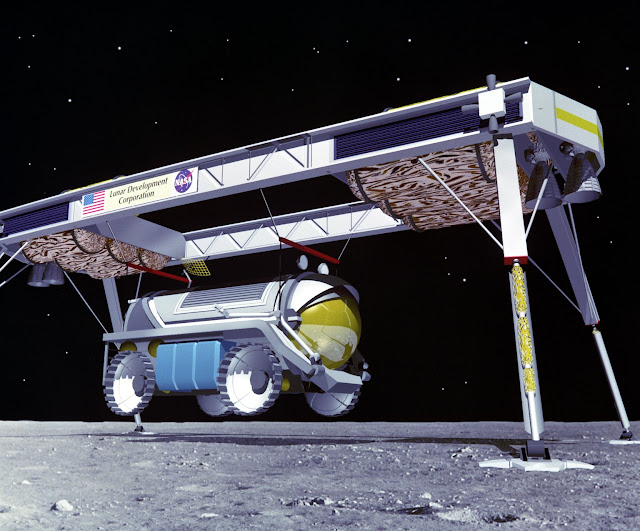 An Energia-launched cargo lander slowly lowers a U.S.-built pressurized moon bus lunar rover to the surface ahead of the arrival of the first two-person ILREC crew. Image credit: NASA
The one-way automated cargo landers, each rectangular in shape and capable of delivering 11 metric tons of payload to the moon's surface, would be assembled and packed in the U.S. and shipped to Russia in C-5 Galaxy or Antonov-124/225 transport planes, then launched on Energia rockets from Baikonur Cosmodrome, a Russian enclave in independent Kazakstan. Based on data Russia provided to NASA, launch teams at Baikonur could prepare two Energia rockets for launch simultaneously. Three Energia launch pads existed to launch lunar cargoes. Energia could place a 5.5-meter-diameter canister containing a U.S.-built cargo lander into Earth orbit attached to a Russian "Block 14C40" upper stage. The upper stage would then perform the TLI burn, boosting the cargo lander toward the moon.
Shuttle-derived heavy-lift boosters would launch Joosten's piloted landers from the twin Kennedy Space Center (KSC) Complex 39 pads. The pads, monolithic Vehicle Assembly Building, and other KSC facilities, most of which were originally constructed in the 1960s for the Apollo moon program, were modified in the 1970s to serve the Space Shuttle. They would require new modifications to support the ILREC program; Joosten assured his readers, however, that no wholly new facilities would need to be constructed at the Florida spaceport.
Joosten considered both Shuttle-C and in-line Shuttle-derived launchers. The Shuttle-C design had a cargo module with attached Space Shuttle Main Engines (SSMEs) mounted on the side of a Shuttle External Tank (ET) in place of the delta-winged Shuttle Orbiter. The in-line design, a conceptual ancestor of the Space Launch System presently (2017) under development, would place the cargo module on top of a modified ET and three SSMEs underneath. The tank would have attached to its sides twin Advanced Solid Rocket Motors more powerful than their Space Shuttle counterparts. Joosten appears to have favored the Shuttle-C design.
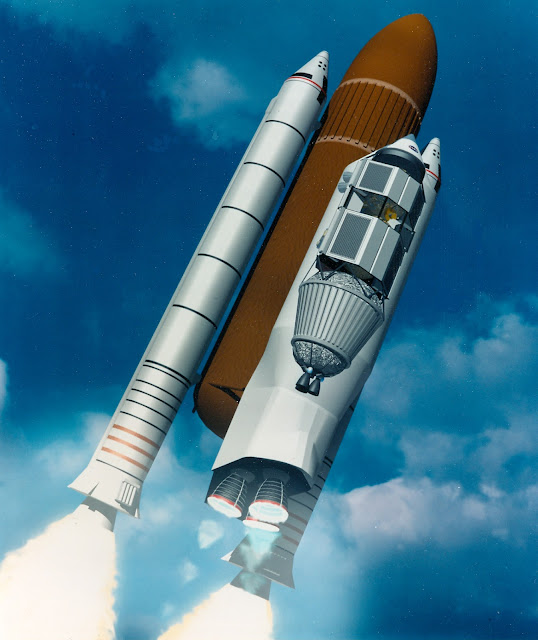 The image above is slightly confusing: it displays a piloted ILREC lander and, below that, a conical TLI stage with three engines, but does not make clear that, except for the white, black, and gray conical crew capsule at the top, both lander and stage would be hidden from view under a streamlined white launch shroud. Missing from this illustration is the solid-propellant launch-escape system tower mounted on the crew capsule's nose. Image credit: NASA
 A piloted ILREC lander descends toward a landing near the regolith processing lander and the teleoperated tanker rover. The aft compartment, located between the two rear landing gear, holds up to two tons of cargo. Image credit: NASA
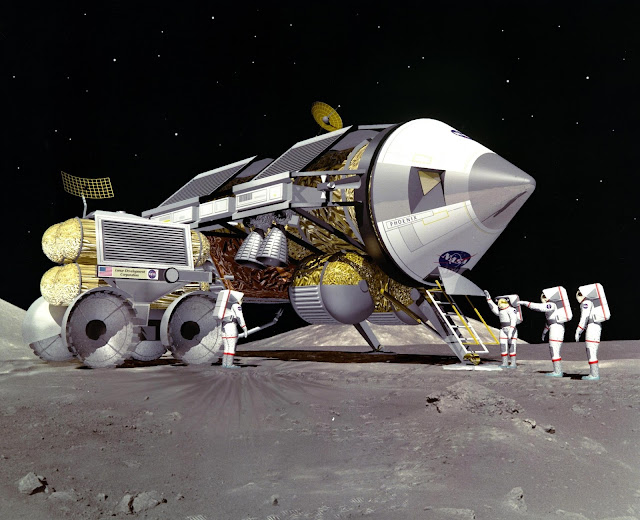 Shortly after touchdown, the teleoperated tanker rover moves into position beside the ILREC crew lander and extends an umbilical so that it can refill the lander's empty liquid oxygen tanks with LUNOX for the trip home to Earth. Note the position of the crew hatch and two of the lander's four engines. Image credit: NASA
The Shuttle-derived heavy-lift rocket would launch the piloted lander, bearing an international crew and about two tons of cargo, into Earth orbit. About 4.5 hours after liftoff, following a systems checkout period, the TLI stage would place the piloted lander on a direct trajectory to the moon. The stage would then be cast off.
Joosten's crew lander design outwardly resembled the fictional "Eagle" transport spacecraft from the 1970s Gerry Anderson TV series Space: 1999. The crew compartment, a conical capsule modeled on the Apollo Command Module (but lacking a nose-mounted docking unit), would be mounted on the front of a horizontally oriented three-legged lander. The three landing legs would fold against the lander's belly beneath a streamlined shroud during ascent through Earth's lower atmosphere.
On the moon, the crew hatch would face downward, providing ready access to the surface via a ladder on the lander's single forward leg; on the launch pad, the hatch would permit horizontal access to the capsule interior much as did the Apollo CM hatch. The crew compartment windows would be inset into the hull and oriented to enable the pilot to view the landing site during descent. The crew spacecraft would land on and launch from the moon using the same set of four belly-mounted throttleable rocket engines.
During descent to the lunar surface, the engines would burn Earth oxygen and hydrogen. Soon after lunar touchdown, the lander would be reloaded with liquid oxygen from the automated lunar oxygen plant.
During return to Earth, Joosten's spacecraft would burn Earth hydrogen and lunar oxygen. The entire crew lander would lift off from the moon, so no expendable descent stages would be left behind to clutter up the site. After a brief period in lunar parking orbit, the ILREC lander would ignite its four engines again to place itself on course for Earth.
Nearing Earth, the crew capsule would separate from the lander section and orient itself for reentry by turning its Apollo-style bowl-shaped heat shield toward the atmosphere. The lander section, meanwhile, would steer toward a reentry point well away from populated areas. The crew capsule would deploy a steerable parasail-type parachute. Joosten recommended that NASA recover the capsule on land - perhaps at Kennedy Space Center - to avoid the greater cost of an Apollo-style CM splashdown and water recovery. Most of the lander section would burn up during reentry.
The first piloted ILREC lander, with a U.S.-Russian crew of two on board, would spend two weeks on the moon. The crew would inspect the automated mining and oxygen production systems and explore using the moon bus rover. In Phase 1, the moonbus would be capable of traveling away from the crew lander landing site for two or three days at a time.
Several Phase 1 piloted missions to the site would be possible; alternately, NASA and Russia could skip immediately to Phase 2 - establishing a temporary lunar outpost - after a single Phase 1 piloted flight. In ILREC Phase 2, three more cargo flights would deliver to the same site a second moonbus rover, a rover support module with an attached airlock derived from Space Station hardware designs, consumables in a cart-mounted pressurizable Space Station-derived module, and science equipment.
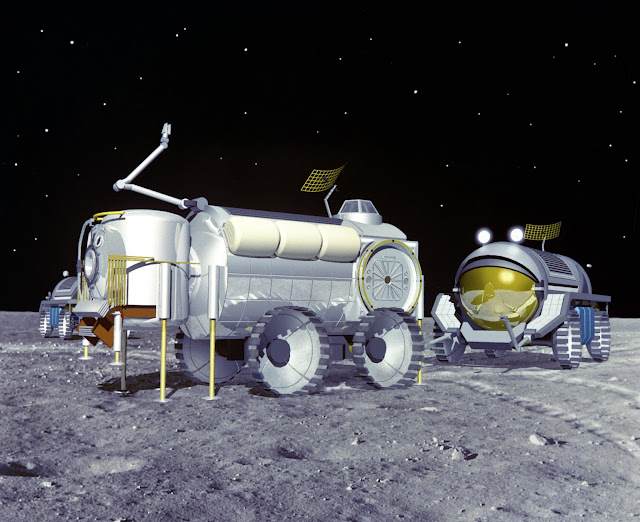 An Energia-launched cargo lander would deliver the U.S.-built airlock/rover support node to the outpost site and lower it to the lunar surface. Astronauts in the pressurized rovers would drive it to a flat area using teleoperations techniques, then would use robot arms on their rovers to lower stilt-like supports. These would level and raise the airlock/node. After the airlock/node's wheels became raised above the ground, they would be removed, clearing the way for the twin rovers to "dock" with the node's two side ports (one port is visible below the observation cupola just right of center). Image credit: NASA
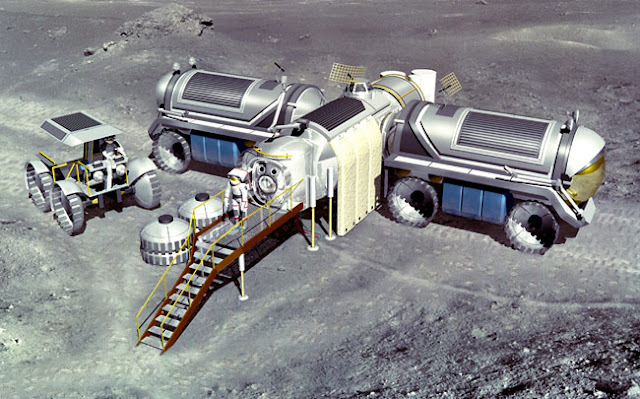 Phase 2 ILREC temporary lunar outpost. Two pressurized rovers are docked tail-first to the support node. Hanging regolith-filled bags provide added protection from ionizing radiation. Wheels removed from the airlock node are stacked to the left of the surface access gangway; they serve as spares for the pressurized rovers. A buried electrical cable (visible as a curved line in the lunar dirt running from center to lower right) leads toward a nuclear reactor (out of view). Image credit: NASA
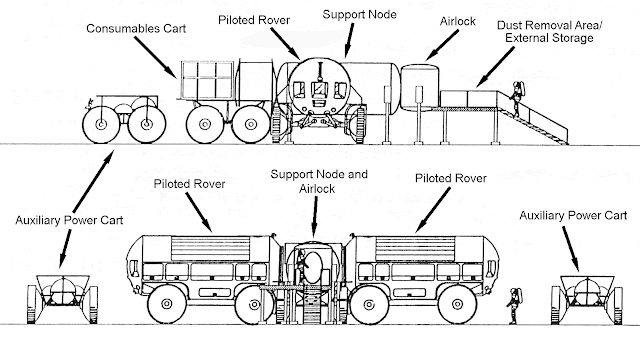 Phase 2 outpost with components identified. The lower image is turned 90 degrees relative to the top image. Image credit: NASA
A piloted flight would then deliver a four-person crew for a six-week lunar surface stay. The crew would divide up into pairs, with each pair living in and operating a moonbus rover. The support module/airlock would include docking ports so that the two moon buses and the consumables module cart could link to it, forming a small outpost.
The moon buses would tow auxiliary power carts in Phase 2 to enable longer traverses across the lunar surface. The moonbus/cart combinations might travel in pairs along parallel routes or one moonbus might remain at the outpost while the other moon bus and its power cart ventured far afield. In the event that a moon bus rover failed beyond walking distance from the outpost and could not be repaired, the other moon bus could rescue its crew.
ILREC Phase 3 was poorly defined: it might see larger lunar crews venturing further afield, or NASA might change direction and use technology developed for the lunar program to put humans on Mars (perhaps still in partnership with Russia). Joosten identified the piloted moon lander crew capsule, Shuttle-derived heavy-lift rocket, moon bus rovers, and Energia as candidate Mars mission hardware. Both Energia and the Shuttle-derived rocket might be upgraded for piloted Mars missions; they might even be merged to create a single international heavy-lift rocket more powerful than either Energia or the Shuttle derivative.
Joosten envisioned that in Phases 1 and 2 Russia would pay for Energia and the Block 14C40 TLI stage, while NASA would pay for the Shuttle-derived rocket and its TLI stage, the crew and cargo landers, moon bus rovers and teleoperated carts, and lunar oxygen production systems. In exchange for Russia's participation, its cosmonauts would walk on the moon in the early years of the 21st century. If U.S.-Russia space cooperation were for any reason curtailed, NASA could continue the moon program by taking over the cargo launches - provided, of course, that U.S. policy-makers determined that an all-U.S. moon program was worth the added cost.
SourcesMir Hardware Heritage, NASA Reference Publication 1357, NASA Johnson Space Center Reference Series No. 3, David S. F. Portree, March 1995, pp. 168-170
"International Lunar Resources Exploration Concept," Kent Joosten, Low Cost Lunar Access Conference Proceedings, 1993, pp. 25-61; paper presented at the AIAA Low Cost Lunar Access conference, Arlington, Virginia, 7 May 1993
International Lunar Resources Exploration Concept, Presentation Materials, Kent Joosten, Exploration Programs Office, NASA Johnson Space Center, February 1993
Press Kit: Apollo 11 Lunar Landing Mission, NASA, 6 July 1969
More Information(...)
Source:
http://spaceflighthistory.blogspot.com/2017/07/sei-swan-song-international-lunar.html]SEI Swan Song: International Lunar Resources Exploration Concept (1993)
 Wątek: [SHB] SEI Swan Song: International Lunar Resources Exploration Concept (1993) (Przeczytany 1853 razy)