Space Race: The Notorious 1962 Proposal to Launch an Astronaut on a One-Way Trip to the Moon (1)
24 July 2015 David S. F. Portree
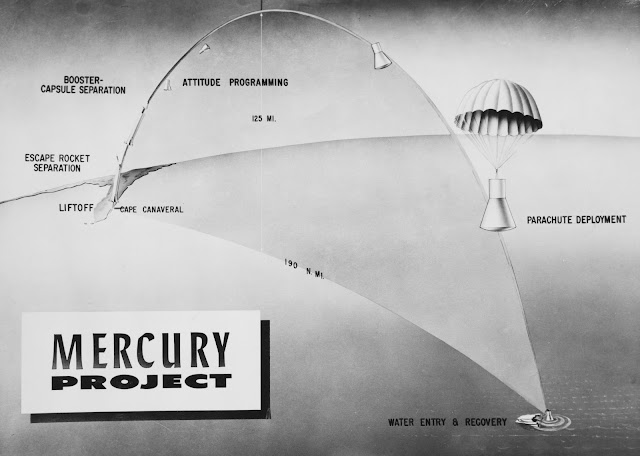 Mercury suborbital flights were considered a prudent first step in U.S. piloted spaceflight. The Soviet Vostok missions upstaged suborbital Mercury, leading NASA to accept more risk by moving on to Mercury orbital missions. Image credit: NASA
When the seven Mercury astronauts were presented to the world on 9 April 1959, it was expected that, before any reached for Earth orbit, each would fly a suborbital "training" flight. These short flights, launched on modified Redstone missiles, would subject the astronauts to preflight preparations, liftoff and acceleration, a brief period of weightlessness, fiery reentry and rapid deceleration, and splashdown and recovery – in short, all of the stresses of an orbital mission. This was judged to be a prudent approach to preparing America’s astronauts for the rigors of orbital spaceflight.
Cosmonaut Yuri Gagarin's launch into Earth orbit in the 10,420-pound Vostok 1 capsule three years later (12 April 1961) consigned this plan to the dustbin. On 5 May 1961, astronaut Alan Shepard flew a 303-mile-long, 116-mile-high suborbital hop lasting 15 minutes, 22 seconds in the 4,040-pound Mercury-Redstone 3/Freedom 7 spacecraft. The flight was widely compared with Gagarin's 108-minute single orbit and derided as proof that the Soviet Union remained far ahead of the United States in space – and that it was, perhaps, superior in other ways.
Before a joint session of Congress on 25 May 1961, President John F. Kennedy called on NASA to land an American on the moon and return him safely to Earth before 1970. NASA tapped Apollo, previously planned as an Earth-orbital program with circumlunar potential, as its new lunar landing program. As for suborbital Mercury training flights, prudence went out the window. NASA flew only one more suborbital mission – Gus Grissom's Mercury-Redstone 4 flight (21 July 1961), which ended with the loss of the Liberty Bell 7 spacecraft during recovery – before terminating Mercury-Redstone to concentrate on Mercury-Atlas orbital flights. Two weeks after Grissom's 15-minute, 37-second flight, Gherman Titov orbited the Earth 17.5 times in 25 hours on board (6-7 August 1961), adding to feelings of humiliation and desperation in the United States.
By the time John Glenn became the first American in orbit (20 February 1962), NASA and several advisory committees were debating how the U.S. should reach for the moon. At the same time, the U.S. civilian space agency began planning a program to bridge the gap between Mercury and Apollo. On 7 December 1961, NASA announced plans for a two-man "Mercury Mark II" spacecraft that would surpass Vostok's achievements beginning in 1963 and 1964. In January 1962, Mercury Mark II was renamed Gemini. The Gemini missions would expose astronauts to space conditions for up to two weeks (roughly the duration of a lunar mission) and give them spacewalk and orbital maneuvering practice.
Many feared, however, that Gemini, like Mercury, would be upstaged. Though the Soviets remained cagey about their space plans, it was widely assumed that their apparent lead in powerful booster rockets would permit them to launch a man to the moon and return him to Earth in about 1965.
Against this backdrop, John M. Cord, a Project Engineer in the Advanced Design Division at Bell Aerosystems Company, and Leonard M. Seale, a psychologist in charge of Bell's Human Factors Division, developed a plan for a desperate mission to put a man on the moon ahead of the Soviets. They unveiled their "One-Way Manned Space Mission" proposal in Los Angeles at the Institute of Aerospace Sciences (IAS) meeting in July 1962.
Cord and Seale explained that, since neither propellants for departing the moon nor parachutes and an Earth-atmosphere-reentry heat shield would be required, their new approach would slash lunar spacecraft mass. This would enable a rocket with between 450,000 and 1.1 million pounds of thrust - perhaps a near-relative of the Saturn I rocket, a Saturn I with an advanced upper stage, or a Titan missile derivative - to launch a one-man moon lander on a Direct-Ascent path to the moon. Such a rocket would, they estimated, be ready in the United States in 1964 or early 1965.
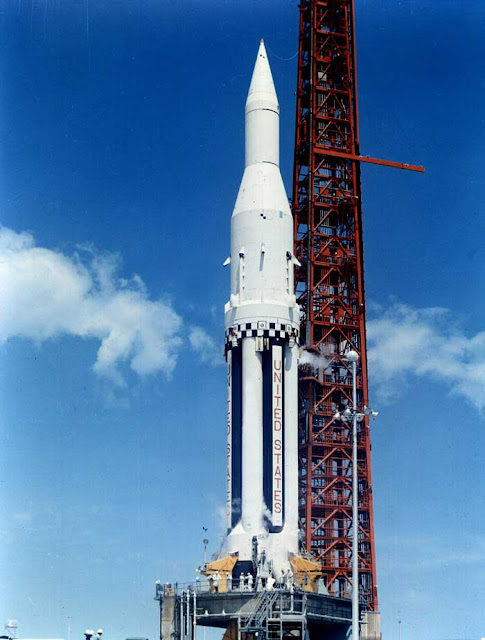 The Saturn I rocket was mainly a test vehicle for Saturn IB and Saturn V systems. Rockets only a little more powerful might have launched the One-Way Space Man cargo capsules and crew capsule during 1964. Image credit: NASA
Though they termed it "one-way," Cord and Seale did not propose a suicide mission. They estimated that a rocket capable of launching a three-man Direct-Ascent Apollo mission to retrieve the One-Way Space Man – that is, a rocket with between 1.1 million and 3.5 million pounds of thrust at liftoff – would become available in the U.S. in the 1965-to-1967 period, between 18 and 24 months after his arrival on the moon. Nevertheless, the mission would be "extremely hazardous." This was due to the fact that, after its boost phase – the period between Earth liftoff and injection onto an Earth-moon path – the astronaut would be unable to abort if some technical malfunction or unknown environmental danger threatened his life. If, on the other hand, the mission were a success, it would be "significant both scientifically and politically."
Cord and Seale viewed their mission as part of a series of increasingly capable lunar missions. First would come automated lunar flyby and orbiter missions to assess radiation hazards and photograph the moon for terrain assessment. Automated Ranger spacecraft would then photograph selected small areas up close as they plummeted toward destructive impact. A slightly different Ranger design would hard-land sturdy instruments, such as seismometers, on the moon.
Next, automated Surveyor soft landers would visit potential One-Way Space Man landing sites to return images and perform soil experiments so scientists could determine whether the One-Way Space Man would be able to land safely. Automated rovers would follow to gather detailed data on the One-Way Space Man landing site. A rover would also place a radio homing beacon at the site to guide the One-Way Space Man's crew lander and cargo landers to safe landings.
The One-Way Space Man mission would come next, then round-trip Apollo missions would begin. The first Apollo would, of course, set down near the One-Way Space Man's lunar base; one of the One-Way Space Man's tasks would be to select a safe site for the three-man Direct-Ascent Apollo lander that would take him home. The Apollo Program might then lead to a permanent lunar base – a goal made more attainable, Cord and Seale argued, by the One-Way Space Man's experiences on the moon.
While the flybys, orbiters, hard and soft landers, and rovers explored the moon, engineers would develop One-Way Space Man hardware. In addition to a suitable man-rated booster rocket, they would develop a "minimum" crew capsule, a cargo capsule, a retro stage with extendible "alighting gear" for soft-landing both capsule types, and a layout for the One-Way Space Man's lunar base.
Testing would then begin. This would include Earth-orbital crew capsule tests bearing primates, much like those conducted ahead of the Mercury-Redstone and Mercury-Atlas manned flights. A boilerplate cargo lander fitted out with engineering sensors and telemetry transmitters would land on the moon, then four cargo landers would home in on the rover-emplaced homing beacon at the One-Way Space Man landing site. The four cargo flights would test systems common to the crew lander and would pre-land supplies and equipment the One-Way Space Man would use to build his base. Finally, the One-Way Space Man would depart Earth for the moon.
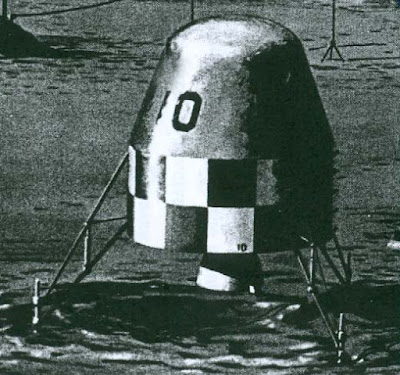 The One-Way Space Man crew capsule. Image credit: Bell Aerosystems
Cord and Seale’s crew capsule would measure 10 feet across its base and about seven feet tall. It would provide 345 cubic feet of living volume for the One-Way Space Man. The capsule would have an empty mass of just 1735 pounds – less than half that of Mercury – and a fully loaded mass of only 2190 pounds. Its low mass was in large part attributable to its lack of an integral Earth-reentry heatshield – the heatshield would be discarded at the end of the boost phase along with other launch-abort systems. In addition to the 180-pound astronaut, the capsule would carry food and water for 12 days (90 pounds), breathing oxygen for 12 days plus an 18-day emergency supply (60 pounds), a space suit with rechargeable life-support backpack (90 pounds), tools and supplies (25 pounds), and health, first-aid, and safety gear (10 pounds).
The thin-skinned crew capsule would not provide adequate radiation protection during the One-Way Space Man's 2.5-day Earth-moon journey nor while he lived in it while setting up his lunar base. This was because providing adequate shielding would add so much mass to the capsule that it would scuttle the entire One-Way Space Man plan. Cord and Seale noted that the next period of high solar flare activity would not begin until 1967, by which time, if all went well, the One-Way Space Man would have returned to Earth; they admitted, however, that more than 25 flares had occurred during the three years prior to their Los Angeles talk.
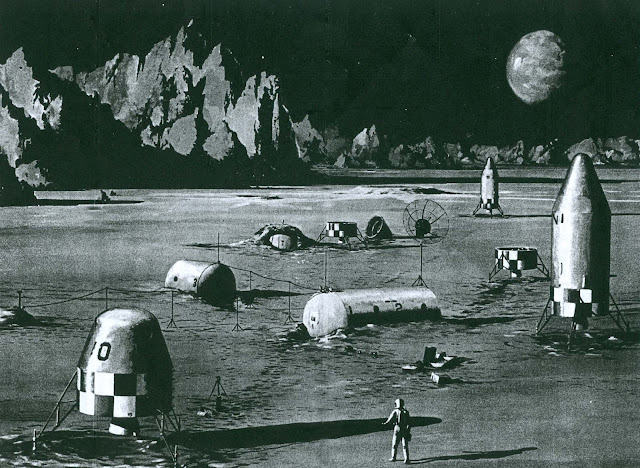 One-Way Space Man lunar base. The nuclear reactor providing electricity to the base is located at the far left edge of the image; overhead cables link it to One-Way Space Man's shelter. A large dish antenna on the shelter links the One-Way Space Man to Earth. Image credit: Bell Aerosystems
Immediately upon landing, the One-Way Space Man would set to work establishing his base. His would be a race against time; in addition to the constant threat of a solar flare, his crew capsule's fuel cells could provide electricity for no more than 9.5 days by the time he landed.
The One-Way Space Man would exit his crew capsule through one of two hatches. The capsule would include no airlock; to exit or enter, the astronaut would need to depressurize or repressurize the entire capsule. The capsule atmosphere would consist of pure oxygen at a pressure of seven pounds per square inch.
The environment into which the One-Way Space Man would step would be extremely hazardous, Cord and Seale warned. In fact, they forecast lunar surface conditions far more harsh than actually exist. They expected that the One-Way Space Man would find few level places and many sharp rocks. The irregular surface and knife-like rock shards would be especially hazardous during the One-Way Space Man's clumsy first days on the moon, when he would be unaccustomed to the low gravity (17% of Earth’s), harsh sunlight (almost twice as bright as on Earth), and deep shadows of the lunar surface.
Micrometeorite dust would cover portions of the surface to a depth of about a yard, Cord and Seale reported. The One-Way Space Man would stir up the dust with his feet as he moved. They told their audience that each disturbed dust grain would ricochet off the surface and stir up additional grains. Combined with dust kicked up by micrometeorite impacts, the astronaut would walk in a veritable dust storm that would at times obscure vision. Inevitably he would carry dust into his shelter; Cord and Seale anticipated that this would place strain on the air filtering system and might damage other systems.
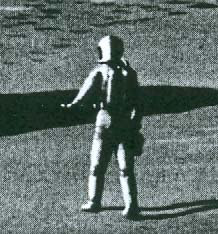 One-Way Space Man space suit. Cord and Seale envisioned a harsh, dusty lunar surface covered with sharp rocks, but this image displays a benign surface. Image credit: Bell Aerosystems
Cord and Seale attempted to estimate how often the One-Way Space Man's space suit would be penetrated by micrometeorites. These would, they reported, travel at an average velocity of 40 kilometers per second. They found that a pressure suit made of sewn three-ply nylon would experience on average 1.3 punctures every four hours. Adding a suit-sealant layer would reduce the decompression danger, but would do nothing to protect the One-Way Space Man's body from the bullet-like impacts of the micrometeorites.
Adding a one-tenth-centimeter-thick woven aluminum layer would slash the average number of punctures to 0.007 per four-hour moonwalk and would attenuate impacts. It would, however, hamper movement. Cord and Seale recommended that the One-Way Space Man be fitted instead with a rigid aluminum suit with the joint flexibility of a nylon soft suit that would permit only 0.002 penetrations per four-hour moonwalk.
During his first 9.5 days on the moon, the One-Way Space Man would unload the four cargo capsules, each of which would measure 10 feet wide and about 13 feet long. Each 2,190-pound cargo capsule would carry 910 pounds of supplies and equipment. Two capsules, equipped with a floor, pre-installed life support systems, and start-up supplies, would become his shelter. He would tip each onto its side, placing its floor parallel with the lunar surface, and remove its conical nosecone. He would then winch the two capsules together, forming a living space about 25 feet long.
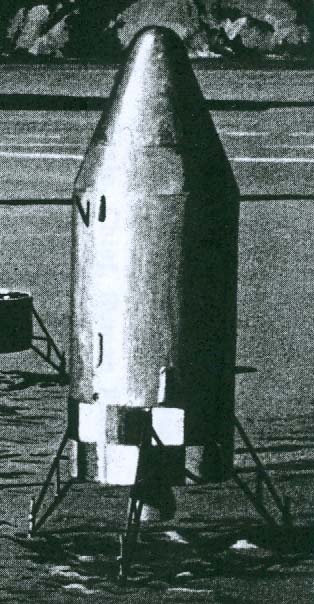 One-Way Space Man cargo capsule. Image credit: Bell Aerosystems
If left unprotected, the One-Way Space Man's shelter would suffer on average 1.4 micrometeorite punctures per year. Cord and Seale noted that burying the shelter under "lunar rubble" would provide protection from micrometeorites and reduce its interior radiation level. Moving enough surface material to adequately bury the 25-foot-long, 10-foot-tall shelter would, however, be beyond the capabilities of a lone astronaut, so they suggested instead that the One-Way Space Man ward off meteorites by installing on his shelter's hull thin metal micrometeorite shields carried inside one of the cargo capsules. The shields, which would stand several inches off the hull, would break up and vaporize micrometeorites that struck them, blunting their impact on the shelter's hull.
For radiation protection, Cord and Seale proposed a separate small radiation shelter that could be easily buried or moved to a “void” in a crater wall. They assumed that six feet of lunar rubble would be sufficient to protect the One-Way Space Man from solar flares. When detectors registered a sharp increase in radiation at the base site, the One-Way Space Man would hurry to the radiation shelter to wait out the flare. As his range of operations increased, he would establish other small shelters at strategic locations around his base site.
The One-Way Space Man would bring along his own potentially hazardous radiation source: a nuclear reactor for generating electrical power. Unlike solar cells, the reactor could make electricity during the frigid two-week lunar night and, unlike fuel cells, it would not require expendables. The astronaut would move the reactor from one of the cargo landers to a small crater and, after running overhead cables back to the shelter and activating it, bury it to protect himself from its ionizing radiation.
 Wątek: [SHB] Space Race:The Notorious 1962 Proposal to Launch an Astronaut on a One-Way (Przeczytany 1739 razy)