Mission to the Mantle: Moonrise (2002)15 October 2017 David S. F. Portree
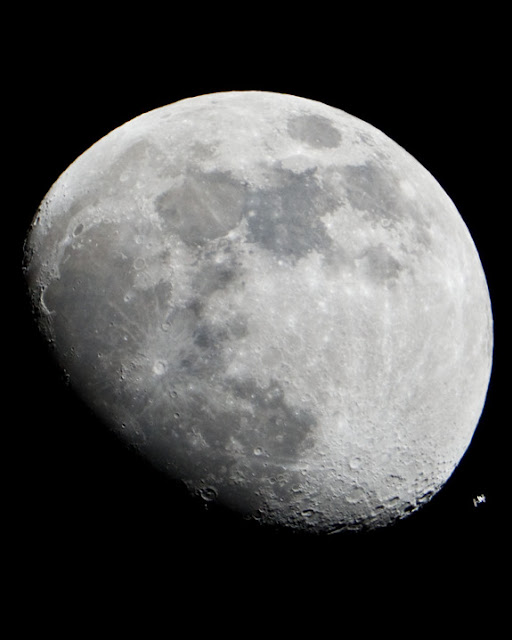 This NASA image of the gibbous moon by photographer Lauren Harnett includes an intruder - the International Space Station (ISS) (lower right). The moon, last visited by humans in December 1972, is about 384,400 kilometers away; ISS, permanently occupied since November 2000, is in low-Earth orbit roughly 1000 times closer (about 400 kilometers).
A casual glance at the moon's disk reveals signs of ancient violence. Nearside, the lunar hemisphere we can see from Earth, is marked by gray areas set against white. Some are noticeably circular. The Apollo expeditions revealed that these relatively smooth basalt plains are scars left by large impactors - comets or asteroids - that pummeled the moon between 3.85 and 3.95 billion years ago during the period known as the Late Heavy Bombardment. These gray areas cover about 20% of the lunar surface. They are concentrated on the Nearside, the lunar hemisphere that faces the Earth.
An Earth-based observer cannot view the largest and oldest giant impact basin because it is out of view on the moon's hidden Farside. South Pole-Aitken (SPA) Basin is about 2500 kilometers wide, making it perhaps the largest impact scar in the Solar System. Lunar Orbiter data revealed its existence in the 1960s, though little was known of it until the 1990s, when the U.S. Clementine and Lunar Prospector polar orbiters mapped surface chemistry over the entire lunar surface. Their data showed that the basin floor probably includes material excavated from the moon's lower crust and upper mantle. In the first decade of the 21st century, laser altimeters on the U.S. Lunar Reconnaissance Orbiter (LRO) and Japanese Kaguya spacecraft confirmed that SPA includes the lowest places on the moon.
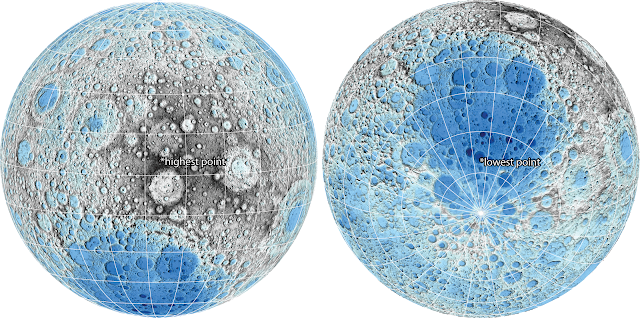 Lunar hemispheres centered on the moon's highest point (left) and lowest point (right). Both occur on the moon's Farside hemisphere and are believed to be associated with the excavation of the South Pole-Aitken Basin perhaps 4 billion years ago. On this U.S. Geologic Survey topographic map, blue indicates low areas and gray and black indicate high areas.
 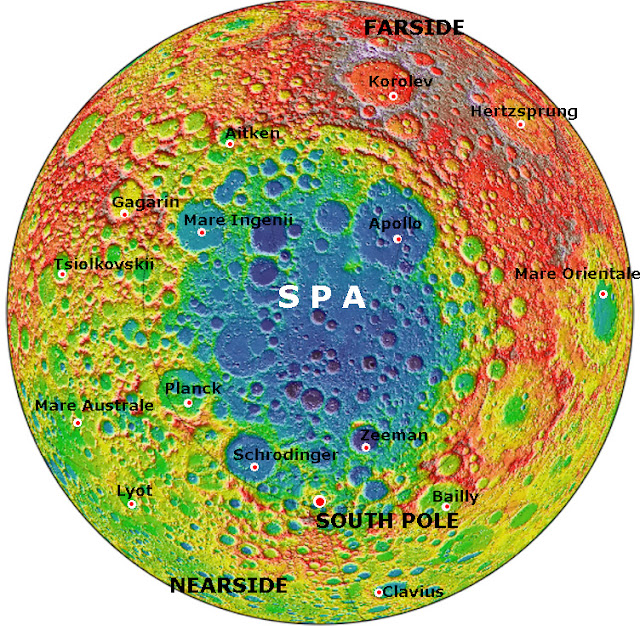 South Pole-Aitken Basin with major features labeled. Image credit: DSFPortree/NASA
 Michael Duke, a retired NASA Johnson Space Center geologist with the Colorado School of Mines, participated in both Apollo and 1990s lunar explorations. In 1999, Duke led a team that proposed a robotic SPA sample-return mission for NASA's low-cost Discovery Program. To fit under Discovery's $300-million-per-mission cost cap, Duke's team had proposed "the simplest-possible mission" - a single lander with no sample-collecting rover, a lunar-surface stay-time of just 24 hours, and a low-capability lunar-orbiting radio-relay satellite (needed because Farside is not in line-of-sight radio contact with Earth). Believing that these limitations added up to a high risk of mission failure, NASA rejected the 1999 proposal.
In 2002, however, the National Research Council's planetary science Decadal Survey declared SPA sample return to be a high scientific priority and, at the same time, proposed a new class of competitively selected medium-cost missions. The latter marked the genesis of NASA's New Frontiers Program, with a cost cap per mission of $700 million. Duke's team immediately began to upgrade its SPA proposal for New Frontiers.
 Geologist Michael Duke in 2004. Image credit: NASA
In October 2002, Duke described the new SPA mission design at the 53rd International Astronautical Federation Congress (the Second World Space Congress) in Houston, Texas. To avoid helping competing New Frontiers proposers, his paper provided only limited technical details.
Duke argued that the SPA sample-return mission could collect ancient deep crust and mantle rocks without a costly rover. Clementine and Lunar Prospector had shown that at least half of the surface material in the central part of SPA was native to the basin, so stood a good chance of having originated deep within the moon.
Furthermore, Apollo demonstrated that any lunar site is likely to yield a wide assortment of samples because the moon's low gravity and surface vacuum enable asteroid impacts to widely scatter rock fragments. The Apollo 11 mission to Mare Tranquillitatis, for example, found and returned to Earth rocks blasted from the moon's light-hued Highlands. Duke proposed that the SPA sample-return lander sift about 100 kilograms of lunar dirt to gather a one-kilogram sample consisting of thousands of small rock fragments. These would have many origins, but a large percentage would be likely to have originated in the moon's deep crust and mantle.
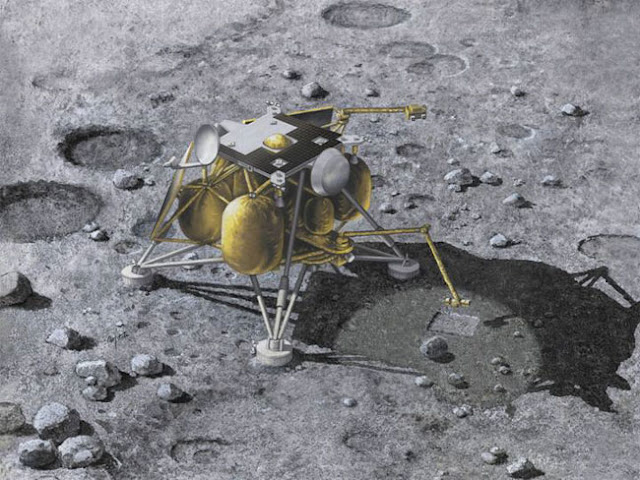 A SPA sample-return lander sifts lunar surface material in quest of small fragments of lunar upper mantle and lower crust material. The gray dome mounted sideways on the right side of the lander, above the sample arm attachment point, is a sample-return reentry capsule for carrying a one-kilogram sample through Earth's atmosphere. Image credit: NASA
NASA rejected the Discovery SPA mission in part out of concern for lander safety. Duke noted that, with the New Frontiers Program's $700-million cost cap, the SPA sample-return mission could include two landers. This would provide a backup lander in case one crashed. He pointed out, however, that automated Surveyor spacecraft of the 1960s had found the moon to be a relatively easy place on which to land even without the benefits of 21st-century hazard-avoidance technology. Two landers would also increase the already good chance that the mission could collect samples representative of the basin's earliest history.
A $700-million budget would also enable a relay satellite "more competent" than its bare-bones Discovery predecessor. It might be placed in a halo orbit around the Earth-moon L2 point, 64,500 kilometers behind the moon as viewed from Earth. From that position, the satellite would permit continuous radio contact between Earth and the landers. A satellite in lunar orbit could remain in line-of-sight contact with both the landers and Earth for only brief periods.
NASA had argued that a single day on the moon provided too little time to modify the SPA Discovery mission if it suffered difficulties. The SPA New Frontiers mission would, therefore, remain on the moon for longer. Duke noted, however, that stay-time would probably be limited to the length of the lunar daylight period (14 Earth days) because designing the twin landers to withstand the frigid lunar night would boost their cost.
In February 2004, Duke's mission - catchily named Moonrise - became one of two SPA sample-return missions proposed for New Frontiers. In July 2004, NASA awarded Moonrise and a Jupiter polar orbiter called Juno $1.2 million each for additional study. In May 2005, the space agency selected Juno for full development. The Southwest Research Institute-led mission left Earth on 5 August 2011 and reached Jupiter on 4 July 2016.
Juno's selection was not the end of Moonrise, though it did mark the end of Duke's direct involvement in the proposed mission. In the New Frontiers proposal cycle that began in 2009, a Jet Propulsion Laboratory/Lockheed Martin/Washington University of St. Louis team proposed Moonrise. In 2011, the SPA sample-return mission was again selected as a New Frontiers finalist, but lost out to the OSIRIS-Rex asteroid sample-returner.
Source "Sample Return from the Lunar South Pole-Aitken Basin," Michael B. Duke, Advances in Space Research, Volume 31, Number 11, June 2003, pp. 2347-2352
More Information (...)Source:
Mission to the Mantle: Moonrise
 Wątek: [Spaceflight History Blog]Mission to the Mantle: Moonrise (Przeczytany 2141 razy)