Space Station Resupply: The 1963 Plan to Turn the Apollo Spacecraft Into a Space Freighter (2)
 Apollo 15 Command and Service Module Endeavor in lunar orbit. Image credit: NASA
The Apollo CM included three astronaut couches, control consoles, small windows at strategic locations, a side-mounted hatch with a window, a docking tunnel and parachutes in its nose, thrusters for orienting it for atmosphere reentry, and, at its base, a bowl-shaped reentry heat shield. Umbilicals and cables in a hinged housing linked the CM to the SM.
The Apollo SM included seven major internal bays. A central cylindrical bay housed tanks of helium pressurant for pushing rocket propellants into the SPS main engine. Arrayed around the central compartment were six triangular bays containing tanks of fuel and oxidizer for the SPS and for four attitude-control thruster quads, electricity- and water-making fuel cells, and tanks of liquid oxygen and liquid hydrogen reactants for supplying the fuel cells.
The MODAP CSM would comprise a stripped-down SM and a beefed-up CM. Because it would spend a limited amount of time in free flight before it docked with an Earth-orbiting station, the MODAP SM could dispense with or minimize many Apollo lunar SM systems. Batteries would replace fuel cells, for example, and a compact LEM descent engine could replace the SPS. The LEM engine would draw its propellants from a pair of spherical tanks in the MODAP SM's central cylindrical compartment. These deletions and additions would free up four of the MODAP SM's triangular bays for cargo transport.
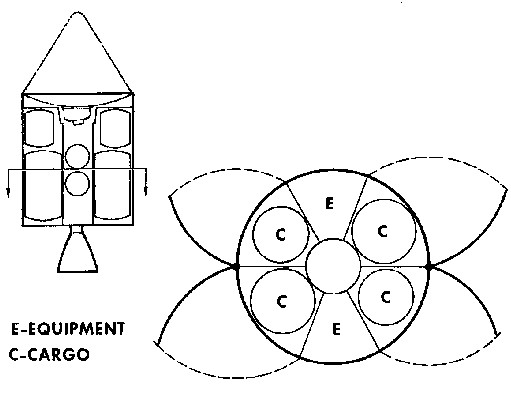 The Apollo SM had six roughly triangular bays arrayed around a cylindrical core. The bays contained propellants, fuel cells, and liquid hydrogen and liquid oxygen tanks, among other systems necessary for a lunar mission. For its Earth-orbital station logistics missions, the MODAP SM needed fewer systems and tanks, so could devote four of the six triangular bays to cargo. The section image at right displays the cargo and equipment bays and a possible arrangement for four cargo doors. Image credit: North American Aviation/NASA
A two-stage Saturn IB rocket capable of placing 32,500 pounds into a 105-nautical-mile circular parking orbit at 28.5° of inclination would launch the MODAP CSM. Pre-launch preparation, launch operations, and ascent to parking orbit would need from five to 10 days, from five to eight hours, and 11 minutes, respectively.
The MODAP CSM would remain in parking orbit for less than five hours before its crew ignited its LEM descent engine to place it into an elliptical transfer orbit with a 260-mile apogee (highest point above the Earth). Upon reaching apogee 45 minutes later, its crew would again ignite the engine to circularize its orbit. Subsequent station rendezvous and docking maneuvers might need up to 17.5 hours.
The company calculated that a 24-man station with crew stays lasting six months would need to receive a MODAP CSM bearing six astronauts and 5855 pounds of supplies eight times per year - that is, every 45 days. The typical cargo manifest would include 1620 pounds of food, 1035 pounds of oxygen, 505 pounds of nitrogen, 1450 pounds of propellants, and 1245 pounds of spare parts. The Project Olympus station would recover and reuse all water launched with it, so would have no need of water resupply.
 These cutaway drawings of the Project Olympus hangar display internal (right) and external palletized cargo transfer methods. The internal method assumes that the entire MODAP CSM can fit into the hangar. The drawing at left shows how the protruding MODAP SM would separate from the MODAP CM and pivot into cargo-unloading position. MODAP CMs for Earth-return are docked radially on the dome-shaped docking hub near the floor of the hangar. Image credit: North American Aviation/NASA
Supplies would reach the Project Olympus station in drum-shaped Cargo Modules, or CAMs, packed in the four empty triangular MODAP SM bays. The mass of the empty CAMs would total 1970 pounds. Liquid and gaseous cargo would fill small CAMs, while solid cargoes would ride on disc-shaped pallets in large CAMs. In all, a MODAP CSM could transport 9127 pounds of cargo and CAMs.
The MODAP CSM would dock with the Project Olympus station via an axial docking unit at the bottom of the station hangar. NAA envisioned that the station would include either a tall hangar for the entire MODAP CSM or a short hangar for the MODAP CM alone (in which case the MODAP SM would protrude into space). If the former, then CAM transfer could occur entirely within the hangar. If the latter, then CAM transfer would occur external to the station. In both cases, after all cargo was transferred, the MODAP SM would be cast off and the hangar closed to protect the MODAP CM.
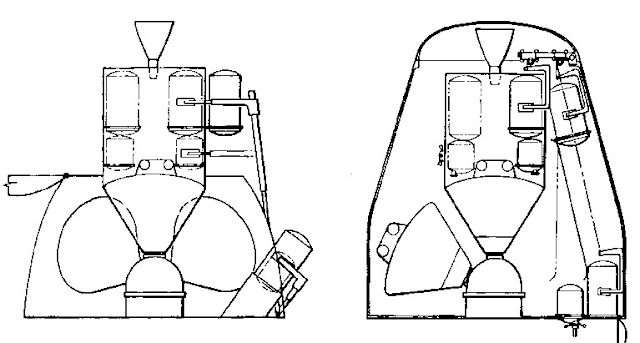 These cutaway drawings of the Project Olympus station hangar show CAM internal (right) and external transfer methods. Compare with palletized transfer drawings above. Image credit: North American Aviation/NASA
To free up the single axial docking port for the next MODAP CSM, a manipulator arm inside the hangar would pivot the MODAP CM to one of three radial berthing ports. It would remained parked there, undergoing periodic inspection and maintenance but otherwise dormant, for up to six months.
Discarding the MODAP SM with its LEM descent engine meant that the MODAP CM would need to carry a separate de-orbit propulsion module. NAA proposed a cluster of six solid-propellant retrorockets, any five of which could deorbit the MODAP CM. The retro package would include batteries for powering the MODAP CM during free-flight prior to reentry. NAA expected that, in normal circumstances, the MODAP CM would need 30 minutes for checkout and undocking. The MODAP CM's crew would ignite its retrorockets immediately after it maneuvered clear of the hangar.
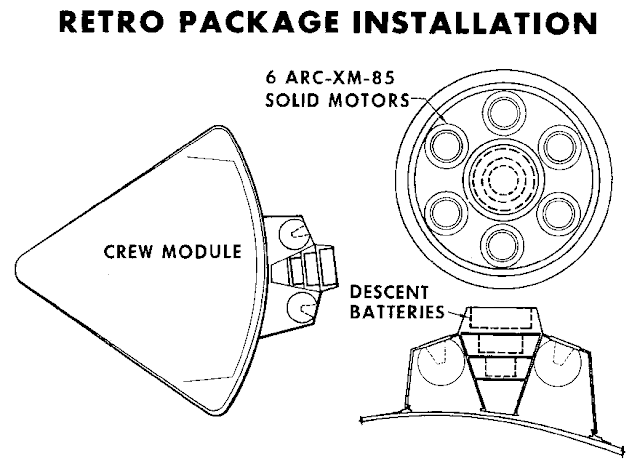 The MODAP CM with solid-propellant retropack. Image credit: North American Aviation/NASA
Twenty-five minutes after retrofire and shortly after retropack separation, the MODAP CM would reenter Earth's atmosphere. Because the MODAP CM would encounter the atmosphere moving at about half the speed of the Apollo lunar CM, its heat shield could be about half as thick. Descent and splashdown would need 11 minutes. With six astronauts on board, the MODAP CM would be heavier than the lunar CM, so would lower on four parachutes; that is, one more than the lunar CM. Its crew could splash down safely if one parachute failed.
Under normal circumstances, the MODAP CM would splash down in the Gulf of Mexico not far from Houston, so crew recovery would take place within a few hours. NAA acknowledged, however, that emergencies might occur. Because of this, the MODAP CM could fly free of the space station for up to 10.5 hours while its inclined orbit and Earth's rotation put it on course for reentry and splashdown at any of three sites. These were the prime site in the Gulf of Mexico, a site near Okinawa in the western Pacific Ocean, and one near Hawaii. To trim costs, fleets of recovery ships would not remain on standby at the landing sites; because of this, the astronauts might need to wait for up to 24 hours for rescue following an emergency splashdown near Okinawa or Hawaii.
An abort during ascent to Earth orbit could cause the Apollo and MODAP CMs to land in southern Africa; that is, to touch down on land. To protect its three-man crew during a land landing, the lunar CM would include shock absorbers in its supporting seat struts. These would enable the crew couches to move vertically up to five inches to dissipate the force of impact.
 A tight fit: six-man MODAP Command Module seating arrangement. Image credit: North American Aviation/NASA
Because the MODAP CM would carry six men arrayed in two rows of three couches each, with one row above the other, NAA found that vertical couch movement would not be an option. The three-man lunar CM would also rely on crushable material behind its heat shield to absorb the force of land impact; this would be inadequate for the greater mass of the six astronauts in the MODAP CM.
NAA proposed to solve the emergency land-landing problem by in effect moving the shock absorbers from the seat struts to the MODAP CM's heat shield and by adding four solid-propellant landing rockets. In the event of a land landing, the bowl-shaped heat shield would deploy downward on shock-absorbing struts and the landing rockets would ignite and pivot out from behind the shield.
NAA envisioned a MODAP CSM design & test program spanning from early 1964 to mid-1968. Operational MODAP CSMs would deliver crews and supplies to 24-man Project Olympus stations between mid-1968 and the end of 1973. The company anticipated that five MODAP CSMs would be used in ground tests and unmanned test flights, and that 40 MODAP CSMs would support the station program. Of these, perhaps two would fail, requiring assembly of at least two backup MODAP CSMs. NAA placed the total cost of the MODAP CSM program including $861 million for Saturn IB rockets at $1.881 billion.
A significant outcome of Olling's Project Development Plan and NAA's MODAP study was the realization that space station crew rotation and resupply would dominate total space station program cost. Summing up his findings, Olling wrote that a "reusable launch vehicle could contribute large economies" (that is, ensure large cost savings) for the station program. Even if four space stations were launched on expendable Saturn V rockets during the Project Olympus program, station cost would total only $1.273 billion; that is, about $600 million less than the MODAP CSM flights.
The Project Olympus and MODAP CSM study teams were not alone in reaching these conclusions; thus, as early as 1963, a reusable logistics spacecraft came to be seen as a desirable component of a large space station program. By 1968, this led to calls by high-level NASA management for a 1970s Space Station/Space Shuttle program.
SourcesFinal Technical Presentation: Modified Apollo Logistics Spacecraft, Contract NAS 9-1506, North American Aviation, Inc., Space and Information Systems Division, November 1963
"Project Olympus: Proposed Space Station Program," Edward H. Olling, NASA Manned Spacecraft Center, 16 July 1962
More Information(...)
Source:
Space Station Resup ply: The 1963 Plan to Turn the Apollo Spacecraft Into a Space Freighter
 Wątek: [SHB] Space Station Resupply: The 1963 Plan to Turn the Apollo Spacecraft Into a (Przeczytany 1954 razy)