http://www.americaspace.com/2018/06/06/soyuz-ms-09-launches-u-s-russian-german-spacefarers-to-space-station/#more-104487Soyuz MS-09 Launches U.S., Russian, German Spacefarers to Space StationBy Ben Evans June 6th, 2018
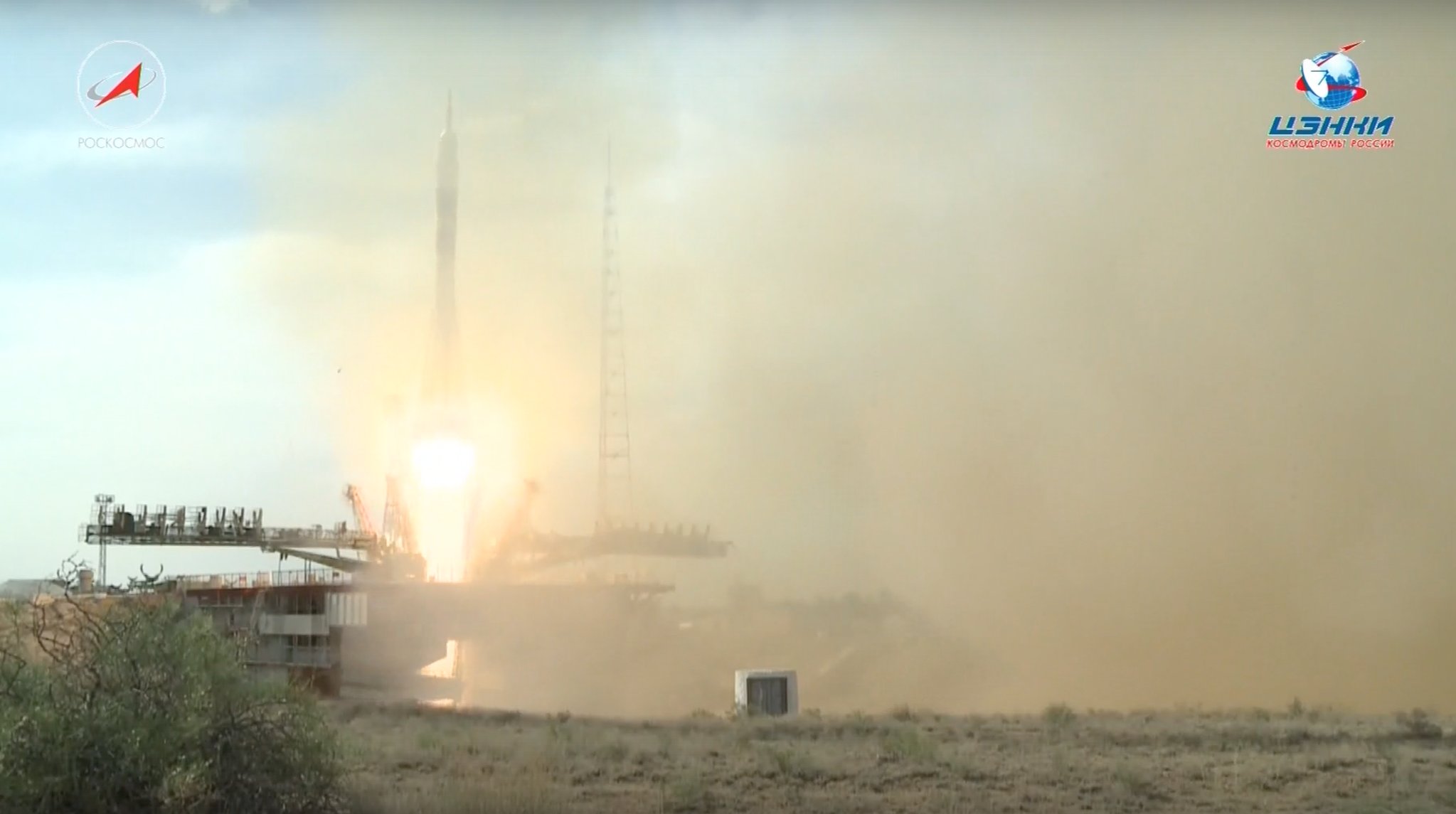 Soyuz MS-09 launches from Site 1/5 at Baikonur at 5:12 p.m. local time (7:12 a.m. EDT) Wednesday, 6 June, bound for a two-day pursuit of the International Space Station (ISS). Photo Credit: Roscosmos/Twitter
Three spacefarers from three nations—including a former Russian Air Force strategic bomber pilot, the second European commander of the International Space Station (ISS) and a Cuban-American flight surgeon moved in January from the backup to the prime crew—have launched from the Baikonur Cosmodrome in Kazakhstan, aboard Soyuz MS-09. Sergei Prokopiev, Alexander Gerst and Serena Auñón-Chancellor rocketed away from Site 1/5 at the historic launch site at 5:12 p.m. local time (7:12 a.m. EDT) Wednesday, 6 June, bound for a six-month increment on the orbiting outpost. They will initially form the second half of Expedition 56, helmed by U.S. astronaut Drew Feustel, before Gerst rotates into the command of Expedition 57 in October, leading the station until his own crew returns to Earth in mid-December.
A czy w ogóle wiadomo, czemu tym razem 48 godzin na dolot do ISS, a nie sześć?
For the third consecutive occasion, a Soyuz crew will embark on a longer rendezvous approach to get to the ISS, spending two days and 34 orbits in transit, due to phasing constraints. The Soyuz MS-08 crew followed a similar profile in March 2018, as did their predecessors aboard Soyuz MS-07, last December. Not since Soyuz MS-06 in September 2017 has a crew followed the shorter, six-hour and four-orbit “fast rendezvous” approach. “08 and 09…happen to be scheduled on dates that do not allow phasing for the four-orbit rendezvous,” NASA’s Rob Navias told AmericaSpace, earlier this year. “Four-orbit rendezvous are desirable, but by no means mandatory.” Depending upon the launch date, it is anticipated that the Soyuz MS-10 flight of Russian cosmonaut Alexei Ovchinin and U.S. astronaut Nick Hague in the fall will follow a shorter rendezvous profile.
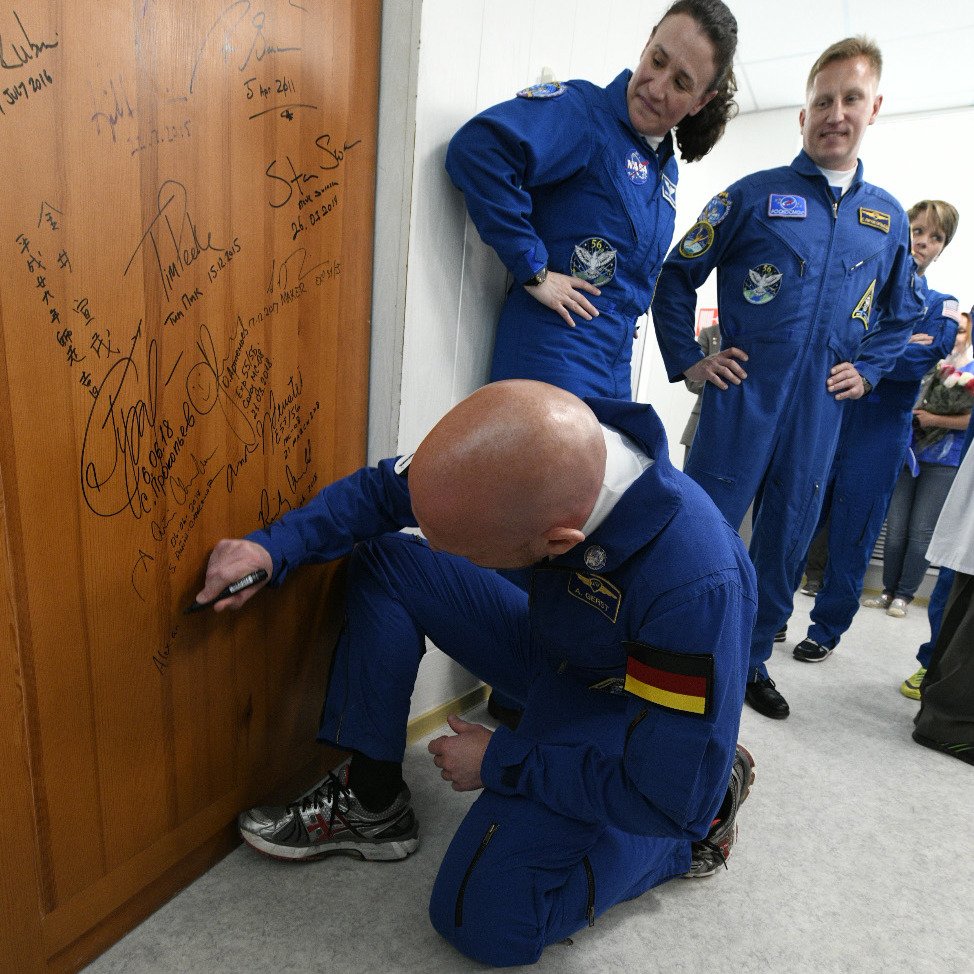 Watched closely by his crewmates, Alexander Gerst completes the traditional ritual of signing his bedroom door in the Baikonur Cosmonaut Hotel. Photo Credit: ESA/Twitter
Gerst, a German citizen, is the only veteran member of the Soyuz MS-09 crew, having previously flown for 165 days during Expeditions 40/41 in May-November 2014. Assignment to his second mission came in May 2016, with the expectation that he would be the second European Space Agency (ESA) astronaut to command the station, after Belgium’s Frank de Winne, who led Expedition 21 in the closing months of 2009. Last year, Gerst announced that his upcoming mission will be named “Horizons”. When asked about the name, he explained that horizons “are a symbol for the unknown and when I gaze at the horizon, I cannot help but wonder what lies beyond it”. ESA Director General Jan Woerner added that the Horizons name was fitting, “as it will open up new horizons in human and robotic spaceflight”.
In January 2017, NASA astronaut Jeanette Epps was assigned to join Gerst aboard Soyuz MS-09, together with cosmonaut Sergei Prokopiev. The three served as backups for last December’s Soyuz MS-07 crew, ahead of their own launch in mid-2018. However, a few weeks later, Epps was abruptly dropped from the crew—for reasons which remain unclear—and replaced by her backup, Auñón-Chancellor. Pre-flight exams concluded on 11 May, after which the prime crew and their backups—Russia’s Oleg Kononenko, together with “rookies” David Saint-Jacques of the Canadian Space Agency (CSA) and Anne McClain of NASA—flew from the Star City cosmonauts’ training center, near Moscow, to Baikonur, on 19 May. Over the following days, they participated in customary activities, including raising U.S., Russian, German and Kazakh flags, and the rookies planted their own trees in Baikonur’s Avenue of Cosmonauts. This provided an opportunity for a spot of humor for Gerst, whose own tree appeared rather sorry for itself, as did the tree of his former Expedition 40/41 crewmate Reid Wiseman. “Hey @astro_reid,” Gerst tweeted on 22 May, “glad there are some things we are better at than planting trees.”
As much as Gerst was looking forward to his mission, there were some things he would miss. “Last night, breathtaking thunderstorm above Baikonur; my absolute favorite weather,” he tweeted on 31 May. “Lightning across entire sky. Stood out there in the rain for two hours & watched the storm sweep across the dark steppe, towards launch pad. Last rain for half-year? I will miss this planet!”
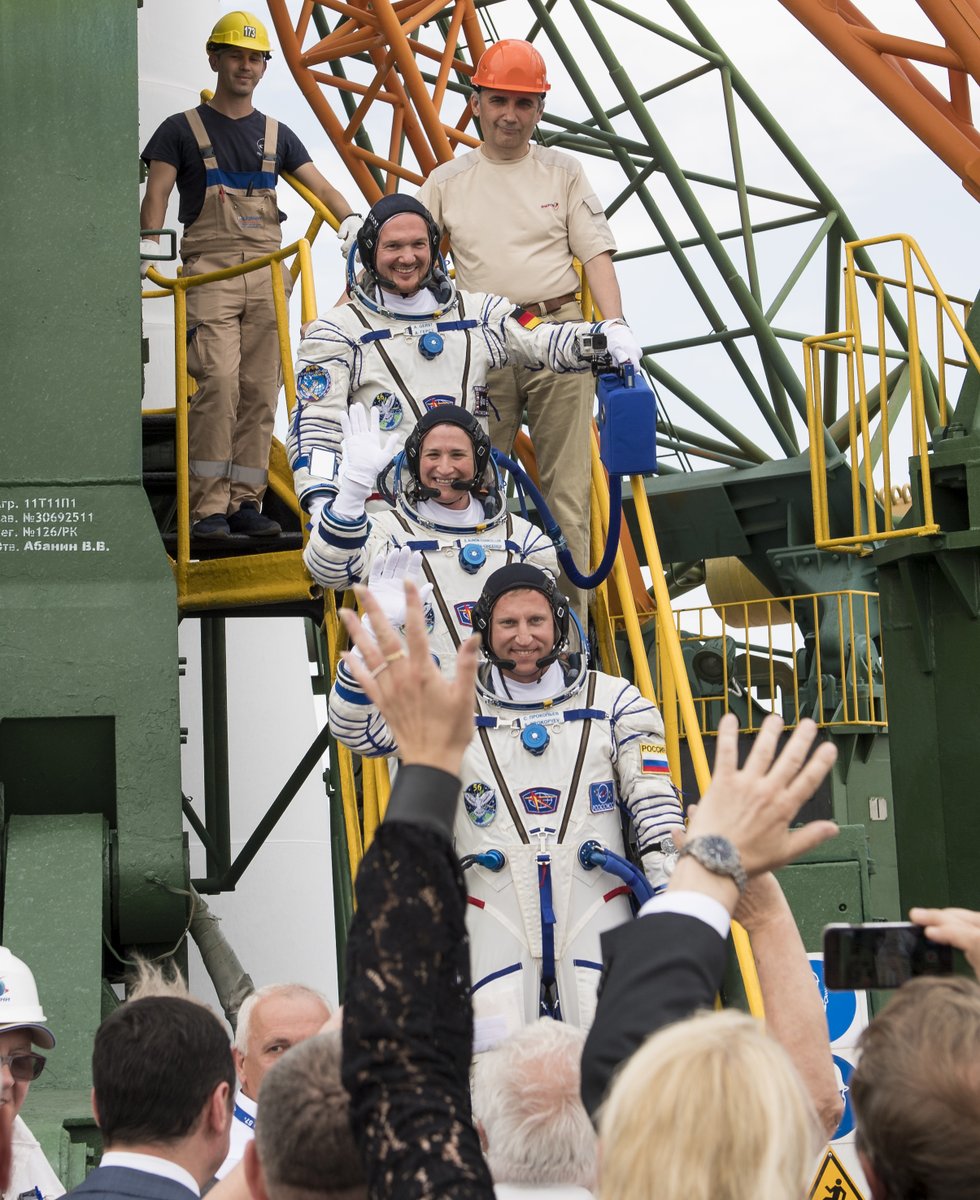 The crew waves to wellwishers before entering Soyuz MS-09. Photo Credit: NASA/Twitter
On 1 June, the Soyuz MS-09 spacecraft, encapsulated within its payload shroud, was transported by rail to Baikonur’s integration facility and placed atop the 162.4-foot-tall (49.5-meter) Soyuz-FG booster. Emblazoned with imagery pertaining to this year’s FIFA World Cup in Sochi, Russia, the rocket was taken to Site 1/5 in a horizontal configuration on 4 June. The nod to the World Cup was particularly relevant, as Gerst’s homeland of Germany are currently the defending champions. However, Gerst was not there. Nor was Auñón-Chancellor. And nor was Prokopiev. Instead, the backup crew of Kononenko, Saint-Jacques and McClain witnessed the rollout. “Soyuz is being rolled out to the launch pad,” tweeted Saint-Jacques. “The prime crew is forbidden to attend because it could bring bad luck.” From his crew quarters, Gerst agreed. “Only the replacement crew can watch,” he tweeted. “Perhaps because someone is afraid that we will think differently…?” Other astronauts were in attendance, too, including former shuttle commander Mark Polansky, who now supports NASA and Commercial Space as an aerospace executive. Also there was Sigmund Jähn, who became Germany’s first national spacefarer, flying to the Soviet Union’s Salyut 6 space station, way back in the summer of 1978. Now a sprightly 81 years old, Jähn was spotted chatting to veteran cosmonaut Pavel Vinogradov.
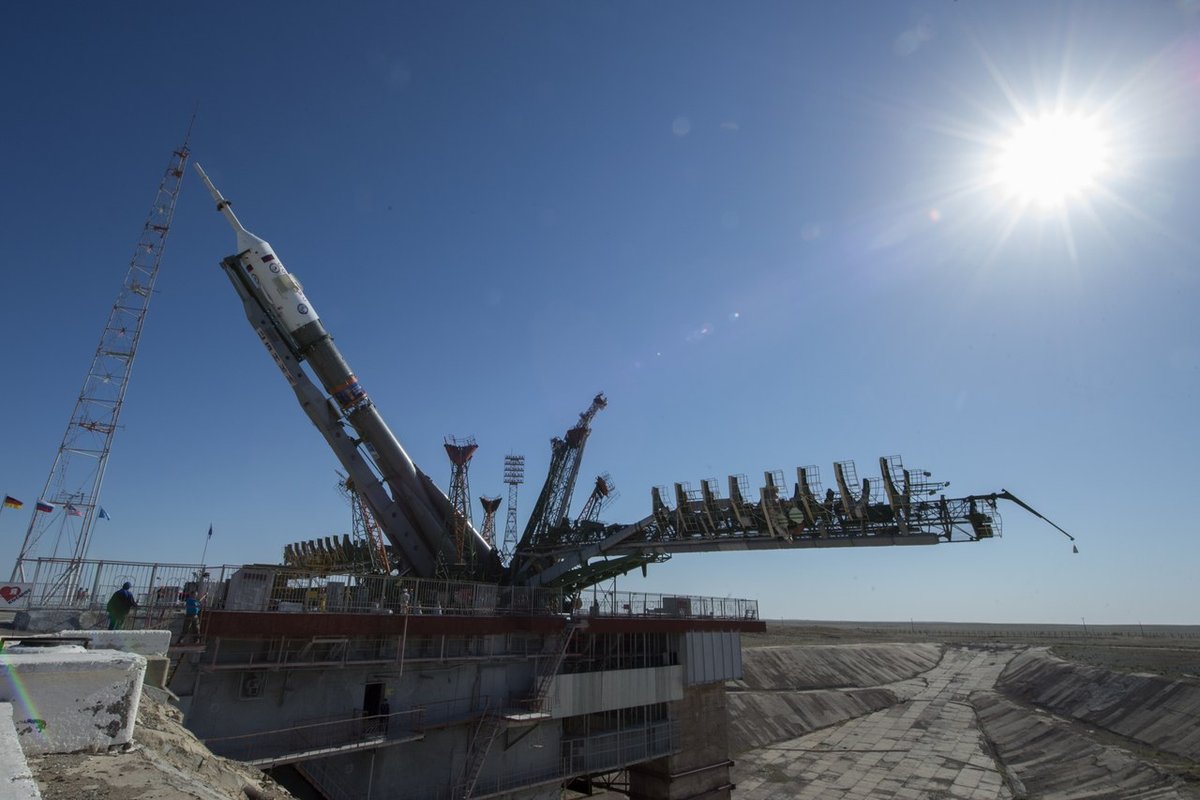 The Soyuz-FG booster for the Soyuz MS-09 mission is elevated to the vertical on Site 1/5 at Baikonur, early Monday, 4 June. Photo Credit: Roscosmos/Twitter
Earlier today, the prime and backup crews were awakened in Baikonur’s Cosmonaut Hotel. They showered, breakfasted on oatmeal, then submitted to disinfecting and microbial sampling in support of the ISS research investigations that they will perform on-orbit. After ceremonially autographing the doors of their hotel rooms and receiving a blessing from a Russian Orthodox priest, the prime crew proceeded via bus to Site 254 to don their Sokol (“Falcon”) launch and entry suits. “Have gotten a great farewell from friends and family,” Gerst tweeted at 11:30 a.m. local time (1:30 a.m. EDT), some 5.5 hours before launch. “Mood in the crew is great. Observe uninterested camels along the wayside.” They then headed out to the launch pad. Prokopiev was inserted into the center commander’s seat of Soyuz MS-09’s descent module, with Gerst taking up his own position in the Flight Engineer-1 seat on the left side of the vehicle and Auñón-Chancellor assuming the right seat as Flight Engineer-2. “Hissing, almost like a living creature,” was Gerst’s description of the venting Soyuz-FG.
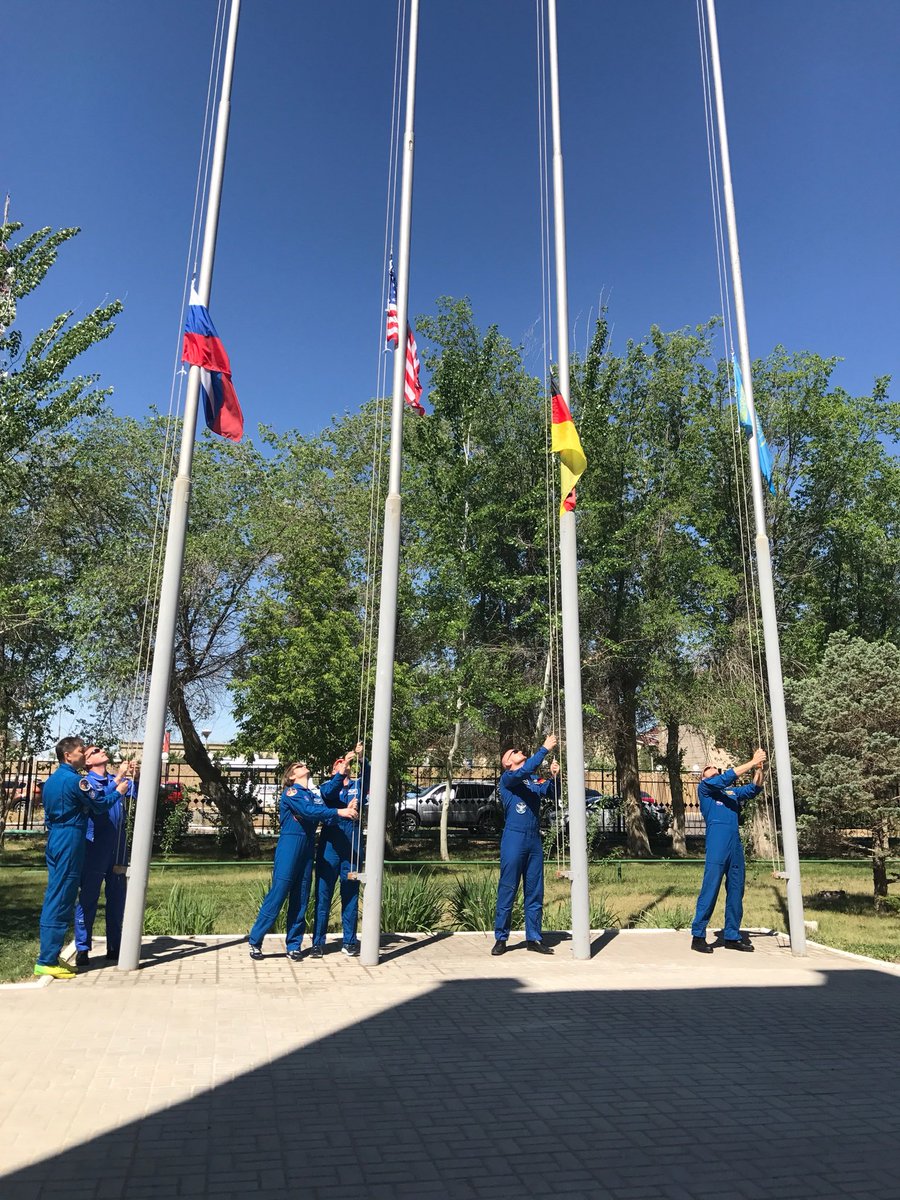 The prime and backup crews raise the national flags of Russia, the United States, Germany and Kazakhstan. Photo Credit: NASA/Twitter
As is traditional, the final phase of the countdown saw music, selected by the crew, piped into the Soyuz cabin. Last month, Gerst tweeted a request for suggestions. “On the launch pad, one hour before launch, during pressure checks, the crew gets to listen to music over the radio,” he explained. After soliciting recommendations, he added a caveat: “Nope, they won’t play “big balls of fire”. Really!”
Already loaded aboard the Soyuz-FG was a highly refined form of rocket-grade kerosene, known as “RP-1”, with liquid oxygen being continuously topped-off until close to T-0, to ensure that boiled-off cryogens were kept replenished and maintained at “Flight Ready” levels. At 4:57 p.m. local time (6:57 a.m. EDT), with about 15 minutes to go, the Launch Abort System (LAS) was armed and transferred to Automatic Mode and the three crew members were instructed to close their space suit visors.
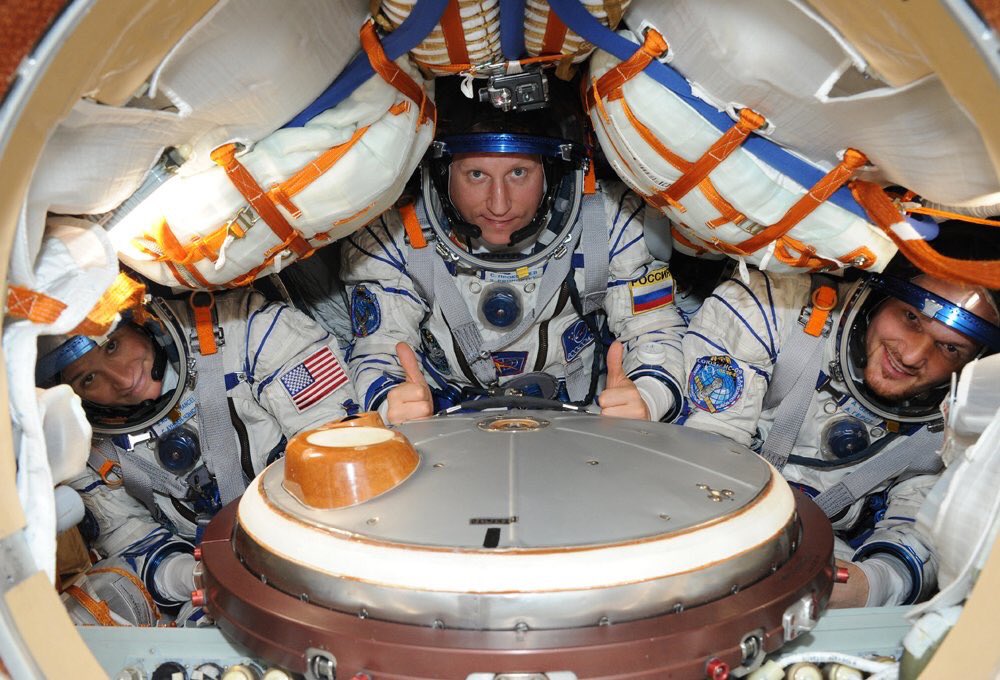 The Soyuz MS-09 prime crew, pictured in their spacecraft during pre-launch fit checks. From left to right are Serena Auñón-Chancellor, Sergei Prokopiev and Alexander Gerst. Photo Credit: RKK Energia/Serena Auñón-Chancellor/Twitter
At T-5 minutes, Prokopiev’s controls were activated and internal avionics aboard Soyuz MS-09 were spooled-up to monitor booster systems throughout ascent. From within the control bunker, the “launch key”—an actual, physical key—was inserted to enable the booster’s ordnance. “It’s a good thing that I was not in charge of the #LaunchKey,” tweeted former NASA astronaut and Soyuz veteran Cady Coleman. “Keeping track of keys never my strength!”
Propellant tanks were pressurized and it was transferred from ground support utilities onto internal power, with the twin umbilical towers retracting away from the vehicle. Ten seconds before T-0, the turbopumps of the RD-108 first-stage engine and the RD-107 engines of the Soyuz-FG’s four tapering, strap-on boosters attained full speed. Five seconds later, the engines themselves ignited and ramped up to full power, before Site 1/5’s fueling tower retracted and Soyuz MS-09 roared into the late-afternoon Baikonur sky.
With the four tapering boosters and the central core powering the initial launch phase, a total of five engines punched out a combined total of 930,000 pounds (422,000 kg) of thrust to lift the 672,000-pound (305,000 kg) rocket away from Earth and onto a two-day voyage to reach the space station.
Less than two minutes into the flight, the strap-on boosters were exhausted and jettisoned, by which point Prokopiev, Gerst and Auñón-Chancellor were traveling in excess of 1,100 mph (1,770 km/h). Interestingly, today’s launch marked the first occasion that a Soyuz-FG had been fitted with an external camera to monitor “staging” in real-time. With both boosters gone, the Soyuz-FG core continued to burn, until the RD-108 shut down a little under five minutes after liftoff. At the instant of shutdown, the rocket and its crew had attained an altitude of 105.6 miles (170 km).
 The Soyuz-FG vanishes into the late-afternoon Baikonur sky, in the opening minutes of today’s flight. Photo Credit: ESA/Twitter
Next came the turn of the third stage, which executed a so-called “Hot Stage” burn, igniting its single RD-0110 engine whilst still attached to the core. A few seconds later, the 89-foot-tall (27.1-meter) core stage was jettisoned. The third stage pushed Soyuz MS-09 to a velocity in excess of 13,420 mph (21,600 km/h) and burned for four minutes, until it shut down at eight minutes and 45 seconds into the flight. By the time of RD-0110 cutoff and the separation of the 22-foot-long (6.7-meter) third stage, Soyuz MS-09 had attained a preliminary orbit with an apogee of 143 miles (230 km) and a perigee of 118 miles (190 km), inclined 51.66 degrees to the equator.
The trio will now spend two days in transit, before Prokopiev guides his ship to a docking at the Earth-facing (or “nadir”) Rassvet module of the station at 9:07 a.m. EDT on Friday, 8 June, whereupon they will bring the resident crew team up to six members, joining Expedition 56 Commander Drew Feustel and Flight Engineers Ricky Arnold and Oleg Artemyev. The new arrivals will have little time to acclimatize, though, as U.S. EVA-51 by Feustel and Arnold is scheduled for 14 June. During the course of their six-month increment, Prokopiev, Gerst and Auñón-Chancellor are expected to support around 300 experiments across a variety of scientific and technological disciplines and welcome two SpaceX Dragon cargo ships in June and November, two Russian Progress vehicles in July and November, Japan’s H-II Transfer Vehicle (HTV)-7 in August and the unpiloted test-flights of SpaceX’s Crew Dragon in August and Boeing’s CST-100 Starliner in November.
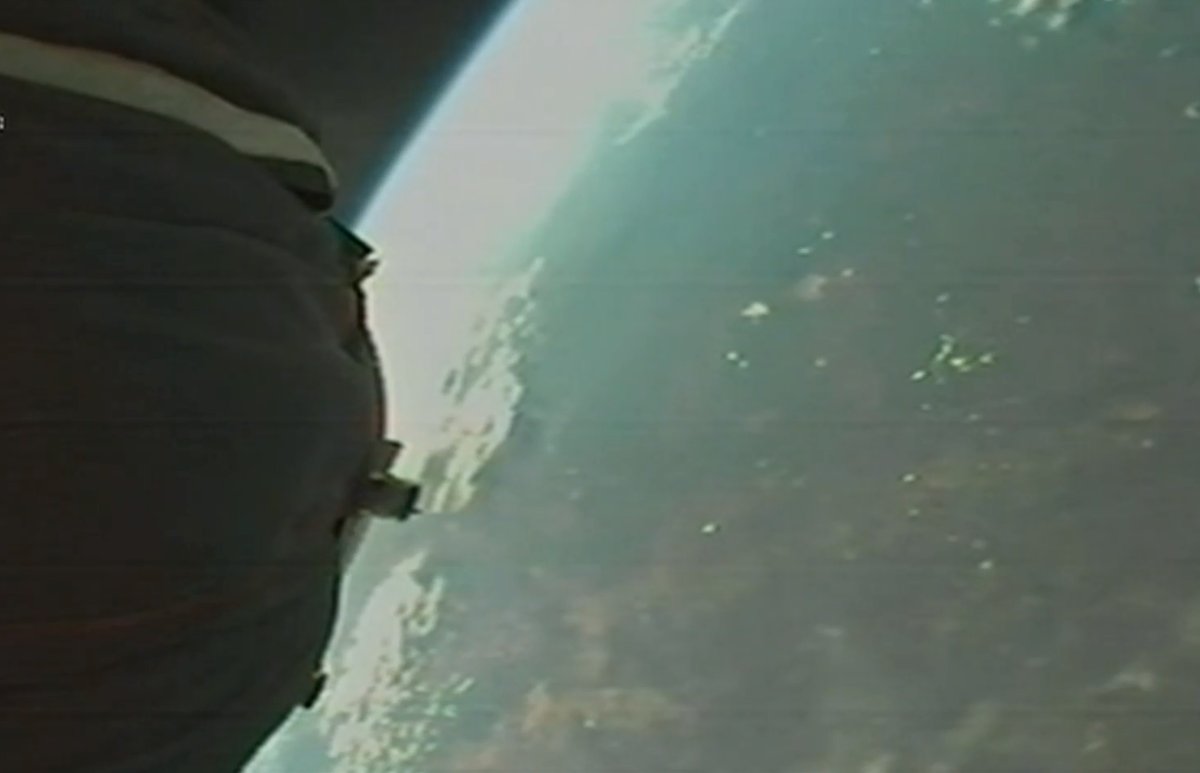 Remarkable view of Soyuz MS-09 from external cameras, shortly before the deployment of the twin solar arrays. Photo Credit: ESA/Twitter
A Russian EVA by Artemyev and Prokopiev is targeted for August, followed by several U.S. EVAs in the the September timeframe. Over a two-year period, from 2017-2019, it is expected that 48 aging nickel-hydrogen batteries on the port-side and starboard-side of the station’s massive Integrated Truss Structure (ITS) will be replaced with 24 small, yet higher-performing lithium-ion batteries. In January 2017, across a pair of EVAs, Expedition 50 spacewalkers Shane Kimbrough, Thomas Pesquet and Peggy Whitson worked to install six batteries into the starboard-side S-4 truss, with the batteries for Power Channels 2A and 4A in the station’s port-side P-4 truss expected to receive attention in the fall 2018 EVAs. The new batteries will ride uphill aboard Japan’s HTV-7 in August.
When Feustel, Arnold and Artemyev return to Earth in early October, Gerst will take command of the ISS and officially kick off Expedition 57. A few days later, on 11 October, Soyuz MS-10 will launch from Baikonur, carrying Ovchinin and Hague. Original plans envisaged a three-man crew but ongoing delays in the launch of Russia’s Multipurpose Laboratory Module (MLM) have caused unfortunate “rookie” cosmonaut Nikolai Tikhonov to be dropped from an ISS prime crew for the second time in less than two years. According to NASA’s Rob Navias, there are no plans for the vacant third seat to be taken by an additional U.S. crew member.
Moving forward, it is expected that ISS expeditions will run for 180-200 days apiece—about a month longer than standard—as NASA and the International Partners ready themselves for the test-flights and Post-Certification Missions (PCMs) of the Commercial Crew Program. Assuming that Prokopiev, Gerst and Auñón-Chancellor land on time on 13 December, they will log a mission of about 190 days. “We and Roscosmos agreed to extend the increments to about 180 days or so,” Mr. Navias told AmericaSpace, “to ensure that we will be making a seamless inclusion of CCP flights to blend in with Soyuz operations.”
 Wątek: Sojuz MS-09 (Przeczytany 42274 razy)