NASA’s Voyager 1 Conserves Power, Resolves Brief Communications PauseOctober 29, 2026 1:30 PM Jet Propulsion Laboratory
 This image, taken on April 27, 1977, shows one of the Voyagers in the 25-Foot Space Simulator thermal vacuum chamber at NASA’s Jet Propulsion Laboratory in Southern California. Image Credit: NASA/JPL-Caltech
NASA’s Voyager team is celebrating two recent developments with the Voyager 1 spacecraft: In September, they successfully completed a months-long effort to stretch the spacecraft’s diminishing power supply. Then, on Oct. 20, an unexpected loss of communication with the spacecraft resolved itself after 48 hours, before the team sent commands to the spacecraft to troubleshoot the issue.
In early September, engineers successfully turned off three devices on the Voyager 1 spacecraft and substituted them with three lower-power alternatives. Nicknamed the “
Big Bang,” the energy-saving effort was completed about six weeks after the mission team performed the same swap on Voyager 2. The Big Bang will enable Voyager 1’s remaining science instruments to operate longer than previously anticipated.
But between now and summer 2027, the team is at the ready for more surprises like the one they recently encountered when they
briefly lost contact with Voyager 1 on Oct. 18 and 19. NASA’s Deep Space Network — large antennas at three facilities around the globe used to communicate with spacecraft at the Moon and beyond — was unable to detect a radio signal from the probe, which is 16 billion miles (24 billion kilometers) from Earth, during two scheduled communications attempts, 24 hours apart. The spacecraft’s signal reappeared 24 hours later, on Oct. 20, and the team has maintained communication with it since then. (...)
https://science.nasa.gov/blogs/voyager/2026/10/29/nasas-voyager-1-conserves-power-resolves-brief-communications-pause/NASA Invites Media, Public to Join Voyager 1 One-Light Day ActivitiesGerelle Q. Dodson Nov 10, 2026 RELEASE M26-086
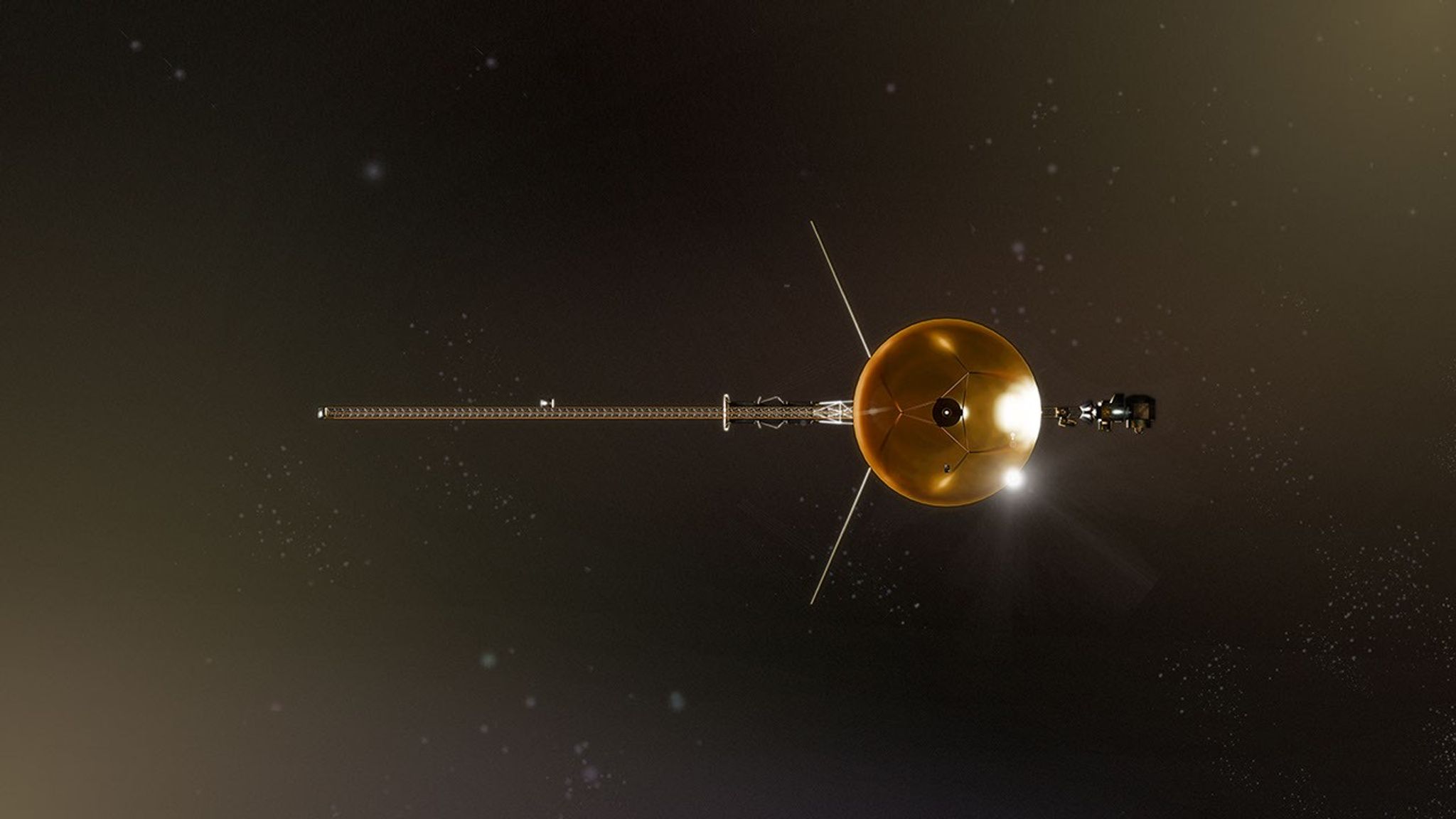 An artist’s concept depicting a Voyager spacecraft. Credit: NASA/JPL-Caltech
Launched nearly 50 years ago in 1977, NASA’s Voyager 1 on Wednesday, Nov. 18 will have traveled one light-day from Earth, which is more than 16 billion miles (25.9 billion kilometers). Voyager 1 is the most distant human-made object, and any light from Earth would take 24 hours to reach the spacecraft. NASA will highlight this historic milestone with two events.
On Tuesday, Nov. 17, NASA invites the world to participate in “Shine Bright for Voyager’s Light-Day” by creating a symbolic wave of golden light encircling the planet after sunset. NASA has created a website that enables smart phones and tablets to flash “VGR”, Voyager’s call sign, in morse code. (...)
https://www.nasa.gov/news-release/nasa-invites-media-public-to-join-voyager-1-one-light-day-activities/
 Wątek: Artykuły o The Voyagers' Odyssey (Przeczytany 9589 razy)