Cause of Lucy solar array deployment problem identifiedby Jeff Foust — January 25, 2022 [SN]
 Engineers believe they know why one of the two solar arrays on the Lucy spacecraft failed to fully deploy, but are still studying whether to try to redeploy the array. Credit: Lockheed Martin
WASHINGTON — Engineers have identified the likely reason one of two solar arrays on NASA’s Lucy asteroid mission failed to latch in place after launch, but NASA is still studying whether to fix the problem.
At a Jan. 25 meeting NASA’s Small Bodies Assessment Group, Hal Levison, principal investigator for Lucy at the Southwest Research Institute, expressed confidence that, regardless if the solar array is fully deployed or not, the issue will not affect the spacecraft’s ability to carry out its mission to study several Trojan asteroids leading and following Jupiter in its orbit around the sun.
Source:
https://spacenews.com/cause-of-lucy-solar-array-deployment-problem-identified/Efforts continue to fully deploy Lucy solar arrayby Jeff Foust — June 10, 2022 [SN]
The principal investigator for NASA’s Lucy asteroid mission says he thinks it’s like the mission can operate as planned even if one of two solar arrays does not fully deploy and latch, based on recent progress tensioning the array. Credit: Lockheed MartinWASHINGTON — Leaders of NASA’s Lucy asteroid mission are increasingly confident that the mission can continue as planned even if ongoing efforts to fully deploy and latch a solar array don’t succeed.
Engineers have been studying for months one of two circular solar arrays that did not fully deploy and latch into place after the spacecraft’s launch in October 2021. They concluded that a lanyard used to pull open the solar array lost tension during the deployment process, causing the lanyard to wrap around the motor shaft.
https://spacenews.com/efforts-continue-to-fully-deploy-lucy-solar-array/Ninth asteroid added to Lucy mission; optimism grows on solar array issueJune 14, 2022 Stephen Clark [SFN]
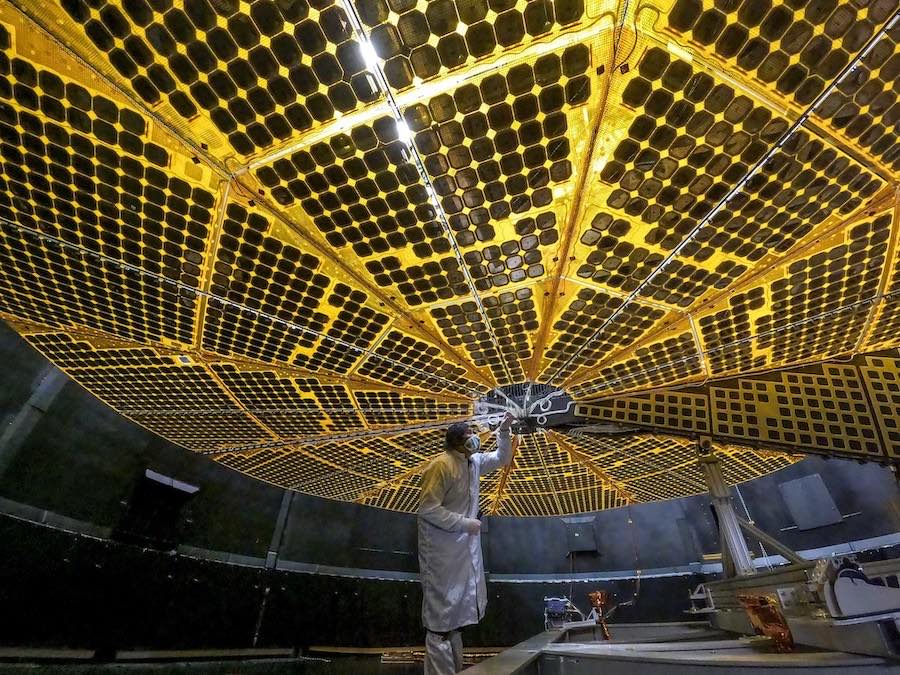 The UltraFlex solar arrays on NASA’s Lucy spacecraft unfold during a ground test at a Lockheed Martin test facility in Colorado. Credit: Lockheed Martin
Engineers have made progress in attempts to fully unfurl a solar array wing that snagged on NASA’s Lucy asteroid explorer shortly after launch last October, adding to optimism that the spacecraft can complete its 12-year mission as planned.
One of Lucy’s two UltraFlex circular solar arrays opened to about 96% of its fully deployed state after arriving in space last October following a launch from Cape Canaveral. The other solar array fully unfurled as the spacecraft began a robotic science mission to fly through swarms of unexplored asteroids that lead and trail Jupiter in its orbit around the sun.
https://spaceflightnow.com/2022/06/14/nasa-making-progress-deploying-stuck-solar-panel-on-lucy-asteroid-probe/NASA suspends efforts to fully deploy Lucy solar arrayJeff Foust January 21, 2023 [SN]
 NASA says that while is it suspending efforts to complete deployment of one of two solar arrays, at least until late next year, the array appears stable and can generate sufficient power to carry out its mission. Credit: NASA/GSFC
WASHINGTON — NASA is suspending efforts, at least until late next year, to try to fully deploy a solar array on its Lucy spacecraft, citing diminishing returns as the spacecraft heads away from the sun.
In a statement quietly posted on NASA’s website Jan. 19, the agency said the latest effort to latch one of two solar arrays on Lucy, more than a month earlier, failed to complete the deployment of the circular array and lock it into place. That effort, NASA said, “produced only small movement in the solar array.”
https://spacenews.com/nasa-suspends-efforts-to-fully-deploy-lucy-solar-array/NASA adds asteroid flyby to Lucy missionJeff Foust January 26, 2023 [SN]
 NASA's Lucy spacceraft will fly by a small main-belt asteroid in November to test the spacecraft's tracking system as well as its stability given that one solar array is not fully deployed. Credit: NASA/GSFC
WASHINGTON — NASA has added another asteroid flyby to its Lucy mission later this year that will provide a test of its capabilities for future encounters.
NASA announced Jan. 25 that the spacecraft will fly by the small main-belt asteroid 1999 VD57 on Nov. 1. The project selected that asteroid after one scientist collaborating on the mission, Raphael Marschall of France’s Nice Observatory, compared the spacecraft’s trajectory to the orbits of 500,000 asteroids.
https://spacenews.com/nasa-adds-asteroid-flyby-to-lucy-mission/UAE outlines plans for asteroid missionJeff Foust June 3, 2023
 The MBR Explorer spacecraft is at least superficially similar in design to NASA's Lucy asteroid mission. It will fly by six asteroids in the main belt before arriving at a seventh in 2034. Credit: UAE Space Agency
WASHINGTON — The United Arab Emirates has released new details about its planned mission to the main asteroid belt, one that is similar to an ongoing NASA mission.
The UAE Space Agency said its Emirates Mission to the Asteroid Belt (EMA) is scheduled to launch in March 2028, flying by six asteroids in the main asteroid belt before arriving at a seventh asteroid in 2034.
https://spacenews.com/uae-outlines-plans-for-asteroid-mission/NASA’s Lucy Spacecraft Snaps Photos of Interstellar Comet 3I/ATLAS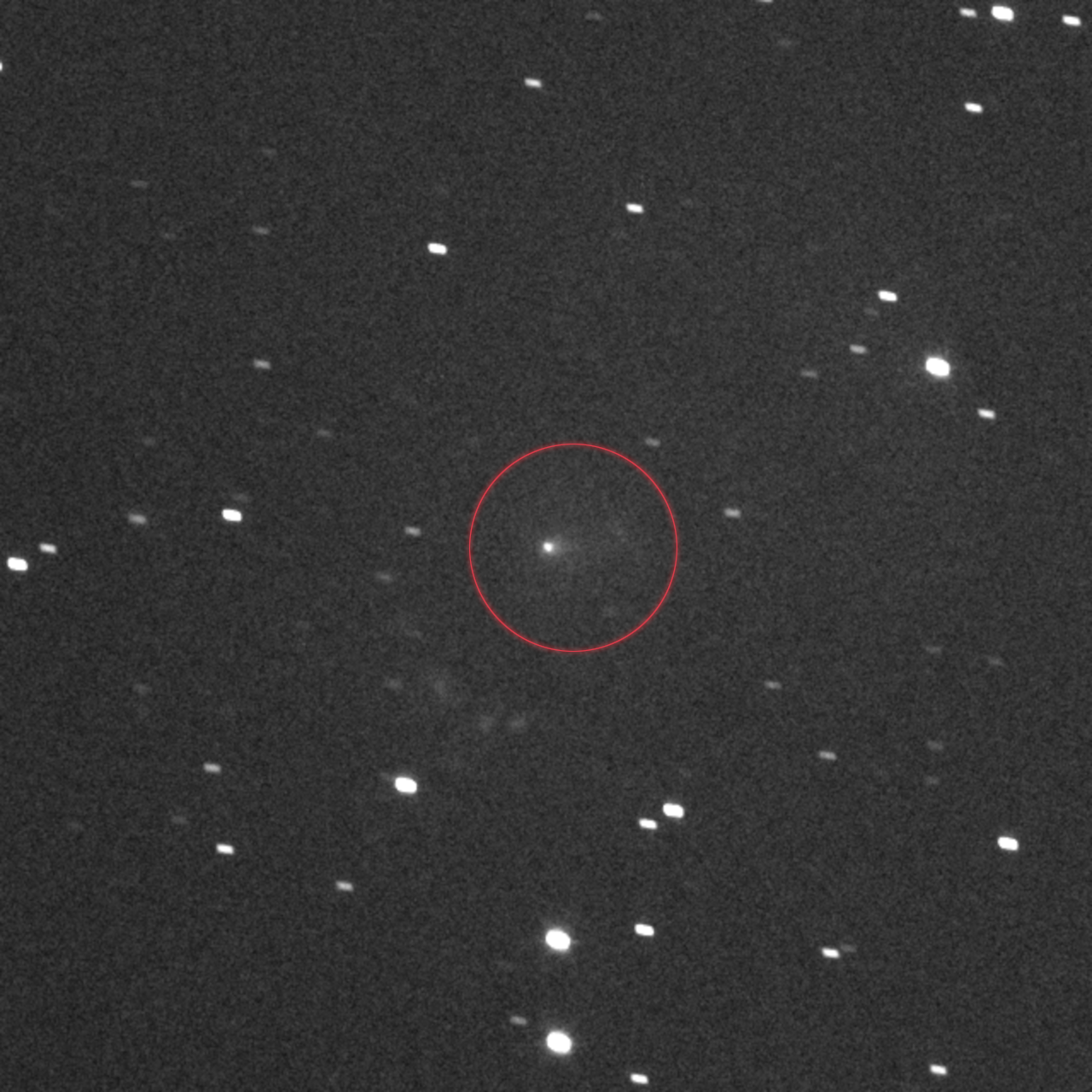 The interstellar comet 3I/ATLAS, circled in the center, as seen by the L’LORRI panchromatic, or black-and-white, imager on NASA’s Lucy spacecraft. This image was made by stacking a series of images taken on Sept. 16, 2025, as the comet was zooming toward Mars. Lucy was 240 million miles away from 3I/ATLAS at the time making its way to explore eight asteroids that share an orbit with Jupiter. The L’LORRI imager captured the comet’s coma, the fuzzy halo of gas and dust surrounding 3I/ATLAS above, and its tail, a smudge of gas flowing to the right of the comet. This image spans about 11 arcminutes of sky, or roughly one-third the width of the full Moon. Solar system north is up.
NASA/Goddard/SwRI/JHU-APLIn mid-September, NASA’s Lucy spacecraft captured images of the intriguing interstellar comet 3I/ATLAS. The third interstellar object ever detected by astronomers as it passed through our solar system, 3I/ATLAS was discovered on July 1 by the NASA-funded ATLAS (Asteroid Terrestrial-impact Last Alert System) survey telescope. At the time, the comet was headed inward from the outer solar system.
Lucy’s high-resolution, black-and-white imager, L’LORRI, captured a series of photos between Sept. 15–17, as the comet was zooming toward Mars. Lucy was 240 million miles away from 3I/ATLAS, well beyond the orbit of Mars, on its way to explore eight asteroids out of two swarms of asteroids that share an orbit with Jupiter, collectively known as the Jupiter Trojan asteroids. (...)
https://science.nasa.gov/blogs/lucy/2025/11/19/nasas-lucy-spacecraft-snaps-photos-of-interstellar-comet-3i-atlas/NASA’s Lucy Reaches Trojan Asteroid Region 5 Years After LaunchNASA Science Editorial Team October 28, 2026 10:11 AM
Having traveled more than 2.2 billion miles since it launched on Oct. 16, 2021, NASA’s Lucy is the first spacecraft to enter a region of primitive solar-system bodies known as the Jupiter Trojan asteroids.
Although there aren’t well-defined boundaries in space, mission engineers know that Lucy is approaching Jupiter’s Lagrange point 4 (L4) by tracking Lucy’s location through the spacecraft’s radio signals and images of surrounding stars. This region is one of two large and unexplored “islands of stability”, where thousands of asteroids share Jupiter’s orbit around the Sun, guided by the combined gravitational pull of the Sun and the gas-giant planet.
The L4 point is surrounded by the group of asteroids that travel ahead of Jupiter in its orbit. The second group, around Lagrange point 5, trails behind the planet. Lucy will visit asteroids in both regions. Trojans in these clusters are as far from Jupiter as the planet is from the Sun, about 484 million miles. (...)
https://science.nasa.gov/blogs/lucy/2026/10/28/nasas-lucy-reaches-trojan-asteroid-region-5-years-after-launch/
 Wątek: Artykuły o Lucy asteroid probe (Przeczytany 4823 razy)