Autor Wątek: Artykuły o Hayabusa2  (Przeczytany 5002 razy)

0 użytkowników i 1 Gość przegląda ten wątek.

Offline Orionid

  • Weteran
  • *****
  • Wiadomości: 28917
  • Very easy - Harrison Schmitt
Artykuły o Hayabusa2
« dnia: Lutego 23, 2019, 23:08 »
Japanese probe lands on asteroid to capture sample
February 22, 2019 Stephen Clark


Moments after landing on asteroid Ryugu, Japan’s Hayabusa 2 captured this view of its landing zone from a distance of about 100 feet (30 meters), showing the probe’s shadow and markings left on the surface, likely from the spacecraft’s thruster jets firing to begin its ascent. Credit: JAXA

Japan’s Hayabusa 2 spacecraft briefly landed on an asteroid Thursday more than 200 million miles from Earth and fired a bullet to scoop up a rocky sample, successfully accomplishing one of the mission’s most challenging maneuvers before returning the asteroid specimen to scientists on the ground in December 2020.

The spacecraft lingered on Ryugu’s surface for just a few moments before firing thrusters to climb away from the asteroid. Hayabusa 2’s ground team in Sagamihara, Japan, celebrated as radio signals beamed back from the probe indicated the touch-and-go maneuver went off without a hitch, delighting engineers who painstakingly planned — then re-planned — the spacecraft’s pinpoint landing.

“Mankind’s hand has reached a new star today,” said Yuichi Tsuda, Hayabusa 2’s project manager at the Japan Aerospace Exploration Agency, or JAXA, through a translator. “JAXA was successful in the operation (and) touchdown of Hayabusa 2 at Ryugu, and sample collection from Ryugu.”

Operating on its own, Hayabusa 2 descended toward Ryugu at a glacial pace Thursday, hitting its expected altitude and speed marks before contacting the surface at 2229 GMT (5:29 p.m. EST). Nineteen minutes later, a shift in the signal coming from Hayabusa 2 indicated it reached the surface and started its ascent, prompting applause from pensive scientists in the control room.

The probe’s navigation system autonomously tracked the location of a target marker deployed onto the asteroid’s surface, allowing Hayabusa 2 to fire its control jets, steering the craft toward a tight landing zone surrounded by hazardous boulders.


Yuichi Tsuda, Hayabusa 2’s project manager, shows a plot of the spacecraft’s altitude during its descent toward asteroid Ryugu during a press conference after the touch-and-go maneuver Thursday. Credit: JAXA

In a press conference a few hours later, mission officials from JAXA confirmed the spacecraft performed flawlessly during the touch-and-go landing.

Telemetry from Hayabusa 2 showed an increase in temperature inside the compartment housing the 0.2-ounce (5 gram) tantalum projectile that shot into the asteroid. The probe uses explosives to fire the bullet, and mission managers said the temperature rise indicated the device functioned as intended.

The projectile was supposed to fire when a sample horn extending from Hayabusa 2 touched the surface of Ryugu. Rock and powder blasted away by the projectile’s impact was expected to funnel through the sample horn into one of three chambers inside the spacecraft’s return capsule, which will bring the samples back to Earth in 2020.

“After confirming the data sent out from Hayabusa 2, we were able to confirm that the sequence for touchdown of Hayabusa 2, including the projectile firing to collect samples, was implemented, and Hayabusa 2’s status is normal,” Tsuda said in a press conference at the Sagamihara control center.

Officials planned to seal the chamber containing the samples from Thursday’s landing, ensuring the material remains uncontaminated during the journey back to Earth.

Hayabusa 2 is Japan’s second mission to collect samples from an asteroid for return to Earth.

A predecessor probe named Hayabusa flew to asteroid Itokawa, but only gathered microscopic specimens from the object after running into numerous problems, including a malfunction in its own projectile firing system, a fuel leak, and reaction wheel failures. Hayabusa, which means “peregrine falcon” in Japanese, returned the little asteroid material it collected back to Earth in June 2010.


Hayabusa 2’s optical navigation camera captured this view of asteroid Ryugu from a distance of 6 kilometers (4 miles) on July 20, 2018. Credit: JAXA

Ryugu is shaped like a spinning top, with an average diameter of nearly 3,000 feet (900 meters). Its gravity field is thousands of times weaker than Earth’s, allowing Hayabusa 2 to fly around the asteroid with minimal fuel.

Scientists classify Ryugu as a C-type asteroid, meaning it is rich in carbon, the basic building block of organic molecules. Researchers are eager to get pristine samples of the asteroid to analyze in laboratories, and search for clues about the origin of water and life on Earth.

Named for a dragon’s palace in a famous Japanese fairy tale, asteroid Ryugu completes one circuit of the sun every 1.3 years. Its path briefly brings it inside Earth’s orbit, making Ryugu a potentially hazardous asteroid.

While Hayabusa 2 explores Ryugu, NASA’s OSIRIS-REx spacecraft is surveying another asteroid — named Bennu — ahead of its own sampling attempt next year. Like Ryugu, Bennu is a carbon-rich asteroid that regularly crosses Earth’s orbit.

OSIRIS-REx will bring home at least 60 grams, or 2.1 ounces of samples from Bennu in 2023, while Hayabusa 2 could return to Earth with at least 100 milligrams of asteroid material. Scientists are hopeful both missions will come back with much more.

Tsuda said engineers were not immediately sure how much sample Hayabusa 2 collected Thursday. But officials are convinced the projectile worked as expected, and Tsuda said he had the “highest expectation” that Hayabusa 2 snared a “decent amount of sample.”

Teams from the Hayabusa 2 and OSIRIS-REx missions are collaborating in their asteroid exploration endeavors. JAXA and NASA have agreed to share asteroid samples brought to Earth by Hayabusa 2 and OSIRIS-REx, and three U.S. scientists on the OSIRIS-REx team are assigned as co-investigators on the Japanese mission. In return, three Japanese researchers formally joined the OSIRIS-REx team.


Hayabusa 2’s ground team poses for a picture after Thursday’s touch-and-go landing on asteroid Ryugu. Credit: JAXA

Hayabusa 2 launched on a Japanese H-2A rocket on Dec. 3, 2014, and thrust toward its asteroid target using ion engines, arriving in Ryugu’s vicinity last June.

The spacecraft dropped a pair of Japanese robots to hop across Ryugu’s surface in September, then released a European mobile scout to land on the asteroid in October. The miniature landers became the first mobile vehicles to explore the surface of an asteroid. All three robots returned imagery and science data.

Mission managers hoped to grab the first sample with Hayabusa 2 in late October, but officials postponed the descent to complete additional analysis and surveys after the spacecraft found the asteroid is more rocky and rugged than expected. Managers decided to deploy a target marker at their preferred landing site for Hayabusa 2’s first sampling attempt, helping the spacecraft navigate a narrow corridor to safely reach a location free of boulders, which could have endangered the mission.

“Ryugu turned out to be more difficult than we expected, so we decided to deploy all kinds of technologies that are available,” Tsuda said.

Hayabusa 2 could try to gather two more samples from other locations on Ryugu before departing the asteroid in November or December. The spacecraft must begin its journey back to Earth by the end of the year to return home in December 2020, when Hayabusa 2 will release a sample carrier to re-enter the atmosphere and parachute to a landing in Australia.

Tsuda aims to complete Hayabusa 2’s critical operations at the asteroid by June or July, when Ryugu makes its closet approach the sun in its 1.3-year orbit.


Artist’s concept of the Hayabusa 2 spacecraft at asteroid Ryugu, showing the probe’s sampling horn in contact with the surface. Credit: JAXA/Akihiro Ikeshita

On one of the sampling maneuvers, Hayabusa 2 will will fire a copper plate — 400 times more massive than the tantalum bullet used Thursday — to carve out a crater on the asteroid, allowing the spacecraft to snag material from underneath Ryugu’s surface. The underground sample could be valuable to scientists because material there has not been exposed to the particles and radiation that bombards the asteroid’s surface.

“We have to work out what to do about the two touchdowns which are still scheduled,” Tsuda said.

“At the present point in time, we cannot formulate a schedule,” Tsuda said. “We don’t want to remain idle for a month. That is not our plan. The state of the (spacecraft) is such that it is in top shape. Maybe every two weeks or three weeks, there are critical operations we wish to conduct.”

Takanao Saiki, Hayabusa 2’s project engineer and flight director, said the release of the copper impactor to create a crater on Ryugu will be one of the major highlights of the mission.

“Just as big as the touchdown operation, and it is quite risky,” Saiki said Thursday. “Honestly speaking, (the impactor) is really a challenge, but all of the team members have been using their brains in the touchdown operation up until today … We would like to celebrate the success today, but from tomorrow we would like to start preparing for (the impactor).”

“This has stepped up our momentum, but we have to remain cautious,” Saiki said.


Source: https://spaceflightnow.com/2019/02/22/japanese-probe-lands-on-asteroid-to-capture-sample/
« Ostatnia zmiana: Maja 09, 2022, 15:17 wysłana przez Orionid »

Offline Orionid

  • Weteran
  • *****
  • Wiadomości: 28917
  • Very easy - Harrison Schmitt
Odp: [Spaceflight Now] Japanese probe lands on asteroid to capture sample
« Odpowiedź #1 dnia: Kwietnia 06, 2019, 23:10 »
Japan’s Hayabusa 2 probe releases ‘bomb’ at asteroid
April 5, 2019 Stephen Clark [SFN]


Artist’s illustration of Hayabusa 2’s impactor experiment. Credit: JAXA

Japan’s Hayabusa 2 spacecraft dropped an explosive charge on asteroid Ryugu on Thursday night in an audacious attempt to carve a crater on the object, exposing pristine underground rocks to be retrieved by the probe for return to Earth.

Six weeks after snagging a sample from Ryugu’s rugged surface, Hayabusa 2 released a device that will use explosives to drive a copper impactor into the asteroid at high speed. The dramatic experiment had never been attempted in space before, and the Hayabusa 2 spacecraft retreated to a safe position on the other side of Ryugu to stay safe during the impact event.

Under the influence of Earth’s gravity, the explosive package weighs about 21 pounds, or 9.5 kilograms. A shaped charge consisting of a plastic explosive was armed to detonate and accelerate a copper plate toward the asteroid’s surface at up to 4,500 mph (2 kilometers per second) to create a new crater on Ryugu.

Scientists expected the impactor would excavate a crater roughly 30 feet, or 10 meters, wide.

The device used Thursday was called the Small Carry-On Impactor, and it was one of several deployable modules carried to Ryugu by Hayabusa 2. Last year, Hayabusa 2 released three landers to explore the asteroid’s surface.

Rocky debris blasted away by the impactor’s collision should expose materials from inside the asteroid, where rock specimens are shielded from radiation and other weathering affects from sunlight and extreme temperature swings. Scientists hope Hayabusa 2 can pick up a sample from the crater in the coming weeks and bring the rocks back to Earth in late 2020 for analysis in laboratories.

Officials from the Japan Aerospace Exploration Agency said shortly after Thursday’s daring maneuver that telemetry radioed back to Earth from Hayabusa 2 indicates it deployed the Small Carry-On Impactor as planned, then released a tiny robot with a camera to record the explosion and impact.

Meanwhile, Hayabusa 2 backed away and traveled to a safe position on the other side the asteroid before the detonation.

JAXA officials were waiting for images relayed from the camera robot to confirm the detonation occurred as planned.


Source: https://spaceflightnow.com/2019/04/05/hayabusa-2-sci-operation/

Offline Orionid

  • Weteran
  • *****
  • Wiadomości: 28917
  • Very easy - Harrison Schmitt
Odp: [Spaceflight Now] Japanese probe lands on asteroid to capture sample
« Odpowiedź #2 dnia: Kwietnia 30, 2019, 22:54 »
Hayabusa 2 locates artificial crater on asteroid
April 29, 2019 Stephen Clark [SFN]

Cytuj
HAYABUSA2@JAXA@haya2e_jaxa Apr 25, 2019
Replying to @haya2e_jaxa
[CRA2] April 25 at 13:14 JST. The spacecraft initiated a rising ΔV (thruster injection) as planned. The start of the ascent at the planned speed (about 30cm/s) has been confirmed.

HAYABUSA2@JAXA @haya2e_jaxa Apr 25, 2019
[CRA2] Crater formation where the Small Carry-on Impactor collided with Ryugu has been confirmed! These images compare the surface before and after the SCI collision. pic.twitter.com/BZPYlHhSjs
Twitter

New images from Japan’s Hayabusa 2 spacecraft show the location of a fresh crater carved from the jagged terrain of asteroid Ryugu by an explosive charge dropped on the tiny world’s rocky surface earlier this month.

The Hayabusa 2 probe has passed the halfway mark in its year-and-a-half-long exploration of Ryugu. After collecting its first sample from the asteroid’s surface in February, Hayabusa 2 maneuvered into position over a different part of Ryugu and released an impactor April 4 to create an artificial crater, exposing pristine subsurface rocks for the spacecraft to examine and retrieve in the coming weeks.

An explosive charge drove the 12-inch (30-centimeter) copper impactor into the asteroid at high speed, striking Ryuku’s surface with enough energy to leave a marking some 66 feet (20 meters) in diameter.

That is twice the size of the crater scientists expected from the impact.

Images downlinked by the Hayabusa 2 spacecraft April 25 revealed the impact site for the first time. After deploying the impactor earlier this month, probe initially flew behind the asteroid to avoid any debris kicked up by the crater-forming collision, then returned to a “home position” around 12 miles (20 kilometers) from the asteroid.

Hayabusa 2 also released a camera to stay closer to the impactor. Pictures relayed from the camera through the Hayabusa 2 spacecraft back to Earth showed a grainy view of a shower of particles thrown away from the asteroid by the impactor.

The image confirmed the impactor struck Ryugu, but scientists did not know how big of a crater it created.

Ground controllers at the Japan Aerospace Exploration Agency, which developed the Hayabusa 2 mission, commanded the spacecraft to move closer to Ryugu last week to search for the new crater.

Hayabusa 2 surveyed the impact site from a distance of about 1 mile (1.6 kilometers).

“The exact size and shape of the artificial crater will be examined in detail in the future, but we can see that terrain of an area about 20 meters wide has changed,” officials tweeted through the Hayabusa 2 mission’s official Twitter account. “We did not expect such a big alteration so a lively debate has been initiated in the project!”

The device used to created the artificial crater was called the Small Carry-On Impactor, and it was one of several deployable modules carried to Ryugu by Hayabusa 2. Last year, Hayabusa 2 released three landers to explore the 3,000-foot-wide (900-meter) asteroid’s surface.

Rocky debris blasted away by the impactor’s collision was expected to expose materials from inside the asteroid, where rock specimens are shielded from radiation and other weathering affects from sunlight and extreme temperature swings. Scientists hope Hayabusa 2 can pick up a sample from the crater in the coming weeks and bring the rocks back to Earth, along with rocks gathered from the asteroid’s surface earlier this year.

Hayabusa 2 arrived at Ryugu last June, and is set to depart the asteroid in November or December for the return cruise to Earth. The spacecraft will jettison a re-entry capsule protected by a thermal shield to plunge into Earth’s atmosphere in December 2020, when the return craft will parachute to a landing in Australia.

Scientists will transfer the asteroid specimens to laboratories for detailed analysis in hopes of learning more about the history of the solar system.


Source: https://spaceflightnow.com/2019/04/29/hayabusa-2-locates-artificial-crater-on-asteroid/

Offline Orionid

  • Weteran
  • *****
  • Wiadomości: 28917
  • Very easy - Harrison Schmitt
Odp: [Spaceflight Now] Japanese probe lands on asteroid to capture sample
« Odpowiedź #3 dnia: Lipca 13, 2019, 03:30 »
Japanese spacecraft snags second sample from asteroid
July 11, 2019 Stephen Clark [SFN]


A camera on-board Hayabusa 2 shows the spacecraft’s sampler horn contacting the asteroid’s surface, then kicking up rocky debris after firing a sampling projectile. Credit: JAXA

Scientists celebrated another success with Japan’s Hayabusa 2 spacecraft late Wednesday (U.S. time), when the robot explorer accomplished a second pinpoint touch-and-go landing on asteroid Ryugu, this time to collect a sample of pristine dust and rock excavated by an explosive impactor earlier this year.

Using rocket thrusters to control its descent, and guided by a laser range finder, Hayabusa 2 glacially approached Ryugu on autopilot Wednesday, slowing to a relative speed of about 4 inches per second (10 centimeters) per second in the final phase of the landing.

Hayabusa 2 maneuvered over a bright navigation aid released on the asteroid’s surface earlier this year to mark the landing site, then went in for the final descent, with the probe’s sampling horn extending from the front of the spacecraft.

Telemetry data and imagery downlinked from Hayabusa 2 show the spacecraft briefly touched down on the asteroid at 9:06 p.m. EDT Wednesday (0106 GMT; 10:06 a.m. Japan Standard Time Thursday), and began climbing away from Ryugu seconds later, pulsing its thrusters to counteract the half-mile-wide (900-meter-wide) asteroid’s feeble gravity.

In a press conference around four hours later, officials hailed the brief landing as a perfect success, following the mission’s first touch-and-go landing on Ryugu in February.

“Hayabusa 2 today executed a second touchdown, and we were able to obtain (information about) the history of  the solar system,” said Yuichi Tsuda, Hayabusa 2’s project manager at the Japan Aerospace Exploration Agency.

Ground teams cheered when data streaming back from the spacecraft, currently orbiting the sun in lock-step with Ryugu more than 151 million miles (244 million kilometers) from Earth, confirmed the touchdown.

Launched in December 2014, Hayabusa 2 is Japan’s mission to travel to an asteroid and collect samples for return to Earth. Scientists are eager to analyze specimens from Ryugu, a dark asteroid rich in carbon, a critical building block of life.

Researchers will study the samples for clues about the formation of the solar system 4.6 billion years ago, and perhaps the origin of water and life on Earth.


Yuichi Tsuda, Hayabusa 2’s project manager, speaks with reporters Thursday. Credit: JAXA

Mission managers last month decided to send Hayabusa 2 on a second sampling run to gather bits of rock and dust from a second location on Ryugu, providing scientists with more varied materials to examine when the mission returns to Earth late next year.

Hayabusa 2’s sampling mechanism works by firing a metal bullet into the asteroid once the probe’s sampler horn contacts the surface. The projectile is designed to force bits of rock and dust through the sampler horn into a collection chamber inside spacecraft.

Takanao Saiki, Hayabusa 2’s project engineer and flight director at JAXA, told reporters in a press briefing Thursday that data downlinked by the spacecraft showed the temperature rose in the projectile’s firing mechanism at the time of landing, suggesting the system functioned as intended.

Three images taken by a camera on-board Hayabusa 2 showed the sampling horn contacting the asteroid, then violently blasting away debris from the surface. Countless tiny asteroid fragments were visible around the spacecraft in the final snapshot in the three-image sequence released by JAXA.

“The third picture is really amazing,” said Makoto Yoshikawa, Hayabusa 2’s mission manager “It’s really awesome, a large amount of chips of rocks are flying off.”

“This is a wonderful picture, I think,” Tsuda said. “Hayabusa 2 touched the surface of Ryugu, so this is evidence.”

A different view of the landing site taken by Hayabusa 2’s navigation camera shows a cloud of debris left behind moments after the spacecraft took off from the asteroid.


Hayabusa 2’s navigation camera recorded this view of the spacecraft’s landing site moments after the touch-and-go maneuver, showing a cloud of debris left in its wake. Credit: JAXA, University of Tokyo, Kochi University, Rikkyo University, Nagoya University, Chiba Institute of Technology, Meiji University, University of Aizu and AIST

With its second and final sample collection complete, Hayabusa 2 started to climb back to a “home position” roughly 12 miles (20 kilometers) from the asteroid. The spacecraft closed the lid to the sample catcher device containing the asteroid pay dirt, and ground teams will later send commands to seal it inside the re-entry canister that will carry the material through Earth’s atmosphere at the end of the mission.

“There’s nothing I need to complain about, everything moved perfectly,” Tsuda said through a translator. “It was a perfect operation, so … it’s a 1,000 score out of 100.”

Not only did the specimens gathered Wednesday come from a different location on Ryugu than the first sampling run, scientists say the newly-captured materials originated from underneath the asteroid’s surface, where they may have escaped radiation and other space weathering effects for billions of years.

The pristine samples were exposed during a daring, unprecedented bombing run by the Hayabusa 2 spacecraft in April. The probe deployed an explosive charge to fire into the asteroid at high speed, carving a fresh crater and ejecting buried materials around the impact site, ripe for retrieval by Hayabusa 2.

“We decided to obtain the samples in this particular area so that we would be able to sample the subsurface materials … and because our operation was perfectly conducted, therefore, we can observe that we obtained some subsurface samples,” said Seiichiro Watanabe, Hayabusa 2’s project scientist from Nagoya University.

“Bringing the subsurface materials (back to Earth) will be something no other country can do in the coming 20 years or so,” Watanabe said.

Hayabusa 2’s sampler carrier has three chambers to separate materials gathered from each landing. Officials decided to press ahead with the second sampling run after assessing the scientific benefits and engineering risks of the maneuver, but with two samples now on-board the spacecraft, mission managers do not plan to attempt a third sampling run.


Artist’s concept of the Hayabusa 2 spacecraft touching down on asteroid Ryugu. Credit: JAXA/Akihiro Ikeshita
While Hayabusa 2 explores Ryugu, NASA’s OSIRIS-REx mission is surveying asteroid Bennu before moving in to collect a sample there in 2020 for return to scientists on Earth in 2023.


OSIRIS-REx is designed to bring home at least 60 grams, or 2.1 ounces of samples from Bennu, significantly more than Hayabusa 2. But OSIRIS-REx is only expected to collect a single sample from one location on Bennu’s surface.

NASA and JAXA agreed in 2014 to share their asteroid samples.

Named for a dragon’s palace in a famous Japanese fairy tale, asteroid Ryugu completes one circuit of the sun every 1.3 years. Its path briefly brings it inside Earth’s orbit, making Ryugu a potentially hazardous asteroid.

The orbit also made Ryugu an attractive candidate for a sample return mission.

The Hayabusa 2 spacecraft arrived at Ryugu in June 2018, and deployed three mobile scouts to hop around the asteroid’s surface last September and October, achieving another first in space exploration.

Hayabusa 2 will depart Ryugu in November or December and fire its ion engines to head for Earth, where it will release a re-entry capsule protected by a heat shield to land in Australia in December 2020.

“We have captured the samples,” Tsuda said. “We must make sure that it comes back to Earth, so we need to continue with the operations properly.”


Source: https://spaceflightnow.com/2019/07/11/japanese-spacecraft-snags-second-sample-from-asteroid/

Polskie Forum Astronautyczne

Odp: [Spaceflight Now] Japanese probe lands on asteroid to capture sample
« Odpowiedź #3 dnia: Lipca 13, 2019, 03:30 »

Offline Orionid

  • Weteran
  • *****
  • Wiadomości: 28917
  • Very easy - Harrison Schmitt
Odp: [SFN] Asteroid samples aboard Japanese probe on track for return to Earth
« Odpowiedź #4 dnia: Sierpnia 30, 2020, 14:09 »
Asteroid samples aboard Japanese probe on track for return to Earth in December
July 16, 2020 Stephen Clark [SFN]


Artist’s concept of the Hayabusa 2 spacecraft releasing its sample return capsule. Credit: JAXA/Akihiro Ikeshita

A capsule carrying extraterrestrial specimens collected by Japan’s Hayabusa 2 spacecraft is scheduled for landing in South Australia on Dec. 6 to wrap up a six-year round-trip mission to an asteroid, officials announced this week.

Officials from the Japan Aerospace Exploration Agency, or JAXA, and the Australian Space Agency said Tuesday they are preparing for the return of Hayabusa 2 in December.

The Hayabusa 2 spacecraft will release a sample return canister as it approaches Earth, then divert itself away from the planet and continue into space. Protected by a heat shield, the nearly 16-inch-diameter (40-centimeter) return capsule will plunge into the atmosphere at more than 26,000 mph (43,000 kilometers per hour) and deploy a parachute for a soft landing in Australia.

Like Japan’s first Hayabusa mission, which returned microscopic asteroid specimens in 2010, Hayabusa 2’s landing capsule will aim for landing in the Woomera Prohibited Area in South Australia.

“The successful return of Hayabusa in 2010 is a great example of achieving shared ambition with international counterparts through partnership,” said Megan Clark, head of the Australian Space Agency, in a statement. “This activity again highlights the role Australia can play in the growing space economy. We look forward to working with JAXA, and encouraging entrepreneurship while ensuring our activities are safe, in space, and on Earth.”

JAXA and the Australian government will cooperate to prepare for the return of Hayabusa 2. The Australian Space Agency said it will coordinate licensing requirements for the landing of the Hayabusa 2 sample carrier, which will include an Authorization of Return of Overseas Launched Space Object from the Australian government.

The Australian military, which oversees operations at the Woomera Range Complex in South Australia, will provide support and access to the Hayabusa 2 landing zone, officials said.


The Hayabusa 2 spacecraft’s navigation camera captured this image of asteroid Ryugu on Wednesday, Nov. 13. Credit: JAXA

The Hayabusa 2 mission’s return to Earth has been planned for late 2020 since the spacecraft’s launch from Japan in December 2014 aboard an H-2A rocket. The spacecraft reached Ryugu, half-mile-wide (900-meter) asteroid that crosses Earth’s orbit, in June 2018 after a journey of three-and-a-half years.

The spacecraft dropped a fleet of landers and rovers to the explore the asteroid’s surface, then approached Ryugu for two touch-and-go-landings in 2019 to gather rock fragments from two different locations. During one of the sample collection maneuvers, Hayabusa 2 descended into an artificial crater created by an explosive impactor released by the spacecraft, allowing the probe to gather material from the asteroid’s subsurface.

Scientists are eager to analyze the specimens, which they expect may contain organic molecules. Researchers believe asteroids like Ryugu, or a larger body like the one from which Ryugu split off, could have seeded Earth with materials necessary for life.

Hayabusa 2 departed Ryugu in November 2019 to begin the year-long trip back to Earth. The probe uses ion thrusters to reshape its trajectory through the solar system, aiming for arrival back at Earth in December.

Officials on Tuesday confirmed the probe’s return date of Dec. 6, Australian time. The landing of the sample capsule will complete a round-trip mission spanning more than 3.2 billion miles (5.2 billion kilometers).

“Successfully realizing this epoch-making sample return mission is a great partnership between Australia and Japan and will be a symbol of international cooperation and of overcoming the difficulties and crisis caused by the pandemic,” JAXA and the Australian Space Agency said in a joint statement Tuesday.

As of this week, Hayabusa 2 was located around 57 million miles (92 million kilometers) from Earth, and the probe’s ion engines had generated more than half of the impulse needed to steer the spacecraft on its return journey.


This illustration shows the Hayabusa 2 spacecraft’s return sequence, from releaes of the sample return canister, through entry into the atmosphere, deployment of the parachute, and landing in Australia. Credit: JAXA

While Hayabusa 2’s mission operations team in Japan continue guiding the spacecraft on its voyage home, scientists are also gearing up for the task of retrieving the asteroid specimens from the the return canister and carrying them from Australia back to Japan for analysis.

Mission planners designed Hayabusa 2 to collect at least 100 milligrams of material from asteroid Ryugu. Engineers have no way of measuring the contents of the sample canister until it returns to Earth, but they are confident the spacecraft gathered the required material due to the near-perfect performance of the sampling system during the touch-and-go landing runs last year.

Hayabusa 2’s mission has stood in contrast to Japan’s Hayabusa mission, which encountered numerous problems during a seven-year mission to asteroid Itokawa in the 2000s. Hayabusa made it back to Earth, but a malfunction of its sample collection system meant it returned with a tiny fraction of the intended specimens.

A recovery team in Australia will locate the Hayabusa 2 sample canister with the help of a radio beacon, then secure it for a flight to Japan, where scientists will transfer the capsule into an ultra-clean curation facility. Researchers will open the canister and extract the asteroid specimens for analysis with sophisticated laboratory instruments.


Source: https://spaceflightnow.com/2020/07/16/asteroid-samples-aboard-japanese-probe-on-track-for-return-to-earth-in-december/

Offline Orionid

  • Weteran
  • *****
  • Wiadomości: 28917
  • Very easy - Harrison Schmitt
Odp: [Spaceflight Now] Japanese probe lands on asteroid to capture sample
« Odpowiedź #5 dnia: Grudnia 07, 2020, 08:08 »
Hayabusa2 delivers asteroid samples to Earth after six-year voyage
by Andrew Jones — December 5, 2020


The 40 x 20 cm Hayabusa2 capsule reentering the atmosphere Dec. 5, 2020. Credit: JAXA/framegrab

HELSINKI — Japan’s Hayabusa2 mission delivered samples taken from a primitive asteroid to Earth Saturday, which could provide potential insights into the origin of life on Earth and evolution of the solar system.

The 40-centimeter-diameter, 16-kilogram Hayabusa2 reentry capsule containing samples from asteroid Ryugu made a visibly fiery entry into the atmosphere on Dec. 5, landing in Woomera Prohibited Area in south Australia just before 1:00 p.m. Eastern.

The event was tracked closely with the Japanese space agency JAXA providing live coveragelive coverage. Recovery of the capsule began after sunrise at Woomera, with an initial search carried out via helicopter and guided by a beacon signal.

The capsule was successfully recovered at 2:47 pm Eastern , JAXA confirmed. The recovery operations follow the end of the main mission of Hayabusa2, a journey taking six years and more than 5 billion kilometers.

The capsule will first be assessed at a Quick Look Facility before transport to Japan where the capsule will eventually be opened. The samples will then undergo laboratory analysis in first vacuum then nitrogen conditions.

On Dec. 4 the mission return capsule had separated from Hayabusa2 at an altitude of about 220,000 kilometers, setting the stage for reentry and the main spacecraft to begin a new quest.

Hayabusa2 is the second time Japan has delivered asteroid material to Earth, and the success also comes amid a flurry of highly challenging and complex sample return missions.

At the time of reporting moon samples believed to be the youngest so far collected were in lunar orbit aboard a Chinese Chang’e-5 spacecraft ahead, while NASA’s OSIRIS-REx spacecraft in October secured material it collected from the asteroid Bennu.

Deep space voyage

Hayabusa2 launched on a Mitsubishi Heavy Industries’ H-IIA rocket in December 2014 and rendezvoused with its target Ryugu, carbonaceous asteroid, in June 2018. The spacecraft spent 18 months in the vicinity of the one-kilometer-diameter asteroid, mapping and investigating the composition, surface temperature and potential magnetic field of the celestial body, as well as deploying two rovers and a lander on the surface.

The material from Ryugu delivered by Hayabusa2 was collected in 2019 by two separate sampling activities using a meter-long sample horn.

A five-gram tantalum projectile was fired down the horn with a sample of material being delivered up the instrument, collecting a planned total sample mass of over 100 milligrams. The second sampling excavated pristine material from beneath the surface, where it would have been shielded from space weathering. The spacecraft departed for Earth in November 2019.

Ryugu belongs to a class of asteroids relatively unchanged since their creation during the early, formative years of the solar system. Ryugu is thought to be similar to meteorites that impacted with—and delivered water and organics to—the young Earth.

https://twitter.com/haya2e_jaxa/status/1333774170224689152

“The materials that formed the Earth, its oceans and life were present in the primordial cloud from which our solar system formed. In the early solar system, these materials were in contact and able to chemically interact within the same parent objects,” a JAXA mission overview states.

The German Aerospace Center, DLR, built the MASCOT lander for Hayabusa2 mission which touched down on asteroid Ryugu in October 2018. DLR and JAXA are now collaborating on a low-cost asteroid mission called Destiny+ and the Martian Moon Exploration mission (MMX), a medium-class mission to Phobos and Deimos. Both are set for launch in 2024.

Mission extension

With half of the xenon fuel for its ion engine remaining, the Hayabusa2 spacecraft is now headed back out into deep space to embark on an extended mission, using the visit to Earth to alter its orbit.

The new plan will see Hayabusa2 will fly past asteroid 2001 CC21 in 2026 and, following two further Earth swing-bys, rendezvous with a new target, asteroid 1998 KY26, in July 2031.

1998 KY26 was one of two candidate targets chosen through engineering considerations, certainty regarding their orbits and scientific criteria. Observations of yet another never-before visited body are expected to bring valuable comparisons and context for the discoveries from Ryugu.

With a diameter of 30 meters and rotation period of just over 10 minutes, the celestial body presents new challenges for rendezvous but provides the opportunity to view an asteroid surface on which centrifugal force dominates gravity.

Hayabusa2 is the follow-on to the successful, pioneering Hayabusa mission which launched in 2003 to sample asteroid Itokawa. It returned with the first asteroid samples in 2010 despite numerous technical difficulties.


Source: https://spacenews.com/hayabusa2-delivers-asteroid-samples-to-earth-after-six-year-voyage/
« Ostatnia zmiana: Grudnia 13, 2020, 20:42 wysłana przez Orionid »

Offline Orionid

  • Weteran
  • *****
  • Wiadomości: 28917
  • Very easy - Harrison Schmitt
Odp: [Spaceflight Now] Japanese probe lands on asteroid to capture sample
« Odpowiedź #6 dnia: Grudnia 07, 2020, 08:16 »
Japanese capsule carrying asteroid rocks lands in Australia after six-year mission
December 5, 2020 Stephen Clark


Artist’s concept of the Hayabusa spacecraft releasing it sample return capsule. Credit: JAXA

An armored re-entry capsule carrying pristine specimens from an asteroid streaked into Earth’s atmosphere and parachuted to a landing in the Australian outback Saturday, bringing home extraterrestrial rocks that could hold clues to the origin of life on Earth.

The Hayabusa 2 mission’s six-year round-trip journey to asteroid Ryugu ended Saturday with the landing of the spacecraft’s sample return capsule near Woomera, Australia.

Officials from the Japan Aerospace Exploration Agency, or JAXA, confirmed shortly after 1 p.m. EST (1800 GMT) that the Hayabusa 2’s nearly 16-inch (40-centimeter) sample carrier landed in Australia. Touchdown likely occurred several minutes earlier.

Recovery teams dispatched via helicopter began hunting for the 35-pound (16-kilogram) capsule using estimates of its landing site derived from a radio beacon signal.

Mission managers expected it could take several hours to find the capsule and recover it. The landing occurred before dawn in Australia.

Once recovery teams locate the capsule, they will transfer the craft to a temporary processing facility at Woomera to prepare it for shipment by airplane to JAXA’s scientific campus in Sagamihara, Japan, by Monday. Scientists will open the canister at Sagamihara and begin analyzing the rocks Hayabusa 2 retrieved from asteroid Ryugu last year.

Engineers at JAXA’s control center monitored the return of the sample capsule, which flew autonomously without propulsion. Ground controllers had no way to command the capsule after it separated from the Hayabusa 2 spacecraft earlier Saturday.

A live webcast from JAXA showed the capsule speeding through the atmosphere over Australia with a plasma trail behind it. Temperatures outside the capsule — which was protected by a carbon heat shield — were predicted to reach as high as 5,400 degrees Fahrenheit (3,000 degrees Celsius).

The capsule hit the atmosphere at nearly 26,000 mph (11.6 kilometers per second).

Two NASA Gulfstream jets carrying scientists and observation instruments were in position over South Australia to image the return capsule’s plunge through the atmosphere. Imagery of the fireball could help engineers improve heat shield designs on future spacecraft, according to NASA.

Approaching the landing zone from the north, Hayabusa 2’s return capsule jettisoned its heat shield and deployed a parachute to slow its descent before touching down in a remote part of the Woomera Range Complex run by the Royal Australian Air Force.

Japan’s first asteroid sample return mission, named Hayabusa, brought back microscopic specimens with a successful parachute-assisted landing at Woomera in June 2010.

“Japan has yet again made history by becoming the first nation to carry out a successful asteroid retrieval mission — not once, but twice,” said Thomas Zurbuchen, head of NASA’s science directorate. “We’re excited for Hayabusa 2’s return and the collaborative science we will undertake involving Hayabusa 2 as well as samples from NASA’s OSIRIS-REx mission.”

OSIRIS-REx collected rocks from asteroid Bennu in October, and will begin its return expedition to Earth next year, targeting a landing in the Utah desert in September 2023.


The Hayabusa 2 spacecraft’s navigation camera captured this image of asteroid Ryugu in 2019. Credit: JAXA

JAXA and NASA plan to share samples from the two asteroid missions. Scientists from France and Germany, which also contributed to Hayabusa 2, will assist in sample analysis work.

“Examining the samples from these missions will dramatically advance our knowledge of the origins of the solar system and enhance our understanding of source of water and organic molecules that are necessary for life,” Zurbuchen said.

The Hayabusa mission suffered problems with its sample collection mechanism, limiting the quantity of asteroid material it could return to Earth. But lessons learned from Hayabusa laid the foundation for Hayabusa 2.

Hayabusa 2 performed nearly flawlessly over its six-year mission, which began with launch from Japan in December 2014 aboard an H-2A rocket. The spacecraft reached Ryugu, a half-mile-wide (900-meter) asteroid that crosses Earth’s orbit, in June 2018 after a journey of three-and-a-half years.

The spacecraft dropped a fleet of landers and rovers to the explore the asteroid’s surface in late 2018, including a hopping robot developed by engineers in Germany and France.

Hayabusa 2 then approached Ryugu for two touch-and-go-landings in 2019 to gather rock fragments from two different locations. During one of the sample collection maneuvers, Hayabusa 2 descended into an artificial crater created by an explosive impactor released by the spacecraft, allowing the probe to gather material from the asteroid’s subsurface.

Scientists are eager to analyze the specimens, which they expect may contain organic molecules. Researchers believe asteroids like Ryugu, or a larger body like the one from which Ryugu split off, could have seeded Earth with materials necessary for life.


A camera on-board Hayabusa 2 captured this image of a target marker (the bright feature at bottom right) being released just above asteroid Ryugu on May 30, 2019. Credit: JAXA

Hayabusa 2 departed Ryugu in November 2019 to begin the year-long trip back to Earth.

The probe used ion thrusters to reshape its trajectory through the solar system, and the ion propulsion system completed its job in September after guiding the spacecraft on a return course to Earth. Additional burns by the spacecraft’s conventional rocket thrusters fine-tuned its approach, targeting a recovery ellipse at Woomera stretching some 90 miles (150 kilometers) long and 60 miles (100 kilometers) wide.

Mission planners designed Hayabusa 2 to collect at least 100 milligrams of material from asteroid Ryugu. Engineers had no way of measuring the contents of the sample canister until it returned to Earth, but they were confident the spacecraft gathered the required material due to the near-perfect performance of the sampling system during the touch-and-go landing runs last year.

“Some people say that Hayabusa had a kind of miracle in space,” said Hitoshi Kuninaka, director of JAXA’s Institute for Space and Astronautical Science, which manages the mission.

The Hayabusa mission made it back to Earth after ground controllers saved the spacecraft from numerous technical problems.

“But Hayabusa 2 is going to have a miracle on the Earth,” he said, referring to the long-awaited sample analysis phase of the mission.

Scientists hope the samples from Ryugu, which is covered in carbon-rich minerals, will shed light on the origins of the solar system more than 4.5 billion years ago, and provide hints on how water and the building blocks for life arrived on Earth.

After releasing the sample return capsule, the Hayabusa 2 mission’s parent spacecraft — still loaded with plenty of propellant — completed three divert maneuvers to steer away from a collision course with Earth. The spacecraft is heading back into the solar system on an extended mission that will include a high-speed flyby of an asteroid in 2026 and a rendezvous with a small fast-rotating space rock in 2031.


Source: https://spaceflightnow.com/2020/12/05/japanese-spacecraft-carrying-asteroid-rocks-lands-in-australia/
« Ostatnia zmiana: Grudnia 13, 2020, 20:46 wysłana przez Orionid »

Offline Orionid

  • Weteran
  • *****
  • Wiadomości: 28917
  • Very easy - Harrison Schmitt
Odp: [SFN] Scientists thrilled with asteroid treasure returned
« Odpowiedź #7 dnia: Grudnia 16, 2020, 19:07 »
Scientists thrilled with asteroid treasure returned by Japanese spacecraft
December 15, 2020 Stephen Clark


Japanese scientists found black material from asteroid Ryugu inside one of the Hayabusa 2 mission’s collection chambers. Credit: JAXA

Japanese space agency officials said Tuesday they found a “large number” of pitch black rock and dust particles after opening a capsule returned to Earth earlier this month by the Hayabusa 2 mission, giving eager scientists their first significant specimens ever brought back from an asteroid.

(...)
Source: https://spaceflightnow.com/2020/12/15/scientists-thrilled-with-asteroid-treasure-returned-by-japanese-spacecraft/

Offline Orionid

  • Weteran
  • *****
  • Wiadomości: 28917
  • Very easy - Harrison Schmitt
Odp: Artykuły o Hayabusa2
« Odpowiedź #8 dnia: Maja 09, 2022, 15:07 »
A tak się zaczęło

Japan launches Hayabusa2 asteroid mission
12/02/2014 11:40 PM By WILLIAM HARWOOD CBS News
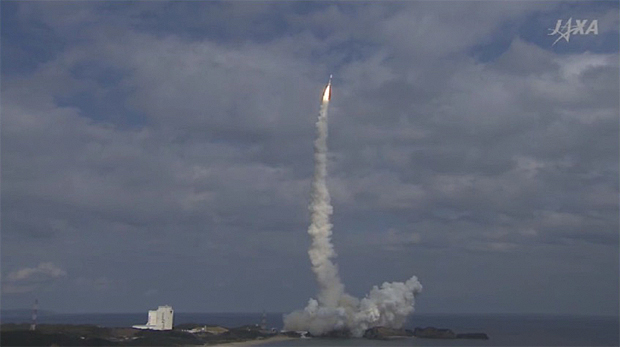

A H-2A rocket blasted off from the Tanegashima Space Center late Tuesday (U.S. time), boosting the Japan Aerospace Exploration Agency's Hayabusa2 probe into space to kick off a four-year voyage to rendezvous with a comet for 18 months of close-range observations. (Credit: JAXA webcast)

An H-2A rocket blasted off from Japan's picturesque Tanegashima Space Center late Tuesday, boosting an innovative science probe into space for a six-year mission to rendezvous with an asteroid, dropping a quartet of small landers to its surface and collecting soil samples before returning to Earth in 2020.

In one of the most ambitious asteroid missions ever attempted, Hayabusa2 will spend about 18 months flying in close formation with asteroid 1999 JU3 and even release a copper impactor designed to blast out a small crater. The probe then will attempt to collect pristine subsurface soil samples that could hold clues about the role asteroids might have played in seeding Earth with the water and organic compounds necessary for life.
https://www.cbsnews.com/network/news/space/home/spacenews/files/120214_hayabusa2_launch.html
« Ostatnia zmiana: Maja 09, 2022, 15:17 wysłana przez Orionid »

Polskie Forum Astronautyczne

Odp: Artykuły o Hayabusa2
« Odpowiedź #8 dnia: Maja 09, 2022, 15:07 »