Lockheed Martin wins contract to build rocket for Mars Sample Returnby Jeff Foust — February 8, 2022 [SN]
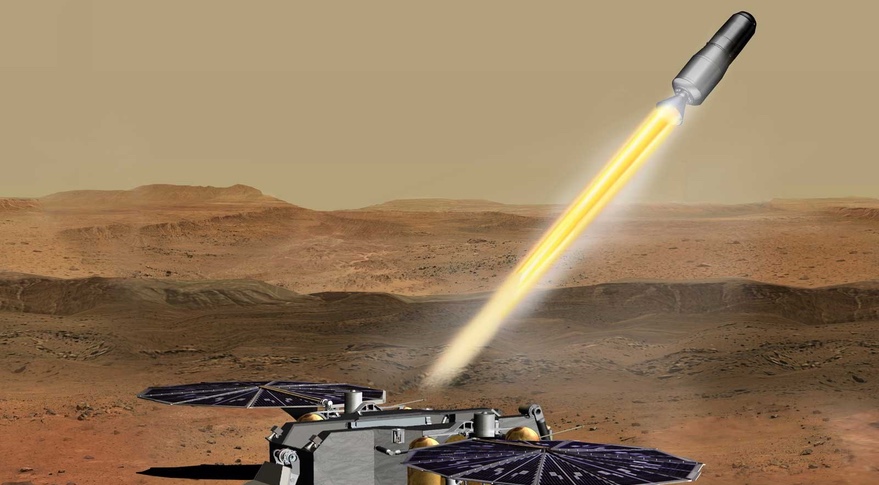 The Mars Ascent Vehicle, seen here in an earlier NASA design, will launch from the surface of Mars to place samples collected by the Perseverance rover into orbit. Credit: NASA
WASHINGTON — NASA has selected Lockheed Martin to build a small rocket that will transport samples collected by the Perseverance rover into orbit around Mars.
The agency said Feb. 7 it awarded a contract valued at up to $194 million to Lockheed to develop the Mars Ascent Vehicle (MAV), an essential element of the overall Mars Sample Return campaign being developed by NASA and the European Space Agency.
The MAV will be transported to Mars on a NASA-led Sample Retrieval Lander, which will also carry an ESA-developed rover. That rover will pick up samples of Martian rock and regolith cached by Perseverance and return them to the lander. Perseverance may also return some samples to the lander on its own.
https://spacenews.com/lockheed-martin-wins-contract-to-build-rocket-for-mars-sample-return/NASA to delay Mars Sample Return, switch to dual-lander approachby Jeff Foust — March 27, 2022 [SN]
Under the revised Mars Sample Return architecture, one lander will carry the Mars Ascent Vehicle (MAV) rocket (above) that will transport samples into orbit and another lander will carry a rover to pick up those samples and transport them to the MAV. Credit: NASAWASHINGTON — NASA plans to delay the next phase of its Mars Sample Return campaign and split a lander mission into two separate spacecraft to reduce the overall risk of the program.
At a March 21 meeting of the National Academies’ Space Studies Board, Thomas Zurbuchen, NASA associate administrator for science, revealed that NASA and the European Space Agency had agreed to revise the schedule and design for upcoming missions that will return samples being cached by the Perseverance rover to Earth.
https://spacenews.com/nasa-to-delay-mars-sample-return-switch-to-dual-lander-approach/NASA to study two alternative architectures for Mars Sample Returnby Jeff Foust January 7, 2025
 A photo montage showing sample tubes shortly after they were deposited onto the surface by NASA’s Perseverance Mars rover. Credit: NASA/JPL-CALTECH/MSSSORLANDO, Fla. — NASA will spend the next year and a half studying two different approaches for returning samples from Mars, one leveraging technologies used on previous Mars missions and the other new commercial vehicles.
NASA leadership announced Jan. 7 that it would pursue studies of two architectures for its Mars Sample Return effort that would take samples currently being collected by the Perseverance rover and bring them back to Earth as soon as 2035.
The main difference between the two options would be how to deliver a redesigned sample retrieval lander to the surface of Mars, which would take the samples from Perseverance and launch them into orbit on a rocket called the Mars Ascent Vehicle (MAV). The samples would then be picked up by a European spacecraft, the Earth Return Orbiter, and brought back to Earth.
The first option, which NASA Administrator Bill Nelson said would cost between $6.6 billion and $7.7 billion, would use the “sky crane” technology previously developed by Jet Propulsion Laboratory for landing the Perseverance and Curiosity rovers. The second option, with projected costs of $5.8 billion to $7.1 billion, would use a commercially provided “heavy lander”.
The first option appears similar to what JPL proposed to NASA last year when the agency solicited studies from within and outside the agency on alternative approaches to MSR. JPL said it would be possible to use the sky crane technology for landing a scaled-down sample retrieval lander with a smaller MAV, estimating it would reduce in half NASA’s estimates of $11 billion to carry out MSR.
NASA did not disclose details on what commercial landers would be used the second option. Nicky Fox, NASA associate administrator for science, declined to discuss specifics about what companies proposed, citing proprietary information. Both Blue Origin and SpaceX did receive study contracts in June 2024 for concepts that would incorporate technologies they are developing for Blue Origin’s Blue Moon and SpaceX’s Starship lunar landers.
“The main difference is in the landing mechanism,” she said of the two options being considered.
Both systems would deliver a redesigned sample retrieval landing platform. It would use a radioisotope thermoelectric generator (RTG) for power rather than solar panels, a move intended to simplify operations of the lander and better deal with dust storms that would impair solar panels. It would also use a smaller MAV, although NASA did not release details on changes in the design of the rocket that was one focus of the study contracts awarded last June.
The landing platform will also include a redesigned sample loading system for transferring sample tubes from Perseverance to the lander in a way that maintains backward planetary protection, or prevention of contamination back on Earth from Martian dust on the outside of the tubes. That is intended to simplify a NASA-designed capture and containment system on ESA’s Earth Return Orbiter that had also been a challenge to develop.
Fox said NASA will work through roughly the middle of 2026 to refine the two architectures. The JPL-developed sky crane, she noted, needs to handle a lander about 20% heavier than what was used for earlier rovers, while other work will focus on the design of the MAV. “It’s almost the normal engineering that we would do to get it up to the preliminary design review level of maturity,” she said. A comparison of the size of the existing design for the MSR lander (right) with a smaller concept proposed by JPL that can use the proven “sky crane” landing system. Credit: NASA/JPL-Caltech Credit: NASA/JPL-CaltechBudgets and schedulesThat initial work, Nelson said, requires Congress to provide at least $300 million in a fiscal year 2025 appropriations bill. NASA originally zeroed out MSR in its 2025 budget request last March, then requested $200 million. A House spending bill introduced last year would have provided $650 million while a Senate version offered $200 million. Congress has yet to pass a final 2025 spending bill, more than three months into the fiscal year.
Fox said that the revised plans would allow for a launch of ESA’s orbiter in 2030 followed by the sample retrieval lander as soon as 2031, allowing samples to be returned no earlier than 2035 but potentially as late as 2039. Nelson said how quickly the samples can be brought back will depend on how much Congress is willing to spend now.
“A bottom line of $300 million is what the Congress ought to consider,” he said. “If they want to get this thing back on a direct return earlier, they’re going to have to put more money into it, even more than $300 million.”
Nelson said he had not directly discussed MSR plans with the incoming Trump administration, saying he has deferred to the “formal transition apparatus” for discussions. However, he defended the decision to study two options and defer a final decision to the next administration. “I think it was a responsible thing to do not to hand the new administration just one alternative if they want to have Mars Sample Return, which I can’t imagine that they don’t.”
The revised plans make it in increasingly likely that the first samples brought back from Mars will be by a Chinese effort that could launch as soon as 2028. Nelson, though, was dismissive of the “grab and go” Chinese plan that would grab samples accessible only at the landing site, rather than the science-driven NASA-led effort to collect samples specifically designed to provide insights in the habitability of Mars early in the planet’s history.
“They’re just going to have a mission to grab and go,” he said. “That does not give you the comprehensive look for the science community. So, you cannot compare the two missions.”
Speaking at the AIAA SciTech Forum here Jan. 6, Laurie Leshin, director of JPL, emphasized the science the samples being collected by Perseverance can provide. She cited an example of one sample that she said contained characteristics that, on Earth, would be considered ancient biosignatures. “That sample is now in the belly of Perseverance, waiting to come home and for us to tear apart in our labs and answer this question about life on Mars,” she said. “Our job is to go get it.”
She outlined the sky crane approach that JPL proposed, but provided no hints about whether it would be selected. She added that she was open to other ways to get the samples back. “If we’ve got Starships going to Mars, great. We’d love to put our lander inside of one of those.”https://spacenews.com/nasa-to-study-two-alternative-architectures-for-mars-sample-return/NASA’s Mars Sample Return mission is dead6 Jan 2026 5:10 PM ET By Paul Voosen
Congress backs Trump administration’s efforts to kill project that would ferry martian rocks to EarthAfter years on life support, NASA’s plan to collect martian rocks and ferry them back to Earth has died. Yesterday, Congress released a compromise spending bill for the present financial year that backs the White House’s effort to kill the Mars Sample Return (MSR) program. Although the bill must be passed by both congressional chambers and signed into law, it effectively signals the end of MSR.
The decision leaves in limbo planetary scientists’ top research objective and abandons, at least for now, several dozen rock cores collected by the Perseverance rover in anticipation that a future mission would rocket them into space. “This is deeply disappointing,” says Victoria Hamilton, a planetary scientist at the Southwest Research Institute and chair of NASA’s Mars Exploration Program Analysis Group. “When we’ve got memos coming out saying we want to be the dominant power in space, I wonder how we leave something this ambitious behind.”
At the same time, the demise of MSR could open up spending for planetary projects that have stalled at NASA, such as two missions already selected for Venus and the development of a probe to Uranus. Those hopes received a shot in the arm with the compromise spending bill, which would budget $7.25 billion for NASA science—a 1% cut from the previous year, but far more than the White House’s proposal to slash the agency’s science budget in half.
Amid its defense of NASA science, however, the text of the compromise bill was clear: “The agreement does not support the existing Mars Sample Return program.” Still, Congress did not cut the program entirely, shifting $110 million into a “Mars Future Missions” program meant to continue the development of technologies that MSR had been developing, including systems for landing spacecraft in the thin martian atmosphere. The money could allow NASA to hit the reset button on the program sometime in the future, says Jack Kiraly, director of government relations at the Planetary Society, an advocacy organization.
MSR had long pitted planetary scientists against each other, as fears grew that its ballooning cost—which rose to $11 billion in 2024—would consume far too much of NASA’s science budget. That led to repeated threats of cancellation from Congress, only for the program to survive in a more limited form while NASA reworked its plans. The agency’s final proposal for the mission, released in January 2025, would have brought its cost back down to $7 billion, closer to earlier estimates. But even that price tag was too high, with other NASA science missions struggling with cost overruns.
The failing U.S. commitment to returning the Perseverance samples has ramifications beyond the United States. MSR was meant to be a joint project with the European Space Agency (ESA), which would provide a spacecraft to catch a container holding the rock samples after it was rocketed off the martian surface. This “Earth Return Orbiter” would then carry the rocks back to our planet. ESA has already done much work on the spacecraft, and it indicated late last year that the project could now be reworked into a standalone mission to study martian geology from orbit. That could potentially add to MSR’s price tag if the mission was eventually revived, should the ESA craft no longer be available.
The faltering plans for MSR come as the scientific value of the rocks collected by Perseverance has grown. In 2024, the rover discovered what many researchers believe could be the best potential evidence for past life on the planet. Drilled out of a dry riverbed spilling into Jezero Crater, the ancient lake the rover has explored since its arrival in 2021, the Cheyava Falls sample contains mineral deposits called “leopard spots” that resemble traces typically left by microbes on Earth. But whether life created the features is impossible to say without getting the sample into labs on Earth. “A rock with a potential biosignature is awaiting return now, and other rocks hold breakthrough discoveries,” says Bethany Ehlmann, a planetary scientist at the University of Colorado Boulder.
Abandoning the effort would signal a loss of U.S. leadership, especially at a time when China is building its own sample-return program to Mars, says Philip Christensen, a planetary scientist at Arizona State University. “The science return from MSR [would] be exceptional and would provide the scientific and engineering foundation for sending humans to Mars.”
There are also pressing, practical questions about what NASA will do with the remaining time available to Perseverance, which is nearing 5 years of exploration and has nearly finished stocking its sample tubes, Hamilton says. “We’d really like to hear from NASA sooner than later that they will work with the community on a plan to get these samples.”doi: 10.1126/science.zrxt2ge
Relevant tags:
About the author
Paul Voosen
Paul Voosen is the earth, climate, and planetary science reporter at Science, covering everything from the fringes of the atmosphere to the innermost inner core, on Earth and elsewhere in the Solar System. He can be found on Signal at voosen.01.
https://www.science.org/content/article/nasa-s-mars-sample-return-mission-dead
 Wątek: Artykuły o Mars Sample Return (MSR) (Przeczytany 6364 razy)