For Final Time, ULA Launches “Most Metal” Delta IV Heavy Into Historyby Ben Evans April 9, 2024 [AS]
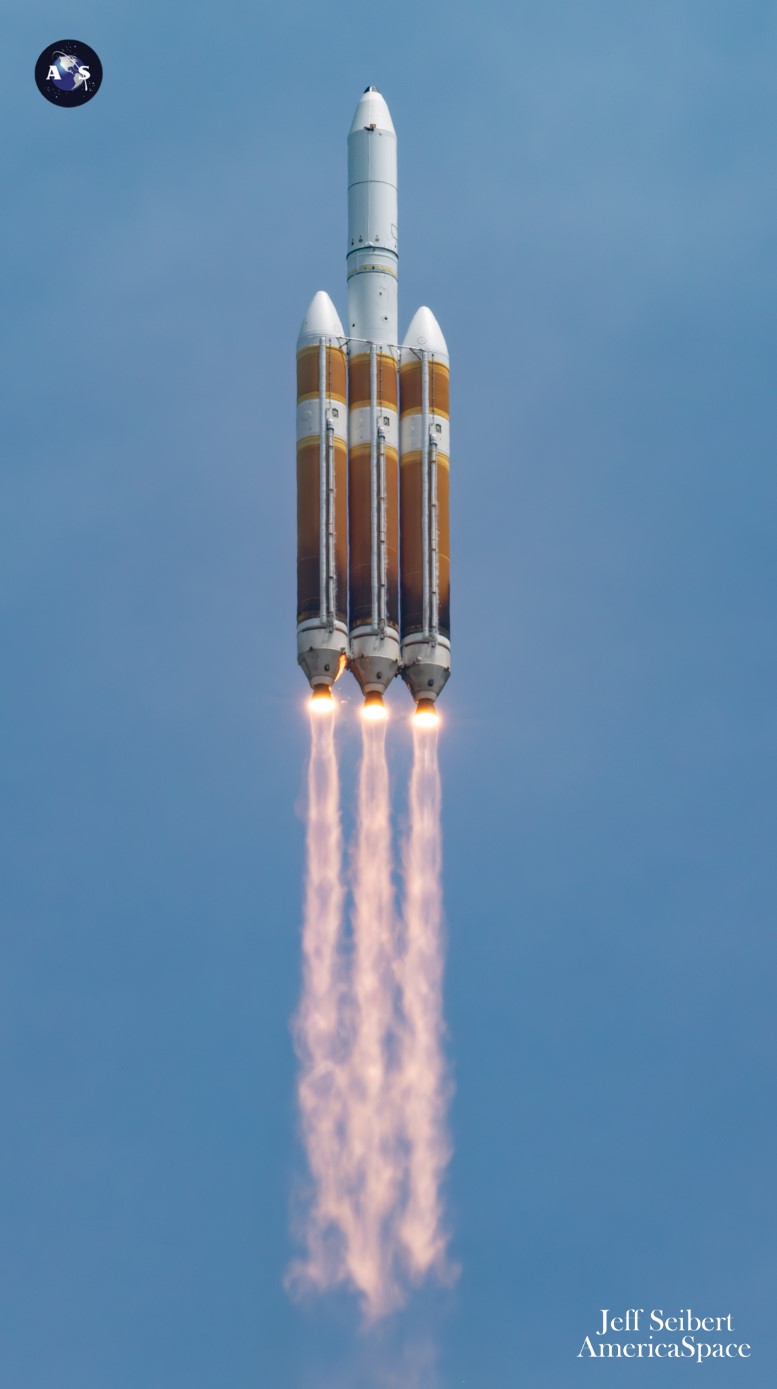 The final Delta IV Heavy roars into clear Florida skies at 12:53 p.m. EDT Tuesday, drawing down the final curtain on the Delta Era after more than 63 years of service. Photo Credit: Jeff Seibert/AmericaSpace
After more than six decades of operational service, 389 flights launched and an impressive 95-percent success rate, the curtain finally fell on the Delta Era at 12:53 p.m. EDT Tuesday as the last triple-barreled Delta IV Heavy—labeled by United Launch Alliance (ULA) as its “Most Metal” of rockets—roared into clear Florida skies, heading into history and the program’s sunset. Pounding Space Launch Complex (SLC)-37B at Cape Canaveral Space Force Station, Fla., with 2.1 million pounds (1 million kilograms) of liftoff thrust, the 235-foot-tall (72-meter) Heavy ferried the National Reconnaissance Office’s highly classified NROL-70 payload on the first leg of its trek up to Geostationary Earth Orbit (GEO).
https://www.americaspace.com/2024/04/09/for-final-time-ula-launches-most-metal-delta-iv-heavy-into-history/ULA concludes six decades of Delta rocket flights with final Delta 4 Heavy missionApril 9, 2024 Will Robinson-Smith [SFN]
 A ULA Delta 4 Heavy rocket lifts off from Space Launch Complex 37 on Tuesday, April 9, 2024. This was the 16th and final launch of a Delta 4 Heavy rocket. Image: Adam Bernstein/Spaceflight Now
The second time was the charm for the finale of the Delta family of rockets. Following an issue with a gaseous nitrogen pipeline beyond the control of United Launch Alliance (ULA) that caused the March 28 scrub the second launch attempt on April 9 proved successful.
https://spaceflightnow.com/2024/04/09/live-coverage-ula-to-launch-final-delta-4-heavy-rocket-from-cape-canaveral/https://spacenews.com/end-of-an-era-delta-4-heavy-soars-one-last-time/https://spacepolicyonline.com/news/farewell-delta/Vulcan competes second flight despite SRB anomalyJeff Foust October 4, 2024 [SN]
 ULA's Vulcan Centaur lifts off on the Cert-2 mission Oct. 4. Credit: ULA webcast
WASHINGTON — United Launch Alliance’s second Vulcan Centaur lifted off Oct. 4 on a test flight needed to certify the vehicle for carrying national security payloads, but may have suffered a problem with one of its solid rocket boosters.
The Vulcan Centaur lifted off at 7:25 a.m. Eastern from Space Launch Complex 41 at Cape Canaveral Space Force Station in Florida. The liftoff took place near the middle of a three-hour launch window after an initial half-hour delay to provide additional time for pre-launch checks.
The first countdown attempt was halted 1 minute and 51 seconds before liftoff. Tory Bruno, chief executive of ULA, said on social media that a “transient on a redundant data system” triggered the hold, and controllers resolved the issue and reset the countdown for the second attempt, which resulted in liftoff.
ULA said that the vehicle’s performance was nominal in the early stages of flight. However, the separation of the two GEM 63XL solid rocket boosters (SRB) took place nearly 30 seconds later than the timeline the company provided before launch. About 35 seconds after liftoff, there appeared to be material coming off one of the boosters, whose plume changed appearance, suggesting damage to the SRB’s nozzle.
https://spacenews.com/vulcan-competes-second-flight-despite-srb-anomaly/ULA launches second Vulcan flight, encounters strap-on booster anomalyOctober 4, 2024 William Harwood [SFN]
 By thirty-seven seconds after liftoff, it was clear one of two strap-on solid fuel boostersvwas suffered an anomaly as can be seen by sparks and debris falling away from the rocket. Image: Adam Bernstein/Spaceflight Now
United Launch Alliance fired off a next-generation Vulcan rocket Friday in the second of two “certification” test flights needed before the new launcher can be used to carry high-priority national security payloads for the U.S. Space Force and the National Reconnaissance Office. (...)
The anomaly aside, the strap-on boosters burned out and were jettisoned about 20 seconds later than planned. The methane-burning BE-4s, each one generating 550,000 pounds of thrust, continued boosting the rocket out of the lower atmosphere for another three minutes or so before shutting down. (...)
The apparent booster anomaly could be seen in long-range tracking camera views when a shower of sparks and what looked like debris fell away from the right-side SRB 37 seconds after liftoff. The problem appeared to originate at or near the nozzle at the base of the booster. The exhaust plume changed shape dramatically, but the Vulcan was able to continue its climb to space.
The anomaly aside, the strap-on boosters burned out and were jettisoned about 20 seconds later than planned. The methane-burning BE-4s, each one generating 550,000 pounds of thrust, continued boosting the rocket out of the lower atmosphere for another three minutes or so before shutting down.
The non-reusable stage then fell away to crash into the Atlantic and the flight continued on the power of the Centaur 5 upper stage’s two Aerojet Rocketdyne RL10C engines.
The upper stage fired its engines a second time after reaching orbit to demonstrate its ability to restart in space, a key requirement for military payloads requiring complex “high energy” trajectories to reach their operational orbits. (...)
https://spaceflightnow.com/2024/10/03/live-coverage-ula-to-launch-second-test-flight-of-its-vulcan-rocket-from-cape-canaveral/Space Force marks Florida’s record-breaking launch yearby Sandra Erwin January 1, 2025
SpaceX dominates the commercial space race. ‘Crazy numbers,’ says Brig. Gen. Kristin Panzenhagen, commander of the Eastern Range A SpaceX Falcon 9 lifted off from Florida on Dec. 31, 2024, completing the company’s 134th and final launch of the year. Credit: SpaceX
WASHINGTON — Florida’s Space Coast capped off a record-breaking year with 93 launches from Cape Canaveral Space Force Station and NASA’s Kennedy Space Center, up from 74 launches in 2023.
Brig. Gen. Kristin Panzenhagen, commander of the Eastern Range and Space Delta 45, credited the accelerated pace to innovations by both Space Launch Delta 45 and the private sector. “We’ve been able to reach these crazy numbers by leveraging automation, modernizing infrastructure, and streamlining processes,” Panzenhagen told SpaceNews.
https://spacenews.com/space-force-marks-floridas-record-breaking-launch-year/SpaceX launch surge helps set new global launch record in 2024by Jeff Foust January 1, 2025
 A Falcon 9 launch of a Dragon cargo spacecraft in November, one of more than 130 launches by SpaceX in 2024. Credit: SpaceX
WASHINGTON — The world set another record for orbital launches in 2024 in a continuing surge of launch activity driven almost entirely by SpaceX.
There were 259 orbital launch attempts in 2024, a 17% increase from the previous record of 221 orbital launch attempts in 2023, based on SpaceNews analysis of open source records. That figure does not include suborbital launches, such as four SpaceX Starship/Super Heavy test flights or two launches of the HASTE suborbital variant of Rocket Lab’s Electron.
https://spacenews.com/spacex-launch-surge-helps-set-new-global-launch-record-in-2024/India eyes record year for space with 10 planned launchesby Andrew Jones January 3, 2025
 An LVM-3 rocket carrying the Chandrayaan-3 spacecraft lifts off from Satish Dhawan Space Centre on July 14, 2023. Credit: ISRO
HELSINKI — India’s space agency is planning 10 orbital launches in 2025 along with a debut commercial launch, potentially taking the country’s launch activity to double figures for the first time.
Indian Space Research Organisation (ISRO) chairman S. Somanath told Indian media that 10 orbital launches are planned across the year, including four Geosynchronous Satellite Launch Vehicle (GSLV) launches, an LVM-3 and a human-rated LVM-3 launch for the Gaganyaan human spaceflight program, as well as three Polar Satellite Launch Vehicle (PSLV) missions and a launch of the SSLV solid rocket.
https://spacenews.com/india-eyes-record-year-for-space-with-10-planned-launches/Dept. of the Air Force opens bidding for Space Launch Complex 14 at Vandenberg SFBJanuary 6, 2026 Will Robinson-Smith
Update: Jan. 6, 1:25 p.m. EST (1825 UTC): Corrected some of the launch complex status information for accuracy.
 Vandenberg SFB Guardians and Airmen supported the NASA Tandem Reconnection and Cusp Electrodynamics Reconnaissance Satellites (TRACERS) mission launch aboard a SpaceX Falcon 9 rocket from Space Launch Complex 4E (SLC-4E) at Vandenberg Space Force Base, July 23, 2025. At the forefront of space operations at Vandenberg, the safety team ensures minimal risk for safe, reliable and frequent access to space. Image: U.S. Space Force/Jennifer Green-Lanchoney
The space, which will be designated as Space Launch Complex 14 or SLC-14, is being set aside for orbital rockets in a heavy or super-heavy vertical launch class. The government defines “heavy” as having payload capacity of between 20,000-50,000 kg (44,092-110,231 lbs) and “super-heavy” anything greater than 50,000 kg.
“Due to the unique attributes of SLC-14 and the goal of maximizing assured access to space in support of national security objectives, the Department of the Air Force (DAF), United States Space Force (USSF), and Space Launch Delta 30 (SLD 30) are committed to ensuring the best use of this property,” the RFI stated.
Vandenberg currently plays host to a variety of launch providers, which are spread across multiple pads:
SLC-2 – Firefly Aerospace, Alpha rocket
SLC-3 – United Launch Alliance, Vulcan rocket (under development)
SLC-4E – SpaceX, Falcon 9 rocket
SLC-5 – Phantom Space, Daytona rocket (undeveloped; environmental assessment completed)
SLC-6 – SpaceX, Falcon 9 and Falcon Heavy rockets (under development)
SLC-8 – Government-owned, multi-use pad (most recently used by Northrop Grumman’s Minotaur 4 rocket on April 16, 2025)
SLC-9 – Undeveloped (a draft environmental assessment document dated Feb. 2025 references Blue Origin in a “Reasonably Foreseeable Projects” table, but a spokesperson for SLD 30 said on Jan. 6 that Blue Origin currently doesn’t hold any out grant or lease for property at VSFB)
SLC-576E Licensed to Long Wall (formerly ABL Space Systems) (...)
Who’s in contention?Multiple U.S. launch providers have rockets that qualify in the heavy to super-heavy classification either currently launching or in development. But in order to increase the diversity of rockets flying from Vandenberg, SLD 30 is looking primarily for options that don’t currently exist at VSFB.
Given all the requirements and the state of play on the orbital launch front, one of the contenders would likely be SpaceX with their Starship-Super Heavy rocket. The company is slated to launch the latest iteration of the rocket, dubbed Version 3, sometime in early 2026.
In 2025, SpaceX also received approval from the Department of the Air Force to move forward with overhauling SLC-37 at Cape Canaveral Space Force Station (CCSFS) in Florida, which will feature two Starhip launch towers. It’s unclear if SpaceX were to make a play for SLC-14 if it would also feature two towers, like SLC-37 or its Starbase site in Texas.
Blue Origin is another likely contender for the launch real estate. While they do have the currently undeveloped space at SLC-9 for its New Glenn rocket, in late November, the company unveiled plans for a news super-heavy lift version called New Glenn 9×4, which will feature nine BE-4 engines on the booster and is designed to carry more than 70 metric tons (154,324 lb) to low Earth orbit.
Another company who may take a shot at the space is Relativity Space. Like both Blue Origin and SpaceX, their heavy lift rocket, Terran R, is also designed to have a reusable first stage booster and is expected to deliver up to 23,500 kg (51,809 lb) to low Earth orbit in its reusable configuration.
Relativity is in the midst of converting Launch Complex 16 at CCSFS from its previous design that supported the smaller Terran 1 rocket, which flew once before it was retired. It’s aiming for an inaugural flight of Terran R from Florida no earlier than late 2026. (...)
https://spaceflightnow.com/2026/01/06/dept-of-the-air-force-opens-bidding-for-space-launch-complex-14-at-vandenberg-sfb/
 Wątek: Artykuły o Space launches (Przeczytany 7661 razy)