Autor Wątek: Artykuły o Roman Space Telescope (RST)  (Przeczytany 4709 razy)

0 użytkowników i 1 Gość przegląda ten wątek.

Online Orionid

  • Weteran
  • *****
  • Wiadomości: 30078
  • Very easy - Harrison Schmitt
Artykuły o Roman Space Telescope (RST)
« dnia: Kwietnia 26, 2020, 18:05 »
A Tale of Two Telescopes: WFIRST and Hubble
April 20, 2020 By Ashley Balzer NASA’s Goddard Space Flight Center, Greenbelt, Md.


This famous Hubble Ultra Deep Field image captured the cosmos in three different types of light: infrared, visible and ultraviolet. While WFIRST will be tuned to see infrared light exclusively, its much wider field of view will enable larger surveys that would take hundreds or even thousands of years for Hubble to complete. Credit: NASA, ESA, H. Teplitz, M. Rafelski (IPAC/Caltech), A. Koekemoer (STScI), R. Windhorst (Arizona State University) and Z. Levay (STScI)

NASA’s Wide Field Infrared Survey Telescope (WFIRST), planned for launch in the mid-2020s, will create enormous cosmic panoramas. Using them, astronomers will explore everything from our solar system to the edge of the observable universe, including planets throughout our galaxy and the nature of dark energy.

Though it’s often compared to the Hubble Space Telescope, which turns 30 years old this week, WFIRST will study the cosmos in a unique and complementary way.

“WFIRST will enable incredible scientific progress on a broad range of topics, from stellar populations and distant planets to dark energy and the structure of galaxies,” said Ken Carpenter, the WFIRST ground system project scientist and Hubble operations project scientist at NASA’s Goddard Space Flight Center in Greenbelt, Maryland. “Hubble contributed tremendously to our understanding in these areas, but WFIRST will propel us forward by studying far more objects in the sky.”

Thirty years after its launch, Hubble continues to provide us with stunning, detailed images of the universe. When WFIRST opens its eyes to the cosmos, it will generate much larger images while matching Hubble’s crisp infrared resolution.


This infographic shows the complementary capabilities of select instruments on three of NASA’s flagship missions: the Hubble Space Telescope and the currently under development Wide Field Infrared Survey Telescope (WFIRST) and James Webb Space Telescope. Hubble views the cosmos in infrared, visible and ultraviolet light, providing a more comprehensive, high-resolution view of individual objects. WFIRST will expand on Hubble’s infrared observations specifically, using a much larger field of view to create enormous panoramas of the universe with the same high resolution. Webb will also conduct high-resolution infrared observations, peering across farther stretches of space with a narrower field of view. Credit: NASA’s Goddard Space Flight Center

Hubble adds to our picture of the universe in ways WFIRST can’t by using ultraviolet vision that captures the high-resolution details, and by providing more specialized features for in-depth study of the light emitted by individual objects. WFIRST provides a more general capability in covering wide areas at visible and infrared wavelengths.

Each WFIRST image will capture a patch of the sky bigger than the apparent size of a full Moon. Hubble’s widest exposures, taken with its Advanced Camera for Surveys, are nearly 100 times smaller. Over the first five years of observations, WFIRST will image over 50 times as much sky as Hubble has covered so far in 30 years.​

Since the quality will be the same, WFIRST will function like a fleet of 100 Hubbles operating in sync. Its large field of view will enable WFIRST to conduct sweeping cosmic surveys that would take hundreds of years using Hubble. Scientists will use these surveys to study some of the most compelling mysteries in the universe, including dark energy — a strange force that is accelerating the expansion of the universe.

Hubble played a major role in discovering dark energy. In 1998, astronomers measured how fast the universe is expanding by using ground-based telescopes to study relatively nearby exploding stars, called supernovae. They made the surprising discovery that the expansion of the universe is speeding up. Astronomers using Hubble confirmed this result by measuring supernovae over a longer period of time. The data demonstrated that while the expansion of the universe was slowing down as expected over most of cosmic history, it began speeding up a few billion years ago.

Scientists have since determined that whatever is causing this acceleration currently makes up about 68% of the total matter and energy in the universe, but so far we don’t know much more about it. Uncovering the nature and role of dark energy will be one of WFIRST’s primary goals. Scientists will use three surveys to examine the dark energy puzzle from different angles, including a survey of one key type of supernova, building on the observations that led to dark energy’s discovery. The mission’s two large area surveys will measure the shapes of hundreds of millions of galaxies and find the distances to tens of millions. This will turn WFIRST’s wide-field images into 3D maps that measure the expansion of the universe and the growth of galaxies within it.

WFIRST will help us understand how dark energy has affected the expansion of the universe in the past, which will shed light on how it may influence the future of the cosmos.


A new set of eyes on the universe

While Hubble views the cosmos in infrared, visible and ultraviolet light, WFIRST will be tuned to see a slightly wider range of infrared light than Hubble can observe. Detecting more of the spectrum of light allows Hubble to create a more comprehensive picture of many processes at work in individual objects in the cosmos. WFIRST is designed to expand on Hubble’s infrared observations specifically, because conducting enormous surveys of the infrared universe will let us see vast numbers of cosmic objects and subtler processes in regions of space that would otherwise be difficult or impossible to view.

WFIRST will help unravel mysteries surrounding dark energy and the evolution of galaxies by peering across enormous stretches of the universe — even farther than Hubble is capable of seeing. These studies require precise infrared observations because light shifts into longer wavelengths, from ultraviolet and visible into infrared, as it travels across vast astronomical distances due to the expansion of space.

WFIRST’s infrared capabilities will also provide a new view into objects that are closer to home. The heart of our Milky Way galaxy is densely populated with rich targets, but shrouded in dust that obscures visible light. As an infrared telescope, WFIRST will essentially use heat-vision goggles to peer right through the dust, giving us a new view into the inner workings of the galaxy.

These observations will allow astronomers to study stellar evolution — the births, lives and deaths of stars. WFIRST will also expand our inventory of exoplanets — planets outside our solar system — by revealing thousands of worlds that astronomers expect will be very different from most of the 4,100 now known. Most of the currently known exoplanets are either very close to their host stars, or large planets orbiting farther away. Hubble has observed some of these planets directly using coronagraphs, which block the glare from stars. WFIRST will build upon that technology to make an active coronagraph that is much better at suppressing starlight — a demonstration of technology that, when further advanced, will enable future space telescopes to image Earth-size exoplanets.


Homing in on cosmic rarities

Scientists will also use WFIRST’s cosmic surveys to obtain enormous samples of some of the most extreme objects in the universe, including quasars — active galaxies with super-bright centers. Pinpointing their locations will allow Hubble and other telescopes to follow up for detailed observations. These investigations will enable astronomers to piece together the history of galaxy growth and the evolution of the universe.

To make these studies possible, WFIRST will operate much farther away from Earth than Hubble does. While Hubble orbits about 340 miles above us, WFIRST will be located about 930,000 miles (1.5 million km) away from Earth in the direction opposite the Sun. At this special place in space, called the second Sun-Earth Lagrange point, or L2, gravitational forces from the Sun and Earth balance to keep spacecraft in relatively stable orbits.

Near L2, WFIRST will orbit the Sun in sync with Earth, using a sunshield to block sunlight and keep the spacecraft cool. Since infrared light is heat radiation, if WFIRST is warmed by radiation from Earth, the Sun or even its own instruments, it will overwhelm the infrared sensors. From this vantage point, WFIRST can view large swaths of sky smoothly over long periods of time.


Enormous tapestries


This image, comparing the apparent sizes of the Andromeda galaxy and the Moon in the sky, demonstrates the type of observation WFIRST will produce. It took Hubble more than 650 hours between 2010 and 2013 to produce the portion of the image outlined in teal, but calculations suggest WFIRST could observe the same area in three hours or less. WFIRST’s infrared observations will also allow us to see through obscuring dust to help us gain further insights into the natures of planets, stars and galaxies.
Credit: Background image: Digitized Sky Survey and R. Gendler; Moon image: NASA, GSFC and Arizona State University; WFIRST simulation: NASA, STScI and B. F. Williams (University of Washington)


To collect as much light as possible, telescopes need large primary mirrors. Since both WFIRST and Hubble have a primary mirror that is 2.4 meters (7.9 feet) across, they gather the same amount of light. While the same size, WFIRST’s mirror is only one-fourth the weight of Hubble’s thanks to advancements in technology.

With Hubble’s similar light collection, resolution and an overlap in infrared capabilities, it can help set expectations for WFIRST. For example, Hubble produced a panoramic image of our neighboring Andromeda galaxy as part of the Panchromatic Hubble Andromeda Treasury (PHAT) program. Scientists compiled the PHAT image from 7,398 exposures taken over the course of three years. WFIRST could replicate Hubble’s PHAT image more than 1,000 times faster. This type of observation will reveal how stars change with time and influence the galaxy in which they reside.

Like Hubble, WFIRST will also offer a General Observer program to support the astronomical community, allowing scientists to take advantage of the mission’s unique capabilities by proposing new, competitively selected observations. As with Hubble, the pursuit of investigations not even contemplated before launch will likely become the primary legacy of the WFIRST mission. The entire trove of WFIRST data will be publicly available within days of being taken — a first for a NASA astrophysics flagship mission. WFIRST will have a robust archival research program to allow scientists to take full advantage of these vast datasets.

WFIRST benefits from an additional 30 years of major technological advances, however Hubble will continue to transform our understanding of the universe. In the coming years, WFIRST’s enormous infrared surveys will reveal interesting targets for follow up by other missions. Hubble can view the targets in additional wavelengths of light and will provide the only high-resolution view of the ultraviolet universe. The James Webb Space Telescope can make detailed observations that go even further into the infrared with its high-resolution, zoomed in view. Combining the WFIRST’s findings with Hubble’s and Webb’s could revolutionize our understanding in a multitude of cosmic pursuits.

“WFIRST’s surveys don’t require that we know exactly where and when to look to make exciting discoveries — we won’t be limited to looking under the cosmic lamppost,” said Goddard’s Julie McEnery, the WFIRST deputy project scientist. “The mission will turn on the floodlights so we can explore the universe in a whole new way.”


WFIRST is managed at Goddard, with participation by NASA's Jet Propulsion Laboratory and Caltech/IPAC in Pasadena, the Space Telescope Science Institute in Baltimore, and a science team comprising scientists from research institutions across the United States.

Source: https://www.nasa.gov/feature/goddard/2020/a-tale-of-two-telescopes-wfirst-and-hubble
« Ostatnia zmiana: Maja 19, 2025, 12:24 wysłana przez Orionid »

Online Orionid

  • Weteran
  • *****
  • Wiadomości: 30078
  • Very easy - Harrison Schmitt
Odp: [NASA] A Tale of Two Telescopes: WFIRST and Hubble
« Odpowiedź #1 dnia: Maja 21, 2020, 00:02 »
NASA renames WFIRST space telescope after pioneering woman astronomer
by Jeff Foust — May 20, 2020 [SFN]


NASA has renamed the Wide Field Infrared Survey Telescope (WFIRST) the Nancy Grace Roman Space Telescope, after an astronomer who led NASA's early efforts in space-based astronomy. Credit: NASA

WASHINGTON — NASA announced May 20 it is renaming a major space telescope under development after an astronomer who led the agency’s early work in space-based astronomy, even as the mission remains under threat of cancellation.

The agency announced that the Wide Field Infrared Survey Telescope (WFIRST) will now be known as the Nancy Grace Roman Space Telescope. Roman, who passed away in 2018, joined NASA in 1959 as its first chief of astronomy, working for the agency for 20 years.

While at NASA, she oversaw the development of an initial series of astrophysics missions, the Orbital Astronomical Observatories, launched from 1966 through 1972 to demonstrate that spacecraft were capable of carrying out observations not possible from the ground.

(...)
Source: https://spacenews.com/nasa-renames-wfirst-space-telescope-after-pioneering-woman-astronomer/

Online Orionid

  • Weteran
  • *****
  • Wiadomości: 30078
  • Very easy - Harrison Schmitt
Odp: Artykuły o Roman Space Telescope (RST)
« Odpowiedź #2 dnia: Października 01, 2021, 02:33 »
Pandemic causes delay and cost increase for NASA’s Roman Space Telescope
by Jeff Foust — September 30, 2021


NASA says the launch readiness date for the Roman Space Telescope will slip by seven months because of impacts of the pandemic, with an "appropriate addition" to its cost as well. Credit: NASA

WASHINGTON — NASA’s Roman Space Telescope has passed its critical design review, but the impact of the pandemic will delay its launch by several months and increase its cost.

Source: https://spacenews.com/pandemic-causes-delay-and-cost-increase-for-nasas-roman-space-telescope/

Online Orionid

  • Weteran
  • *****
  • Wiadomości: 30078
  • Very easy - Harrison Schmitt
Odp: Artykuły o Roman Space Telescope (RST)
« Odpowiedź #3 dnia: Lipca 22, 2022, 14:53 »
NASA selects Falcon Heavy to launch Roman Space Telescope
by Jeff Foust — July 19, 2022 [SN]


NASA’s Roman Space Telescope will launch on a Falcon Heavy in October 2026. NASA awarded SpaceX a $255 million contract for the launch July 19. Credit: NASA/GSFC

WASHINGTON — NASA has selected SpaceX to launch the Nancy Grace Roman Space Telescope on a Falcon Heavy, but at a price significantly higher than most previous agency contracts.

NASA announced July 19 that it awarded a contract to SpaceX to launch Roman on the company’s Falcon Heavy rocket in October 2026 from the Kennedy Space Center in Florida. The contract is valued at $255 million for the launch and other mission-related costs.
https://spacenews.com/nasa-selects-falcon-heavy-to-launch-roman-space-telescope/

NASA selects SpaceX’s Falcon Heavy rocket to launch Roman Space Telescope
July 19, 2022 Stephen Clark [SFN]


Artist’s illustration of the Nancy Grace Roman Space Telescope. Credit: NASA’s Goddard Space Flight Center

NASA announced Tuesday it awarded SpaceX a $255 million contract to launch the Nancy Grace Roman Space Telescope, the agency’s next flagship astronomy mission, on a Falcon Heavy rocket from the Kennedy Space Center in 2026.
https://spaceflightnow.com/2022/07/19/nasa-selects-spacexs-falcon-heavy-rocket-to-launch-roman-space-telescope/

Roman Space Telescope top challenge for new NASA astrophysics director
by Jeff Foust — July 24, 2022 [SN]


Mark Clampin (center) will take over as director of NASA's astrophysics division Aug. 15 after working on several major missions, including the James Webb Space Telescope. Credit: NASA GSFC/Rebecca Roth

WASHINGTON — The person tapped to be the next head of NASA’s astrophysics division says his top priority is to keep the agency’s next large space telescope on schedule and within its budget.

NASA announced July 14 that Mark Clampin would take over as director of NASA’s astrophysics division, effective Aug. 15. He succeeds Paul Hertz, who announced last year his intent to step down from the position after a decade. Hertz will remain at the agency as a senior adviser to Thomas Zurbuchen, NASA associate administrator for science.
https://spacenews.com/roman-space-telescope-top-challenge-for-new-nasa-astrophysics-director/
« Ostatnia zmiana: Stycznia 06, 2023, 20:45 wysłana przez Orionid »

Polskie Forum Astronautyczne

Odp: Artykuły o Roman Space Telescope (RST)
« Odpowiedź #3 dnia: Lipca 22, 2022, 14:53 »

Online Orionid

  • Weteran
  • *****
  • Wiadomości: 30078
  • Very easy - Harrison Schmitt
Odp: Artykuły o Roman Space Telescope (RST)
« Odpowiedź #4 dnia: Sierpnia 30, 2026, 23:57 »
NASA launches Roman Telescope to provide wide view of cosmos

August 30, 2026 — As NASA's first chief astronomer, Nancy Grace Roman championed the launch of space-based telescopes, providing astronomers the chance to "peer through a keyhole" into the cosmos. Now, an orbital observatory bearing her name has lifted off to "kick down the door," providing a much wider view of the universe.

"The Nancy Grace Roman Space Telescope will blow your mind," said Nicky Fox, NASA's associate administrator for science, during a pre-launch press conference on Saturday. "Roman's large field of view and fast survey speeds will reveal untold cosmic objects while shining a light on dark energy and dark matter. During its mission, Roman will discover tens of thousands of new planets, billions of galaxies, thousands of supernovae and tens of billions of stars, and it will do all of that at a speed about thousand times that of Hubble."

"So to put that into context, what Roman can do in a month would take Hubble a century," said Fox. (...)

"Roman is kind of like a Swiss Army telescope," said Fox. "It will bring us into a new era of space discovery, as well as reexamine the endless sky as we know it and unlock the foundation for our future flagship missions that will take advantage of this incredible technology and the journey that we've gone on to allow us to search for habitable worlds in in the future." (...)

The Roman is the first space telescope to be named for a woman.

The plaque is also the mounting point for a memory card containing a total of 1,350,144 names submitted by people from across the globe, including astronauts from NASA's Artemis II and Artemis III missions.

The Nancy Grace Roman Space Telescope team at NASA's Goddard Space Flight Center in Maryland anticipates releasing its first images by early 2027.

The observatory is adorned with a metal plaque etched with Roman's name, a picture of her, the years that she lived and a brief description that reads in part, "She envisioned a world where everyone has access to and enthusiasm for science. This observatory is a continuation of her legacy and her dream." (...)

The Roman has a primary mission lifetime of five years and is designed to support an additional five-year extended mission. While NASA currently does not have the capability to do so, the observatory is outfitted with a mounting ring for a possible refueling and servicing mission.
https://www.collectspace.com/news/news-083026a-nancy-grace-roman-space-telescope-launch.html

NASA launches its Roman Space Telescope to explore the hidden universe
By William Harwood Updated on: August 30, 2026 / 4:54 PM EDT / CBS News
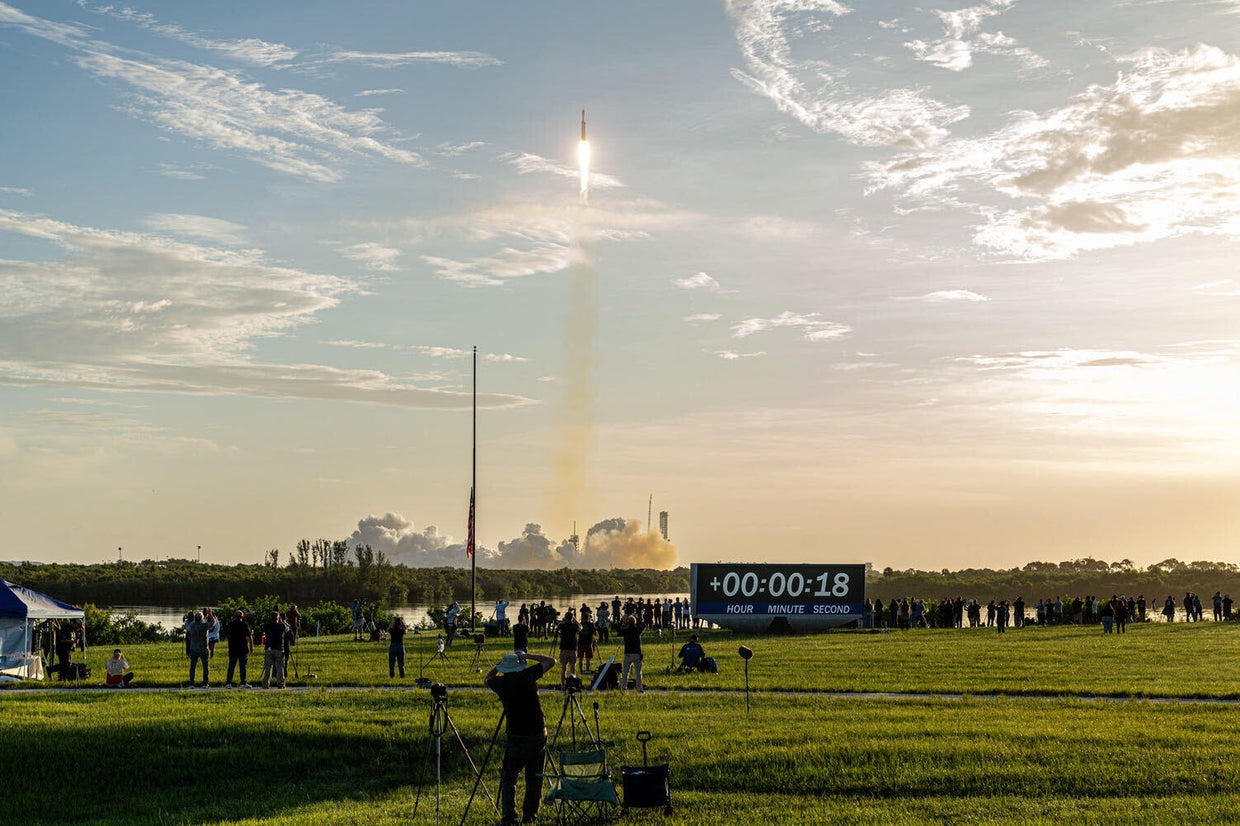

NASA's $4.3 billion Roman Space Telescope was launched atop a SpaceX Falcon Heavy rocket, kicking off a three-month voyage to a point in space a million miles from Earth. John Pisani/Spaceflight Now

NASA's $4.3 billion Roman Space Telescope was launched atop a SpaceX Falcon Heavy rocket Sunday, kicking off a three-month voyage to a point in space a million miles from Earth where it will map the large-scale structure of the cosmos with a wide-field 300-megapixel camera. (...)

At the same time, Roman's wide-field camera will look for stars that periodically dim as planets pass in front as viewed from the telescope. Some 6,200 exoplanets have been discovered to date. By the end of Roman's mission, that number is expected to climb well above 100,000. (...)

It will take about 100 days to reach L2. Once on station, Roman will study the effects of dark matter, the mysterious substance that pervades the universe, holds galaxies and galactic clusters together and accounts for most of the mass in the cosmos.

At the same time, Roman will work to gain statistically significant insights into the nature of the equally mysterious dark energy, a repulsive force presumably present since the Big Bang that became dominant about 5 billion years ago as the universe expanded and thinned out. Ever since, the expansion of the cosmos has been speeding up. (...)

"We think that we will be capable of detecting exoplanets that are about 100 million times fainter than their stars, and with that capability, we are hoping to see ... a Jupiter twin around a nearby star using visible light reflected from its cloud tops for the first time," said Vanessa Bailey, the Roman coronagraph instrument scientist at the Jet Propulsion Laboratory. "Then, we can use that light to study the composition of its atmosphere." (...)
https://www.cbsnews.com/news/nasa-launches-roman-space-telescope-explore-hidden-universe/

'A giant leap forward': Nasa launches powerful new space telescope
3 hours ago Grace Eliza Goodwin
https://www.bbc.com/news/articles/ce87e55vgpjo

Cytuj
NASA Administrator Jared Isaacman @NASAAdmin 4:58 PM · Aug 30, 2026
The President of the United States called into the NASA press conference after the historic Roman Telescope launch.

There is a reason nearly 70% of Americans support NASA's return to the Moon, compared with just 35% during the Kennedy era. The world’s most accomplished space agency, backed by @POTUS, bipartisan support in Congress, and an extraordinary workforce, can absolutely achieve the near impossible.

We are returning astronauts to the Moon, building the base, getting underway on nuclear power in space, with many more exciting missions like Roman to follow!
https://twitter.com/NASAAdmin/status/2094077288312713662
« Ostatnia zmiana: Sierpnia 31, 2026, 00:02 wysłana przez Orionid »

Online Orionid

  • Weteran
  • *****
  • Wiadomości: 30078
  • Very easy - Harrison Schmitt
Odp: Artykuły o Roman Space Telescope (RST)
« Odpowiedź #5 dnia: Sierpnia 31, 2026, 07:17 »
How NASA turned a spy satellite into its new dark energy telescope
By Jonathan O'Callaghan edited by Clara Moskowitz August 18, 2026

NASA’s Nancy Grace Roman Space Telescope will soon launch to unravel the mysteries of dark energy and dark matter


The Nancy Grace Roman Space Telescope is prepared for launch in a clean room at the NASA Goddard Space Flight Center in Greenbelt, Md. NASA/Chris Gunn

Alan Dressler stared in awe at the line of Hubble telescopes stretching out in front of him. It took NASA two decades to design and build its own Hubble Space Telescope, which transformed our understanding of the galaxies and stars after its 1990 launch. Now, standing inside a New York defense contractor’s clean room in 2012, Dressler faced an assembly line of Hubble clones. They weren’t astronomy telescopes. They were spy satellites of equal capability. And one of them was being given to NASA for free.

So begins the saga of the Nancy Grace Roman Space Telescope, which now sits in Florida, ready to launch on a SpaceX Falcon Heavy rocket within weeks. Roman will offer unprecedented knowledge of dark energy and dark matter, the mysterious components of the universe that explain our very existence. It will find more alien worlds outside our solar system than ever before, and it will also test a crucial technology that may one day reveal life on such worlds. It is, in the words of Julie McEnery of the NASA Goddard Space Flight Center and the mission’s senior project scientist, a telescope capable of “spectacular things.”

And the story of how Roman arrived at the launchpad is as amazing as the science it will perform. The observatory’s core was built to spy on America’s adversaries in a post-9/11 world. When that program collapsed, the National Reconnaissance Office (NRO) found itself with spare telescopes it no longer needed. Would NASA like any of them, officials asked? The space agency jumped at the offer.

Roman’s story is not only a tale of important science and unlikely interagency cooperation but also one of unusual efficiency. It is set to launch under budget and ahead of schedule, a feat almost unheard of for complex astronomical observatories. “When we get things right and have success stories like Nancy Grace Roman, let’s learn from some of the magic that created that outcome,” NASA administrator Jared Isaacman said in an April press conference. (...)

Even then, WFIRST was not out of the woods. “We had a lot of near-death experiences,” Spergel says. “It was canceled five times in the president’s budget,” he says—twice during the Obama era and three times in the first Trump administration. Each time, Congress elected to save the mission, with astronomers, including Spergel, traveling to Washington, D.C., to sing the praises of the telescope to senators such as Senator Chuck Schumer of New York. “I don’t think this would have happened without Schumer’s support,” Spergel notes. (...)
https://www.scientificamerican.com/article/how-nasa-turned-a-spy-satellite-into-the-nancy-grace-roman-space-telescope/
Cytuj
Jonathan McDowell @planet4589 12:00 AM · Aug 30, 2026
I wrote to Lisa Bartusek, Roman team member and the author of the 2022  paper that Wikipedia cites for the 10500 kg design planning value. She  tells me the actual launch mass is 9174 kg including 1116 kg of  hydrazine. Result!

Jonathan McDowell @planet4589·Aug 29
Roman Space Telescope friends, can we have an *accurate* mass of RST for the record? At one point the plan was 8137 kg dry 9253 kg wet, but recent press says about 10500 kg wet? Really 2400 kg of hydrazine or what's the missing piece?
https://twitter.com/planet4589/status/2093821207866921215
Cytuj
s2a systems @s2a_systems 6:23 PM · Aug 30, 2026
And a short time-lapse of today’s recordings of the Nancy Grace Roman Space Telescope and the Falcon upper stage (leading). Recorded on 2026-08-30 between 12:38:18 and 13:21:23 UTC. #NASARoman
https://twitter.com/s2a_systems/status/2094098569607123293
« Ostatnia zmiana: Sierpnia 31, 2026, 08:52 wysłana przez Orionid »

Polskie Forum Astronautyczne

Odp: Artykuły o Roman Space Telescope (RST)
« Odpowiedź #5 dnia: Sierpnia 31, 2026, 07:17 »