Prelude to the Lunar Base Systems Study I: Lunar Oxygen (1983) (2)
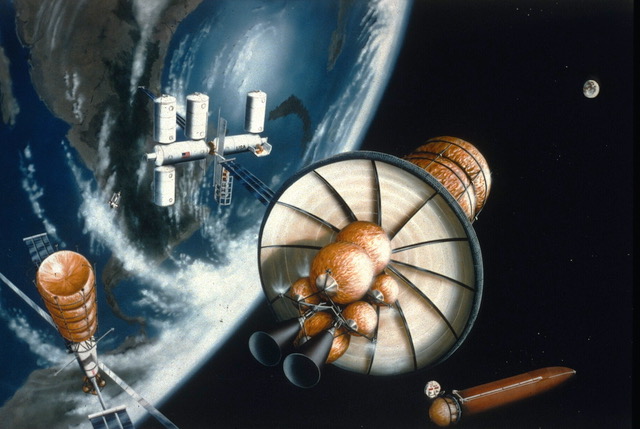 This painting by Eagle Engineering artist Pat Rawlings displays elements of Davis's proposed lunar oxygen STS infrastructure in LEO. The close proximity of the elements is schematic, not realistic. At lower right, a remote-controlled OMV detaches a spherical tank filled with liquid hydrogen from an ET/ACC. The LEO propellant dump is at lower left. Small in the distance above it, silhouetted against the Earth, is a Shuttle Orbiter. A version of the SOC is depicted to the right of the Orbiter. In the foreground, a small OTV prepares to leave Earth orbit; liquid hydrogen tanks bound for lunar orbit ride on its bowl-shaped rigid aerobrake heat shield.Davis described his lunar oxygen STS infrastructure in operation. A Space Shuttle would launch liquid hydrogen for the LEO propellant dump in a spherical tank inside an Aft Cargo Carrier (ACC) fitted over the dome-shaped end of its External Tank (ET).
Normally, the ET would separate from the Orbiter as it neared orbital velocity, tumble and break up in the upper atmosphere, and fall into the Indian Ocean. When the ACC was attached, however, the Shuttle Orbiter would boost the ET/ACC combination to LEO and separate. A remote-controlled OMV based at the SOC would then detach the hydrogen tank from the ACC and move it to the propellant dump, where refrigeration and high-tech insulation would ensure that no hydrogen was lost to boil-off.
Zero liquid hydrogen boil-off was, Davis explained, critical to making his lunar oxygen STS infrastructure viable. He wrote that the Centaur G' stage was expected to lose about 3% of its liquid hydrogen to boil-off per day. A similar boil-off rate at any point in his lunar oxygen STS infrastructure would be "intolerable."
Davis assumed two types of modular OTVs, each of which could be tailored to carry out several types of missions. The OTVs, clusters of spherical propellant tanks linked by struts, would perform roundtrip missions between LEO and GEO and between LEO and an LLO SOC and propellant dump. The OTVs could operate with or without a pressurized module containing a crew.
The smaller OTV, which would burn 25 metric tons of liquid hydrogen and liquid oxygen during a voyage from LEO to LLO and back, would include a rigid aerobrake heat shield 18 meters wide. The heat shield, which would include thermal protection tiles akin to those attached to the Space Shuttle Orbiter, would enable the OTV to use atmospheric drag to capture into LEO with minimal propellant expenditure. The smaller OTV could transport nearly 43 metric tons of liquid hydrogen from the LEO propellant dump to its counterpart in LLO.
A single-stage Lunar Module lander based on the smaller OTV design would burn 28 metric tons of liquid hydrogen/liquid oxygen propellants to travel from LLO to the lunar surface and back. It would be capable of lifting 41 metric tons of liquid oxygen from the lunar surface to the LLO propellant dump.
Davis used Lunar Module landing gear as an example of how hardware in his lunar oxygen STS infrastructure would need to be optimized to reduce mass. The Apollo Lunar Module's four landing legs and foot pads accounted for 3.3% of its landed weight; the small OTV-based Lunar Module would exploit new materials and improved understanding of the lunar surface to reduce the figure to 2%.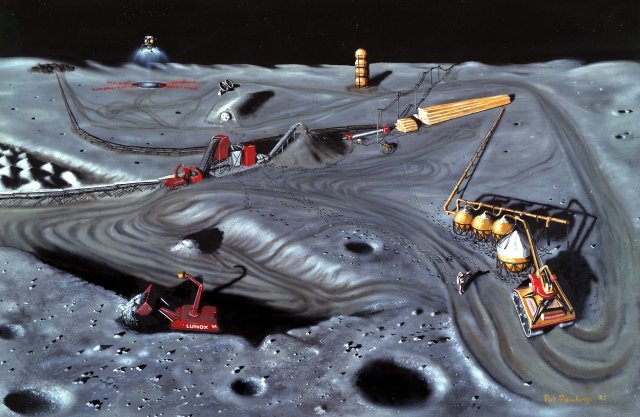 On the Moon: at lower left, a robotic front-end loader scoops lunar dirt; behind it, another deposits dirt in a hopper at the start of the lunar oxygen refining process. Cables strung on poles link the lunar oxygen refinery to a nuclear reactor just over the horizon. Lunar oxygen is liquified and poured into a tank at center right; the filled tank will be added to the stack of tanks in the background at center top. Conveyor belts transport tailings to a storage area at upper left, just beyond the Lunar Module launch & landing pad, and to the open pit mine at center left. Image credit: Pat Rawlings/Eagle Engineering, Incorporated/NASA.
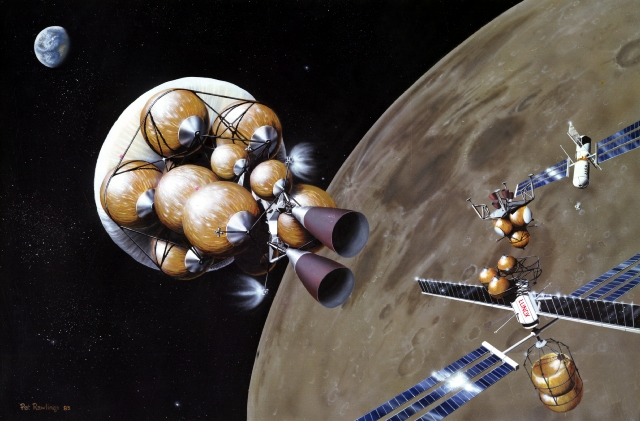 In lunar orbit: in the foreground, a large OTV with a stowed white ballute heat shield prepares to depart LLO for Earth orbit carrying a cargo of lunar oxygen. In the background, the LLO propellant dump orbits close by the lunar SOC. Meanwhile, a Lunar Module bearing lunar liquid oxygen moves in to dock with the propellant dump. Image credit: Pat Rawlings/Eagle Engineering, Incorporated/NASA.In its basic form, the larger OTV would carry a propellant load of 33 metric tons. Two such OTVs could be combined to form an OTV with a propellant load of 78 tons. The latter configuration would be capable of transporting more than 200 metric tons of lunar oxygen from LLO to the LEO propellant dump. This would, he calculated, require an aerobrake heat shield about 115 meters wide; that is, wider than an American football field with end zones.
One might be forgiven for asking why such a large lunar oxygen cargo was necessary; that is, why Davis did not propose transporting it to LEO using several smaller OTVs spaced out over time. He explained that minimum-energy opportunities for travel from the LLO propellant dump to LEO would occur less than once per month. They would be infrequent because the OTV could only depart LLO as its orbital plane coincided with that of the LEO propellant dump. To do otherwise would demand plane-change maneuvers that would contribute toward making the lunar oxygen STS infrastructure uneconomical.
During aerobraking, the OTV would pass through Earth's upper atmosphere at an altitude of between 50 and 100 kilometers so that atmospheric drag could reduce its speed. The OTV would then climb back into space toward an apogee (orbit high point) near SOC altitude (about 400 kilometers). At apogee, it would ignite its engines to raise its perigee (orbit low point) out of Earth's atmosphere. For the perigee-raise maneuver, Davis budgeted only enough propellants to change OTV speed by 100 meters per second. He suggested that, if further analysis showed this to be insufficient, then an SOC-based OMV might retrieve the OTV and lunar oxygen payload at apogee.
In neither the small OTV nor the large OTV case could aerobrake heat shield mass exceed 3.5% of OTV mass at the time of Earth atmosphere entry. Davis focused on heat shield mass reduction because other OTV systems were already optimized, OTV propellants had been trimmed to the bare minimum required, and reducing the liquid oxygen cargo would defeat the purpose of the exercise. He conceded that cutting aerobrake heat shield mass so dramatically might constitute a significant technical challenge; most OTV studies, he explained, had assumed that the heat shield would make up at least 10% of OTV mass at Earth atmosphere entry.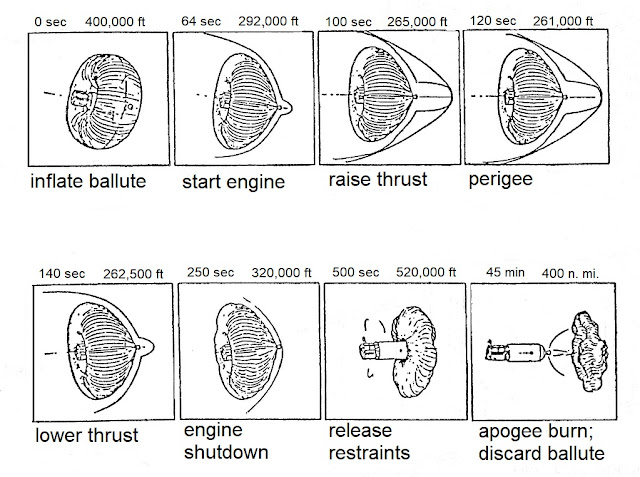 Ballute in action. This is representative of ballutes in general; the inflatable heat shield is shown here attached to a single-engine cylindrical tug, not the two-engine large OTV Davis described, and aerobraking events take place at higher altitudes than in his scenario. Image credit: NASA.To reduce the mass of the large OTV heat shield, Davis suggested that it might take the form of an expendable fabric ballute ("balloon-parachute"). The OTV would point its twin engines in its direction of motion as the donut-shaped ballute inflated; the engines would then operate in "idle" mode to create a relatively cool gas barrier between the ballute surface and the high-temperature plasma generated in front of the ballute by Earth atmosphere reentry at lunar-return speed (3.2 kilometers per second).
Davis used computer models to attempt to determine the Mass Payback Ratio (MPR) of his proposed lunar oxygen STS infrastructure. An MPR of 1 would mean that the mass of resources (mainly propellants) expended to exploit lunar oxygen would equal the mass of the lunar oxygen supplied to LEO. NASA would thus gain nothing from putting lunar oxygen to work in the STS. If, on the other hand, the mass of the lunar oxygen delivered to LEO exceeded the mass of the resources needed to exploit it, then more detailed study might be justified.
Davis cited a computer model that included 25 roundtrip OTV flights between LEO and LLO and 103 roundtrip Lunar Module flights between LLO and the lunar surface. He wrote that, in exchange for 983 metric tons of liquid hydrogen, hydrogen tanks, and OTV attitude-control system propellant dispatched to the Moon, 2414 metric tons of lunar liquid oxygen would arrive in the LEO. He judged that this quantity could support 90 OTV flights between LEO and GEO over a period of about five years.
This indicated a preliminary MPR of 2.45, which, Davis wrote, justified additional study. He anticipated, however, that it probably would not provide enough margin to maintain a positive MPR if the mass of hardware and propellants required to establish and maintain the lunar oxygen STS infrastructure were taken into consideration.
Davis did not provide weight estimates for the LEO propellant dump, the LLO propellant dump and LLO SOC, and the Lunar Modules. Neither did he estimate the weight of the Earth-launched liquid hydrogen and liquid oxygen propellants needed to initiate the lunar oxygen STS infrastructure, nor the weight of Earth-launched liquid hydrogen needed to fly resupply and crew rotation missions after lunar oxygen became available. He assumed that the OTVs and LEO SOC would be built for LEO and GEO operations even if NASA did not return to the Moon, so disregarded their weight in his model.
He did, however, provide a weight estimate for the lunar surface mining and refining facility. Mining robots, a habitat for housing 10 facility caretakers, refining equipment, storage tanks, a nuclear reactor for generating electricity, radiator panels, and other equipment would have a combined weight of 437 metric tons. Adding this to the 983 tons of hydrogen, tanks, and attitude-control propellant would lead to an MPR of only 1.7.
If, somehow, the MPR remained sufficiently favorable after more detailed technical studies yielded credible complete weight estimates, then complex economic analyses would follow. These would, Davis explained, be based on real-world dollars and would take into account societal factors such as "affordability."
Davis conceded that extending the STS to the Moon probably could not be justified solely on the basis of economics. He argued that lunar resources should nevertheless be developed. He cited a January 1982 Los Alamos National Laboratory (LANL) proposal for an international research laboratory on the Moon; it promised wide-ranging scientific, economic, political, and defense benefits. With a nod to the political language of the 1980s United States, Davis declared that the "vitality of Free World commerce and physical security would be greatly increased by the presence of. . .resources in space."
This post is the first in a series on lunar base planning in the 1980s centered on activities at NASA JSC. The next installment will examine NASA JSC's March 1984 in-house Lunar Surface Return study.SourcesSpace Operations Center presentation materials, NASA Johnson Space Center, 18 January 1982.
"NASA Conference to Highlight Return to the Moon," NASA News Release 83-007, Steve Nesbitt, no date (March 1983).
"Economic Benefits of Lunar Base Cited," E. Bulban, Aviation Week & Space Technology, 18 April 1983, pp. 132-133, 135-137.
Fourteenth Lunar and Planetary Science Conference Special Sessions Abstracts — Return to the Moon — March 16, 1983, Future Lunar Program — March 17, 1983, LPI Contribution 500, Lunar and Planetary Institute, 1983.
Lunar Oxygen Impact Upon STS Effectiveness, Report No. 8363, Hubert Davis, Eagle Engineering, Inc., May 1983.
"Return to the Moon," Andrew Chaikin, Sky & Telescope, June 1983, p. 493.
NASA Johnson Space Center Oral History Project Edited Oral History Transcript: Hubert P. Davis, 28 July 2009 (
https://historycollection.jsc.nasa.gov/JSCHistoryPortal/history/oral_histories/DavisHP/DavisHP_7-28-09.htm — accessed 20 March 2020).
More Information(...)
Source:
http://spaceflighthistory.blogspot.com/2020/04/prelude-to-lunar-base-systems-study-i.html
 Wątek: [SHB] Prelude to the Lunar Base Systems Study I: Lunar Oxygen (1983) (Przeczytany 1942 razy)