Autor Wątek: [SFN] Emirates Mars Mission arrives in Japan for launch preparations  (Przeczytany 3128 razy)

0 użytkowników i 1 Gość przegląda ten wątek.

Online Orionid

  • Weteran
  • *****
  • Wiadomości: 28869
  • Very easy - Harrison Schmitt
Emirates Mars Mission arrives in Japan for launch preparations
May 5, 2020 Stephen Clark


The Emirati Mars Mission, or Hope spacecraft, is pictured inside a clean room during ground testing. Credit: MBRSC
The Arab world’s first Mars probe has arrived at its launch site in Japan after officials navigated coronavirus-related quarantine protocols and travel restrictions to ensure the spacecraft can launch on time in July.


The Mars orbiter arrived at the Tanegashima Space Center in Japan on April 24 after a multi-day journey from Dubai via air and sea transport, ready to begin final testing, fueling and other preparations for liftoff during a three-week window opening July 14 (U.S. time) aboard a Japanese H-2A rocket.

Funded by the United Arab Emirates, the Emirates Mars Mission — known as Hope, or Al Amal — was developed in a partnership between the Mohammed Bin Rashid Space Centre in Dubai and the Laboratory for Atmospheric and Space Physics at the University of Colorado at Boulder.

Although the mission packs scientific punch, the government of the UAE also devised the project as a way to catalyze changes in the country’s academic and industrial sectors to focus more on technology and innovation. The mission is also timed to arrive at Mars before the 50th anniversary of the country’s independence in December 1971.

“The identity of the mission is not just about the UAE, it’s also for the Arab world,” said Omran Sharaf, project manger for the Emirates Mars Mission. “It’s supposed to inspire the Arab youth, and send a message of hope to them, and a message that basically tells them if a country like the UAE is able to reach Mars in less than 50 years, then you guys can do much more given the history you have, given the human talent that you have.”

Carrying three science instruments, the Hope mission will measure conditions in the Martian atmosphere from a unique semi-synchronous orbit high above the Red Planet. The mission is the first from the Arab world to travel to another planet.

About the size of Mini Cooper, the spacecraft was assembled at LASP’s facilities in Colorado, with the help of Emirati engineers and scientists. The probe was delivered to Dubai in February for additional testing, and then was supposed to be transported to Japan in early May.

But the coronavirus pandemic forced officials to shuffle the schedule, and mission managers decided to send the probe to Japan early.

“We did have to ship it earlier than planned due to the situation currently with COVID-19, and the restrictions that have been imposed around the world when it comes to travel and shipping stuff,” Sharaf said. “It did significantly increase the risks within the mission. For us, to mitigate this risk, we thought the best way to do it was to ship it as early as possible to Tanegashima, and send the team there as early as possible.”

The decision to ship the spacecraft to the launch site early forced engineers in Dubai to curtail some of the planned testing on the probe, but Sharaf said all critical checks were completed before the orbiter left for Japan.

“We had to basically wrap up quickly,” Sharaf said. “We focused on the critical testing and completing the critical testing. When it comes to missions to Mars, it’s always good to test, test, and test again. The more you test, the more reliable your system is. The more you test, the better you understand your system … We focused on the critical testing, and we said we’re going to ship it there, and we’ll continue the testing while we’re there.”

Sharaf dispatched 11 engineers and technicians in early April to Japan, where they spent two weeks in quarantine to ensure they had no symptoms of the COVID-19 viral disease.

On April 20, the Hope spacecraft left the Mohammed Bin Rashid Space Centre in Dubai to begin the four-day journey to Tanegashima, located off the southern coast of the Japanese island of Kyushu, the southernmost of the country’s main islands.

Packaged inside a climate-controlled shipping container, the spacecraft rode an Russian-operated, Ukrainian-built Antonov An-124 cargo plane from Dubai to Nagoya, Japan. The final phase of the journey occurred a ship, which carried the probe from Nagoya to Tanegashima Island.

“This was supposed to be a quiet phase, in which we’re all set and finished and ready to launch,” Sharaf said in an interview with Spaceflight Now. “We were supposed to send it in early May, and it was supposed to be quite a relaxed schedule. But COVID-19 found a way to keep us busy.”


Packed inside a transport canister, the Hope spacecraft arrived in Japan in late April aboard an Antonov An-124 cargo plane from Dubai. Credit: MBRSC

Six members of the Emirates Mars Mission team accompanied the spacecraft to Japan. Once there, they began their own two-week quarantine period as mandated by the Japanese government, Sharaf said.

When they complete the quarantine period, the personnel will join the 11 engineers and technicians that traveled to Japan earlier in Japan to complete final testing on the spacecraft inside a payload processing facility clean room at Tanegashima.

“As a mitigation plan, I have to have a backup team ready in Dubai just in case I need to send them to Japan in case something happens,” Sharaf said. “Before, we were going to send everyone there, and send people back and forth as needed. Some people were going to go there for two weeks, then they were going to come back, then after another two weeks go there as needed. But we changed the philosophy. We had to actually adapt to the situation.

“So we sent everyone there that needs to be there, the critical ones, and then I had to make sure that I had backups in Dubai,” Sharaf said. “I had to separate the teams … It will take about 50 days to prepare the spacecraft for launch, and given the quarantine period the team has to go through, that’s some extra days. So shipping it early was quite beneficial.”

Many of the tests engineers will perform on the spacecraft at Tanegashima will double- or triple-check work accomplished prior to the probe’s shipment to Japan.

“Whatever tests we’ll be doing in Japan, we’ve confirmed it already here,” Sharaf said. “The only thing that we need to do now in Japan that we didn’t do is actually after we fill up the tank with hydrazine gas.

“Once we do that, there’s a specific test we do for the propulsion system and for the tanks to make sure that everything’s OK and there’s no leakage,” Sharaf said. “And then we are ready to launch. This is one of the final things that takes place.”

More than half of the spacecraft’s weight at launch will be comprised of hydrazine fuel. Fully loaded, the orbiter will weigh nearly 3,000 pounds (1,350 kilograms) at the time of liftoff.

The spacecraft will be encapsulated inside nose shroud of its H-2A rocket, then raised on top of the launcher inside a vertical assembly building at Tanegashima before rollout to the launch pad.

The UAE Space Agency and the Mohammed Bin Rashid Space Centre, or MBRSC, booked a dedicated launch on an H-2A rocket with Mitsubishi Heavy Industries in 2016.

The launch window opens July 14 (July 15 in Japan) and extends three weeks. Interplanetary missions taking a direct route to Mars must launch in certain periods every 26 months, when Earth and Mars are in the right positions in the solar system.

Two other Mars missions are scheduled for launch in July.

NASA Perseverance rover is set for liftoff as soon as July 17 from Cape Canaveral aboard a United Launch Alliance Atlas 5 rocket. China’s first Mars rover is due to depart Earth the same month on top of a Long March 5 launcher.

The Hope mission will enter orbit around Mars in February 2021, the same month the U.S. and Chinese missions arrive at the Red Planet.


File photo of an H-2A rocket launch from the Tanegashima Space Center in Japan. Credit: JAXA

Like the spacecraft itself, the Hope probe’s three science instruments were developed in a cooperation between research institutions in the United States and the United Arab Emirates.

A color camera on the mission was developed by LASP at the University of Colorado at Boulder and MBRSC. Infrared and ultraviolet spectrometers were produced by LASP, Arizona State University and the University of California, Berkeley, in partnership with Emirati scientists.

The sensors will scan the Martian atmosphere, joining a fleet of NASA, European Space Agency and Indian spacecraft currently operating at the Red Planet.

“The motivation behind the Emirates Mars Mission science is covering the lower atmosphere of Mars throughout an entire Martian day, and sampling it throughout all of the seasons on Mars,” sad Sarah Al Amiri, chief scientist on the Hope project and the UAE’s minister of state for advanced sciences.

After swinging into an initial capture orbit next February, the Hope spacecraft will maneuver into an operational science orbit around April 2021 that ranges between approximately 12,400 miles (20,000 kilometers) and 26,700 miles (43,000 kilometers) above Mars.

During parts of each 55-hour orbit, the spacecraft’s move at roughly the same speed around Mars as the planet’s rotation. That will give the orbiter’s science instruments sustained views of the same region of Mars.

The Hope mission will pursue many of the same science objectives as NASA’s Mars Atmosphere and Volatile Evolution, or MAVEN, spacecraft. MAVEN arrived at the Red Planet in 2014.

Scientists have analyzed data from the MAVEN mission to confirm that the bombardment of the solar wind and radiation stripped away the Martian atmosphere, transforming the planet from a warmer, wetter world into the barren planet of today.

Hope will track oxygen and hydrogen escaping from the Martian atmosphere into space, and will peer deeper into the planet’s atmosphere than MAVEN. Scientists want to investigate possible links between Martian weather and climate with the escape of atmospheric particles.

Sharaf said U.S. personnel were embedded together with Emirati teams in instrument and spacecraft engineering groups during the Hope mission’s development.

“Everyone functioned as the Emirates Mars Mission team,” Sharaf said. “So we had people from the U.S. reporting to the people from the UAE. We had people from the UAE reporting to people from the U.S., all under one organizational structure working on the project. This is the philosophy that we usually follow on our missions, especially the ones that require know-how transfer.”

The training aspect of the Hope mission is similar to the way Emirati engineers worked with a South Korean company to build the DubaiSat 1 and 2 Earth-imaging satellites, which launched in 2009 and 2013. Using lessons learned from that experience, UAE teams took on more responsibility in building the KhalifaSat Earth observation satellite that launched in 2018.

The UAE’s first astronaut, Hazzaa Ali Almansoori, flew to the International Space Station on a nearly eight-day mission last year.

“The direction for the government was to build it, don’t buy it,” Sharaf said of the Emirates Mars Mission. “Work with others, learn from others, don’t start from scratch. Start where others ended, so complement their work. However, you need to build it, you’re not going to buy it. Obviously, there is going to be risk associated with that, especially since it’s the first mission we’ve built that goes to Mars.

“COVID-19, by itself, was a big risk because one of the objectives that was set by the government for us … was to reach Mars before the 2nd of December 2021, which is the 50th anniversary of the establishment of the UAE,” Sharaf said. “So missing the launch opportunity this year means that we actually would not meet an important goal that has been set for the mission.”


Source: https://spaceflightnow.com/2020/05/05/emirates-mars-mission-arrives-in-japan-for-launch-preparations/

Online Orionid

  • Weteran
  • *****
  • Wiadomości: 28869
  • Very easy - Harrison Schmitt
Odp: [SN] The UAE’s hope for success at Mars, and at home
« Odpowiedź #1 dnia: Lipca 16, 2020, 23:16 »
The UAE’s hope for success at Mars, and at home
by Jeff Foust — July 13, 2020 Updated July 14 with new launch date.
This article originally appeared in the July 13, 2020 issue of SpaceNews magazine.
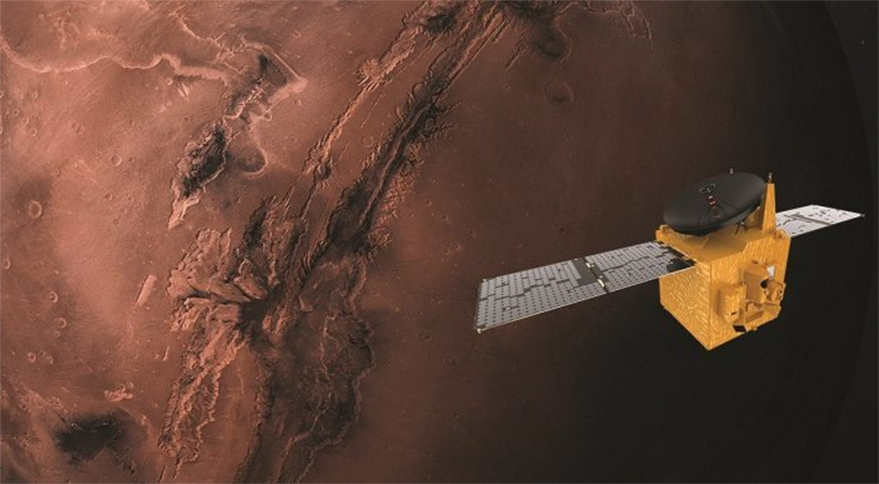

On July 14, the Emirates Mars Mission, or Hope, is scheduled to launch on an H-2A rocket from Japan and will go into orbit around Mars next February. Credit: UAE Space Agency

Mars is a popular destination for science missions, but also a challenging one even for major space powers. Russia and the former Soviet Union have a long history of failed Mars missions: Russia’s last two, Mars 96 and Fobos-Grunt, couldn’t even leave Earth orbit. Japan’s only Mars mission to date, Nozomi, suffered various problems after its 1998 launch that kept it from going into orbit around Mars. China is only now attempting its first stand-alone Mars mission, Tianwen-1.

A Mars mission is all the more difficult for a country with little spaceflight experience. Yet, the United Arab Emirates is willing to try. On July 16, the Emirates Mars Mission, or Hope, is scheduled to launch on an H-2A rocket from Japan and will go into orbit around Mars next February (a launch attempt July 14 was postponed by poor weather.) Once in orbit, Hope is designed to operate for at least one Martian year, studying the planet’s weather and climate.


“It’s a big challenge, but an attainable one,” said Sarah al-Amiri, deputy project manager for the UAE’s Hope mission. Credit: UAE Space Agency

Project leaders said they took on a Mars mission precisely because it would be difficult. “It’s a big enough challenge, but an attainable one,” said Sarah al-Amiri, UAE minister of state for advanced sciences and deputy project manager for Hope, during a webinar about the mission in June.

The UAE started satellite programs in the mid-2000s as part of an effort to diversify the country’s economy and make it less dependent on the energy industry. That effort began with a series of Earth observation satellites, first built in cooperation with South Korea but later assembled domestically.

Doing so, she said, gave the country’s engineers experience in creating new capabilities rather than just maintaining existing systems. Working on the technologies needed for spacecraft created an increasing number of engineers who could benefit other sectors of the UAE’s economy as well.

After a series of Earth imaging satellites, a science mission was the next step in the view of the Emirati government. “They wanted us to take it to the next level,” said Omran Sharaf, project manager for Hope. “They wanted us to create a career path for scientists.”

Planning for Hope started in late 2013, although full-scale assembly of the spacecraft began only in 2018. Part of the extended planning included identifying what science goals would both be feasible for this mission and not duplicate accomplishments by past missions.

“One of the requirements very early on was to send a mission that does more than capture an image declaring that the UAE reached Mars,” al-Amiri said, including “ensuring that it is complementary to other nations and an active area of research the UAE can focus on.”

That led to Hope becoming essentially a meteorology mission. “We are the very first weather satellite for Mars,” she said. Past missions have only sporadically studied atmospheric conditions, looking at specific locations at specific times. “It’s like me telling you to study Earth at different times of the day in Alaska, London and the UAE, and then be able to form a complete picture of the weather and climate.”

The 1,350-kilogram spacecraft will carry three instruments: a camera, infrared spectrometer and ultraviolet spectrometer. Those instruments, operating in a high, elliptical orbit around Mars, will study changing atmospheric conditions globally, as well as the loss of hydrogen and oxygen from the atmosphere to space. The data from the mission will be made freely available shortly after the spacecraft enters its final science orbit around Mars later next year.

The mission does involve some international cooperation. The UAE worked closely with several American universities with experience in space science missions, such as the Laboratory for Atmospheric and Space Physics at the University of Colorado. “We all worked under one umbrella as one team,” Sharaf said.


Credit: UAE Space Agency

The spacecraft went to the United States last year for environmental tests in Colorado that wrapped up last December, then returned to the UAE for final preparations. However, the coronavirus pandemic forced the mission to move up shipment of the spacecraft by about three weeks, from midMay to late April. One team of engineers went first to Japan so they would be out of quarantine when the spacecraft arrived. Those who traveled with the spacecraft had to then go into quarantine before they could take part in launch preparations there.

“Nothing about this mission has been easy, from day one,” Sharaf said. “The time frame has been challenging. The budget itself has been a big challenge.”

He did not provide the budget for Hope, saying only that it will be disclosed “at a later stage.” Among recent Mars missions, the one most similar to Hope was NASA’s MAVEN orbiter mission, launched in 2013 to study how the Martian atmosphere escapes to space. MAVEN, somewhat larger than Hope, cost about $670 million to build and launch.

Project officials haven’t discussed what they might do after Hope. Unlike the United States, Europe or other nations that have carried out or planned a series of Mars missions, the UAE hasn’t announced any future Mars missions or other major space science missions.

Instead, there’s more of a focus on applying the experience from the mission to other science and technology fields in the country. “What we’re now looking at is how we deploy this model that has been constructed in planetary exploration for the UAE for the development of various sectors,” al-Amiri said, such as pharmaceuticals and biotechnology.

Both Hope and other UAE space initiatives, like an astronaut program that sent the first Emirati to space last year, are also intended to be tools of outreach — one of the reasons why this mission is named Hope. “It’s the hope for the Emirati youth for their future, and also for Arab youth,” Sharaf said.

Asked to give the odds for success, he declined to give a specific figure, but noted about half of all Mars missions historically have failed. “We totally understand that, and that’s why the UAE chose Mars as a target, because of the challenges around it,” he said. “But the challenges we’re facing in the region are also not easy.”


Source: https://spacenews.com/the-uaes-hope-for-success-at-mars-and-at-home/
« Ostatnia zmiana: Lipca 21, 2020, 00:06 wysłana przez Orionid »

Online Orionid

  • Weteran
  • *****
  • Wiadomości: 28869
  • Very easy - Harrison Schmitt
United Arab Emirates successfully sends its first mission toward Mars
July 19, 2020 Stephen Clark


A Japanese H-2A rocket lifts off at 5:58 p.m. EDT (2158 GMT) Sunday from the Tanegashima Space Center. Credit: MHI

Riding a Japanese rocket, the Arab world’s first interplanetary probe departed planet Earth on Sunday to begin a seven-month journey to Mars on a dual mission of scientific exploration and proving the mettle of the UAE’s growing space program.

Funded and led by the United Arab Emirates, the Mars probe carries a digital camera to image the Martian surface, dust storms and ice clouds, and spectrometers to measure constituents at multiple levels of the planet’s atmosphere.

The science payload will allow researchers to better link Martian weather with longer-term trends of atmospheric loss, the process by which molecules are stripped away from Mars by the solar wind.

“It is a weather satellite, and that’s one objective of the mission,” said Sarah al-Amiri, the Mars mission’s lead scientist and the UAE’s minister of state for advanced sciences, in a pre-launch interview with Spaceflight Now. “We also look at what role Mars’s weather plays in atmospheric loss. That’s the other part of the mission.”

The Emirates Mars Mission — also called Hope, or Al Amal — also carries the UAE’s ambition to become a bigger player in international science, high-tech research and development, and space exploration.

“One of the objectives of this mission is to develop scientific capabilities and develop researchers, and in the long run, develop scientists who are able to work in planetary research, focusing on Mars for now,” al-Amiri told Spaceflight Now.

The Hope probe launched at 5:58:14 p.m. EDT (2158:14 GMT) Sunday from the Tanegashima Space Center in Japan. A Japanese H-2A rocket, built by Mitsubishi Heavy Industries, took off with the nearly 3,000-pound (1,350-kilogram) Hope spacecraft at 6:58 a.m. Japan Standard Time on Monday.

The 174-foot-tall (53-meter) H-2A launcher darted into a sunny sky over Tanegashima and arced toward the east over the Pacific Ocean. The rocket’s core stage engine and twin strap-on solid-fueled boosters combined to push the launcher into the sky with 1.4 million pounds of thrust.


Cytuj
Check out a replay of the H-2A rocket firing into a clear morning sky over the picturesque Tanegashima Space Center in Japan with the UAE’s #HopeMarsMission.

Seconds later, a vapor cone appears around the launcher as it exceeds the speed of sound. https://t.co/xxyCmibQGt pic.twitter.com/1CfHYek8AP

— Spaceflight Now (@SpaceflightNow) July 19, 2020

Less than two minutes later, the H-2A’s solid rocket boosters burned through their pre-packed propellants and jettisoned. The H-2A’s clamshell-like payload fairing separated around four minutes into the mission, followed by shutdown of the rocket’s hydrogen-fueled core stage engine roughly six-and-a-half minutes after liftoff.

The rocket shed its first stage to fall into the Pacific, and the H-2A’s cryogenic upper stage ignited two times to first reach a preliminary low-altitude parking orbit, then to propel the Hope spacecraft to a velocity of some 21,000 mph (34,000 kilometers per hour).

The second upper stage burn gave the Hope probe enough energy to break free of the grip of Earth’s gravity.

The H-2A released the spacecraft about 56 minutes into the mission while flying over the Atlantic Ocean east of Brazil.

A few minutes later, the Hope probe flew in range of a NASA Deep Space Network tracking station near Madrid. After a brief concern that one of the spacecraft’s two solar array wings may not have unfurled, ground controllers at the Mohammed Bin Rashid Space Center in Dubai confirmed both panels had, in fact, deployed.

That news prompted a round of applause in the mission control room in Dubai.

Telemetry data beamed down from Hope indicated the spacecraft’s computer, propulsion and communication systems, and other components were functioning normally.

“The Emirates has successfully launched the first interplanetary mission in the Arab world, commencing a 493-million-kilometer (306-million-mile) journey to Mars,” said Ahmad Al Falasi, the UAE’s minister of state for higher education and chairman of the UAE Space Agency. “This is a huge leap forward for the UAE’s ambitious space program. The Emirates Mars Mission is a catalyst that has already served to significantly accelerate the development of the UAE’s space, education, science and technologies sectors.”


The Emirati Mars Mission, or Hope spacecraft, is pictured inside a clean room during ground testing. Credit: MBRSC

The launch of the UAE’s Hope mission Sunday will be followed by the departures of two more Mars missions later this month. Launch opportunities for Mars missions come every 26 months or so, when Earth and Mars are properly positioned in their orbits around the sun.

China’s Tianwen 1 Mars mission is scheduled for launch as soon as Thursday, July 23, on top of a heavy-lift Long March 5 rocket. Tianwen 1 is China’s first Mars mission, and it includes an orbiter and a rover that will attempt to land on the Red Planet.

NASA’s Perseverance rover will follow with a liftoff from Cape Canaveral scheduled for July 30 aboard a United Launch Alliance Atlas 5 rocket. Perseverance carries a sophisticated suite of science instruments to explore Jezero Crater, where scientists believe water once flowed in an ancient river delta.

Mars has dried up over the last several billion years, but scientists hope to find signs of ancient life in samples collected at Jezero Crater. Perseverance will gather rock core samples for eventual return to Earth by a future robotic mission.

The European Space Agency had planned to launch its ExoMars rover to the Red Planet this month, but ESA delayed the mission to the next Mars launch window in 2022 due to problems with the spacecraft’s parachute.

The UAE’s Hope orbiter, China’s Tianwen 1 mission, and NASA’s Perseverance rover will all arrive at Mars next February.

The UAE government first announced plans for the Emirates Mars Mission –also known as Hope, or Al Amal — in July 2014. The government-funded project was designed, built, tested and readied for launch in less than six years, and on a budget of roughly $200 million, a fraction of the cost of NASA’s Mars orbiters.

The spacecraft and its three scientific payloads were developed as a collaborative project between scientists at the Mohammed Bin Rashid Space Center, the UAE Space Agency, and three universities in the United States.

The spacecraft was assembled by Emirati and U.S. engineers at the Laboratory for Atmospheric and Space Physics at the University of Colorado at Boulder. Scientists from Arizona State University and the University of California, Berkeley, also contributed to developing the mission’s scientific instruments.

“International collaboration, especially in a scientific mission, is critical,” said Omran Sharaf, the Hope mission’s program manager, in a pre-launch interview with Spaceflight Now. “So we have parts that have been developed in the UAE, we have parts that have been developed in the U.S., and have parts that have been developed in Canada, in Spain, in Europe, that are actually within the mission itself.”

The UAE’s government set the nation on a course for a Mars mission by outlining several objectives, including inspiration for Arab youth, revitalizing the UAE’s high-tech sector, introducing a culture for research and development, and aligning the mission’s arrival at Mars with the 50th anniversary of the country’s independence in 2021.


Cytuj
Burj Khalifa celebrates the #FirstArabicCountdown
Watch the launch of the #HopeProbe LIVE https://t.co/mCEo0Nphjv#HopeMarsMission pic.twitter.com/2LYO0bjK1K

— Hope Mars Mission (@HopeMarsMission) July 19, 2020

The UAE celebrated the launch of the Hope mission with a colorful display on Burj Khalifa in Dubai, the tallest building in the world.

“The identity of the mission is not just about the UAE, it’s also for the Arab world,” Sharaf said. “It’s supposed to inspire the Arab youth, and send a message of hope to them.”

“Usually, missions that are sent to Mars take a long time and cost more because redundancy is important,” Sharaf said. “In our case, our philosophy was simplicity was important. So instead of crowding our spacecraft with a lot of instruments, we decided to focus on specific questions and address a specific set of questions.”

Emirati engineers worked alongside teams in Colorado to design and build the Hope spacecraft, collaborating and learning from veteran aerospace engineers who have worked on numerous interplanetary missions. In the future, the UAE could pursue more ambitious interplanetary probes, and do more of the work on its own.

The training aspect of the Hope mission is similar to the way Emirati engineers worked with a South Korean company to build the DubaiSat 1 and 2 Earth-imaging satellites, which launched in 2009 and 2013. Using lessons learned from that experience, UAE teams took on more responsibility in building the KhalifaSat Earth observation satellite that launched in 2018.

The UAE’s first astronaut, Hazzaa Ali Almansoori, flew to the International Space Station on a nearly eight-day mission last year.

The country’s burgeoning space program is geared toward helping the UAE foster a “post-oil economy,” Sharaf said.

“So that’s why they went with a Mars shot,” he said. “They wanted to create an ecosystem that supports the creation of an advanced science and technology sector. The other thing that the UAE wanted to do is it wanted to prepare future scientists and engineers in the UAE that eventually would be able to address our national challenges, which are mainly focused around water resources, food resources, and clean energy.”


Artist’s illustration of the Hope spacecraft at Mars. Credit: MBRSC

“The direction for the government was to build it, don’t buy it,” Sharaf said of the Emirates Mars Mission. “Work with others, learn from others, don’t start from scratch. Start where others ended, so complement their work. However, you need to build it, you’re not going to buy it. Obviously, there is going to be risk associated with that, especially since it’s the first mission we’ve built that goes to Mars.”

Pete Withnell, a program manager at LASP who worked on the Emirates Mars Mission, said it was an “ideal choice” for UAE officials to reach out to experts at U.S. research institutes to help develop the Mars orbiter. After all, he said, universities are made to transfer knowledge.

“Perhaps the most visible part of this mission is a spacecraft, and instruments, and a journey to Mars, and an important scientific endeavor to happen there,” Withnell said in a virtual media briefing before the launch. “That’s all inside of this greater purpose of creating the knowledge economy, and creating a program which used knowledge transfer as its driving mechanisms.”

More than 450 people worked on the Emirates Mars Mission, according to Sharaf. About 200 members of the team have come from the UAE, and about 150 people from LASP in Colorado have worked on the project. Of the 200 Emiratis assigned to the mission, more than a third have been women, Sharaf said.

“The very fabric that a university is made out of is one based on education, teaching, mentorship, and indeed, collaboration,” Withnell said. “So these concepts were not only familiar to us, but it was our very nature to participate in this program in the way that the original founders and visionaries of this program required.”

“I would say at the beginning of the program six years ago, there was no blueprint,” Withnell said. “There was no plan that existed how to go about organizing this type of collaboration for a deep space mission.”

With the successful launch behind it, the Hope probe will perform the first in a series of course correction maneuvers in August, beginning a process of fine-tuning the Hope probe’s trajectory toward Mars. Eventually, navigators on Earth will guide the spacecraft toward a precise aimpoint near the Red Planet, comparable to an archer hitting 2-millimeter target from a kilometer away, according to Withnell.

A 30-minute firing by the Hope probe’s engines will steer the spacecraft into orbit around Mars in February, completing the interplanetary journey. The maneuver to enter orbit at Mars is one of the riskiest phases of the mission, Sharaf said.

After swinging into an initial capture orbit next February, the Hope spacecraft will maneuver into an operational science orbit around April 2021 that ranges between approximately 12,400 miles (20,000 kilometers) and 26,700 miles (43,000 kilometers) above Mars.

During parts of each 55-hour semi-synchronous orbit, the spacecraft’s move at roughly the same speed around Mars as the planet’s rotation. That will give the orbiter’s science instruments sustained views of the same region of Mars in much the same way weather satellites in geostationary orbit provide uninterrupted views of the same part of Earth.

The Hope mission will pursue many of the same science objectives as NASA’s Mars Atmosphere and Volatile Evolution, or MAVEN, spacecraft. MAVEN arrived at the Red Planet in 2014.

Scientists have analyzed data from the MAVEN mission to confirm that the bombardment of the solar wind and radiation stripped away the Martian atmosphere, transforming the planet from a warmer, wetter world into the barren planet of today.

The Hope probe will track oxygen and hydrogen escaping from the Martian atmosphere into space, and will peer deeper into the planet’s atmosphere than MAVEN. Scientists want to investigate possible links between Martian weather and climate with the escape of atmospheric particles.

“We focus on three primary objectives,” said Sarah Al Amiri, the lead scientist for the Emirates Mars Mission and the UAE’s minister of state for advanced sciences. “The first is to characterize the weather system of Mars throughout an entire year, and more importantly fill in the gap of the day-to-night transitions within the weather of Mars.

“We also look at how far out hydrogen and oxygen extend into space. That gives us an understanding of how far out it gets, and provides a better understanding of atmospheric escape,” she said.

One of the tasks of the science team will be “linking the two objectives together, characterizing changes within the lower atmosphere, so if there’s a dust storm on Mars, or changes in temperature, how does that impact rates of atmospheric escape, and particularly escape of hydrogen and oxygen from the outer atmosphere.

A color camera on the mission was developed by LASP at the University of Colorado at Boulder and MBRSC. Infrared and ultraviolet spectrometers were produced by LASP, Arizona State University and the University of California, Berkeley, in partnership with Emirati scientists.

NASA Administrator Jim Bridenstine said in June that the UAE’s advancements in space exploration could lay the groundwork for further international cooperation.

“I’m very excited about the United Arab Emirates, and their Hope mission,” Bridenstine said. “We have done a lot to support them, and they want to be big supporters of ours in the Artemis (moon landing) program.

Bridenstine congratulated the UAE on the successful launch Sunday.

“Today marks the culmination of tremendous hard work, focus, and dedication, as well as the beginning of the UAE’s journey to Mars with the ultimate goal of human habitation of the Red Planet,” Bridenstine said in a written statement. “This mission is aptly named since it’s a symbol of inspiration for the UAE, the region, and the world.”

In addition to the help from U.S. universities, which contributed without the direct support from NASA, the U.S. space agency is providing tracking and communications time on the Deep Space Network throughout Hope’s mission to Mars.

“We are in awe of the speed and commitment the UAE, through both the Mohammed bin Rashid Space Center and the UAE Space Agency, has demonstrated in developing its first interplanetary spacecraft,” Bridenstine said. “Moreover, your dedication to advancing the world’s understanding of Mars by publicly sharing the science and data produced by Hope represents the values of unity, peace, and transparency, that will be so important as humanity moves ever farther into the solar system.

“Even during these challenging times, humanity’s spirit of exploration and curiosity remain undeterred,” Bridenstine said. “We’re eager for our own Mars mission, Perseverance, to join Hope on its journey to explore Mars. Much like the UAE and the United States of America here on Earth, our two spacecraft will travel to Mars together to benefit the entire world.”


Source: https://spaceflightnow.com/2020/07/19/united-arab-emirates-successfully-sends-its-first-mission-toward-mars/
« Ostatnia zmiana: Lutego 07, 2021, 00:08 wysłana przez Orionid »

Online Orionid

  • Weteran
  • *****
  • Wiadomości: 28869
  • Very easy - Harrison Schmitt
Odp: [SN] UAE’s Hope mission on its way to Mars
« Odpowiedź #3 dnia: Lipca 21, 2020, 00:09 »
UAE’s Hope mission on its way to Mars
by Jeff Foust — July 19, 2020


A H-2A rocket carrying the UAE's Hope Mars orbiter mission lifts off July 19. Credit: MHI webcast

WASHINGTON — A Japanese rocket launched the United Arab Emirates’ first mission to Mars July 19, an orbiter that will study the planet’s weather while demonstrating the country’s growing space capabilities.

The H-2A rocket lifted off from the Tanegashima Space Center in Japan at 5:58 p.m. Eastern. The launch was originally scheduled for July 14 but delayed five days by poor weather at the launch site.

The rocket’s upper stage released the Emirates Mars Mission, or Hope, spacecraft, nearly an hour after liftoff. The spacecraft contracted controllers shortly after separation.

Hope is a 1,350-kilogram satellite developed by the Mohammed bin Rashid Space Centre (MBRSC) in the UAE. The spacecraft will arrive at Mars in February 2021 and go into an initial elliptical orbit between 1,000 and 49,380 kilometers above the planet. It will later move into its desired orbit for science observations, with altitudes ranging from 20,000 to 43,000 kilometers.

Development of Hope started in late 2013 as the next phase in the country’s effort to grow its space capabilities, after development of a series of Earth observation spacecraft. “They wanted us to take it to the next level,” said Omran Sharaf, project manager for Hope. “They wanted us to create a career path for scientists.”

Hope carries three instruments: a camera, infrared spectrometer and ultraviolet spectrometer. The spacecraft will provide data on the Martian atmosphere, including monitoring weather and climate to a greater degree than past Mars orbiter missions by the United States and other nations.

“One of the requirements very early on was to send a mission that does more than capture an image declaring that the UAE reached Mars,” said Sarah al-Amiri, UAE minister of state for advanced sciences and deputy project manager for Hope. “We are the very first weather satellite for Mars.”

The UAE is not doing Hope entirely on its own. Besides purchasing the H-2A launch from Japan’s Mitsubishi Heavy Industries, MBRSC partnered with several universities in the United States, such as Arizona State University, the University of California Berkeley Space Sciences Laboratory and the Laboratory for Atmospheric and Space Physics (LASP) at the University of Colorado. Those universities collaborated on the spacecraft and its instruments.

That partnership included building and testing Hope at LASP’s facilities in Colorado. “Our partners at LASP have been key to ensuring the success of the mission, delivering an extraordinary spacecraft in almost half the time of conventional missions but also in providing the resources and knowledge we need to drive our own development of space systems engineering and planetary science,” Sharaf said.

“Hope will capture the ebbs and flows of weather on Mars to a degree that wasn’t possible before,” said Daniel Baker, director of LASP, in a statement. “It’s a showcase for how space exploration has become an increasingly international endeavor.”

NASA is also supporting the mission by providing Hope access to the Deep Space Network for communications. “Today marks the culmination of tremendous hard work, focus, and dedication, as well as the beginning of the UAE’s journey to Mars,” NASA Administrator Jim Bridenstine said in a post-launch statement. “All of us at NASA are excited about the prospects for ambitious future partnerships with the UAE in low Earth orbit and, via the Artemis program, on and around the moon with the ultimate destination of Mars.”

Hope is the first of three Mars missions scheduled to launch over the next two weeks. China is expected to launch its Tianwen-1 Mars mission, which features an orbiter, lander and rover, on a Long March 5 July 23. NASA will launch its Mars 2020 mission, carrying the rover Perseverance, on July 30 on an Atlas 5 from Cape Canaveral, Florida.


Source: https://spacenews.com/uaes-hope-mission-on-its-way-to-mars/

Polskie Forum Astronautyczne

Odp: [SN] UAE’s Hope mission on its way to Mars
« Odpowiedź #3 dnia: Lipca 21, 2020, 00:09 »

Online Orionid

  • Weteran
  • *****
  • Wiadomości: 28869
  • Very easy - Harrison Schmitt
Odp: [SN] Hope prepares to enter orbit around Mars
« Odpowiedź #4 dnia: Lutego 07, 2021, 00:14 »
Hope prepares to enter orbit around Mars
by Jeff Foust — February 5, 2021 [SN]


The Emirates Mars Mission, also known as Hope, will attempt to enter orbit around Mars Feb. 9 during a 27-minute insertion maneuver. Credit: UAE Space Agency

WASHINGTON — As the United Arab Emirates’ Hope spacecraft arrives at Mars, those involved with the mission have a mix of confidence and concern about the chances of successfully entering orbit.

The Emirates Mars Mission, or Hope, spacecraft will arrive at Mars Feb. 9, entering orbit at about 10:41 a.m. Eastern. The spacecraft will fire its main thrusters for 27 minutes to slow it down enough for the planet’s gravity to capture the spacecraft into orbit.

The maneuver is one of the most critical phases of the mission after its launch in July 2020. Failure to perform the maneuver as planned could prevent the spacecraft from entering orbit or even cause it to collide with the planet, as happened with NASA’s Mars Climate Orbiter mission in 1999.

“This is a heavily rehearsed, designed, tested maneuver,” said Sarah Al Amiri, UAE minister of state for advanced technology and chairperson of the UAE Space Agency, during a Feb. 1 webinar. “But we have never used our thrusters for 27 minutes continuously. We’re going to burn half of our fuel.”

“Seven years’ worth of work involving a team of amazing individuals from several continents rests on the fate of Mars orbit insertion, which is not an easy maneuver,” she said, describing her mixed feelings as “comfortable and uncomfortable, worried and not worried.”

Others involved in the Hope mission are more confident. “The spacecraft is very healthy,” said Pete Withnell, program manager for the Emirates Mars Mission at the University of Colorado’s Laboratory for Atmospheric and Space Physics (LASP), which worked with the UAE to assemble the spacecraft and provided some of its instruments. The spacecraft is also on its planned trajectory, he said during a Jan. 28 briefing.

The thrusters that will be used for the orbit capture maneuver have been tested many times for short burns, including course corrections after launch. The key, he said, is to start the maneuver on time. “That is most likely the riskiest part of the maneuver.”

“This is a highly practiced, highly simulated, highly analyzed event,” he said. “I cannot imagine being better prepared than we are right now. We are very fortunate to have a very healthy spacecraft, and everything is looking very good at the moment. I’m optimistic.”

Those preparations do come with some stress. Withnell described engineers waking up in the middle of the night “in a cold sweat, thinking and rethinking” aspects of the mission. “That’s healthy for the mission, but not so healthy for the individuals.”

Should Hope make it into orbit, it will use its suite of three instruments to provide a comprehensive view of the Martian atmosphere, including tracking the planet’s weather and studying processes by which gasses escape the atmosphere into space.

Those studies will begin later in the year, once the spacecraft maneuvers into its final orbit between 20,000 and 43,000 kilometers in altitude. The orbit will allow the spacecraft to capture a complete view of the planet’s atmosphere, across the planet and at different times of day, every nine days.

“There’s about to be a fire hose of data headed my way,” said David Brain, deputy science lead for the mission at LASP. Like Withnell, he felt optimistic about the upcoming orbit insertion maneuver. “There’s a chance that it might not go well, and we’ll deal with that if it happens.”

The mission is a flagship for the UAE’s young space program, demonstrating its capabilities and serving as a symbol of the country’s technological achievements, both for its citizens and those in the Gulf region. The mission coincides with the UAE’s 50th anniversary.

“We’re seeing a lot of excitement” in the country, said Al Amiri, including billboards counting down until Hope’s arrival at Mars. “There’s a lot of support.”

The mission is the first of three arriving at Mars this month, and will be followed Feb. 10 by China’s Tianwen-1 spacecraft, which will go into orbit before deploying a lander with a rover, likely in May. NASA’s Mars 2020 mission will land the rover Perseverance on Mars Feb. 18.

Simply getting Hope built and launched, particularly amid the disruptions of the pandemic, was a major achievement, but Al Amiri said she wasn’t ready to declare Hope a success even if it does make it into orbit. “For me to declare mission success is very hard to do,” she said. “It’s a continuous learning experience. It’s a continuous mission.”


Source: https://spacenews.com/hope-prepares-to-enter-orbit-around-mars/

Online Orionid

  • Weteran
  • *****
  • Wiadomości: 28869
  • Very easy - Harrison Schmitt
Odp: [SN] Hope enters orbit around Mars
« Odpowiedź #5 dnia: Lutego 12, 2021, 02:43 »
Hope enters orbit around Mars
by Jeff Foust — February 9, 2021 [SN]


Hope fired its thrusters for 27 minutes to slow the spacecraft enough to enter orbit around Mars. Credit: MBRSC
WASHINGTON — The United Arab Emirates’ first Mars mission, Hope, successfully entered orbit around the planet Feb. 9.


Hope completed a 27-minute burn of its main thrusters, slowing the spacecraft down enough to enter an initial “capture” orbit around Mars, at 10:57 a.m. Eastern, the Mohammed Bin Rashid Space Centre announced. Signals from the spacecraft confirming a successful orbital insertion arrived 11 minutes later.

The Mars orbit insertion (MOI) maneuver was designed to place the spacecraft into an orbit of 1,000 by 49,380 kilometers around Mars, but the center did not immediately confirm the spacecraft’s orbital parameters.

“MOI was the most critical and dangerous part of our journey to Mars, exposing the Hope probe to stresses and pressures it has never before faced,” Omran Sharaf, project director for what’s formally known as the Emirates Mars Mission, said in a statement. “With this enormous milestone achieved, we are now preparing to transition to our science orbit and commence science data gathering.”

The spacecraft will spend the next two months moving into its final science orbit at altitudes ranging from 20,000 to 43,000 kilometers above the planet. The orbit is designed to allow the spacecraft’s instruments to capture full views of the planet’s atmosphere every nine days to support studies of Martian weather patterns as well as how gasses in the planet’s atmosphere escape to space.

Hope is the UAE’s first mission beyond Earth orbit, and the UAE is only the fifth entity to successfully place a spacecraft into orbit around Mars, after the United States, former Soviet Union, European Space Agency and India. The mission was timed in part to commemorate the 50th anniversary of the country later this year.

“As a young nation, it is a particular point of pride that we are now in a position to make a tangible contribution to humanity’s understanding of Mars,” Sarah Al Amiri, UAE minister of state for advanced technology and chair of the UAE space agency, said in a statement. “This also marks an important point for the Emirates to continue the drive to diversify its economy utilizing science and technology.”

The UAE worked closely with several universities in the United States on the mission, including the University of Colorado Boulder, University of California Berkeley and Arizona State University, including on the spacecraft itself as well as its suite of three instruments.

“Hope will capture the ebbs and flows of weather on Mars to a degree that wasn’t possible before. It’s a showcase for how space exploration has become an increasingly international endeavor,” said Daniel Baker, director of the Laboratory for Atmospheric and Space Physics at the University of Colorado, in a statement before Hope’s arrival at Mars.

Hope, which launched July 19 on a Japanese H-2A rocket, is the first of three Mars missions launched last July arriving at Mars this month. China’s Tianwen-1 mission is scheduled to enter orbit around Mars Feb. 10, although the Chinese government has said little about the spacecraft’s upcoming arrival. The spacecraft will deploy a lander, carrying a rover, to touch down in the Utopia Planitia region of Mars in May.

NASA’s Mars 2020 mission will arrive at Mars Feb. 18, landing the Perseverance rover in Jezero Crater. Perseverance will study the planet’s past habitability and cache samples for return to Earth by two NASA and ESA missions scheduled for launch no earlier than 2026.


Source: https://spacenews.com/hope-enters-orbit-around-mars/

Online Orionid

  • Weteran
  • *****
  • Wiadomości: 28869
  • Very easy - Harrison Schmitt
Arab world’s first interplanetary spacecraft safely arrives at Mars
February 9, 2021 Stephen Clark [SFN]


Artist’s concept of the Hope spacecraft arriving in orbit around Mars. Credit: MBRSC

The United Arab Emirates became the fifth nation or space agency to put a spacecraft into orbit around Mars on Tuesday with the arrival of Hope, a probe built in partnership with U.S. scientists to obtain a unique global perspective on the Red Planet’s weather and climate.

The Hope spacecraft fired a cluster of rocket jets to maneuver into orbit beginning at 10:30 a.m. EST (1530 GMT) Tuesday, while tense engineers gathered at the mission control center in Dubai monitored telemetry streaming back from the probe.

It took about 11 minutes for radio signals traveling at the speed of light to journey the nearly 119 million miles (191 million kilometers) from Mars to Earth. The time delay meant the planned 27-minute engine burn was nearly halfway over by the time engineers confirmed it started.

Data streaming down from the Hope spacecraft indicated the probe successfully entered orbit around Mars around 11 a.m. EST (1600 GMT).

Omran Sharaf, project director for the Emirates Mars Mission, announced the completion of the successful Mars Orbit Insertion maneuver, prompting applause and fist bumps in the control center at the Mohammed Bin Rashid Space Center in Dubai. The famous super-tall Burj Khalifa tower lit up with a special display celebrating the achievement, the first time a spacecraft from the Arab world has reached another planet.

Seven years ago, the Emirates Mars Mission was just an idea. The UAE had never developed a deep space mission when the government announced the Hope project in 2014.

Now the Emirati mission makes the UAE the fifth entity to put a satellite into orbit around Mars, following the United States, the former Soviet Union, the European Space Agency, and the Indian Space Research Organization.

“I think people are in shock, myself included, but there’s a lot of relief, maybe a bit of disbelief on arriving at this milestone and arriving exactly as planned,” said Sarah Al Amiri, the UAE’s minister of state for advanced sciences, and chair of the UAE Space Agency. “It’s been an amazing journey with a lot of obstacles and a lot of challenges, and to see this come to fruition … We couldn’t have hoped for a better outcome.”

Al Amiri said a quick-look assessment showed the spacecraft was in orbit around Mars following its make-or-break rocket burn, which was designed to scrub more than 2,200 mph (about 1,000 meters per second) of velocity from Hope’s trajectory relative to Mars. The spacecraft targeted an initial “capture orbit” ranging between 600 miles and 30,700 miles (1,000-by-49,380 kilometers) from Mars.

It will take several hours to determine to exact orbit achieved by the Hope, or Al Amal, spacecraft, Al Amiri said. The ground team in Dubai plans a follow-up press conference Wednesday to discuss details of the orbit insertion maneuver.

Developed for $200 million, a fraction of the cost of NASA’s recent Mars orbiters, the Emirates Mars Mission was conceived with the goals of inspiring Arab youth, fostering new high-tech development in the UAE, and collecting new scientific data on the Red Planet.

Al Amiri said the mission had succeeded in the first two objectives before it even arrived at Mars.

“Within a circle of people within the Arab region that I’m with, a lot of them are people that I’ve had discussions with even prior to the launch of this mission, and they were highly speculative with whether or not we will be able to achieve this objective,” Al Amiri said last month. “And for them it’s been a reality check on what is possible from this region, and a reality check on how we can go about creating more and more positive change from the region. And I think a lot of the youth, especially over the course of at least the last six to seven years, have been really frustrated with instability and are looking for the creation of stability.

“Mars has been visible in the sky,” she said. “Almost every child that I come into daily contact with … they’ll be able to point out Mars in the sky. I don’t think I’ve ever lived through a time where that was normal conversation in family settings.”

The scientific promise of the Emirates Mars Mission hinged on a good outcome of Mars Orbit Insertion, or MOI, maneuver, and the Hope spacecraft had just one chance to get it right.

“We took a risk on the methodology that we developed this mission on, but this risk paid off today,” Al Amiri told Spaceflight Now Tuesday. “We really hope the scientific mission starts with the same remarkable entrance into Mars orbit that we’ve seen today.”

“MOI was the most critical and dangerous part of our journey to Mars, exposing the Hope probe to stresses and pressures it has never before faced,” Sharaf said in a statement. “While we have spent six years designing, testing and retesting the system, there is no way to fully simulate the impacts of the deceleration and navigation required to achieve MOI autonomously. With this enormous milestone achieved, we are now preparing to transition to our science orbit and commence science data gathering.”

The Emirates Mars Mission launched July 19 from the Tanegashima Space Center in Japan, riding a Japanese H-2A rocket procured by the UAE government from Mitsubishi Heavy Industries. The H-2A hurled the 3,000-pound (1,350-kilogram) Hope spacecraft on a high-speed trajectory escaping the bonds of Earth’s gravity.

After deploying its solar panels and completing a post-launch checkout, the spacecraft fired its thrusters several times to adjust its course toward Mars, setting the stage for the critical MOI maneuver Tuesday.


Twitter

“Anything that you want to attempt to do in space is hard,” said Pete Withnell, program manager for the Emirates Mars Mission at the Laboratory for Atmospheric and Space Physics at the University of Colorado at Boulder, a partner on the project. “And something as sporty as getting a spacecraft into orbit around another planet is even harder.

“Many people may know the statistics,” Withnell said in a virtual press briefing in late January. “Less than half of those spacecraft that have been sent to Mars have actually made it successfully.”

But the UAE made it to Mars on its first try.

The Hope spacecraft traveled 307 million miles (494 million kilometers) across the solar system to reach the Red Planet. Navigators calculated the probe’s trajectory with the precision required for an archer to hit a 2-millimeter target from a kilometer away, according to Withnell.

The science instruments will collect their first data at the Red Planet in the coming weeks, setting the stage for Hope to move into an operational science orbit by mid-May that ranges between approximately 12,400 miles (20,000 kilometers) and 26,700 miles (43,000 kilometers) above Mars.

During parts of each 55-hour semi-synchronous orbit, the spacecraft’s move at roughly the same speed around Mars as the planet’s rotation. That will give the orbiter’s science instruments sustained views of the same region of Mars in much the same way weather satellites in geostationary orbit provide uninterrupted views of the same part of Earth.

In addition to the LASP facility in Colorado — where the spacecraft was built — and Dubai’s Mohammed Bin Rashid Space Center — where the probe will be operated — scientists from Arizona State University, the University of California, Berkeley, and Northern Arizona University contributed to the Hope mission.

The UAE’s government set the nation on a course for the Emirates Mars Mission with the goal of reaching the Red Planet by the 50th anniversary of the country’s independence in 1971.


The Emirati Mars Mission, or Hope spacecraft, is pictured inside a clean room during ground testing. Credit: MBRSC

More than 450 people worked on the Emirates Mars Mission, according to UAE officials. About 200 members of the team have come from the UAE, and about 150 people from LASP in Colorado have worked on the project. Of the 200 Emiratis assigned to the mission, more than a third have been women.

David Brain, the Hope mission’s deputy science lead at LASP in Colorado, said the instruments aboard the Hope spacecraft are similar to sensors flown on past space missions, but the UAE’s probe will go into a unique orbit that lingers higher above Mars.

The Emirates Mars Mission will put the instruments “into this new orbit that opens up all new science for us to investigate the Martian atmosphere,” Brain said. “So there are three aspects of the science orbit that are important. No. 1, it’s a very high altitude orbit, much higher than most other Mars science missions. That high-altitude orbit lets our instruments observe Mars from the global perspective. We’ll always be seeing roughly half of Mars, no matter where we are in the orbit when we look at the planet.

“No. 2, the orbit is fairly close to parallel with the Mars equator, and by this, I mean something like how the moon orbits Earth,” Brain said. “EMM will have a moon-like orbit around the planet unlike many other Mars spacecraft, which orbits over the top of the North Pole, and then over the bottom of the South Pole. They have highly inclined orbits that are very polar. Those kinds of orbits are great for science, but they force the spacecraft to always observe at the same time of day, 2 a.m., 2 p.m. 2 a.m., 2 p.m. When you lay that orbit on its side like the moon orbits the Earth, suddenly every time you go around the planet, you visit at every time of day. You get above midnight, you get above noon, you get above 3 p.m. You’ve seen all the times of day, which is great for our science.”

“The last part of the orbit that’s important here is that it still is elliptical. Sometimes the spacecraft is close to Mars, sometimes far from Mars,” Brain said. “So when it’s far from Mars, it’s moving slowly, it’s above one time of day, while Mars spins underneath. So it can observe many geographic regions at a single time of day. When the whole probe gets close to Mars it speeds up, and it can match the speed at which Mars is spinning on its axis. It can hover above a single geographic region like the big volcano Olympus Mons and study the atmosphere there at many times of day.”

Many of the science goals of the Emirates Mars Mission build on discoveries made by NASA’s Mars Atmosphere and Volatile Evolution, or MAVEN, which arrived at the Red Planet in 2014. Scientists have analyzed data from the MAVEN mission to confirm that the bombardment of the solar wind and radiation stripped away the Martian atmosphere, transforming the planet from a warmer, wetter world into the barren planet of today.

The Hope probe will track oxygen and hydrogen escaping from the Martian atmosphere into space, and will peer deeper into the planet’s atmosphere than MAVEN. Scientists want to investigate possible links between Martian weather and climate with the escape of atmospheric particles.

A color camera on the mission was developed by LASP at the University of Colorado at Boulder and MBRSC. Infrared and ultraviolet spectrometers were produced by LASP, Arizona State University and the University of California, Berkeley, in partnership with Emirati scientists.

“Overall, the science goal of EMM is to get a global understanding of sort of how the atmosphere works together, transport in the atmosphere, how weather above Olympus Mons influences weather completely on the other side of the planet, or at a different time,” Brain said.

“The first science objective is to understand the lower atmosphere of Mars in a global sense, and how the lower atmosphere of Mars varies geographically with time of day, and over the Martian seasons,” Brain said.


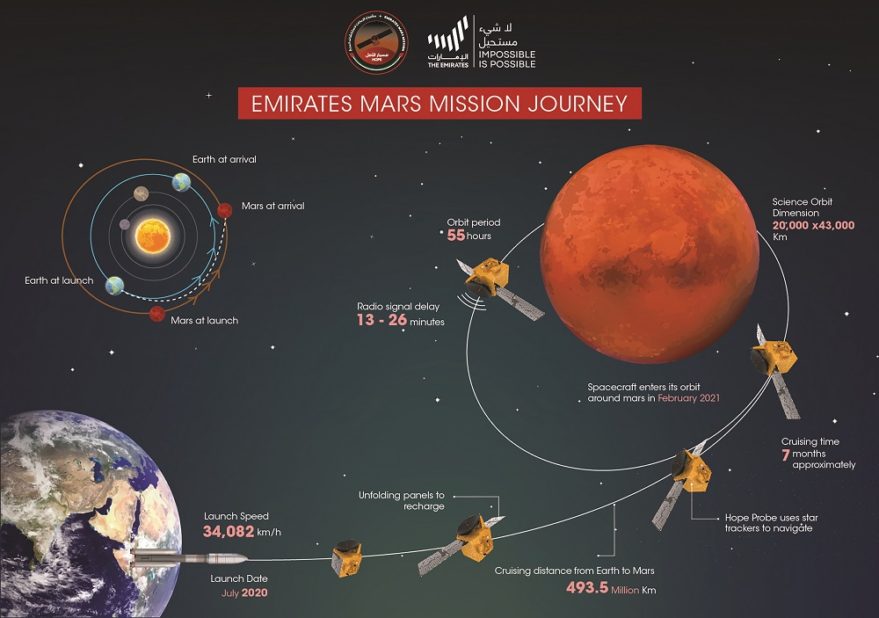
This infographic illustrates the Hope mission’s journey to Mars. Credit: MBRSC

The Hope mission will also probe the outermost layers of the Martian atmosphere, where hydrogen and oxygen are escaping into space.

“We’ve learned from past missions that the loss of the atmosphere over time, over Martian history, we think, is important. But we need to do more to quantify that loss to understand how the rest of the atmosphere influences that loss to space,” Brain said.

The Hope spacecraft’s other primary science goal is to study the link between weather in the lower atmosphere and the conditions at the top of the atmosphere.

“If there’s a dust storm in the lower atmosphere, does atmospheric escape increase, and how?” Brain said. “If there is some change in the lower atmosphere, or a bunch of cloud formations, how does the upper atmosphere respond? In the past we’ve had missions that study the upper atmosphere, we’ve had missions to study the lower atmosphere, usually at just a single time of day, but we haven’t had a lot of observations that help us how understand how the atmosphere works from bottom to top, so EMM will provide that information.”

“We’re going to get complete coverage of the Martian atmosphere every nine Martian days, and by complete coverage, I mean we will have observed every geographic region at every time of day every nine days,” Brain said.

Two more international robotic Mars missions are on the heels of the Hope spacecraft.

China’s Tianwen 1 orbiter and rover are scheduled to arrive at Mars on Wednesday. If successful, the arrival will make China the sixth nation to send a spacecraft to the Red Planet.

The Tianwen 1 mission’s rover will remain attached to its parent spacecraft in orbit around Mars until it attempts a landing in May.

NASA’s Perseverance rover is on track to reach Mars on Feb. 18, carrying sophisticated instruments designed to study the ancient habitability of the planet. Perseverance will also gather rock samples for return to Earth by a future mission.


https://spaceflightnow.com/2021/02/09/arab-worlds-first-interplanetary-spacecraft-safely-arrives-at-mars/
« Ostatnia zmiana: Kwietnia 05, 2021, 02:23 wysłana przez Orionid »

Online Orionid

  • Weteran
  • *****
  • Wiadomości: 28869
  • Very easy - Harrison Schmitt
Odp: [BBC] UAE Hope mission returns first image of Mars
« Odpowiedź #7 dnia: Lutego 14, 2021, 20:16 »
UAE Hope mission returns first image of Mars
Jonathan Amos Science correspondent 8 hours ago


UAESA/MBRSC/LASP/EMM-EXI image captionThe image shows three shield volcanoes in a line, as well as Olympus Mons, the largest volcano in the Solar System

The United Arab Emirates' Hope mission has returned its first picture of Mars.

The spacecraft entered into an orbit around the Red Planet on Tuesday, making the UAE the first Arab nation in history to have a scientific presence at Earth's near neighbour.

This first image will be followed by many similar such views of Mars.

Hope was put in a wide orbit so it could study the planet's weather and climate systems, which means it also will see the planet's full disk.

It's a type of view that's familiar fare from Earth-based telescopes, but less so from satellites actually positioned at Mars.

They traditionally have been kept close in to the planet so they can get high-resolution pictures of the surface and act as telecommunications relay stations for landed robots in contact with Earth.


Artwork: The UAE is the first Arab nation in history to send a probe to Mars

The picture at the top of this page was captured by Hope's EXI instrument from an altitude of 24,700 km (15,350 miles) above the Martian surface at 20:36 GMT on Wednesday - so, one day after arriving at the Red Planet.

The north pole of Mars is in the upper left of the image. At centre, just emerging into the early morning sunlight, is Olympus Mons, the largest volcano in the Solar System. Look right on the boundary between night and day, the so-called terminator.

The three shield volcanoes in a line are Ascraeus Mons, Pavonis Mons, and Arsia Mons. Look east, to the limb of the planet, and you can see the mighty canyon system, Valles Marineris. It's part covered by cloud.

"The transmission of the Hope Probe's first image of Mars is a defining moment in our history and marks the UAE joining advanced nations involved in space exploration," the mission's twitter account stated. "We hope this mission will lead to new discoveries about Mars which will benefit humanity."

Hope is now running in an initial ellipse around Mars that comes as close as 1,000km from the planet and goes out to almost 50,000km. Over the course of the next few weeks, this will be trimmed to a 55-hour, 22,000km-by-43,000km orbit that is inclined to the equator by about 25 degrees.

It's from this high perch that Hope plans to carry out some novel research. It's going to trace how energy moves through the atmosphere from the very bottom to the very top.

One of its quests is to study the leakage into space of neutral atoms of hydrogen and oxygen - remnants from Mars' once abundant water. This will add to our understanding of precisely how a previously warm and wet planet became the cold, dusty, desiccated world it is today.

On the day the UAE Hope probe took this first image, the Chinese Tianwen-1 orbiter arrived at Mars.

Like Hope, it had to execute a braking manoeuvre to be sure of being captured by the planet's gravity.

The Tianwen-1 mission carriers a rover which will be despatched to the surface in May or June.

China's space agency has released early imagery of what its satellite saw during its orbit insertion.

These pictures come not from a science camera like Hope's EXI instrument, but from low-resolution cameras used by engineers to inspect the spacecraft.

In the movie below, the view is dominated by Tianwen-1's solar panel, but the Martian atmosphere and surface topography are clearly visible.

This coming week, it is the turn of the Americans. Their Perseverance rover reaches Mars on Thursday and will try immediately to land in a near equatorial crater called Jezero.


Source: https://www.bbc.com/news/science-environment-56060890

Polskie Forum Astronautyczne

Odp: [BBC] UAE Hope mission returns first image of Mars
« Odpowiedź #7 dnia: Lutego 14, 2021, 20:16 »