Autor Wątek: [SN] NASA sets late October launch date for first operational Crew Dragon  (Przeczytany 5254 razy)

0 użytkowników i 1 Gość przegląda ten wątek.

Online Orionid

  • Weteran
  • *****
  • Wiadomości: 29186
  • Very easy - Harrison Schmitt
NASA sets late October launch date for first operational Crew Dragon mission
by Jeff Foust — August 14, 2020


NASA astronauts (from left) Shannon Walker, Victor Glover and Mike Hopkins, and JAXA astronaut Soichi Noguchi sit in a Crew Dragon capsule during training for their Crew-1 mission, now scheduled to launch Oct. 23. Credit: SpaceX

WASHINGTON — NASA announced Aug. 14 that the first operational SpaceX commercial crew mission to the International Space Station will launch in late October, a delay to accommodate other spacecraft flying to the station.

The agency said it has set a date of no earlier than Oct. 23 for the Crew-1 launch, which will send three NASA astronauts and one astronaut from the Japanese space agency JAXA on a Crew Dragon spacecraft to the ISS for a six-month mission. NASA previously said the mission would launch in late September, but officials had hinted in recent days that the launch could be delayed until October.

“Right now it’s scheduled for late September. It could slip into October,” NASA Administrator Jim Bridenstine said Aug. 7 in a keynote speech at an online conference for alumni of the International Space University.

Just before the launch of the Demo-2 mission May 30, NASA said it was targeting a launch date of no earlier than Aug. 30 for Crew-1, assuming that Demo-2 returned by the beginning of August. However, in the weeks before the Demo-2 splashdown Aug. 2, NASA said they required at least six weeks to complete certification work on the spacecraft before launching Crew-1, pushing that launch back to the latter part of September.

The new delay, NASA said in its announcement of the Crew-1 launch date, is primarily because of other visiting vehicle traffic at the ISS. The Soyuz MS-17 spacecraft is scheduled to launch to the station Oct. 14, transporting NASA astronaut Kate Rubins and Roscosmos cosmonauts Sergey Ryzhikov and Sergey Kud-Sverchkov to the station. They will replace the current crew of NASA’s Chris Cassidy and Roscosmos’ Anatoly Ivanishin and Ivan Vagner, who are scheduled to return to Earth on the Soyuz MS-16 spacecraft several days after the arrival of Soyuz MS-17.

In addition to the Soyuz arrivals and departures, a Cygnus cargo spacecraft is currently scheduled for launch Sept. 29 on an Antares rocket from Wallops Island, Virginia. Cygnus spacecraft typically arrive at the station two to three days after launch.

Crew-1 will transport to the station NASA astronauts Michael Hopkins, Victor Glover and mission specialist Shannon Walker, and JAXA astronaut Soichi Noguchi. “We’re ready to go to the space station,” Glover said at a press conference after the Demo-2 splashdown Aug. 2. “We’re very close to ready to fly the Dragon into low Earth orbit.”

The late October launch of Crew-1, NASA said, will allow them to remain on the station through the launch this spring of Crew-2, which will transport a new crew of astronauts from NASA, JAXA and the European Space Agency to the station. While the Crew-1 mission will use a new Falcon 9 booster and Crew Dragon spacecraft, Crew-2 will use the Dragon capsule from the Demo-2 mission and the Falcon 9 booster from Crew-1.

NASA still has to complete certification of the Crew Dragon spacecraft to allow the Crew-1 mission to proceed. At the post-splashdown press conference, Steve Stich, manager of NASA’s commercial crew program, said he expected the final certification review to take place in late August or early September.

Source: https://spacenews.com/nasa-sets-late-october-launch-date-for-first-operational-crew-dragon-mission/

NASA sets Oct. 23 as target launch date for first operational Crew Dragon mission
August 14, 2020 Stephen Clark [SFN]


NASA’s SpaceX Crew-1 crew members are seen seated in the company’s Crew Dragon spacecraft during crew equipment interface training. From left to right are NASA astronauts Shannon Walker, mission specialist; Victor Glover, pilot; and Mike Hopkins, Crew Dragon commander; and JAXA astronaut Soichi Noguchi, mission specialist. Credit: SpaceX

The first operational flight of SpaceX’s Crew Dragon spacecraft with four astronauts aboard is set to launch from the Kennedy Space Center in Florida no earlier than Oct. 23, following a formal certification review to assess data from the Crew Dragon’s two-man test flight that concluded earlier this month, NASA said Friday.

The four-person crew on the next Crew Dragon mission was set to blast off in late September, but NASA announced Friday that the launch would be pushed back to Oct. 23 to better fit within the International Space Station’s busy schedule of crew and cargo deliveries.

Spacecraft commander Mike Hopkins, pilot Victor Glover, and mission specialists Shannon Walker and Soichi Noguchi of the Japan Aerospace Exploration Agency will ride the Crew Dragon spacecraft into orbit on top of a Falcon 9 rocket from pad 39A at the Kennedy Space Center.

Assuming a launch on Oct. 23, the four-person crew will lift off around 5:47 a.m. EDT (0947 GMT) for a predawn climb into orbit. The launch time could be adjusted slightly as the International Space Station’s orbit changes due to aerodynamic drag and possible reboost maneuvers.

A launch Oct. 23 would put Hopkins and his crewmates on course to dock with the space station Oct. 24, kicking off a six-month expedition on the orbiting research complex.

The Crew Dragon mission set for launch in October will be SpaceX’s first regular crew rotation flight to the space station. Designated Crew-1, the mission follows the first Crew Dragon flight to the station on a demonstration mission with astronauts Doug Hurley and Bob Behnken.

Hurley and Behnken launched on SpaceX’s Demo-2 mission May 30 from the Kennedy Space Center and docked at the space station the next day. The launch marked the first time astronauts flew into orbit from U.S. soil since the retirement of the space shuttle in 2011.

The Demo-2 test flight concluded Aug. 2 with Hurley and Behnken’s splashdown Aug. 2 in the Gulf of Mexico. Although NASA and SpaceX say the Crew Dragon spacecraft performed well on the 64-day test flight, officials plan a review in late August or early September to assess data from the Demo-2 mission and formally certify the Crew Dragon for regular crew rotation missions lasting up to seven months.

SpaceX is under contract with NASA for at least six “post-certification” crew rotation missions to the space station through 2024. Through a series of funding agreements since 2011, NASA has committed more than $3.1 billion to SpaceX for development, testing and operational flights of the commercial Crew Dragon spacecraft.

“NASA certification of SpaceX’s crew transportation system allows the agency to regularly fly astronauts to the space station, ending sole reliance on Russia for space station access,” NASA said Friday.


SpaceX’s Crew Dragon spacecraft for the Crew-1 mission at the company’s headquarters in Hawthorne, California. Credit: SpaceX

In a statement released Friday, NASA said the Crew-1 mission’s launch was rescheduled from late September to no earlier than Oct. 23 in order “to accommodate spacecraft traffic for the upcoming Soyuz crew rotation and best meet the needs of the International Space Station.”

The Crew Dragon’s launch Oct. 23 and docking Oct. 24 will follow a Russian Soyuz crew rotation in mid-October.

Russian engineers are readying the Soyuz MS-17 spacecraft for launch Oct. 14 from the Baikonur Cosmodrome in Kazakhstan with Russian commander Sergey Ryzhikov, cosmonaut Sergey Kud-Sverchkov, and NASA astronaut Kate Rubins.

The Soyuz MS-17 crew will dock with the space station a few hours after launch, joining station commander Chris Cassidy and Russian flight engineers Anatoly Ivanishin and Ivan Vagner for a week-long crew handover.

Cassidy, Ivanishin and Vagner are due to depart the space station Oct. 21 and head for landing in Kazakhstan, leaving the three-person Soyuz MS-17 crew on the orbiting lab to await the arrival of the Crew-1 astronauts Oct. 24, which will raise the station crew size to seven.

Two U.S. resupply missions are also scheduled for launch to the space station before the end of the year.

A Northrop Grumman Cygnus commercial supply ship is set for liftoff Sept. 29 from Wallops Island, Virginia, on top of an Antares rocket. The Cygnus cargo freighter will arrive at the station Oct. 3 with several tons of experiments, crew provisions and other hardware.

A SpaceX Dragon cargo ship could launch from Cape Canaveral as soon as November. That mission will be SpaceX’s 21st cargo launch to the space station, but the first to employ a new supply vehicle design based on an unpiloted version of the Crew Dragon spacecraft.

The timing of the Crew-1 mission’s launch in October will set up the landing of Hopkins’ crew in late April, about one month after the scheduled launch and docking of the next Crew Dragon flight — known as Crew-2 — next spring. NASA wants at least several weeks of overlap between the Crew-1 and Crew-2 astronauts on the space station.

During that period, Russia plans to launch a fresh Soyuz crew mission to the space station to replace Ryzhikov, Kud-Sverchkov and Rubins. With eight Crew Dragon astronauts and six Soyuz crew members coming and going at the station next April, the research outpost could briefly host 14 astronauts and cosmonauts, breaking the record for the most people in space at one time.

Boeing is also gearing up for a second unpiloted test flight of its Starliner crew capsule late this year, but officials have not announced a target launch date for the mission. The Starliner will dock with the space station in a repeat of an unpiloted demonstration flight in December 2019 that failed to reach the orbiting research lab.

If that flight goes well, Boeing could launch astronauts to the space station on its commercial Starliner spacecraft for the first time in 2021. Like SpaceX, Boeing is under contract with NASA for at least six operational Starliner crew rotation flights to the station.

Source: https://spaceflightnow.com/2020/08/14/nasa-sets-oct-23-as-target-launch-date-for-first-operational-crew-dragon-mission/
« Ostatnia zmiana: Września 24, 2021, 17:27 wysłana przez Orionid »

Online Orionid

  • Weteran
  • *****
  • Wiadomości: 29186
  • Very easy - Harrison Schmitt
Odp: [SN] NASA and SpaceX wrapping up certification of Crew Dragon
« Odpowiedź #1 dnia: Listopada 24, 2020, 00:38 »
NASA and SpaceX wrapping up certification of Crew Dragon
by Jeff Foust — September 29, 2020


NASA and SpaceX are completing reviews of minor changes to the Crew Dragon spacecraft, including its heat shield and a sensor used to measure altitude for parachute deployment, based on data collected during the Demo-2 mission this summer. Credit: NASA/Bill Ingalls

WASHINGTON — NASA and SpaceX are finalizing reviews of minor changes to the Crew Dragon spacecraft that they expect will be complete before the first operational mission launches to the International Space Station at the end of October.

During a series of press conferences Sept. 29 about the upcoming Crew-1 mission to the ISS, officials said they were incorporating lessons learned from the Demo-2 flight of the Crew Dragon this summer into the design of the spacecraft.

One issue involves the heat shield on the spacecraft. “We found on a tile a little bit more erosion than we wanted to see,” said Hans Koenigsmann, vice president of build and flight reliability at SpaceX. The problem appeared to be with how air flowed around “tension ties,” or bolts that link the capsule to the trunk section of the spacecraft that is jettisoned just before reentry. “We saw some flow phenomenon that we really didn’t expect, and we saw erosion to be deeper than we anticipated.”

He emphasized that erosion was limited to a very small area of the heat shield, and didn’t put the Demo-2 crew in jeopardy. “It’s relatively easy to fix,” he said, by using a more erosion-resistant material for the tiles around the four tension ties. That change was tested in an arcjet chamber at the Ames Research Center last week “and it came out great.”

A second issue was with parachute deployment, which took place within what Koenigsmann called the “allowable box” for reentry but a little lower than expected. SpaceX is changing an instrument that uses barometric pressure to determine altitude to correct the problem.

Those changes have been the major issues before NASA formally certifies the Crew Dragon spacecraft for operational missions. “The big chunk of the certification is in those upgrades,” said Kathy Lueders, NASA associate administrator for human exploration and operations. Other focus areas include new capabilities added to the Crew-1 mission, such as being able to dock with two different ports on the station.

Most of the rest of the certification work is completed, she said, including a program-level certification review. “We’re just in the process of finalizing the last few pieces of our documentation needed to close our human rating certification plans,” she said, work she expected to completed in the next week to 10 days. A “final final” certification will take place at the flight readiness review for the Crew-1 mission, about a week before launch.

Another change for the Crew-1 mission will address an issue after splashdown on the Demo-2 mission, when dozens of private boats swarmed around the spacecraft. Koenigsmann said NASA and SpaceX is closely coordinating with the U.S. Coast Guard to maintain a 16-kilometer “keep out zone” around the splashdown site, to be patrolled by additional Coast Guard vessels.

The Crew Dragon mission that will fly the Crew-1 mission features other upgrades, including the ability to support four people and remain in orbit for 210 days. The spacecraft also features an improved backshell that will increase the wind limits for reentry, said Anthony Vareha, the lead NASA flight director for the mission. For Demo-2, he said, there was just one chance in seven of having acceptable winds, but “we got it right on the first try.” For Crew-1, that will improve to one in four.

The day before the briefings, NASA announced it was delaying the Crew-1 launch by eight days to Oct. 31. Part of the reason for the slip was to wrap up that certification work, as well as provide more time between the arrival and departure of Soyuz spacecraft in mid-October and the Crew-1 mission. “It’s a very busy October for us,” Lueders said.

Another factor in the announcement in the delay was to provide more time to track down an air leak on the station. Shortly before the briefings started, NASA announced the rate of the leak had increased, and had been isolated to the Zvezda module in the station. “We think there’s something going on there,” said Kenny Todd, deputy manager of the ISS program at NASA.

That leak does not pose a safety issue for the crew, and Todd said additional air bottles will be flown to the station on a Cygnus cargo spacecraft scheduled for launch Oct. 1. It also should not affect the Crew-1 mission, he added. “We’ll be OK out to the spring of next year” based on the current leak rate, he said. “This is not necessarily a near-term problem, as long as the leak rate stays at where it’s at today.”

The four astronauts who will fly on the Crew-1 mission — NASA astronauts Mike Hopkins, Victor Glover and Shannon Walker, and JAXA astronaut Soichi Noguchi — said they were ready for the flight, having finished all their training for the mission except for a few final simulator sessions. The astronauts announced that, following the tradition of the Demo-2 mission, where astronauts Bob Behnken and Doug Hurley named their Crew Dragon spacecraft “Endeavour,” they had selected the name “Resilience” for their spacecraft.

“I think all of us can agree that 2020 has certainly been a challenging year,” Hopkins said. “The name ‘Resilience’ is really in honor of the SpaceX and NASA teams and, quite frankly, it’s in honor of our families, our colleagues, our fellow citizens, international partners and leaders, who have all shown that same quality, that same characteristic through these difficult times.”


Source: https://spacenews.com/nasa-and-spacex-wrapping-up-certification-of-crew-dragon/

Online Orionid

  • Weteran
  • *****
  • Wiadomości: 29186
  • Very easy - Harrison Schmitt
Odp: [SN] NASA’s Crew-1 commander to be sworn into U.S. Space Force
« Odpowiedź #2 dnia: Listopada 26, 2020, 00:55 »
NASA’s Crew-1 commander to be sworn into U.S. Space Force from the International Space Station
by Sandra Erwin — October 28, 2020 [SN]


The SpaceX Crew-1 members include NASA astronauts Shannon Walker, Victor Glover, Mike Hopkins, and JAXA (Japan Aerospace Exploration Agency) astronaut Soichi Noguchi. Credit: NASA

Air Force Col. Michael “Hopper” Hopkins, commander of NASA’s SpaceX Crew-1 mission, will be commissioned into the U.S. Space Force.

WASHINGTON — NASA astronaut Michael Hopkins, a U.S. Air Force colonel and the commander of the upcoming SpaceX Crew Dragon mission, is transferring to the U.S. Space Force and is expected to be commissioned aboard the International Space Station.

“If all goes well, we’re looking to swear him into the Space Force from the International Space Station,” said Gen. John “Jay” Raymond, chief of space operations of the U.S. Space Force.

Col. Michael “Hopper” Hopkins is the commander of NASA’s SpaceX Crew-1 mission scheduled to launch Nov. 14 from Kennedy Space Center, Florida. The crew of four includes Hopkins, NASA astronauts Victor Glover and Shannon Walker, and Japan Aerospace Exploration Agency mission specialist Soichi Noguchi.

Col. Catie Hague, a spokesperson for the chief of space operations, told SpaceNews that the service is working with NASA to schedule a transfer ceremony once Hopkins is on board the International Space Station.

Hopkins, like hundreds of other airmen who are now in the Space Force, is transferring voluntarily. He was selected by NASA to be an astronaut in 2009.

Hopkins would be the first member of the Space Force to serve in NASA’s astronaut corps. Hague noted that for more than 60 years, men and women from the Army, Navy, Marine Corps, Air Force and Coast Guard have helped fill the ranks of the astronaut corps. “The U.S. Space Force, as the newest military service, is looking forward to contributing to this legacy,” Hague said.

Raymond is working with NASA Administrator Jim Bridenstine on the details of a planned transfer ceremony “as a way to spotlight the decades-long partnership between DoD and NASA,” Hague said.


Source: https://spacenews.com/nasas-crew-1-commander-to-be-sworn-into-u-s-space-force-from-the-international-space-station/

Online Orionid

  • Weteran
  • *****
  • Wiadomości: 29186
  • Very easy - Harrison Schmitt
Odp: [SN] Crew-1 launch remains on schedule despite Sentinel-6 slip
« Odpowiedź #3 dnia: Listopada 27, 2020, 01:24 »
Crew-1 launch remains on schedule despite Sentinel-6 slip
by Jeff Foust — November 3, 2020 [SN]


The Crew-1 commercial crew mission remains on schedule for launch Nov. 14 despite a delay of another Falcon 9 launch of the Sentinel-6 Michael Freilich ocean science satellite. Credit: SpaceX

WASHINGTON — NASA is delaying the launch of an ocean science satellite on one Falcon 9 rocket, but says that delay will not affect another Falcon 9 launch of a commercial crew mission.

The agency announced Nov. 3 it was delaying the launch of the Sentinel-6 Michael Freilich satellite on a Falcon 9 from Vandenberg Air Force Base in California from Nov. 10 to Nov. 21. The reason for the delay, the agency said, was to give SpaceX time to replace two engines in the rocket’s first stage.

The performance of the Falcon 9’s Merlin engines had been under scrutiny since a launch abort seconds before the scheduled liftoff of a Falcon 9 carrying a GPS 3 satellite Oct. 2. An investigation eventually blamed the abort on a “masking lacquer”, a coating used to protect engine components when they are anodized for corrosion protection. The lacquer was not properly cleaned after anodizing, blocking a relief valve in the gas generator of one of the Merlin engines in the stage.

At an Oct. 28 briefing, NASA said it was replacing two Merlin engines in the Falcon 9 booster that will launch the Crew-1 commercial crew mission, currently scheduled for Nov. 14 from the Kennedy Space Center. At the time it said it was replacing one engine on the Falcon 9 first stage for Sentinel-6 Michael Freilich, but that it was still inspecting the engines on that booster.

Before the briefing, NASA indicated that the Sentinel-6 launch would take place first, and that NASA would review the data from the launch before deciding to proceed with the Crew-1 mission. But at that briefing, agency officials said Crew-1 didn’t need to wait for the Sentinel-6 launch. “There is, right now, not a hard bar between these missions,” said Kathy Lueders, NASA associate administrator for human exploration and operations. “We’re going to fly both missions when it’s the right time.”

Instead, agency officials said they wanted to see the GPS 3 launch go first. “One of the engines that we are installing on the first stage has a slight change that we would like to see fly on the GPS 3 mission first,” said Steve Stich, manager of NASA’s commercial crew program. “We would like to see that one mission go fly before we fly crew.”

At the time of the briefing, SpaceX had not yet rescheduled the GPS 3 launch. However, after a successful static-fire test of the booster Oct. 31, SpaceX announced that the launch was now rescheduled for Nov. 5.

NASA, in the statement about the Sentinel-6 launch delay, stated that the Crew-1 mission remains on schedule for Nov. 14. The four-person crew entered prelaunch quarantine Oct. 31, and will travel to the Kennedy Space Center for final prelaunch preparations Nov. 8.


Source: https://spacenews.com/crew-1-launch-remains-on-schedule-despite-sentinel-6-slip/

Polskie Forum Astronautyczne

Odp: [SN] Crew-1 launch remains on schedule despite Sentinel-6 slip
« Odpowiedź #3 dnia: Listopada 27, 2020, 01:24 »

Online Orionid

  • Weteran
  • *****
  • Wiadomości: 29186
  • Very easy - Harrison Schmitt
Odp: [SFN] Veteran Japanese astronaut to become SpaceX’s first international
« Odpowiedź #4 dnia: Listopada 29, 2020, 02:29 »
Veteran Japanese astronaut to become SpaceX’s first international passenger
November 14, 2020 Stephen Clark


Japanese astronaut Soichi Noguchi during training at SpaceX headquarters in Hawthorne, California. Credit: SpaceX

Japanese astronaut Soichi Noguchi has traveled to the International Space Station on a space shuttle and a Russian capsule. He’s now gearing up to launch on a SpaceX Crew Dragon spaceship, becoming only the third person to launch from Earth into orbit on three different types of spacecraft.

He will join a small club that, so far, only includes NASA astronauts Wally Schirra and John Young. Schirra flew on NASA’s Mercury, Gemini, and Apollo capsules, while Young rocketed into orbit on two Gemini flights, two Apollo missions, and two space shuttle launches.

“It’s quite an honor to have the same experience like Mr. John Young did,” Noguchi said. “I still remember my astronaut candidate days, when I came here back in 1996, John Young was still flying T-38s. So I had the privilege to fly with him. So it’s definitely quite an honor.”

Noguchi flew to the space station in 2005 aboard the space shuttle Discovery on the first shuttle mission after the Columbia accident in 2003, in which seven astronauts died during re-entry. He launched again in 2009 on a Russian Soyuz rocket for a 164-day expedition on the space station.

“For me, the three different space vehicles also have three different methods of landing,” Noguchi told Spaceflight Now in a recent interview. “The first one was on a runway, with concrete, the second one was on the ground in Kazakhstan, and this one is in the ocean. So the three different types of landing will make it really interesting.”

Noguchi is flying to the space station under an arrangement between NASA and the Japan Aerospace Exploration Agency, or JAXA. NASA provides rides to the station for Japanese, European, and Canadian astronauts in exchange for the partner agencies paying their share of the space station’s operating costs.

“It’s kind of interesting that in Japan, we don’t have our own space vehicle, but based on the international cooperation, we are able to execute this type of big milestone,” Noguchi said. “Of course, there are a lot more people behind me. So this is just the beginning, but we are happy to witness this historic flight.”

Within a few years, the Crew Dragon, Boeing’s Starliner crew capsule, NASA’s Orion deep space vehicle, and Russia’s Soyuz spacecraft will all be flying with astronauts to destinations in Earth orbit and beyond. That means more space fliers will soon have the opportunity to launch from Earth and land on three or more types of vehicles, joining Schirra, Young, and Noguchi.

(EDITOR’S NOTE: This list doesn’t include Apollo astronauts who also launched from the moon inside NASA’s lunar module, in addition to launching from Earth on different rockets.)


Soichi Noguchi inside the white room at pad 39B on July 26, 2005, before boarding the space shuttle Discovery for his first spaceflight. Credit: NASA

Noguchi, a 55-year-old aeronautical engineer with two space missions under his belt, has logged more than 177 days in orbit to date. He’s set to kick off his third spaceflight Sunday, beginning an expedition planned to last nearly six months.

Noguchi will join NASA commander Mike Hopkins, pilot Victor Glover, and mission specialist Shannon Walker on the Crew Dragon capsule when it blasts off Sunday night from pad 39A at the Kennedy Space Center in Florida.

Liftoff of the Crew Dragon on top of a Falcon 9 rocket is set for 7:27 p.m. EST Sunday (0027 GMT Monday), weather permitting.

Noguchi and his crewmates are setting off on a six-month mission aboard the space station, culminating with a parachute-assisted splashdown in early May on their Crew Dragon spacecraft, which the astronauts named “Resilience.”

The launch this weekend will mark the first regular crew rotation flight — known as Crew-1 — to the space station with SpaceX’s Crew Dragon spaceship, following a successful two-person test flight to the station earlier this year.

In the future, four-person crews will be the norm on Crew Dragon missions. NASA also has a contract with Boeing to fly Starliner crew capsules to the space station.

NASA spent about $5 billion to help SpaceX and Boeing develop the Crew Dragon and Starliner systems, according to Phil McAlister, the agency’s director of commercial spaceflight. The companies also invested their own money into the program through public-private partnerships with NASA.

Noguchi, who was a Boy Scout when he was growing up in Japan, also has experience with different types of spacesuits.

He wore NASA’s orange launch and entry suit on his shuttle flight, and then wore Russia’s Sokol pressure suit when he launched and landed on the Soyuz spacecraft. SpaceX’s flight suit serves a similar purpose to the shuttle and Sokol suits, providing a survivable environment for astronaut in case the Crew Dragon spacecraft depressurizes in flight.


Soichi Noguchi smiles and gives a thumbs-up after landing on a Soyuz capsule June 2, 2010. Credit: NASA/Bill Ingalls

“It’s a bit different,” Noguchi said of the SpaceX pressure suit. “The good thing about SpaceX is it’s simple. The bad thing is it’s simple … It’s very simple, so there are less points of failure, and it’s very lightweight, and that’s great.

“Because of the simpleness, there are sometimes little shortcomings,” he told Spaceflight Now. “There are certain things you cannot really do, like depressurizing the suit is tough compared to Soyuz and the shuttle. But the simplicity is the beauty, and it’s lightweight, and overall it’s a nice design. I like it.”

Noguchi praised SpaceX’s “speed and flexibility” as the Dragon crew trained at the company’s headquarters in Hawthorne, California, near Los Angeles.

“Everything was close by, meaning that during the training, if I had some deep questions, technical questions, the engineer who created those displays was right across the floor, or the technician who actually built it was one floor down,” Noguchi said. “So we can actually go talk to the source of that information, and if sometimes we need to change the displays, sometimes we need to change position of a pump, and with good reason, they can adapt to those changes.

“It’s not so uncommon that within a day, they would change the display, or in a few days that would completely change the hardware,” Noguchi said. “That speed and flexibility I really liked about SpaceX.”

Noguchi said he ran into “inevitable” restrictions related to export control restrictions related to U.S. International Traffic in Arms Regulations, or ITAR.

“I’m a foreign national, so there are a lot of ITAR issues,” Noguchi said. “Those information and technical exchange agreement issues are always there. It’s inevitable.”

Export control regulations limit access to satellite hardware and technical drawings for foreign nationals.

“I try not to be considered as a spy, and also I would like to get the information to become a safe operator,” Noguchi said. “So getting a diagram, or a drawing, or a paper is really tough. But, of course, SpaceX and also my crew are really helping me to understand and become a good operator.

“To safely operate a complex vehicle like Crew Dragon, we need to have appropriate system understanding, and in that sense, SpaceX was pretty cooperative with trying to dodge the bullet, to make sure we don’t violate those ITAR rules,” Noguchi said.

Noguchi said he encountered similar headwinds when training for his Soyuz mission in Russia.

“For the Russian Soyuz, yes, we were constantly dealing with those issues,” he said. “But with Russia, we have a long lasting relationship, so we know how to dodge the bullet. We know the safe thing to do.

“Compared to SpaceX, it’s obviously a new thing, a new challenge for them,” Noguchi said. “Obviously, I am the first student for them other than an American, so they tried to make sure that we — SpaceX and I — don’t violate the regulations, and at the same time they can train me as a valid operator. So that was a challenge.”

European Space Agency astronaut Thomas Pesquet is training to fly on the Crew-2 mission on a SpaceX Crew Dragon capsule next year.

“Fortunately, after me, we have other foreign astronauts in training so hopefully they have a much smoother experience with SpaceX, and Boeing in the same manner,” Noguchi said.

“We obviously are being cautious,” said Kathy Lueders, head of NASA’s human spaceflight division. “When he had flown before (on the space shuttle), it was on a system that we owned. The other thing is the insight on your vehicle is also dependent on what the crew member needs to do.”

Hopkins and Glover began training to fly the Crew Dragon spacecraft in 2018, while Noguchi and Walker joined the crew earlier this year. Hopkins and Glover, the commander and pilot, are trained to take over manual control of the spacecraft if its autopilot system runs into problems during docking or undocking at the space station.

Noguchi and Walker are more akin to passengers during the Crew Dragon’s launch and landing.

“I think we’ll just have to continue to work through it,” Lueders said of training international astronauts. “In talking to the crew, we’ve had the discussion … Are you getting the training you need to be able to do what you need to do?”

Lueders said NASA and JAXA managers were satisfied with the training of the Dragon crew, including Noguchi. JAXA’s representative gave their “go” to proceed with the mission during a Flight Readiness Review Tuesday.

“We’ve been working with JAXA for a while, and I think it was pretty evident in the way they were able to say ‘go’ on Tuesday,” Lueders said.


Source: https://spaceflightnow.com/2020/11/14/veteran-japanese-astronaut-to-become-spacexs-first-international-passenger/

Online Orionid

  • Weteran
  • *****
  • Wiadomości: 29186
  • Very easy - Harrison Schmitt
Odp: [SN] NASA certifies SpaceX Crew Dragon spacecraft ahead of Crew-1 launch
« Odpowiedź #5 dnia: Grudnia 13, 2020, 14:24 »
NASA certifies SpaceX Crew Dragon spacecraft ahead of Crew-1 launch
by Jeff Foust — November 11, 2020 [SN]


The astronauts of the Crew-1 mission pose with their spacecraft as it, and its Falcon 9 rocket, are rolled out to the pad at the Kennedy Space Center Nov. 9. Credit: NASA/Joel Kowsky

WASHINGTON — NASA formally certified SpaceX’s Crew Dragon spacecraft for transporting astronauts to and from the International Space Station, clearing the way for a Nov. 14 launch.

Agency officials completed the certification of the spacecraft by signing a document known as a Human Rating Certification Plan during a flight readiness review for the Crew-1 mission Nov. 10. That confirmed that SpaceX met all of NASA’s requirements for safely carrying astronauts on the Crew Dragon spacecraft and Falcon 9 launch vehicle.

“It’s just a tremendous day that is a culmination of a ton of work,” said Kathy Lueders, NASA associate administrator for human exploration and operations, at a Nov. 10 briefing about the flight readiness review. Lueders managed the commercial crew program at NASA for several years before being promoted to her current position in June. “It’s NASA saying to SpaceX you have shown us you can deliver a crew transportation capability that meets our requirements.”

NASA officials previously said they planned to finalize the certification, the final milestone of the overall commercial crew development program, at that review. That allowed them to analyze minor changes made after the Demo-2 test flight this summer, such as modifications to its heat shield and a sensor that triggers the release of parachutes during the capsule’s descent.

After years of sometimes contentious relations, both NASA and SpaceX had kind words for each other. “This certification milestone is an incredible achievement from NASA and SpaceX that highlights the progress we can make working together with commercial industry,” NASA Administrator Jim Bridenstine said in an agency statement.

“Thank you to NASA for their continued support of SpaceX and partnership in achieving this goal,” Elon Musk, chief executive of SpaceX, said in the same statement. “I could not be more proud of everyone at SpaceX and all of our suppliers who worked incredibly hard to develop, test and fly the first commercial human spaceflight system in history to be certified by NASA.”

The certification, and completion of the flight readiness review, clears the way for the launch of the Crew-1 mission Nov. 14 at 7:49 p.m. Eastern from the Kennedy Space Center. The launch will send NASA astronauts Mike Hopkins, Vic Glover and Shannon Walker, and JAXA astronaut Soichi Noguchi, to the ISS for a six-month stay.

That launch remains on schedule despite SpaceX making a minor repair to the Falcon 9 rocket. The company said it would swap out a valve on the rocket’s upper stage after a review of testing data. That pushed back a static-fire test of the rocket’s first stage by a day, to Nov. 11.

That repair would take only a couple hours, according to Benji Reed, senior director of human spaceflight programs at SpaceX. “I’m not too worried about needing to delay further. We do have a little bit more time,” he said at the briefing. A successful static-fire test Nov. 11 would allow NASA and SpaceX to perform a “dry dress rehearsal” of launch preparations Nov. 12 as well as a final launch readiness review.

The review also confirmed that SpaceX had addressed a problem with the engines on the Falcon 9 that triggered a last-second abort of an Oct. 2 launch of a GPS 3 satellite. SpaceX later determined that a “masking lacquer” material blocked tiny valves in the engine’s gas generator. SpaceX corrected the problem and successfully launched that GPS 3 satellite Nov. 5.

SpaceX replaced two of the engines on the Falcon 9 first stage for this mission as part of that investigation. “We reviewed all the data on those two new engines. All that data looks good,” said Steve Stich, NASA commercial crew program manager. “So I feel really good about this vehicle.”

NASA and SpaceX highlighted the various firsts for the mission at the briefing, including the first operational commercial crew mission and the first time NASA has flown four people on a capsule. It will also be the first orbital crewed mission licensed by the Federal Aviation Administration’s Office of Commercial Space Transportation. Stich said that the FAA will have responsibility for public safety during launch and reentry.

“It’s very exciting to us get past this milestone and have the agency approve our human rating certification,” Stich said of NASA’s certification of Crew Dragon, noting he’s been involved in the program for 10 years. “Even though we’re certified, I don’t treat this flight any differently than any other flight. We’re going to methodically make sure we’re ready to go launch.”


Source: https://spacenews.com/nasa-certifies-spacex-crew-dragon-spacecraft-ahead-of-crew-1-launch/
« Ostatnia zmiana: Grudnia 13, 2020, 14:26 wysłana przez Orionid »

Online Orionid

  • Weteran
  • *****
  • Wiadomości: 29186
  • Very easy - Harrison Schmitt
Odp: [SFN] Photos: Falcon 9 rocket rolled out to pad 39A for Crew-1 launch
« Odpowiedź #6 dnia: Grudnia 23, 2020, 01:50 »
Photos: Falcon 9 rocket rolled out to pad 39A for Crew-1 launch
November 11, 2020 Stephen Clark [SFN]

SpaceX raised a 215-foot-tall (65-meter) Falcon 9 rocket on pad 39A at NASA’s Kennedy Space Center in Florida this week, shortly after the launcher rolled out of the company’s hangar with a Crew Dragon spaceship to ferry four astronauts to the International Space Station.

The Falcon 9 rocket emerged from SpaceX’s hangar at the southern perimeter of pad 39A Monday night. A transporter carried the rocket up the ramp to the historic launch complex, where hydraulics hoisted the rocket vertical in preparation for a launch scheduled for 7:49 p.m. EST Saturday (0049 GMT Sunday).

SpaceX’s Crew Dragon Resilience spacecraft is mounted on top of the Falcon 9 rocket. The capsule will launch on SpaceX’s first operational crew rotation flight to the space station, carrying NASA commander Mike Hopkins, pilot Victor Glover, mission specialist Shannon Walker, and Japanese astronaut Soichi Noguchi on a six-month expedition in orbit.

These photos were taken Monday night and Tuesday as SpaceX prepared to test-fire the Falcon 9 rocket’s engines ahead of the crew launch.


Credit: NASA/Joel Kowsky


Credit: NASA/Joel Kowsky


Credit: NASA/Joel Kowsky


Credit: NASA/Joel Kowsky


NASA astronauts Shannon Walker, Victor Glover, Mike Hopkins, and Japanese space flier Soichi Noguchi pose with their Crew Dragon spacecraft Monday night as the Falcon 9 rocket rolled out to pad 39A at the Kennedy Space Center in Florida.  Credit: NASA/Joel Kowsky


Credit: NASA/Joel Kowsky


Credit: NASA/Joel Kowsky


Credit: NASA/Joel Kowsky


Credit: NASA/Joel Kowsky


Credit: NASA/Joel Kowsky


Credit: NASA/Joel Kowsky


Credit: NASA/Joel Kowsky


Credit: SpaceX


Credit: SpaceX


Credit: SpaceX


Credit: SpaceX


Credit: NASA/Joel Kowsky

Source: https://spaceflightnow.com/2020/11/11/photos-falcon-9-rocket-rolled-out-to-pad-39a-for-crew-1-launch/
« Ostatnia zmiana: Grudnia 23, 2020, 01:59 wysłana przez Orionid »

Online Orionid

  • Weteran
  • *****
  • Wiadomości: 29186
  • Very easy - Harrison Schmitt
Odp: [SN] SpaceX launches first operational Crew Dragon mission to ISS
« Odpowiedź #7 dnia: Grudnia 25, 2020, 00:11 »
SpaceX launches first operational Crew Dragon mission to ISS
by Jeff Foust — November 15, 2020. Updated Nov. 16 with post-launch press conference details. [SN]


A SpaceX Falcon 9 rocket, carrying a Crew Dragon spacecraft with four astronauts on board, lifts off from the Kennedy Space Center Nov. 15. Credit: NASA/Joel Kowsky

WASHINGTON — A SpaceX Crew Dragon spacecraft carrying four American and Japanese astronauts is on its way to the International Space Station after a successful Falcon 9 launch Nov. 15.

The Falcon 9 lifted off from the Kennedy Space Center’s Launch Complex 39A at 7:27 p.m. Eastern. The Crew Dragon spacecraft, named “Resilience” by its four-person crew, separated from the rocket’s upper stage 12 minutes after liftoff. The rocket’s first stage landed on a droneship in the Atlantic Ocean nine and a half minutes after liftoff.

The spacecraft is scheduled to dock with the ISS at approximately 11 p.m. Eastern Nov. 16. The crew of NASA astronauts Mike Hopkins, Vic Glover and Shannon Walker, and JAXA astronaut Soichi Noguchi, will stay on the station for six months.

“The big milestone here is that we are moving away from development and test into operational flight,” NASA Administrator Jim Bridenstine said at a post-launch press conference.

The launch was scheduled for Nov. 14 but delayed a day because of weather that delayed the arrival of the droneship to the landing zone in the Atlantic. It was not affected by an apparent case of COVID-19 by SpaceX Chief Executive Elon Musk, who reported mixed testing results and symptoms consistent with a mild case. Musk was not in close contact with the crew, and was notably absent from pre-launch activities at KSC, with company president Gwynne Shotwell present instead.

There were a few minor technical issues during both the countdown and after liftoff. That included alerts about a thermal control system issue on the spacecraft after reaching orbit, which Kathy Lueders, NASA associate administrator for human exploration and operations, were sensor issues when the system started up that were soon resolved. “This is not an unusual thing to happen when a system is started up like this,” she said. “Dragon’s flying beautifully right now.”

Spacecraft controllers also worked on propellant line heaters for one set of the spacecraft’s Draco thrusters that were not working immediately after liftoff. NASA reported a few hours later that heaters were working normally again.

Moving into operations

The Crew-1 mission sets a number of firsts. Glover will be the first Black astronaut to perform a long-duration flight on the ISS. Noguchi is the first Japanese astronauts to fly to orbit on three different vehicles: the shuttle, Soyuz and Crew Dragon. The mission is the first crewed orbital flight licensed commercially by the Federal Aviation Administration.

The mission is also the first operational commercial crew flight, after the successful completion of the Demo-2 test flight this summer with NASA astronauts Bob Behnken and Doug Hurley on board. NASA signed the paperwork formally certifying the spacecraft at the end of a flight readiness review Nov. 10.

“It’s just a tremendous day that is a culmination of a ton of work,” Lueders said at a Nov. 10 briefing after the review. “It’s NASA saying to SpaceX you have shown us you can deliver a crew transportation capability that meets our requirements.”

The certification also formally closed out SpaceX’s commercial crew contract with NASA to develop and demonstrate the Crew Dragon spacecraft. “With this milestone, NASA has concluded that the SpaceX system has successfully met our design, safety and performance requirements,” said Phil McAlister, director of commercial spaceflight development at NASA Headquarters, during a Nov. 12 call with reporters. “It marks the end of the development phase of the system.”

Crew-1 is the first of a series of what are formally known as “post-certification missions” by NASA. Crew-2, which will fly astronauts from NASA, JAXA and the European Space Agency, has a launch readiness date of March 30, 2021, agency officials said at the Nov. 10 briefing. Crew-3 would follow in late summer or early fall.

NASA has called these “operational” missions on many occasions because they are intended primarily for crew transportation to and from the ISS, rather than testing of the spacecraft itself. “We’re launching what we call an operational flight to the International Space Station,” Bridenstine said during a media event at KSC Nov. 13.

However, agency officials acknowledge that the vehicle is still new, with more to learn. “I would not characterize it as ‘operational’ at this point. There a little bit of a debate as to when we will achieve that designation,” McAlister said. “We’ve completed the development phase, and we are transitioning into operations.”

But, he added, “We don’t want to ever just declare victory and say we’re done learning and get complacent.” He emphasized the need to “stay vigilant” during these missions, even though the certification confirms that the vehicle meets the NASA requirements.

There will inevitably be problems, McAlister said. “I fully expect there to be issues and anomalies on future missions. No mode of human transportation is risk-free: even bicycles malfunction from time to time,” he said.

The present and future of space stations

The four Crew-1 astronauts will join NASA astronaut Kate Rubins and Roscosmos cosmonauts Sergey Ryzhikov and Sergey Kud-Sverchkov, who arrived at the station last month on a Soyuz spacecraft. That will bring the station’s crew to seven for the first time on a long-duration basis, something NASA has emphasized as a means of increasing the station’s scientific output.

“We’re looking forward to having the extra capability on board, which will allow us to increase the science we do, increase the exploration development we do,” said Joel Montalbano, NASA ISS program manager, at a Nov. 13 briefing.

“It’s going to be exciting to see how much work we’re going to be able to get done while we’re there,” said Hopkins, commander of Crew-1, during a Nov. 9 media event. He said the crew had seen the plan for their first week of activities on the station after their arrival, which had little unscheduled time. “I think they’re going to keep us pretty busy.”

NASA is working to build up the business case for future commercial space stations that will eventually serve as successors for the ISS. Part of that is demonstrating the kinds of activities that could be done on those future space stations. “The next big phase is commercial space stations themselves,” Bridenstine said. “The ultimate goal is to have more resources to do things for which there is not a commercial marketplace, like go to the moon and on to Mars.”

“I believe we are about to see a major expansion in our ability to work in, play in and explore space,” McAlister said of what commercial crew vehicle, including Crew Dragon and Boeing’s CST-100 Starliner, will be able to achieve. “People have predicting this for decades, and I hope we are on the cusp of seeing that happen.”


Source: https://spacenews.com/spacex-launches-first-operational-crew-dragon-mission-to-iss/

Online Orionid

  • Weteran
  • *****
  • Wiadomości: 29186
  • Very easy - Harrison Schmitt
Odp: [SFN] Astronauts fly with SpaceX in landmark launch
« Odpowiedź #8 dnia: Grudnia 25, 2020, 19:51 »
Astronauts fly with SpaceX in landmark launch for commercial spaceflight
November 16, 2020 Stephen Clark [SFN]


A Falcon 9 rocket lifts off at 7:27 p.m. EST Sunday (0027 GMT Monday) with SpaceX’s Crew Dragon spacecraft carrying four astronauts to the International Space Station. Credit: Stephen Clark / Spaceflight Now

A Crew Dragon capsule ferried four astronauts into space Sunday night after a rumbling departure from the Kennedy Space Center in Florida, setting off on a 27-hour pursuit of the International Space Station on SpaceX’s first operational crew rotation flight to the orbiting outpost.

The commercial crew capsule, named “Resilience” by its four-person crew, rocketed off pad 39A at the Florida spaceport at 7:27:17 p.m. EST Sunday (0027:17 GMT Monday). A 215-foot-tall (65-meter) Falcon 9 rocket gave the Crew Dragon spacecraft a fiery ride into orbit.

NASA commander Mike Hopkins was joined inside the crew capsule by pilot Victor Glover, mission specialist Shannon Walker, and Japanese astronaut Soichi Noguchi. The four-person team is heading for a nearly six-month expedition on the space station, where the Dragon spaceship is due to dock at 11 p.m. EST Monday (0400 GMT Tuesday).

The Falcon 9 launcher streaked into a clear evening sky, taking aim on the International Space Station as it flew northeast from Florida’s Space Coast powered by nine Merlin 1D engines generating 1.7 million pounds of ground-shaking thrust.

Two-and-a-half minutes into the mission, the Falcon 9’s 15-story-tall first stage shut down and separated to begin falling toward a controlled propulsive landing on a SpaceX drone ship parked in the Atlantic Ocean.

The rocket’s upper stage ignited its single Merlin-Vacuum engine and accelerated into orbit with Hopkins and his crewmates. SpaceX mission control regularly radioed status reports to the Dragon crew as the rocket headed up U.S. East Coast, then crossed the Atlantic Ocean on a course toward the British Isles.

The Falcon 9 shut down its upper stage engine around nine minutes after liftoff, and the rocket deployed the Crew Dragon Resilience spacecraft about three minutes later. The rocket’s first stage booster, meanwhile, nailed an on-target landing on SpaceX’s offshore recovery platform for reuse on SpaceX’s next crew mission in 2021.

“To the entire Falcon 9 team, well done, that was one heck of a ride,” Hopkins said shortly after launch. “There was a lot of smiles (up here) … Making history is definitely hard and you guys all made it look easy. Again, congratulations to everyone. Resilience is in orbit.”


Astronauts Shannon Walker, Victor Glover, Mike Hopkins, and Soichi Noguchi wave to their families, media, and VIPs outside the Neil Armstrong Operations and Checkout Building. Credit: NASA/Joel Kowsky

The successful blastoff marked the start of the first human spaceflight mission to Earth orbit operated as a commercial service.

SpaceX, working under contract to NASA, built the Falcon 9 rocket and Crew Dragon spacecraft, own both vehicles, and control the mission from its corporate headquarters in Hawthorne, California, near Los Angeles.

The first “operational” Crew Dragon mission, known as Crew-1, will pave the way for more commercial flights to orbit carrying professional astronauts and paying passengers.

The Crew-1 mission is the first of at least six space station crew rotation flights NASA has contracted to SpaceX, following a successful demonstration mission to the space station earlier this year.

NASA astronauts Doug Hurley and Bob Behnken launched May 30 on the Crew Dragon’s final developmental test flight, ending a nearly nine-year gap in independent human spaceflight capability to low Earth orbit after the retirement of NASA’s space shuttle fleet.

Hurley and Behnken spent two months on the space station before returning to Earth for a parachute-assisted splashdown on their Crew Dragon Endeavour spacecraft in the Gulf of Mexico on Aug. 2.

After reviewing data from the test flight, SpaceX engineers reinforced part of the Crew Dragon’s heat shield and made several other adjustments before managers cleared the Crew-1 mission for launch.

NASA officials formally certified the Crew Dragon spacecraft and Falcon 9 rocket for operational flights during a two-day Flight Readiness Review last week.

“The big milestone here is we are now moving from development and test and into operational flights,” said NASA Administrator Jim Bridenstine.

NASA has spent $6 billion over the last decade helping companies develop new commercial human-rated spacecraft. In 2014, the space agency selected SpaceX and Boeing as partners to complete development of the Crew Dragon and Starliner crew capsules.

SpaceX has signed agreements with NASA valued at more than $3.1 billion to cover design, testing, and six operational flights of the Crew Dragon spacecraft.

The launch Sunday night was licensed by the Federal Aviation Administration — the first time that agency has licensed a crew launch into Earth orbit. The FAA regularly licenses commercial satellite launches by U.S. companies.

“I believe 20 years from now, we’re going to look back at this time as a major turning point in our exploration and utilization of space,” said Phil McAlister, director of commercial spaceflight development at NASA Headquarters. “It’s not an exaggeration to state that with this milestone, NASA and SpaceX have changed the historical arc of human space transportation.”

“Not only can NASA transport our astronauts to and from the International Space Station with U.S. systems, but now, for the first time in history, there is a commercial capability from a private sector entity to safely and reliably transport people to space,” McAlister said in a pre-launch conference call with reporters.


The Crew-1 astronauts strapped into their seats before launch Sunday. Credit: SpaceX

The Commercial Crew Program has its roots in the Obama administration, which canceled NASA’s Constellation moon program in 2010 after the George W. Bush administration’s lunar exploration initiative suffered delays and cost overruns.

An independent commission found in 2009 that it would cost more than $34 billion to complete the first phase of the Constellation program, which would have fielded the Ares 1 rocket and an Orion crew capsule capable of flights to the International Space Station.

McAlister said the Commercial Crew Program saved taxpayers between $20 billion and $30 billion, and will result in two independent crew transportation systems for low Earth orbit missions, once the Crew Dragon and Starliner spaceships are both cleared for operational flights.

Boeing’s Starliner has not yet flown with astronauts, and the aerospace contractor plans a second unpiloted test flight in early 2021 after software problems cut short the Starliner’s first orbital demonstration mission last year.

The Crew Dragon and Starliner could fly private astronauts on standalone missions without going to the International Space Station. Eventually, the commercial capsules could transport researchers, space tourists, and professional astronauts to privately-owned outposts in orbit.

Although officials hailed the Crew-1 mission as a milestone toward making human spaceflight more affordable and routine, NASA and SpaceX officials said they would stay vigilant in assessing technical risks on future commercial crew launches.

“Make no mistake, every flight is a test flight when it comes to space travel, but it’s also true that we need to routinely be able to go the International Space Station,” Bridenstine said.

Hopkins, commander of the Crew Dragon Resilience spacecraft, said one of the goals of his flight is to “put the vehicle through its operational paces.”

The Crew-1 mission is the first time four astronauts have flown on a Crew Dragon spacecraft — and the first time a four-person crew have been inside any capsule in orbit. Past space missions flying on crew capsules have carried no more than three astronauts, while NASA’s space shuttle accommodated as many as eight astronauts.

Hopkins and his crewmates will fly nearly three times longer than the Crew Dragon test flight earlier this year, pushing the capsule close to its 210-day maximum mission duration.

“Bob and Doug’s mission was the developmental test mission,” Glover said in a pre-flight press conference, referring to Crew Dragon’s Demo-2 mission. “As soon as we hit Day 64, that’s going to be the first time that a Crew Dragon at the space station his hit that milestone, and every day after that will be new territory.”

“In general, I think it’s more of an operational checkout than development testing,” Hopkins said.

The start of commercial Crew Dragon service ends NASA’s sole reliance on Russian Soyuz spacecraft to ferry astronauts to and from the space station.


The Crew Dragon Resilience spacecraft rockets off pad 39A atop a 215-foot-tall Falcon 9 launcher. Credit: NASA/Joel Kowsky

Hopkins, 51, is a native of Missouri and a colonel in the U.S. Air Force. He served as a flight test engineer before his selection as a NASA astronaut in 2009, then completed a 166-day expedition on the space station in 2013 and 2014. NASA named him to command the first operational Crew Dragon mission in 2018.

Glover is the mission’s rookie, and he is set to become the first Black astronaut to live and work on the space station for a long-duration expedition. The 44-year-old U.S. Navy test pilot was born and raised in Southern California, graduated with a bachelor’s degree in engineering from Cal Poly, then flew F/A-18 fighter jets before joining NASA’s astronaut corps in 2013.

Shannon Walker was born in Houston and earned a bachelor’s degree, master’s degree, and a PhD in space physics from Rice University. Walker, 55, was a flight controller and integration engineer on the space shuttle and space station before NASA selected her as an astronaut in 2004. She logged 163 days in orbit on the space station in 2010.

Noguchi, 55, is the most experienced astronaut on the Dragon crew. With Sunday night’s launch, Noguchi became the third person to blast off from Earth and fly into orbit on three different types of spacecraft, joining a small club with legendary NASA astronauts Wally Schirra and John Young.

He previously flew on a space shuttle mission and launched on a Russian Soyuz rocket to the space station. The Crew-1 mission is Noguchi’s third spaceflight.

After docking Monday night, the four Dragon astronauts will join NASA astronaut Kate Rubins and Russian cosmonauts Sergey Ryzhikov and flight engineer Sergey Kud-Sverchkov on the International Space Station, raising the size of the lab’s long-term crew to seven people for the first time.

Rubins, Ryzhikov, and Kud-Sverchkov launched Oct. 14 on a Soyuz spacecraft.

The space station has typically operated with six people on-board. The addition of a seventh crew member will increase the pace of scientific experiments on the orbiting lab, NASA officials said.

The seven-person crew will also perform a series of spacewalks, oversee arrivals and departures of cargo freighters, and perform maintenance tasks on the space station.

The next Crew Dragon mission is tentatively scheduled to launch March 30 with an all-veteran crew consisting of NASA commander Shane Kimbrough, pilot Megan McArthur, Japanese astronaut Akihiko Hoshide, and European Space Agency astronaut Thomas Pesquet. They will ride the same Crew Dragon Endeavour capsule that Hurley and Behnken flew earlier this year.

A fresh three-man team of Russian cosmonauts will launch around April 10 to replace Rubins, Ryzhikov, and Kud-Sverchkov, who are slated to land in their Soyuz capsule in mid-April. Then Hopkins and his crewmates will leave the complex and head splashdown in the Atlantic Ocean or Gulf of Mexico some time around May 1.

But first, the Crew Dragon Resilience spacecraft has to link up with the International Space Station Monday night. The capsule accomplished its first major rocket firing around 45 minutes after liftoff Sunday, setting the stage for additional maneuvers Monday to approach the station.

Ground controllers at SpaceX’s operations center in Hawthorne tracked several technical problems on the spacecraft soon after launch Sunday night.

One of the issues involved thermal control loops on the crew capsule. Automated sensors detected a pressure spike in the spacecraft’s cooling system, but engineers on the ground restored the coolant loops to full capability.

Then mission control studied “high resistance” readings that temporarily disabled three of four propellant line heaters associated with a group of Draco thrusters on the spacecraft. Flight rules require at least two of four propellant line heaters be working, briefly raising concerns that the heater glitch might impact the capsule’s journey to the space station.

Ground teams determined the issue was triggered by a software limit that was set too conservatively, causing the three heaters to be taken offline. After relaxing the resistance limit, all four heaters in the Draco thruster quad were reactivated, restoring the system to full redundancy.

“That is excellent news,” Hopkins said. “Good to hear — back to full fault tolerance for the prop manifold heaters,” Hopkins said.


Source: https://spaceflightnow.com/2020/11/16/astronauts-ride-spacex-crew-capsule-in-landmark-launch-for-commercial-spaceflight/

Online Orionid

  • Weteran
  • *****
  • Wiadomości: 29186
  • Very easy - Harrison Schmitt
Odp: [SFN] Photos: Four astronauts launch aboard SpaceX Falcon 9 rocket
« Odpowiedź #9 dnia: Grudnia 29, 2020, 00:01 »
Photos: Four astronauts launch aboard SpaceX Falcon 9 rocket
November 20, 2020 Stephen Clark [SFN]

These images show the liftoff of SpaceX’s Crew Dragon Resilience spacecraft on top of a 215-foot-tall (65-meter) Falcon 9 rocket from pad 39A at NASA’s Kennedy Space Center in Florida, carrying four astronauts on an expedition to the International Space Station.

The Falcon 9 rocket lifted off from pad 39A at 7:27:17 p.m. EST on Nov. 15 (0027:17 GMT on Nov. 16) with NASA commander Mike Hopkins, pilot Victor Glover, mission specialist Shannon Walker, and Japanese astronaut Soichi Noguchi.

The Falcon 9 launcher streaked into a clear evening sky, taking aim on the International Space Station as it flew northeast from Florida’s Space Coast powered by nine Merlin 1D engines generating 1.7 million pounds of ground-shaking thrust.

The mission, known as Crew-1, marked the first operational crew rotation flight to the space station with SpaceX’s Crew Dragon capsule and Falcon 9 rocket.

After a 27-and-a-half hour pursuit, the Crew Dragon Resilience spaceship autonomously docked with the space station at 11:01 p.m. EST on Nov. 16 (0401 GMT on Nov. 17). A few hours later, Hopkins and his crewmates floated into the space station to join three crew members already living aboard the orbiting research lab.


NASA astronauts Shannon Walker and Mike Hopkins walk across the crew access arm leading to the Crew Dragon capsule at pad 39A. Credit: SpaceX


Japanese astronaut Soichi Noguchi and NASA astronaut Victor Glover walk across the crew access arm leading to the Crew Dragon capsule at pad 39A. Credit: SpaceX


The Crew-1 astronauts strapped into their seats before launch. Credit: SpaceX


NASA astronaut Victor Glover and JAXA astronaut Soichi Noguchi are seen on the fixed service structure at pad 39A before boarding the Crew Dragon. Credit: NASA/Joel Kowsky


Credit: NASA/Joel Kowsky


Credit: NASA/Joel Kowsky


The Crew Dragon Resilience spacecraft rockets off pad 39A atop a 215-foot-tall Falcon 9 launcher. Credit: NASA/Joel Kowsky


Credit: SpaceX


Credit: SpaceX


Credit: SpaceX


Credit: NASA/Joel Kowsky


Credit: SpaceX

Source: https://spaceflightnow.com/2020/11/20/photos-four-astronauts-launch-aboard-spacex-falcon-9-rocket/

Online Orionid

  • Weteran
  • *****
  • Wiadomości: 29186
  • Very easy - Harrison Schmitt
Odp: [SN] Crew Dragon docks to ISS on first operational mission
« Odpowiedź #10 dnia: Kwietnia 21, 2021, 06:00 »
Crew Dragon docks to ISS on first operational mission
by Jeff Foust — November 17, 2020. Updated 7 a.m. Eastern with details from post-docking briefing. [SN]


The Crew Dragon spacecraft "Resilience" after docking with the International Space Station Nov. 16. Credit: NASA TV

Source: https://spacenews.com/crew-dragon-docks-to-iss-on-first-operational-mission/
« Ostatnia zmiana: Kwietnia 21, 2021, 06:04 wysłana przez Orionid »

Online Orionid

  • Weteran
  • *****
  • Wiadomości: 29186
  • Very easy - Harrison Schmitt
Odp: [SFN] Crew Dragon docking gives space station
« Odpowiedź #11 dnia: Kwietnia 21, 2021, 06:04 »
Crew Dragon docking gives space station its first long-term crew of seven
November 17, 2020 Stephen Clark [SFN]


SpaceX’s Crew Dragon “Resilience” spacecraft docked at the International Space Station. Credit: NASA TV/Spaceflight Now

SpaceX’s Crew Dragon Resilience spacecraft glided to a smooth automated docking Monday night at the International Space Station, delivering four astronauts to join the three-person crew already on-board, boosting the size of the lab’s long-duration crew to seven for the first time.

The space station has typically been staffed with six long-duration crew members since 2009, expanding from two- and three-person crews during construction of the research outpost. A seven crew member increase the scientific output of the more than $100 billion research complex.

Source: https://spaceflightnow.com/2020/11/17/crew-dragon-docking-gives-space-station-its-first-long-term-crew-of-seven/
« Ostatnia zmiana: Września 24, 2021, 17:23 wysłana przez Orionid »

Online Orionid

  • Weteran
  • *****
  • Wiadomości: 29186
  • Very easy - Harrison Schmitt
Odp: [SN] Crew Dragon moves to new docking port at ISS
« Odpowiedź #12 dnia: Kwietnia 21, 2021, 06:20 »
Crew Dragon moves to new docking port at ISS
by Jeff Foust — April 5, 2021 [SN]


The SpaceX Crew Dragon spacecraft approaches the International Space Station to dock during a port-relocation maneuver April 5. Credit: NASA TV

Source: https://spacenews.com/crew-dragon-moves-to-new-docking-port-at-iss/

Online Orionid

  • Weteran
  • *****
  • Wiadomości: 29186
  • Very easy - Harrison Schmitt
Odp: [SN] Crew-1 splashdown delayed by weather
« Odpowiedź #13 dnia: Kwietnia 28, 2021, 14:27 »
Crew-1 splashdown delayed by weather
by Jeff Foust — April 27, 2021


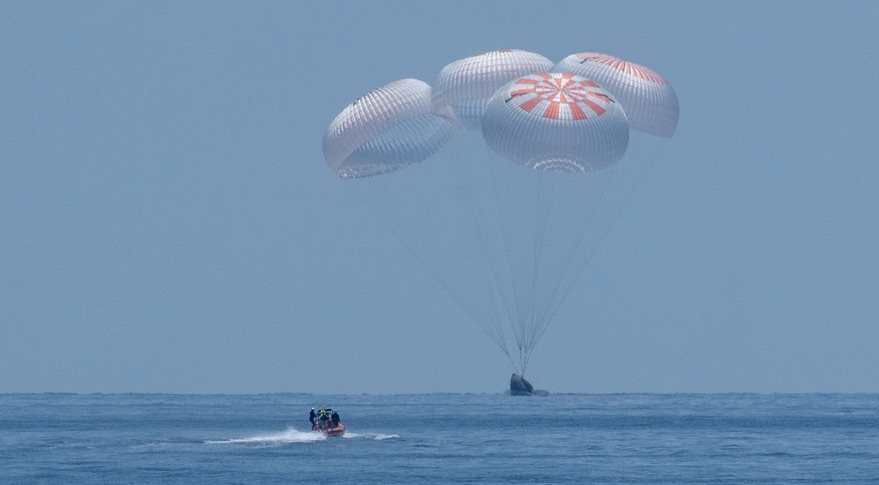
A Crew Dragon spacecraft splashes down in the Gulf of Mexico to end the Demo-2 mission in August 2020. NASA and SpaceX are delaying the return of the Crew-1 Crew Dragon spacecraft by three days because of weather off the Florida coast. Credit: NASA/Bill Ingalls

WASHINGTON — NASA and SpaceX are postponing the return of a Crew Dragon spacecraft by three days because of poor weather forecast in the splashdown location off the Florida coast.

NASA announced late April 26 that, in cooperation with SpaceX, it is postponing the return of the Crew-1 mission, which was scheduled to undock from the International Space Station April 28 and splash down in the Gulf of Mexico south of Tallahassee, Florida, later that day. NASA said forecasted wind speeds in that zone will be “above the recovery criteria” for a safe landing.

Source: https://spacenews.com/crew-1-splashdown-delayed-by-weather/

Online Orionid

  • Weteran
  • *****
  • Wiadomości: 29186
  • Very easy - Harrison Schmitt
Odp: [SFN] Return of SpaceX crew capsule delayed by high winds
« Odpowiedź #14 dnia: Kwietnia 28, 2021, 15:17 »
Return of SpaceX crew capsule delayed by high winds
April 26, 2021 Stephen Clark [SFN]


SpaceX’s Crew Dragon Resilience spacecraft during a port relocation maneuver outside the International Space Station on April 5. Credit: NASA

High winds predicted off the coast of Florida this week will keep SpaceX’s Crew Dragon Resilience spacecraft and its four-person crew in orbit until Saturday, three days after their previously scheduled return to Earth from the International Space Station.

Source: https://spaceflightnow.com/2021/04/26/return-of-spacex-crew-capsule-delayed-by-bad-weather/

Polskie Forum Astronautyczne

Odp: [SFN] Return of SpaceX crew capsule delayed by high winds
« Odpowiedź #14 dnia: Kwietnia 28, 2021, 15:17 »