Remembering ‘Gordo’MAY 01, 2023
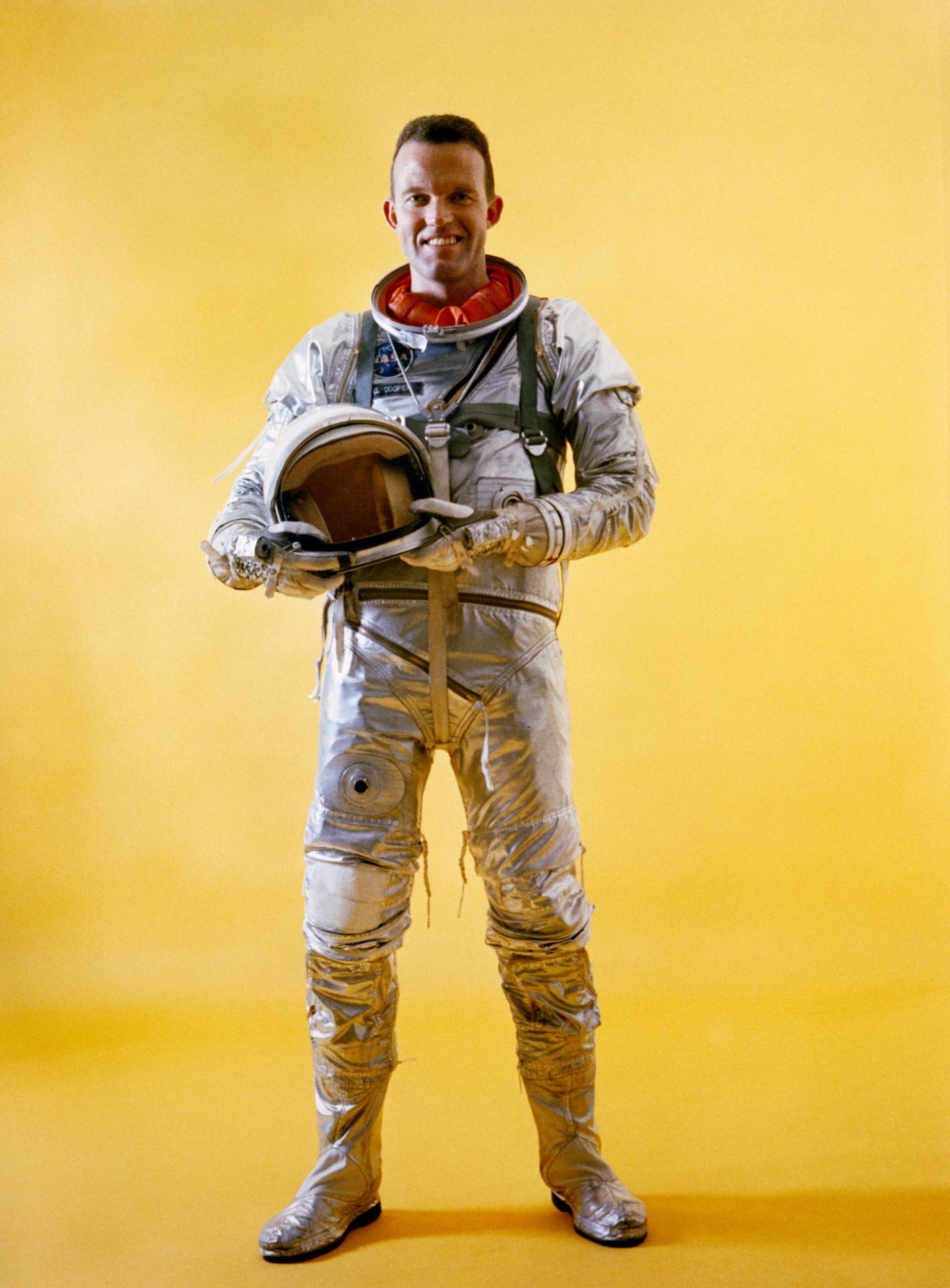 S63-01755 (May 1963) — Full-length portrait of Mercury astronaut L. Gordon Cooper Jr., in spacesuit during Mercury-Atlas 9 prelaunch activities. NASACooper died Oct. 4 at his California home at the age of 77. He piloted the sixth and last flight of the Mercury program (Faith 7, in 1963) and later commanded Gemini 5, becoming the first man to make a second orbital flight. A memorial service is planned for Friday, October 15 at NASA’s Johnson Space Center in Houston, Tex.
“Gordo was one of the most straightforward people I have ever known. What you saw was what you got,” said fellow Mercury astronaut and former U.S. Senator John Glenn, in a statement released by the Astronaut Scholarship Foundation.
Another of the “Original Seven,” Wally Schirra added, “We seven were bonded like brothers, maybe even closer if that’s possible.”
Other veterans of that groundbreaking era of exploration recalled Cooper’s “can-do” spirit.
“He never said ‘you can’t do it.’ He was gung ho on everything,” said Norris Gray, the NASA Fire Chief and Emergency Preparedness Officier during the Mercury days. Sam Beddingfield, then Mechanical Engineer for Project Mercury added, “He knew what he was doing and could always make things work.”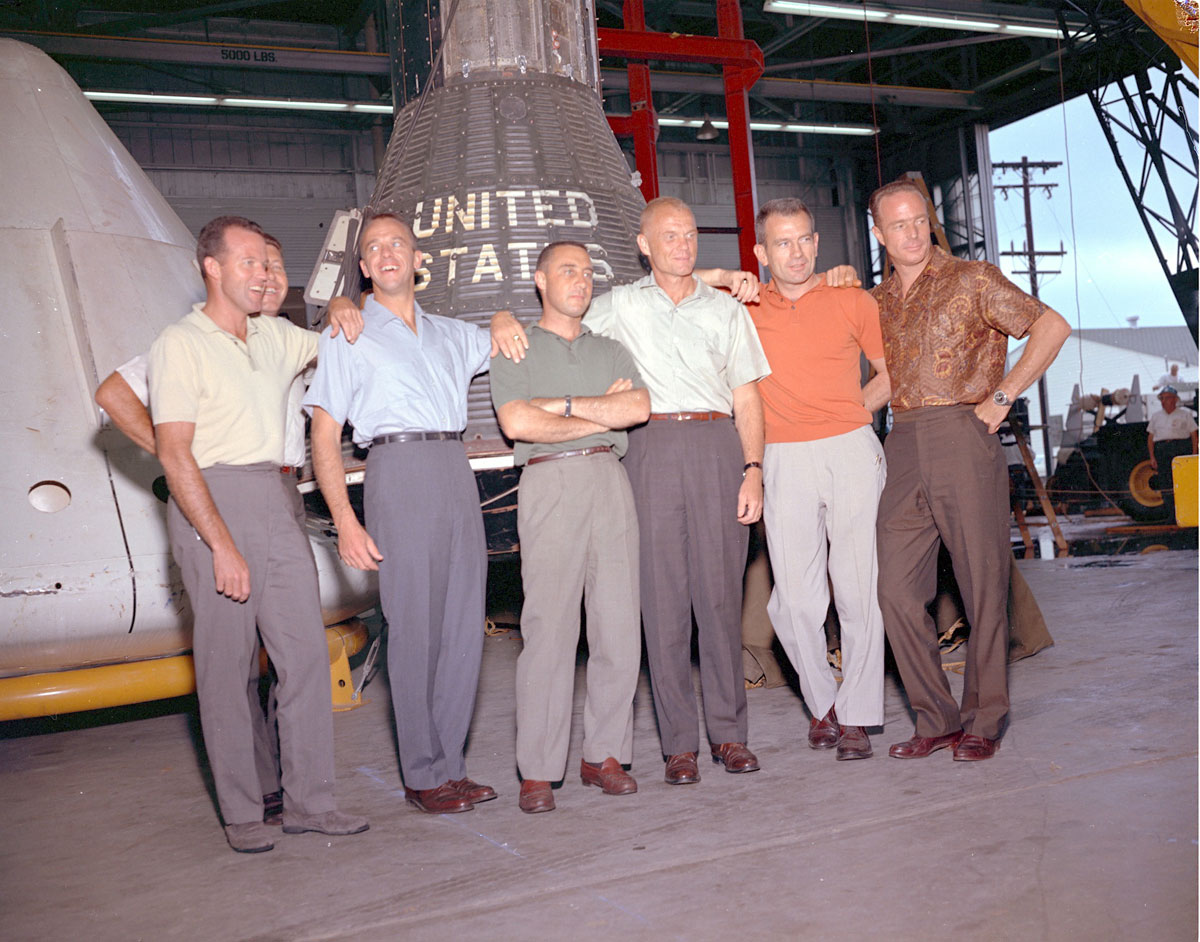 Cooper with his fellow Mercury astronauts in Houston, in a 1963 photo. From left: Cooper, Wally Schirra (partially obscured), Alan Shepard, Gus Grissom, John Glenn, “Deke” Slayton and Scott Carpenter. NASA
“Gordo was his own wonderful guy,” said Dr. Christopher C. Kraft, flight director in the Mercury days. Kraft praised Cooper as “an excellent test pilot,” but also remembered his lighter side.
“Walt {Williams, then head of flight operations} and I were in his office at the Cape one Sunday afternoon,” said Kraft. “We were talking with each other, and a sudden roar came upon us. The roar was a jet airplane diving onto the Cape at a very high rate of speed, which was forbidden. We looked out the window to see none other than Gordo and his F-101.”
Legendary Flight Director Gene Kranz, assistant flight director on Mercury, also recalled Cooper’s mischievous nature in his book, “Failure Is Not an Option.”
"After a joyful cry of 'Eeeeee hah,' he turned and offered his hand, saying, 'Hi, I'm Gordo Cooper.' I had just met my first Mercury astronaut." — Gene Kranz, former NASA flight director, in his book "Failure Is Not an Option"Gene Kranz Former NASA Flight Director
Kranz describes arriving in Florida to report to work for the first time at Mercury Control on Cape Canaveral. “After the plane rolled to a stop … a shiny new Chevrolet convertible wheeled to a halt just beyond the wingtip. An Air Force enlisted man popped out, saluted, and held open the car’s door for a curly-haired guy in civilian clothes, a fellow passenger who deplaned ahead of me,” writes Kranz.
The curly-haired man offered Kranz a ride to the Cape, and he hopped in. “After clearing the plane,” Kranz writes, “he peeled into a 180-degree turn and raced along the ramp for 100 yards, my neck snapping back as he floored the Chevy. I had never driven this fast on a military base in my life. I was thinking I had hitched a ride with a madman, or at least someone who apparently had no concern about being pulled over the Air Police for speeding and breaking every regulation in the book.”
Kranz continues: “Hitting the highway, he made a wide turn and a hard left, burning rubber. In no time, he had the needle quivering between eighty and ninety miles an hour. After a joyful cry of ‘Eeeeee hah,’ he turned and offered his hand, saying, ‘Hi, I’m Gordo Cooper.’ I had just met my first Mercury astronaut.
“I thought of that handshake often in the many years that followed. Mercury worked because of the raw courage of a handful of men like Cooper, who sat in heavy metal eggcups jammed on the top of rockets, and trusted those of us on the ground.”
The best way to sum up ‘Gordo’ may be with his own words, spoken in his 70s, when he was still designing and testing aircraft: “I get cranky if I don’t fly at least three times a month.”L. Gordon Cooper Image Gallery
https://www.nasa.gov/gallery/l-gordon-cooper/Reporting by Amiko Nevills
NASA Johnson Space Center
Originally published Oct. 6, 2004
https://www.nasa.gov/humans-in-space/astronauts/former-astronauts/remembering-gordo/Dick Gordon, orbiting the Moon in Apollo 12's CSM "Yankee Clipper", set a solo spaceflight record OTD 1969. His 37h 42+m isolation surpassed Gordo Cooper's 30h 20+m 1963 record aboard "Faith 7." Gordon's record was later surpassed by Apollo 14's Stu Roosa's 39h 45+m in Feb 1971.
https://twitter.com/aisoffice/status/1859557266174697499Mercury astronaut Gordon Cooper diesOctober 4, 2004 — The "best pilot you ever saw" is no longer to be seen.
Gordon "Gordo" Cooper, 77, the last American to launch alone to orbit the Earth, died on Monday morning (Oct. 4) at his home in Ventura, California, from cardiac arrest.
Cooper was selected by NASA in 1959 to be one of the original seven Mercury astronauts. On May 15-16, 1963, he piloted his Faith 7 capsule on the sixth and final flight of Project Mercury. Cooper tested the one-seater craft to its limits on a 22-orbit, 34-hour flight. Electrical problems near the end of the mission meant he had to manually fire his retrorockets and steer the capsule through re-entry. (...)
http://www.collectspace.com/news/news-100404a-mercury-astronaut-gordon-cooper-dies.htmlGordon Cooper, Astronaut, Is Dead at 77By Matthew L. Wald Oct. 5, 2004
Correction Appended
WASHINGTON, Oct. 4 - Gordon Cooper, the astronaut who flew the last of the pioneering Mercury space missions and stayed aloft in a Gemini capsule long enough to demonstrate that a trip to the moon was feasible, died Monday at his home in Ventura, Calif., NASA said. He was 77.
He died of natural causes, Mitch Breese of the Ventura County medical examiner's office, was quoted by The Associated Press as saying.
Mr. Cooper was the last Mercury astronaut and thus the last American astronaut to fly alone in space. His mission, in his Faith 7 capsule, from May 15 to 16 in 1963, covered 34 hours, 20 minutes, more than all five of the previous Mercury shots combined.
His second, and last, trip into space was on Gemini 5, a two-man, eight-day mission in August 1965 that set a space endurance record, just short of 191 hours.
In an era ripe with firsts, he was reported to be the first American to sleep in space -- seven and a half hours, dreamlessly, he reported -- and the first to fly twice. He was also the first American televised from space.
He was raring to go long before his launching. Visiting the factory where the booster rocket for his mission was being built, he attached a NASA seal to its side, drew an arrow pointing up and wrote, "Launch This Way!"
In orbit, he radioed back in his Oklahoma twang, "Boy, this is wonderful."
"Boy, oh, boy. It looks that pretty. Boy, oh, boy."
Toward the end of his Mercury mission, the automatic system that was supposed to control his descent failed, and he had to take control manually. When Mr. Cooper, then an Air Force major, was asked by flight controllers if he was in position for firing his retrorockets, he replied, "right on the old bazoo." He was hailed for making a bull's-eye landing, 7,000 yards from a waiting aircraft carrier.
Among other achievements of that flight, Mr. Cooper reported using a handkerchief to chase down droplets of water floating around in the zero-gravity environment and obscuring the view of his instruments.
The Gemini mission made Mr. Cooper the world record-holder for time in space, at 222 hours, though for a time it appeared that it would have to be brought down early because of a problem with an experimental device to produce electrical power, a fuel cell.
Astronauts now live in space for months at a time, but in the 1960's, no one was certain how long they could survive in a weightless environment.
"He truly portrayed the right stuff," Sean O'Keefe, the NASA administrator, said in a statement on Monday, recalling the Tom Wolfe book that recounted the history of the Mercury program. Mr. Cooper "helped gain the backing and enthusiasm of the American public, so critical for the spirit of exploration," Mr. O'Keefe said.
Mr. Cooper's death leaves three of the original seven astronauts still living, John H. Glenn Jr., the former senator from Ohio; Walter M. Schirra Jr.; and M. Scott Carpenter. Another, Virgil I. Grissom, known as Gus, was one of three astronauts killed in a fire inside an Apollo capsule on the launching pad. Donald K. Slayton, known as Deke, and Alan B. Shepard Jr. died of natural causes.
Mr. Cooper said he first took the controls of an airplane at age 7 or 8, when his father, an Army colonel, took him up. He was selected for the astronaut corps in April 1959, at 32 the youngest of the astronauts.
Leroy Gordon Cooper Jr. was born on March 6, 1927, in Shawnee, Okla. He completed three years at the University of Hawaii and received an Army commission; he later transferred to the Air Force and went on active duty in 1949. He flew F-84's and F-86's. In 1956, he received a bachelor of science degree in aeronautical engineering from the Air Force Institute of Technology. Later, he flight-tested experimental fighter aircraft at Edwards Air Force Base in California.
But his career was limited. In an August 2000 interview on CNN, he said he had not been chosen as a prime crew member for an Apollo mission because of "a lot of in-house politics." He did serve as an understudy on one mission.
Mr. Cooper appeared on television as part of a book tour for his memoir "Leap of Faith: An Astronaut's Journey into the Unknown" (HarperCollins, 2000). In it, Mr. Cooper described encounters he said he had had with unidentified flying objects in his days as a test pilot and stated his belief in extraterrestrial intelligence.
Mr. Cooper retired from the Air Force in 1970 as a colonel. Beginning before his retirement, he was the president of a company that built and distributed marine engines and fiberglass boats and another that tested and raced championship cars at Indianapolis and other tracks and pioneered the installation of jet engines on cars, according to his NASA biography.
He was part owner of a boat racing team and was a consultant to General Motors, Ford and Chrysler on automotive components.
Mr. Cooper's first marriage was to Trudy B. Olson. According to a NASA biography of Mr. Cooper prepared for the 40th anniversary of his Gemini flight, last year, that marriage ended in divorce, and he married Suzan Taylor in 1972. A NASA spokeswoman said last night that Mr. Cooper was survived by his wife but that she had no further information on survivors. The biography of a year ago lists four daughters: Camala Keoki Thorpe and Janita Lee Stone from his first marriage, and Elisabeth Jo and Colleen Taylor Cooper from his second.
Correction: October 6, 2004, Wednesday An obituary of the astronaut Gordon Cooper yesterday credited him erroneously with two breakthroughs. He was not the first American to fly into space twice; that was Virgil I. Grissom. Nor was he the last American astronaut to fly alone in space; in the last week, Michael W. Melvill and Brian Binnie flew solo in SpaceShipOne, the privately financed rocket and glider. A picture caption about the seven original Mercury astronauts carried an erroneous date. The time was 1961, not 1971. In some copies, the article included a NASA biography's misspelling of his wife's given name. She is Suzan, not Susan.
Correction: October 6, 2004, Wednesday An obituary of the astronaut Gordon Cooper yesterday credited him erroneously with two breakthroughs. He was not the first American to fly into space twice; that was Virgil I. Grissom. Nor was he the last American astronaut to fly alone in space; in the last week, Michael W. Melvill and Brian Binnie flew solo in SpaceShipOne, the privately financed rocket and glider. A picture caption about the seven original Mercury astronauts carried an erroneous date. The time was 1961, not 1971. In some copies, the article included a NASA biography's misspelling of his wife's given name. She is Suzan, not Susan.https://www.nytimes.com/2004/10/05/obituaries/gordon-cooper-astronaut-is-dead-at-77.htmlhttps://www.goodreads.com/book/show/723354.Leap_of_Faith
 Wątek: Leroy Gordon Cooper, Jr. (1927-2004) (Przeczytany 1030 razy)