Jeszcze pozostało 5 sekund świetlnych do osiągnięcia przez Voyagera 1 odległości 1. dnia świetlnego od Ziemi, co powinno nastąpić 18.11.2026 o 10:16:07 UTC (11:16:07 CET).
NASA wants you to 'shine bright' today for Voyager 1's light-day milestone. Here's howBy Samantha Mathewson Published 2 hours ago
(...) To celebrate the spacecraft, participants can use a flashlight, phone, bike light or other portable light source to send the signal skyward. And don't fret if you're unfamiliar with Morse code: NASA has created an automated flasher that can be opened in a smartphone or tablet browser to display the VGR sequence. (...)
https://www.space.com/space-exploration/voyager/nasa-wants-you-to-shine-bright-today-for-voyager-1s-light-day-milestone-heres-howWhat Voyager Teaches Us From One Light-Day AwayNASA's Curious Universe Season 14 Episode 2 Nov 17, 2026

(...) The Voyagers detected lightning on Jupiter, the first time scientists had seen lightning on another planet. (...)
JACOB: After Neptune, the Voyagers would never again pass close enough to an object for their cameras to be useful. Mission managers decided to turn the cameras off to save resources for other science instruments. But before the Voyagers closed their eyes, Voyager 2 took one last look back toward us. It captured an image called the family portrait. We see six planets as they circle the Sun, including Earth.
CARL SAGAN: And you can see it. This is—it looks like more than a dot, but it is in fact less than a pixel.
JACOB: In 1990, the astronomer Carl Sagan unveiled Voyager 2’s perspective of our home planet. Sagan stood on stage with the project scientist who led the Voyager science team—a man named Ed Stone. Together they revealed our home, seen from about 4 billion miles away.
SAGAN: In this color picture you can see that it is slightly blue. And, uh, this is where we live—on a blue dot. (...)
https://www.nasa.gov/podcasts/curious-universe/voyager-one-light-day/NASA’s Voyager 1 Makes History Reaching One Light-Day From EarthJessica Taveau Nov 19, 2026 RELEASE 26-098
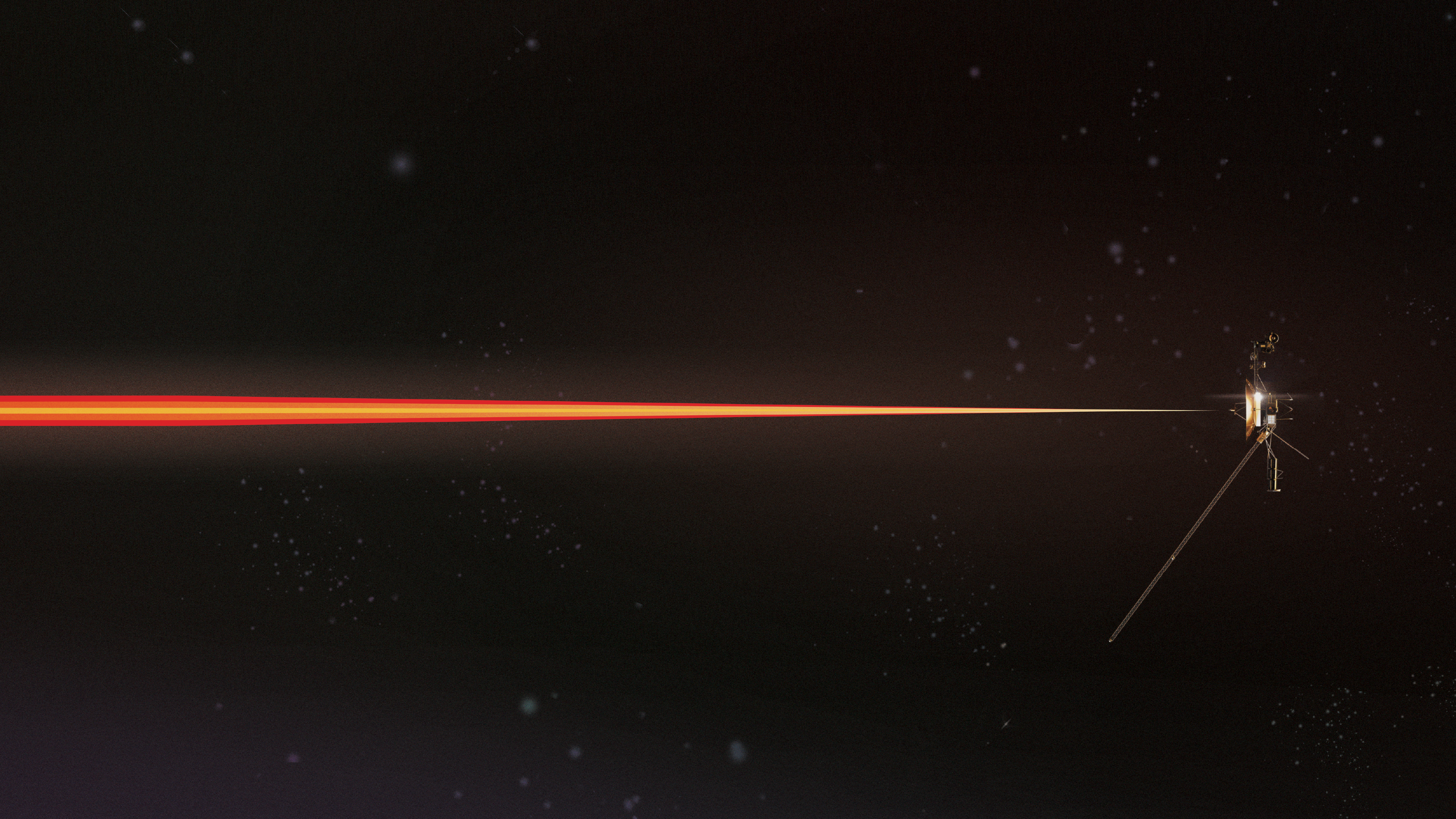 Voyager 1, depicted in this artist’s concept, reached one light-day from Earth on Nov. 18, 2026.
Credit: NASA/JPL-CaltechNASA’s Voyager 1 probe, humanity’s farthest-flying spacecraft, has reached one light-day from Earth, after more than 49 years of constant travel. A light-day is the distance light travels in 24 hours, equaling about 16.1 billion miles (25.9 billion kilometers). The spacecraft achieved the milestone at 2:16 a.m. PST (5:16 a.m. EST) Nov. 18.
Voyager team members at NASA’s Jet Propulsion Laboratory in Southern California, managed by Caltech, heard from the probe 24 hours later, the time it took for the spacecraft’s radio signal traveling at the speed of light to reach Earth, early Thursday.
“Traveling a light-day is a singular feat for a spacecraft, but Voyager is so much more than a distant traveler. The Voyager mission would be remarkable just for what it contributed to planetary science with the Grand Tour of the outer planets,” said Joe Westlake, director, Heliophysics Division at NASA Headquarters in Washington. “But it went on to become central to NASA’s fleet of heliophysics missions offering insights into the star that we all revolve around, the Sun.” (...)
https://www.nasa.gov/news-release/nasas-voyager-1-makes-history-reaching-one-light-day-from-earth/ Wątek: Dane z odległych sond Voyager-1 i Voyager-2 (Przeczytany 239 razy)