Apollo-Soyuz: An Orbital Partnership BeginsJuly 10, 2015
(...)
'Hello, Darlin'On July 17, 1975, the five explorers and the two craft -launched two days before - approached each other for docking. As Stafford guided the Apollo forward, Soyuz commander Leonov quipped "Tom, please don't forget about your engine." Just after noon on the East Coast in the U.S., with a live TV audience watching, the two craft finally met. "Soyuz and Apollo are shaking hands now."
A few hours later it was the crew members who were literally shaking hands, exchanging hugs and ceremonial gifts, including U.S., Soviet and United Nations flags, commemorative plaques, medallions, certificates and tree seeds.
The crews received a congratulatory message from Soviet premier Leonid Brezhnev and a phone call from U.S. President Gerald Ford, who joked with astronaut Slayton about being the "world's oldest space rookie."
The 51-year old Slayton had been one of the "Original Seven" Mercury astronauts, but was grounded due to a heart condition. Finally cleared to fly on Apollo-Soyuz, Slayton reported, "it's been a great experience. I don't think there's any way anybody can express how beautiful it is up here."
https://www.youtube.com/watch?time_continue=522&v=hM25uYAQWeoApollo Commander Stafford had another unique cultural exchange for the cosmonauts. He'd gotten country music star Conway Twitty to record "Privet Radost," a Russian version of his hit "Hello, Darlin'." About an hour before the two craft undocked, the song was played from orbit and heard all over the world. Mission Control quipped that it "sounded like it was from far Western Oklahoma, around Kiev."
The Apollo crew returned to Earth on July 19, their Russian counterparts two days later. It would be two decades until the countries teamed up again with the Shuttle-Mir program, but the seed was planted. As Brand said, "I really believe that we were sort of an example … to the countries. We were a little of a spark or a foot in the door that started better communications."
https://www.nasa.gov/topics/history/features/astp.htmlApollo–Soyuz: A cold war handshake in space, 40 years onApollo–Soyuz: A cold war handshake in space, 40 years onBy Mick O'Hare 17 July 2015
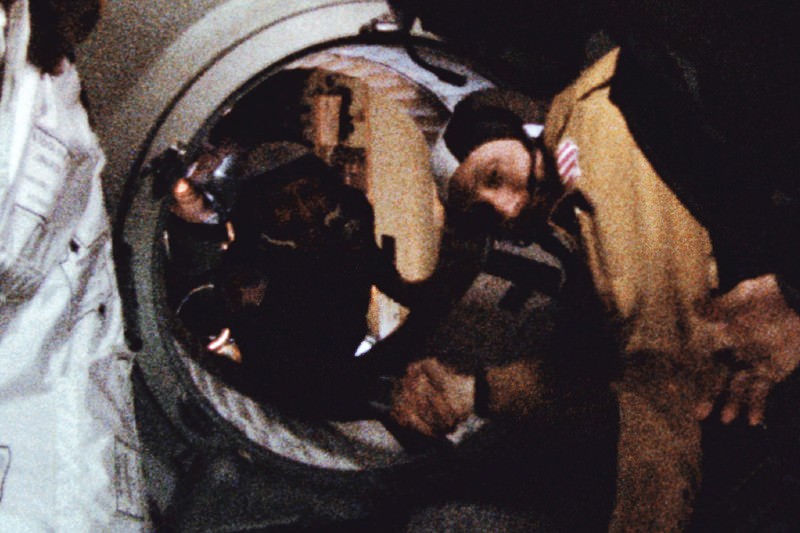
One small handshake, one giant leap for future space collaboration, as things turned out (Image: NASA)
Everybody knows the space race was driven by cold war politics: without the Soviet Union and the US battling to outmanoeuvre each other, we wouldn’t have had Sputnik, Vostok or Apollo. But amid all the rhetoric and duplicity, the Apollo-Soyuz Test Project – a mission now almost forgotten – was able to unite the two space programmes via a brief window that opened in a wall of implacable ideological mistrust.
Today is the 40th anniversary of a key moment in the project, when capsules from both superpowers docked in orbit and their crews shook hands, exchanged gifts and then conducted experiments jointly. One of these involved positioning one spacecraft in the line with the sun to create a fake eclipse so they could take photos of the solar corona.
The project, which became known as “the handshake in space”, had seemed unachievable only a few years earlier during the Cuban missile crisis. How did it get off the ground?
“Both nations had lost astronauts and cosmonauts,” says Cathy Lewis, historian of international space programs at the Smithsonian National Air and Space Museum in Washington DC, and the curator of its Apollo-Soyuz permanent exhibit, Space Race. “The death of the crew of Soyuz 11 returning from the Salyut 1 space station in 1971 prompted a consensus that both sides required some sort of rescue feasibility.”
DetenteThe idea originated at the UN and received a boost after 1971, when US president Richard Nixon and later his secretary of state Henry Kissinger were looking for projects to build the detente between the two countries. Two crews were selected: the Americans under the command of Thomas P. Stafford, the Russians under Alexei Leonov.
There were obstacles, especially with the proxy war in Vietnam still under way. “Both administrations were entirely mistrustful, with cold warriors on both sides,” says Lewis. “Even the civilian aerospace engineers grew up in a climate of mistrust. But once assigned to Apollo-Soyuz, being engineers, they found they spoke the same languages in many ways.”
There were practical challenges, too. Both sides had less than two decades of experience in space flight, and docking two spacecraft was difficult. Apollo used a pure oxygen atmosphere, whereas Soyuz used standard air. The crews couldn’t move between the two without a period of adjustment.
The solution was something called the androgynous docking adapter. “The adapter was essentially an airlock that would allow the crews to transition from the two atmospheres. And it was supposed to be built jointly,” says Lewis.
But it proved impossible for both sides to work on it simultaneously: they were too far apart geographically and pre-internet communications were too time-consuming. The adapter ended up being built in the US.
Lessons for todayIs there anything the mission can teach us given that relations between the US, European Union, and Russia still have flashpoints?
“Yes,” says Lewis. “There is the pragmatic point that this engineering feat became the basis on which, years down the line, all the signatories knew they could build the International Space Station. If you can do this simple project you can do the more advanced things.
“People from different ideologies worked side by side. It led, perhaps, to more openness. This was the first Soyuz launch televised live and announced in advance.”
The relationships between cosmonauts, astronauts and engineers have endured. At Mission Control in Korolyov, near Moscow, the room where they hosted their American counterparts is preserved as shrine to Apollo-Soyuz. Stafford and Leonov remain friends, and Leonov is godfather to Stafford’s two youngest children.
In fact, there is such respect between the two groups of former cold war enemies that, although a version of the Soyuz spacecraft has been displayed in Washington DC since 1976 as part of the Apollo-Soyuz exhibit, nobody at the museum has ever been inside it.
“Technically it is on loan so we’re not free to do that,” says Lewis. “It is a bit like breaking into somebody’s sarcophagus, or climbing on their artwork. We wouldn’t do it.”
https://www.newscientist.com/article/dn27910-apollosoyuz-a-cold-war-handshake-in-space-40-years-on/Soyuz Is Mainstay Of Soviet ProgramBy Theodore Shabad July 15, 1975
The Soyuz spacecraft that is to be launched today is a modernized version of a standard orbital vehicle that has been the mainstay of the Soviet Union's manned space program since 1967.
Unlike the more elaborate Apollo, which was planned for trips to the moon, the Soyuz, whose name means “union”, was designed strictly to take men into orbit around the earth and back again.
This limited purpose has enabled the Soviet Union to produce a relatively simple manned space vehicle at low cost, a key factor in a space exploration effort that is presumably beset with funding and budget problems in the Soviet Union as it is in the United States.
Commenting on the Russians' simple design of the Soyuz, Brig. Gen. Thomas P. Stafford, the Apollo commander in the joint mission, said:
“They can build it very cheaply, they can test it and check it out very cheaply. They can turn 'em out like hotcakes.”
Another fundamental difference between the two spacecraft reflects different philosophic approaches. In the Apollo, designed for space travel at great distances from the earth, the men on board are basically in control, and tell their machines when and where to go.
The Soyuz Is controlled almost entirely from the ground, leaving relatively little initiative to the men aboard. The Soviet astronaut is, in effect. more a passenger than a captain of his ship.
Commenting on this aspect of the Soviet spaceship, Eugene A. Cernan, an American astronaut who has worked in the Soyuz and who commanded the last Apollo moon flight, said:
“To a pilot, someone like me who has been brought up on the philosophy of being part of what's going on and being able to make my own decisions, it's depressing in a way. I don't mean it critically, it's just fact of life.”
The 23‐foot‐long Soviet craft consists of three sections: an orbital module at the forward end; a descent module in midsection, and a service module, with rocket engine, propellant, electric ower and communications systems, in the rear.
The oval‐shaped orbital module, seven feet in diameter and nine feet lang, is used by the crew for work and rest in orbit as well as for scientific experiments. It is connected by a Thatch to the more conically configured descent module, which has the main controls and crew couches and is used during launching and descent. In orbit, power‐producing solar panels deploy to a total wing spread of nearly 28 feet.
Before re ‐ entry into the earth's atmosphere, the descent module jettisons the upper orbital section and the lower service module, exposing the heat shield that protects the crew against the high temperatures generated during return to the earth.
Lands on the Ground
Unlike the Apollo, which splashes down at sea, the Soyuz has been designed to come down on land. It deploys parachute to slow descent and, about eight feet from the ground, fires retro rockets to insure a soft landing.
In view of the different approaches used in the Soviet and American programs since their beginnings in the late nineteen‐fifties, a number of space systems had to be made compatible for the Apollo‐Soyuz project. In the case of the Soyuz, they required modifications of rendezvous and docking systems, cabin atmosphere and communications.
One of the biggest problems was posed by the difference in atmospheres traditionally used on Soviet and American spacecraft. Apollo's orbital atmosphere is pure oxygen at five pounds per square inch, or one–third the earth's atmospheric pressure at sea level, while the Soyuz has been using a normal terrestrial pressure and air mix of one–fifth oxygen and four–fifths nitrogen.
The differences in cabin atmospheres required designing, a docking module, or air lock, carried by Arollo in which crew members become habituated to the other draft's atmosphere during visits.
However, to speed the transfer process, the difference in spacecraft atmospheres has been reduced by lowering the Soyuz air pressure to two– thirds of normal atmospheric pressure and doubling its oxygen content to 40 per cent.
Konstantin D. Bushuyev, the technical director of the ApolloSoyuz project on the Soviet side, has urged the United States to use ordinary air in future spacecraft to facilitate joint experiments, and such an atmosphere will in fact be used in the space shuttle, now under development.
In modifying its rendezvous technique, the Soyuz adopted radar and optical systems used by Apollo, including blinking lights for operations on the dark side of the earth. A compatible docking assembly was jointly designed by American and Soviet engineers for the link‐up between Soyuz and the docking module carried by Apollo.
Communications frequencies used by the Americans were added to the Soyuz as systems to insure voice links both between the two spacecraft and between Soyuz and American ground stations in addition to its regular television, data and voice links to the Soviet control center.
The development of the Soyuz as a multipurpose manned spacecraft followed after the first two types of Soviet manned craft — the Vostok (East), which placed Yuri A. Gagarin in orbit in 1961, and the Voskhod (Sunrise), which carried the first three‐man crew in 1964 and provided the first space walk the following year.
The Soyuz, in contrast to the previous ships, was designed to dock with other spacecraft and to remain in orbit up to a month with as many as three astronauts.
After initial testing of the new craft as part of the unmanned Cosmos series, Soyuz I was launched in April, 1967, with Vladimir M. Komarov aboard. The flight ended tragically when the parachute lines became twisted in the final phase of recovery and the craft fell to earth.
But the ship was perfected and, from 1968 to 1971, performed a continuous series of experiments. In January, 1969, Soyuz 4 and Soyuz 5 linked up in orbit, thus demonstrating the creation of a primitive orbital station. Crew members could move from one Soyuz to another, although they did so by crawling around outside rather than through a hatch between the two craft.
In October, 1969, the Soviet Union launched three ships on successive days with a total of seven astronauts in what was described as the first group flight. And the following June. a two‐man crew set what was then a duration record of nearly 18 days in orbit.
Finally, in 1971, a three‐man crew aboard Soyuz 11 docked with an orbital station, Salyut 1, which had been launched into orbit previously, forming a combination about 60 feet long and weighing 25 tons. The astronauts stayed aboard for a new record of nearly 24 days. But on riding their ferry craft back to earth in shirtsleeves, they were killed by sudden depressurization because of an air leak.
Slowdown Followed Tragedy
This new tragedy caused a noticeable slowdown in Soviet space activity. For safety. Soviet astronauts were henceforth required to wear spacesuits during launching and descent, reducing the seating capacity in the cramped Soyuz craft from three to two. Re‐design of the Soyuz took more than two years, and after unmanned tests, it flew again in September, 1973, with a two‐man crew.
After two unmanned Cosmos flights that tested Soyuz modifications for the joint mission were checked out last December by a two‐man crew aboard Soyuz 16. The two astronauts. Col. Anatoly V, Filipchenko and Nikolai N. Rukavishnikov, made up the first back‐up crew for the joint mission.
Soyuz 16 simulated the entire 142‐hour flight programmed for the Soviet side in the joint project, testing the new docking mechanism and automatic systems to be used during the Apollo‐Soyuz link‐up. The new oxygen‐enriched cabin atmosphere was tested, and American ground stations joined in a tracking exercise.
Mr. Bushuyev, the Soviet project leader, pronounced the test flight a success, and said the entire package of new systems had been checked out for the Soviet‐American mission.https://www.nytimes.com/1975/07/15/archives/soyuz-is-mainstay-of-soviet-program.htmlRussians Are ConfidentBy Christopher S. Wren Special to The New York Times July 15, 1975
MOSCOW, July 14—Top officials of the Soviet Soyuz space program confidently asserted today that they were ready to loft a two‐man crew into orbit tomorrow on a historic space rendezvous with an American Apollo spaceship.
“Everything I have said suggests that the Soyuz spacecraft will be fully ready for launching,” the Soviet deputy project director, Vladimir A. Timchenko, told Soviet and foreign newsmen as he ran through a list of preparations
“We have every reason to be confident that the flight control will be successful,” reported Aleksei S. Yeliseyev, the Soyuz mission flight director.
Meanwhile, preparations for the joint mission dominated the news today in the Soviet press. For the first time the Soviet Union was publicizing a space shot in advance and the curious Russians were thus being treated to an unusual look at their space program [Page 22.]
As Mr. Timchenko spoke at. the mission press center in a downtown Moscow hotel, 1,400 miles to the southeast two Soyuz spaceships, one of them in reserve, waited atop their launching rockets on the desert launching pad at the Baikonur cosmodrome in Soviet Central Asia.
The astronauts of the Soyuz prime crew, Col. Aleksei A. Leonov and Valeriy N. Kubasov, talked at Baikonur with a group of selected Soviet journalists from behind a glass partition put up on doctors' instructions to protect the astronauts from possible infection.
“Our flight must prove useful not only for our two countries, the U.S.S.R. and the U.S.A., but also for all those who will go into space in the future,” said Colonel Leonov.
This afternoon, the first shift of Soviet technicians began around‐the‐clock staffing of the Soyuz mission control center as the launching countdown advanced. Seven American space technicians from the National Aeronautics and Space Administration also began to work at teh center, which is at Kaliningrad, a suburban town just north of Moscow.
The blast‐off of the spaceship, which is to be designated as Soyuz 19, is scheduled for 3:20 P.M. Moscow time (8:20 A.M. Eastern daylight.) Seven and a half hours later the Apollo ship will be launched from Cape Canaveral, Fla. The flight plan calls for the two ships to meet and dock on Thursday during the Soyuz craft's 36th orbit in space. The Soyuz will return to earth Monday.
Soviet weather forecaster expect the desert temperatures at Baikonur, which have been climbing to well over 100 degrees Farenheit, to ease to about 80 degrees at launching time.
The only Americans being invited to watch the Soyuz blast‐off at Baikonur are the American ambassador to Moscow, Walter J. Stoessel Jr., and his wife. American correspondents here have been refused permission on the ground that the original Soviet‐American agreement did not provide for their presence.
Today, the Soyuz commander, Colonel Leonov, and his flight engineer. Mr. Kubasov, made the traditional preflight pilgrimage to the Baikonur lodgings of the late pioneer astronaut, Yuri Gagarin, and the late space scientist, Sergei P. Korolev.
Colonel Leonov also chatted by telephone with the American Apollo commander, Brig. Gen. Thomas P. Stafford.
“We were gladdened by this call,” Colonel Leonov told the Soviet journalists afterwards, according to the press agency Tass. “I could sense from my conversation with the Apollo commander that his crew, just as ours, is looking forward to the launch and to a rendezvous in orbit.”
At the Moscow press center today,. Mr. Yeliseyev said that the second Soyuz craft, being held in reserve in case the first Soyuz malfunctioned during launching, would not be sent up to rendezvous with the Salyut space station carrying two other Soviet Astronauts.
Mr. Yeliseyev, in response to questions, said that radio communications between the space station and the docked Soyuz‐Apollo spaceships were possible. But he said that the two missions would not interfere with each other since the Apollo and Soyuz craft would be docked in orbit 137 miles above the earth while the salyut would be 217 miles above the earth. He noted that only once would the, Salyut pass directly over the docked ships.https://www.nytimes.com/1975/07/15/archives/meeting-in-space.html
 Wątek: Misja Apollo-Sojuz - 50 lat (Przeczytany 32126 razy)