Awaria podczas startu Sojuza! 11.10. o 08:40:15 z Bajkonuru wystrzelona została RN Sojuz-FG, która miała wynieść w T+8' 45" na orbitę
statek kosmiczny
Sojuz MS-10. Jego połączenie z ISS miał być wykonane o 14:44.
Podczas rozdzielenia
pierwszego i drugiego stopnia doszło do awarii i przerwania startu. Lądownik powrócił balistycznie na Ziemię
20 km na wschód od Żezkazganu, załoga jest cała i zdrowa.http://lk.astronautilus.pl/n181001.htm#06Nieudany start Sojuza MS-10 BY REDAKCJA ON 11 PAŹDZIERNIKA 2018
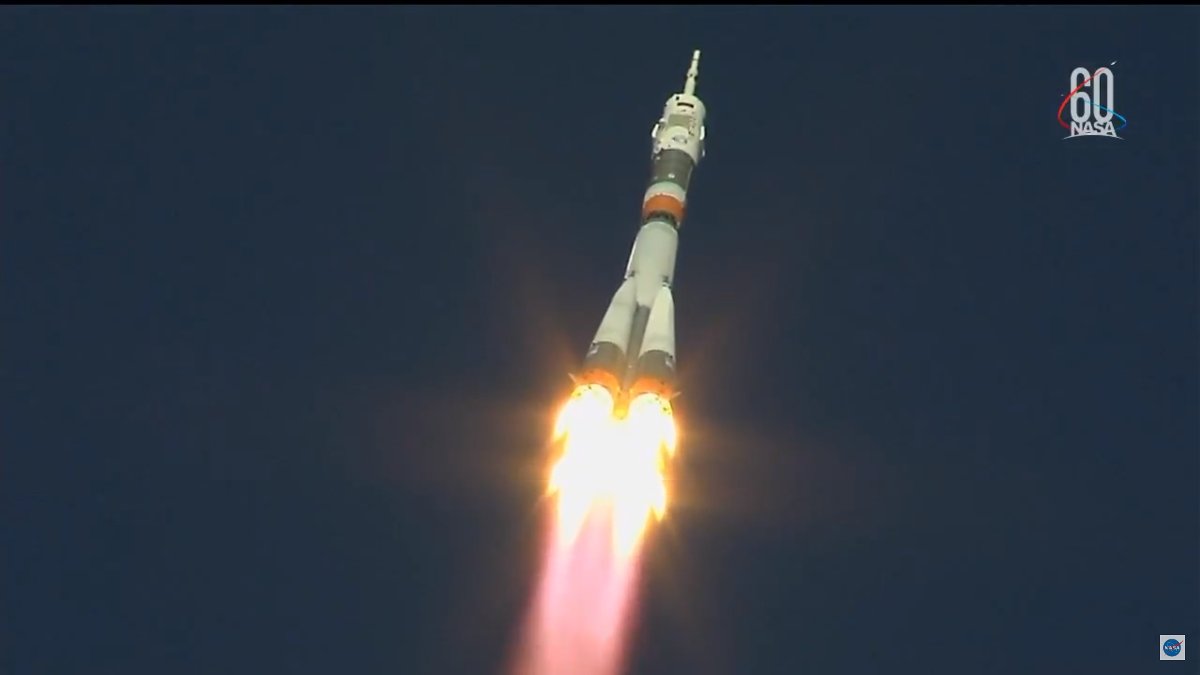 Start Sojuza MS-10 - 11.10.2018 / Credits - NASA TV
Jedenastego października doszło do nieudanego startu rakiety Sojuz z kapsułą Sojuz MS-10. W trakcie wznoszenia doszło prawdopodobnie do awarii rakiety nośnej.
Do startu Sojuza MS-10 doszło 11 października o godzinie 10:40 CEST. Start nastąpił z kosmodromu Bajkonur w Kazachstanie. Celem lotu miała być Międzynarodowa Stacja Kosmiczna (ISS). Na pokładzie Sojuza MS-10 znalazło się dwóch kosmonautów:
Aleksiej Owczynin (Rosja, 2 lot)
Tyler Hague (USA, 1 lot)
 Logo misji Sojuz MS-10 / Credits - NASA, Roskosmos
Początkowe etapy wznoszenia przebiegały prawidłowo. W trakcie separacji pierwszego i drugiego stopnia rakiety Sojuz załoga Sojuza MS-10 poinformowała o nieprawidłowym działaniu rakiety. Kosmonauci mieli odczuć “nieważkość”, a następnie poinformowali, że pojazd rotuje. Kilkadziesiąt sekund później doszło do przerwania kontaktu z kapsułą.
 Załoga Sojuza MS-10 / Credits – NASAhttps://www.youtube.com/watch?time_continue=216&v=c0l5QBmqQoI
Start Sojuza MS-10 / Credits – NASA TV
Aktualizacja – godzina 11:22 CEST – kosmonauci żyją! Po lądowaniu udało im się nawiązać kontakt z zespołem ratunkowym.
Aktualizacja – godzina 12:08 CEST – lądowanie kapsuły Sojuz MS-10 nastąpiło około 20 km na zachód od kazachskiego miasta Żezkazgan. Od miejsca startu w Bajkonurze do miejsca lądowania jest około 410 km.
Aktualizacja – godzina 12:10 CEST – ekipa ratunkowa dotarła do kapsuły. Kosmonauci są już na zewnątrz kapsuły.
Aktualizacja – godzina 13:38 CEST – śmigłowce zabierają kosmonautów. Pojawiły się (niepotwierdzone) informacje, że załoga nie była w dobrym stanie po lądowaniu. Amerykanin zostanie przetransportowany do USA bez dłuższych zatrzymań w Rosji.
Aktualizacja – godzina 13:58 CEST – pojawiły się pierwsze zdjęcia załogi Sojuza MS-10 po podjęciu przez zespół ratunkowy. Można je zobaczyć
w wątku na Polskim Forum Astronautycznym.
Ten artykuł będzie aktualizowany w miarę napływu informacji.
https://kosmonauta.net/2018/10/nieudany-start-sojuza-ms-10/#prettyPhotoSoyuz crew lands safely after emergency launch abortOctober 11, 2018 William Harwood
 A Soyuz rocket lifts off with the Soyuz MS-10 spacecraft Thursday. Credit: NASA/Bill Ingalls
(...) But two minutes and two seconds after liftoff, just a few seconds after the rocket’s four liquid-fueled strap-on boosters separated from the central core stage, something went wrong. Long-range tracking cameras showed the strap-ons and what appeared to be multiple other objects falling away from the rocket.
“Failure of the booster,” a translator called out, presumably relaying a report from Ovchinin to Russian mission control near Moscow. “Failure of the booster.” Moments later, he confirmed the Soyuz had separated from the rocket’s upper stage, saying “we are in weightlessness.”
Moments after that, as the spacecraft plunged back into the thick lower atmosphere, it rapidly decelerated, subjected the crew to nearly seven times the normal force of gravity at one point.
“We are getting ready for the G loads,” Ovchinin reported. “G load is 6.7.”
“Copy,” a Russian flight controller replied.
“We are feeling rotation, the G load is going down,” the cosmonaut reported. “G load is 2.72 and going down.”
“Tighten the straps” for landing, the flight controller called.
Air-to-ground communications with the crew were cut off shortly after that exchange, either because NASA or the Russian space agency opted to keep the loop private, because of a malfunction or because the capsule passed beyond the range of its radio system.
In any case, NASA launch commentator Brandi Dean, monitoring events from the Johnson Space Center in Houston, reported the Soyuz’s descent module landed near the town of Dzhezkazgan, a familiar staging site for normal Soyuz re-entries and landings, about 250 miles from the Baikonur Cosmodrome.
Russian recovery crews dispatched from Baikonur aboard helicopters reached Ovchinin and Hague by radio before arriving at the landing site and reported both crew members were in good shape. Photographs later were posted by the Russian space agency Roscosmos, showing both men relaxing in Dzhezkazgan, chatting with support personnel.
 Roscosmos tweeted these photos of Alexey Ovchinin and Nick Hague shortly after their emergency landing Thursday. Credit: Roscosmos
It was not immediately known what might have gone wrong with the Soyuz FG booster, but Dmitri Rogozin, director general of Roscosmos, said a State Commission would investigate the mishap, adding in a tweet “the Soyuz MS emergency rescue system worked. The crew is saved.” (...)
https://spaceflightnow.com/2018/10/11/soyuz-crew-lands-safely-after-emergency-launch-abort/Soyuz launch to ISS aborted after booster failure; crew safeby Jeff Foust — October 11, 2018
(...) In a brief presentation at the International Symposium for Personal and Commercial Spaceflight here Oct. 11, Mark Vande Hei, a NASA astronaut who returned from five and a half months on the ISS in late February, said the anomaly took place 119 seconds after liftoff, a second after first stage separation. He added the cause the the anomaly is still unknown.
The abort took place several seconds after the launch abort tower on top of rocket was jettisoned, leaving a shroud surrounding the Soyuz that has abort thrusters of its own. “Somewhere around 119 seconds, those thrusters on the shroud took the crew safely away from whatever the problem was,” he said. (...)
https://spacenews.com/breaking-soyuz-launch-to-iss-aborted-after-booster-failure/Soyuz FG fails during ascent – Soyuz MS-10 crew safe after ballistic entry abortwritten by Chris Gebhardt October 10, 2018
(...) Overall, this was the 139th Soyuz spacecraft launch and the 65th flight of a Soyuz-FG rocket, which had a 100% success rate since its introduction on 20 May 2001. That was until today. (...)
https://www.nasaspaceflight.com/2018/10/soyuz-reduced-2-crew-launch-station/Artykuły astronautyczne
 Wątek: Sojuz MS-10 (Przeczytany 85359 razy)