Autor Wątek: The Space Review  (Przeczytany 161817 razy)

0 użytkowników i 2 Gości przegląda ten wątek.

Online Orionid

  • Weteran
  • *****
  • Wiadomości: 29365
  • Very easy - Harrison Schmitt
Odp: The Space Review
« Odpowiedź #135 dnia: Grudnia 08, 2020, 07:21 »
The future of Mars exploration, from sample return to human missions
by Jeff Foust Monday, December 7, 2020


An illustration of a Mars Ascent Vehicle, containing samples collected by the Mars 2020 mission, launching into Martian orbit for later return to Earth. (credit: NASA/JPL-Caltech)

When an Atlas V lifted off from Cape Canaveral July 30, NASA heralded it as the beginning of a new era of Mars exploration. The rocket was launching NASA’s Mars 2020 mission, which will land the rover Perseverance on the surface of Mars in February. That rover will collect samples for later return to Earth, a long-running goal of scientists.
https://www.thespacereview.com/article/4086/1

Online Orionid

  • Weteran
  • *****
  • Wiadomości: 29365
  • Very easy - Harrison Schmitt
Odp: The Space Review
« Odpowiedź #136 dnia: Grudnia 15, 2020, 19:37 »
Review: How to Astronaut
by Jeff Foust Monday, December 14, 2020


How to Astronaut: An Insider’s Guide to Leaving Planet Earth
by Terry Virts
Workman Publishing Co., 2020
hardcover, 320 pp., illus.
ISBN 978-1-5235-0961-4
US$27.95
https://www.amazon.com/exec/obidos/ASIN/1523509619/spaceviews

Most astronaut memoirs describe an unconventional career in a conventional way. They often follow a chronological approach—sometimes flashing back or forward—to describe the career path that person took to becoming an astronaut, the experience of training for and flying missions, and finally how the experience changed them. A few diverge from that path, like Chris Hadfield’s An Astronaut’s Guide to Life on Earth, which used his experience to offer lessons on, as he put it, “how to live better and more happily here on Earth.” (See “Review: An Astronaut's Guide to Life on Earth”, November 18, 2013.)
https://www.thespacereview.com/article/4087/1

Online Orionid

  • Weteran
  • *****
  • Wiadomości: 29365
  • Very easy - Harrison Schmitt
Odp: The Space Review
« Odpowiedź #137 dnia: Grudnia 15, 2020, 19:37 »
More space on the ground: trendy analogues vs. an unpleasant reality
by Ilaria Cinelli Monday, December 14, 2020


Analogue missions are intended to prepare for future human missions to places like the Moon and Mars, but depending on how they are designed may not be that useful.

The astronaut job is probably the only one that is at the same time both the most wanted job in the space sector and one of the silliest expectations someone may have as a career goal. Still, it is a job! There are high hopes for upcoming human spaceflights, and the commercial astronaut job is slowly opening the door to new types of astronauts. However, such a “silly expectation” drives people to find new opportunities to become astronauts no matter what. Thus, the boom of analogue astronauts has started!
https://www.thespacereview.com/article/4088/1

Online Orionid

  • Weteran
  • *****
  • Wiadomości: 29365
  • Very easy - Harrison Schmitt
Odp: The Space Review
« Odpowiedź #138 dnia: Grudnia 15, 2020, 19:37 »
Beyond Apollo: guiding the next Moon landing
by Alan Campbell Monday, December 14, 2020


The lunar lander under development by the Blue Origin-led “National Team” that includes Draper, Lockheed Martin and Northrop Grumman. (credit: Blue Origin)

The Apollo Moon landing is familiar to many. Neil Armstrong looks out the window of the lunar module, adjusts his descent to avoid craters and boulders while keeping an eye on his dwindling fuel supply, and maneuvers to the surface for the first time. While the scene is destined to be repeated, experts agree the next Moon landing will be far different affair.
https://www.thespacereview.com/article/4089/1

Polskie Forum Astronautyczne

Odp: The Space Review
« Odpowiedź #138 dnia: Grudnia 15, 2020, 19:37 »

Online Orionid

  • Weteran
  • *****
  • Wiadomości: 29365
  • Very easy - Harrison Schmitt
Odp: The Space Review
« Odpowiedź #139 dnia: Grudnia 15, 2020, 19:37 »
Starship contradictions
by Jeff Foust Monday, December 14, 2020


SpaceX’s Starship SN8 vehicle lifts off from the company’s South Texas test site December 9. (credit: SpaceX)

Can a launch that ends in a spectacular explosion be considered a success? Can a company be hailed for being open when it is also far from transparent about its work? Can a development program be described as proceeding at breakneck speed while also being well behind schedule?
https://www.thespacereview.com/article/4090/1

Online Orionid

  • Weteran
  • *****
  • Wiadomości: 29365
  • Very easy - Harrison Schmitt
Odp: The Space Review
« Odpowiedź #140 dnia: Grudnia 15, 2020, 19:37 »
Big bird, little bird: chasing Soviet anti-ballistic missile radars in the 1960s
by Dwayne A. Day Monday, December 14, 2020


Declassified image of the MABELI signals intelligence satellite launched in January 1972 to search for and characterize Soviet anti-ballistic missile radars. MABELI was the latest in a sequence of satellites and special payloads used by the United States to try to determine the extent of the Soviet ABM program. (credit: NRO)

The second bus-sized HEXAGON photo-reconnaissance satellite roared off its California launch pad in January 1972. Inside of its payload shroud atop the Titan III rocket, the HEXAGON looked somewhat like a train locomotive, and tucked along one of its slab sides was a small rectangular box about the size of a suitcase. After the HEXAGON reached its proper orbit and stabilized itself, circling the Earth over its poles, the box detached, pushed off by springs. It started spinning, and then fired a small rocket motor that boosted its orbit a bit higher than the big bird that had delivered it into space. The small satellite began unfolding like an origami crane spreading out, deploying solar panels and numerous antennas, most of them pointed down at the Earth.
https://www.thespacereview.com/article/4091/1

Online Orionid

  • Weteran
  • *****
  • Wiadomości: 29365
  • Very easy - Harrison Schmitt
Odp: The Space Review
« Odpowiedź #141 dnia: Grudnia 23, 2020, 00:47 »
Review: Cosmic Odyssey by Jeff Foust
Monday, December 21, 2020


Cosmic Odyssey: How Intrepid Astronomers at Palomar Observatory Changed our View of the Universe
by Linda Schweizer
MIT Press, 2020
hardcover, 312 pp., illus.
ISBN 978-0-262-04429-5
US$39.95
https://www.amazon.com/exec/obidos/ASIN/0262044293/spaceviews

Asked today what is the most influential astronomical observatory, many might say the Hubble Space Telescope, or perhaps the Keck Observatory in Hawaii or the Very Large Telescope in Chile. For most of the latter half of the 20th century, though, the likely response would have been the Palomar Observatory, home to the 200-inch (five-meter) telescope that for decades was the largest in the world. It allowed astronomers to peer deeper into the universe than ever before.
https://www.thespacereview.com/article/4092/1

Online Orionid

  • Weteran
  • *****
  • Wiadomości: 29365
  • Very easy - Harrison Schmitt
Odp: The Space Review
« Odpowiedź #142 dnia: Grudnia 23, 2020, 00:47 »
Creating an inspector “mascot” satellite for JWST
by Philip Horzempa Monday, December 21, 2020


The James Webb Space Telescope recently completed the last deployment test of its sunshield before its October 2021 launch. (credit: NASA/Chris Gunn)

The James Webb Space Telescope has a heritage that stretches back at least half a century. It is a very complex spacecraft that will require numerous deployments to achieve its operational configuration. These will be monitored by instrumentation on the spacecraft, but given that each operation must proceed without error, it would be prudent to send a “Mascot” to monitor them. This would take the form of a cubesat that would ride with JWST after being launched as a secondary payload on the Ariane 5 that launches JWST. (...)
https://www.thespacereview.com/article/4093/1

Online Orionid

  • Weteran
  • *****
  • Wiadomości: 29365
  • Very easy - Harrison Schmitt
Odp: The Space Review
« Odpowiedź #143 dnia: Grudnia 23, 2020, 00:47 »
Candy CORN: analyzing the CORONA concrete crosses myth
by Joseph T. Page II Monday, December 21, 2020


Present-day Concrete Cross. Courtesy of Google Maps.

A few years ago, NPR Morning Edition released a story about spy satellites that caught my attention during a morning commute to work. Reporter Danny Hajek covered a story about mysterious 60-foot-long (18-meter-long) concrete crosses found in the Arizona desert titled, “Decades-Old Mystery Put to Rest: Why Are There X’s in the Desert?” The NPR story details how two adventurers, Chuck Penson and Pez Owen, spotted mysterious crosses while flying cross-country in Owen’s Cessna. The crosses spotted by Penson and Owen were just a handful of targets laid out over a 16-by-16-mile (26-by-26-kilometer) grid across the desert near Casa Grande, Arizona. Wondering what the crosses were for, the pair reached out to the US Army Corps of Engineers, since one of the bronze positioning markers at the center of one crosses stated “Army Map Service” with a date of 1966. According to the story, the US Army Corps of Engineers response made the connection between the concrete crosses and the CORONA program. [1]
https://www.thespacereview.com/article/4094/1

Online Orionid

  • Weteran
  • *****
  • Wiadomości: 29365
  • Very easy - Harrison Schmitt
Odp: The Space Review
« Odpowiedź #144 dnia: Grudnia 23, 2020, 00:47 »
Twilight for Trump space policy
by Jeff Foust Monday, December 21, 2020


Vice President Mike Pence speaking at the December 9 National Space Council meeting. (credit: White House)

On December 9, the National Space Council met for the eighth and last time in the Trump Administration at the Kennedy Space Center. The event, held in the Apollo/Saturn V Center there, with that rocket above attendees’ heads, was something of a season finale for the council. Cabinet secretaries and other officials spent about an hour recounting the work they had done in space policy in the last four years, from the establishment of the Space Force to commercial space regulatory reforms.
https://www.thespacereview.com/article/4095/1

Online Orionid

  • Weteran
  • *****
  • Wiadomości: 29365
  • Very easy - Harrison Schmitt
Odp: The Space Review
« Odpowiedź #145 dnia: Grudnia 23, 2020, 00:47 »
From TACSAT to JUMPSEAT: Hughes and the top secret Gyrostat satellite gamble
by Dwayne A. Day and Nicholas W. Watkins Monday, December 21, 2020
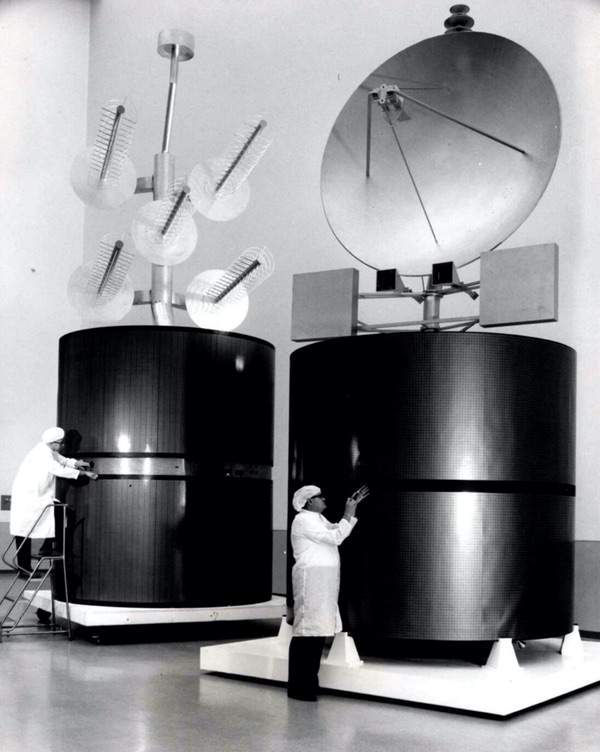

Photo of Hughes’ HS-308 TACSAT (left) in May 1968 next to their proposal for Intelsat IV based on the HS 312 bus. These are mockups. Intelsat IV had a different antenna farm at top. This basic design led to the JUMPSEAT and Satellite Data System satellites for the National Reconnaissance Office. (credit: Hughes)

Starting in August 1968, the secretive National Reconnaissance Office began launching new intelligence satellites into much higher orbits to accomplish their missions. The first was the CANYON series of communications intelligence satellites, followed in 1970 by the first of the RHYOLITE telemetry interception satellites. In spring 1971, the NRO launched a new and enigmatic satellite named JUMPSEAT, which has remained perhaps the most mysterious of these high-orbit satellites. Each of these satellites pushed the state of the art in terms of payloads, antennas, and satellite design. But JUMPSEAT represented a concerted effort by a civil and commercial satellite designer to break into the top-secret world of satellite intelligence by leveraging a new technology and a military contract to demonstrate that it could perform the mission of both detecting signals from the ground, and spotting missile launches with an infrared telescope.
https://www.thespacereview.com/article/4096/1

(Editor’s Note: The Space Review will not publish the week of December 28. Our next issue will be January 4, 2021. Happy holidays!)

Online Orionid

  • Weteran
  • *****
  • Wiadomości: 29365
  • Very easy - Harrison Schmitt
Odp: The Space Review
« Odpowiedź #146 dnia: Stycznia 07, 2021, 03:51 »
Review: Stephen Hawking: A Memoir of Friendship and Physics
by Jeff Foust Monday, January 4, 2021


Stephen Hawking: A Memoir of Friendship and Physics
by Leonard Mlodinow
Pantheon, 2020
hardcover, 240 pp.
ISBN 978-1-5247-4868-5
US$25.00
https://www.amazon.com/exec/obidos/ASIN/1524748684/spaceviews

It’s been nearly three years since Stephen Hawking passed away. At the time of his death in 2018, Hawking had been for decades one of the most famous scientists in the world, even though few people understood his research in topics such as black holes and cosmology. He was, in many respects, a cultural figure, revered for his intelligence and his achievements in spite of the physical limitations imposed by amyotrophic lateral sclerosis (ALS).
https://www.thespacereview.com/article/4097/1

Online Orionid

  • Weteran
  • *****
  • Wiadomości: 29365
  • Very easy - Harrison Schmitt
Odp: The Space Review
« Odpowiedź #147 dnia: Stycznia 07, 2021, 03:51 »
Why I’m flying to space to do research aboard Virgin Galactic
by Alan Stern Monday, January 4, 2021


SpaceShipTwo ascends to the edge of space during a December 2018 test flight. (credit: MarsScientific.com and Trumbull Studios)

[Editor’s Note: A version of this essay was first published last month by The Hill, and is republished here with permission.]

Unlike researchers in virtually every other field of science, space researchers have long been limited to operating their experiments by remote control. Why? Because for many decades it was simply not possible or not practical to send themselves into space to do their work. This forced us to routinely have to incorporate expensive and often failure-prone automation into our experiments to replace the human operator.
https://www.thespacereview.com/article/4098/1

Online Orionid

  • Weteran
  • *****
  • Wiadomości: 29365
  • Very easy - Harrison Schmitt
Odp: The Space Review
« Odpowiedź #148 dnia: Stycznia 07, 2021, 03:52 »
Catalonia’s space ambitions
by Marçal Sanmartí Monday, January 4, 2021


A few weeks after announcing the plans to launch satellites and create a space agency, Jordi Puigneró, Catalan minister of digital policies, announced the creation of a spaceport in Lleida-Alguaire Airport.

In October, the British newspaper The Guardian published an article titled “Catalonia to invest in ‘Catalan NASA’ space agency and satellites.” Many people were surprised as Catalonia is an autonomous nationality inside the kingdom of Spain, not an independent state. And it’s quite small. It measures around 32,000 square kilometres, approximately the size of the state of Maine in the US or slightly bigger than Wales in the UK. If we visit the Catalan government website and check the information provided there, we might conclude that the term “Catalan NASA” is a big exaggeration.
https://www.thespacereview.com/article/4099/1

Online Orionid

  • Weteran
  • *****
  • Wiadomości: 29365
  • Very easy - Harrison Schmitt
Odp: The Space Review
« Odpowiedź #149 dnia: Stycznia 07, 2021, 03:52 »
Can space bridge a widening partisan divide?
by Jeff Foust Monday, January 4, 2021


Congress has been able to work on space issues in a bipartisan manner in the past, but will that be possible this year? (credit: J. Foust)

Sunday marked the start of the 117th Congress, with the swearing in of members, a vote for the Speaker of the House (won, as expected, by Nancy Pelosi), and other introductory matters. A new Congress represents a clean slate, clearing out all the legislation that didn’t become law in the previous Congress.
https://www.thespacereview.com/article/4100/1

Polskie Forum Astronautyczne

Odp: The Space Review
« Odpowiedź #149 dnia: Stycznia 07, 2021, 03:52 »