Review: Flashes of Creationby Jeff Foust Monday, January 10, 2022
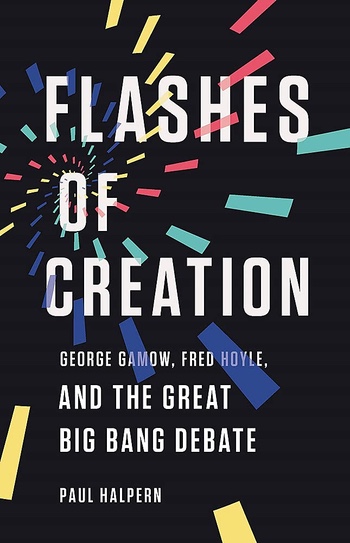
Flashes of Creation: George Gamow, Fred Hoyle, and the Great Big Bang Debate
by Paul Halpern
Basic Books, 2021
hardcover, 304 pp., illus.
ISBN 978-1-5416-7359-5
US$30
https://www.amazon.com/exec/obidos/ASIN/154167359X/spaceviewsOn Saturday, controllers completed the last of the major deployments of the James Webb Space Telescope when the second of two “wings” holding segments of its primary mirror swung into place. Months of work still lie ahead to align the telescope optics and commission the instruments, but astronomers were both relieved the deployments had gone so well and confident the telescope will fulfill its ambitious science goals. “The core science of this telescope was to see the very first light in the universe: the first galaxies that formed, perhaps even the first stars,” said Heidi Hammel, vice president for science at the Association of Universities for Research in Astronomy, during a press conference Saturday. “That’s why it was built the way it was built.”
https://www.thespacereview.com/article/4309/1Steady growth beyond the skies: five trends in outer space from 2021by Harini Madhusudan Monday, January 10, 2022
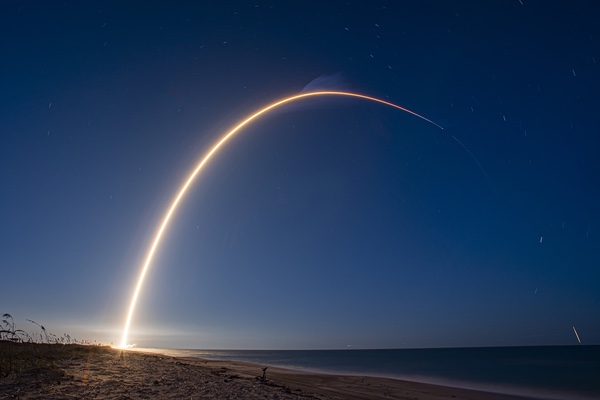 SpaceX launched 31 Falcon 9 rockets in 2021, part of a worldwide surge in orbital launch activity last year. (credit: SpaceX)
Outer space was one of the most successful domains in 2021 amidst fluctuations in politics and industry worldwide. The world observed dynamic growth in space, specifically in the participation of non-state players, while among the government players there was significant institutionalization. There were an estimated 141 orbital launches in the year with 132 successes and up to ten missions that were related to various planetary achievements. The 2020s have seen a significant increase in investment in space, and many of the missions undertaken in the past decade have come to fruition in the past two years. These achievements individually have added a lot of value and have set the ball rolling for a Space Race 2.0. This time, it includes many more contenders than the US or the former USSR, and have expanded to include major corporations competing at an unprecedented scale. What are the highlights of space activities in 2021?
https://www.thespacereview.com/article/4310/1New year, new (and overdue) rocketsby Jeff Foust Monday, January 10, 2022
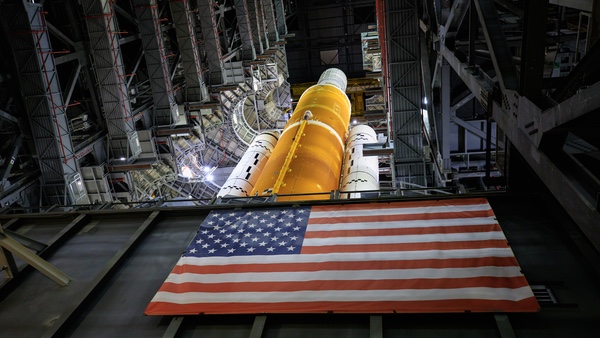 The first SLS in the Vehicle Assembly Building at the Kennedy Space Center, awaiting a first launch some time in 2022. (credit: NASA/Frank Michaux)
In a race to see which will launch first, neither the Space Launch System nor Starship appears to be winning.
Both giant launch vehicles are set to make their first launches early this year. In the case of SLS, that launch comes after years of delays that have had ripple effects on the overall Artemis program. SpaceX’s Starship had also fallen behind the aspirational schedules of its founder, Elon Musk, who in September 2019 predicted that the company would “try to reach orbit in less than six months” (see “Starships are meant to fly”, The Space Review, September 30, 2019).
https://www.thespacereview.com/article/4311/1Blacker than a very black thing: the HEXAGON reconnaissance satellite signals intelligence payloadsby Dwayne Day Monday, January 10, 2022
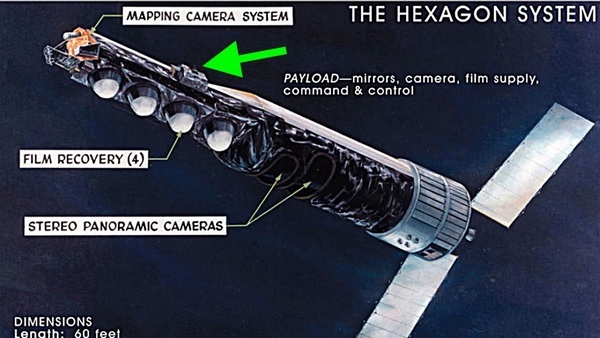 HEXAGON satellites had a large forward section that could carry deployable satellites as well as attached "pallets" used for collecting signals intelligence.
On April 18, 1986, a giant Titan 34D rocket roared off its launch pad at California’s Vandenberg Air Force Base and promptly blew itself to smithereens.
The rocket exploded only a few hundred feet above the ground, relatively close to the ocean, and rained pieces of rocket, propellant, and a top secret spy satellite all over the surrounding area. The satellite was a HEXAGON reconnaissance satellite, the last of its type, and its loss was a major blow to the American intelligence community, happening less than a year after another Titan launching from Vandenberg destroyed another reconnaissance satellite called CRYSTAL (originally KENNEN), leaving the United States with very limited reconnaissance capability.
https://www.thespacereview.com/article/4312/1
 Wątek: The Space Review (Przeczytany 183173 razy)