42/XII 2003 [65-67]65)
Some thoughts on Mars Directby David Boswell Monday, December 1, 2003
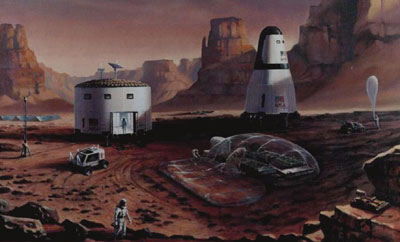 Mars Direct has emerged as the leading architecture for human missions to Mars. However, that doesn’t mean that there’s no room for improvement. (credit: Mars Society)
If one or more nations decide to go to Mars within our lifetime, I believe that they will use Robert Zubrin’s Mars Direct plan as the blueprint for the mission. His plan provides a realistic scenario for sending a crew to Mars for an investment of time and money similar to what was spent on the Apollo program. The Case for Mars, first published in 1996, explains this plan in detail.
https://www.thespacereview.com/article/65/166)
Missile defense, RLVs, and the future of American spacepowerby Taylor Dinerman Monday, December 1, 2003
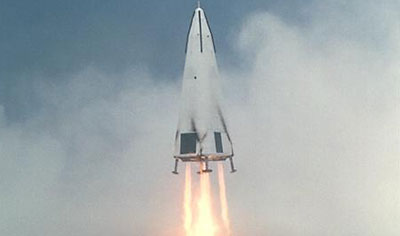 The genesis of the DC-X program (shown here in its NASA-funded DC-XA version) was a desire to reduce launch costs to support a missile defense program. (credit: NASA)“We know from history that every medium—air, land and sea—has seen conflict. Reality indicates that space will be no different. Given this virtual certainty, the U.S. must develop the means to both deter and to defend against hostile acts in and from space.”
—Rumsfeld Commission Report, January 2001
In the 1980s, the opponents of “Star Wars” often claimed that “the effective protection of a nation against nuclear attack had never been a serious prospect (and in the view of most scientists, is not today).” The naysayers’ argument was more with Isaac Newton and with Earth’s gravity field than it was with Ronald Reagan or Edward Teller and the others who wanted to defend America and its allies against ballistic missiles.
https://www.thespacereview.com/article/66/167)
There are plenty of ideas, but no consensus, on the future of US space policy. Does this mean nothing will change?by Jeff Foust Monday, December 1, 2003
 Speakers at the ASA’s forum in the House Science Committee’s hearing room on Capitol Hill. (credit: J. Foust)
Vision revisionA lot has been said and written in recent weeks about the desire, if not the necessity, for an overarching new policy, or vision, for US space efforts (see “The vision thing”, The Space Review, November 10, 2003). A lot of people, in Congress and elsewhere, have spoken of the need to give NASA in particular a bold new goal that can give the space agency a focus during a time when many perceive the agency to be without direction. The fact that the Bush Administration is currently carrying out a secretive internal space policy review, with results that could be announced within weeks, has emboldened those calling for a new space vision.
https://www.thespacereview.com/article/67/143/XII 2003 [68-70]68)
The necessity of launch range upgradesby Winston W. Gardner, Jr. Monday, December 8, 2003
 A view of the Cape Canaveral Spaceport from orbit. (credit: USGS)
The Air Force’s Eastern Range, extending from the Cape Canaveral Spaceport over the Atlantic and into space, is a complex system of equipment and people designed to ensure the safety of launches from the spaceport. The range has done its job with great success, but over the years has earned a reputation for excessive complexity and cost. Designed around the needs of mature, operational, largely government-supported launch programs (Atlas, Delta, Titan, Shuttle), the range is becoming too expensive and inflexible for new launch programs.
https://www.thespacereview.com/article/68/169)
How important is the Moon?by Taylor Dinerman Monday, December 8, 2003
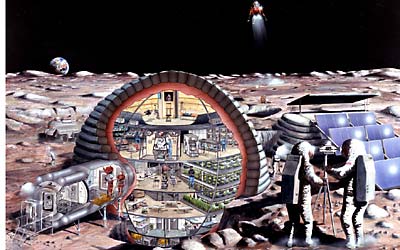 A 1980s-era illustration of what a future moonbase might look like. (credit: NASA)
The last week has seen renewed speculation over whether or not the President will announce a new space policy, one that will take America back to the Moon to stay. The debate over why we should or should not go naturally will intensify.
Of course there are lots of good, basic reasons why we should build a sustainable moonbase. They have been laid out over the years by the space advocacy community. The scientific and technological knowledge to be gained by building such a base is huge. The moon is an ideal point from which to launch missions to Mars and beyond. Mineral and energy resources, for example, helium-3, are there to be exploited.
https://www.thespacereview.com/article/69/170)
The Falcon and the showmanby Jeff Foust Monday, December 8, 2003
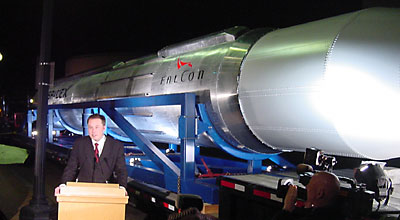 Elon Musk talks about the Falcon and SpaceX’s plans for the future outside the National Air and Space Museum in Washington. (credit: J. Foust)
The National Mall, and the streets surrounding it in downtown Washington, has been home to a wide range of events. It has seen parades, demonstrations, rallies, festivals, fireworks, and, three months ago, a concert to kick off the NFL season, featuring an increasingly overexposed (in multiple senses of the term) Britney Spears. The area can now add one more event to its history: the unveiling of a new commercial rocket.
https://www.thespacereview.com/article/70/1Photo Gallery: Falcon unveilinghttps://www.thespacereview.com/gallery/344/XII 2003 [71-73]71)
To Mars, to Marsby Taylor Dinerman Monday, December 15, 2003
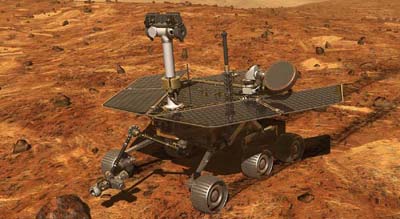 With any luck NASA’s twin Mars Exploration Rovers will soon be rolling across the terrain of the Red Planet, looking for evidence of water and life. (credit: NASA)
Many, if not most, space enthusiasts are familiar the refrain from Elaine Walker’s song : “To Mars, to Mars, it’s halfway to the stars.” If not astronomically correct, it does have a certain poetic power. Sending people to Mars is by far the most difficult of the conceivable manned missions that the US or anyone else could hope to carry out within the next forty or fifty years. Realistically no US President is going to decide to send people to Mars anytime soon. Going to the Moon or to L-1 seems the best we can hope for.
https://www.thespacereview.com/article/71/172)
A new hangar for the nation’s atticby Jeff Foust Monday, December 15, 2003
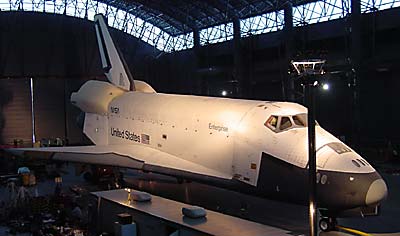 The space shuttle Enterprise is one of the highlights of the new Udvar-Hazy Center, but viewing of the orbiter will be limited for the next several months. (credit: J. Foust)
The Smithsonian’s National Air and Space Museum (NASM) is an impressive facility. Spanning nearly two blocks along the National Mall in downtown Washington, it is home to some of the most important artifacts in the history of aviation and spaceflight, from the Wright Flyer and the Spirit of St. Louis to the X-15 and the Apollo 11 command module. With an average attendance of nine million people a year (10.8 million in fiscal year 2003, a year that saw attendance decreases at other Washington-area museums because of the recession and continued 9/11 aftermath), the museum bills itself as the most popular on the planet.
https://www.thespacereview.com/article/72/1Photo Gallery: NASM Udvar-Hazy Centerhttps://www.thespacereview.com/gallery/473)
Suborbital spaceflight: a road to orbit or a dead end?by Clark S. Lindsey Monday, December 15, 2003
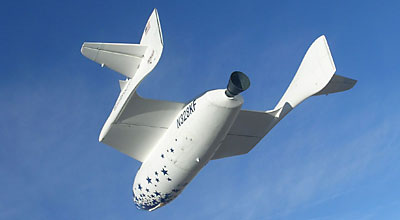 Scaled Composites’ SpaceShipOne, seen above during a glide test earlier this month, is one of the best known planned suborbital RLVs. However, is it a dead end on the path to orbital RLVs? (credit: Scaled Composites)
When Burt Rutan introduced the SpaceShipOne (SS1) to the world last spring, the debut attracted tremendous publicity to the X Prize competition and boosted the credibility of the promise for routine passenger flights on reusable suborbital space vehicles. Space activists hailed it as a major milestone on the long uphill climb to a commercial human spaceflight industry.
https://www.thespacereview.com/article/73/145/XII 2003 [74-76]74)
Letters: Europe’s space science programby David Parker Monday, December 22, 2003
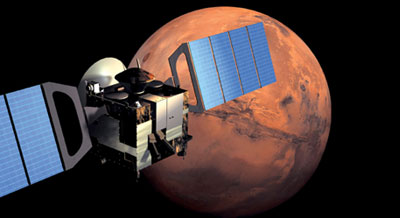 ESA’s Mars Express mission is far from the last of the agency’s science missions, accordingf to Parker. (credit: ESA)
As a European citizen involved in the space science program over here, I find the Space Review interesting and stimulating. However, it does sometimes reflect a rather Americo-centric view of the world, and the article entitled “To Mars, to Mars” by Taylor Dinerman dated Monday, December 15, 2003 has driven me to correct the significant errors in this paragraph:
The European Mars Express/Beagle 2 mission is a first for ESA and is one of the few missions they are doing that conforms to their declared science and exploration role. In fact, given the cuts in space science this may be (along with Rosetta) one of the last classic European space missions. As ESA becomes more of a quasi-military organization and less of a scientific one probes such as these will be less common while their money and effort will go into projects such as Galileo and GMES.
https://www.thespacereview.com/article/74/175)
Review: recalling SojournerMonday, December 22, 2003
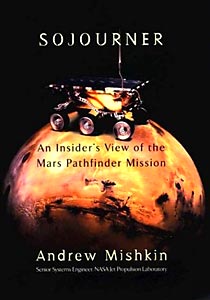 Sojourner: An Insider’s View of the Mars Pathfinder Mission
By Andrew Mishkin
Berkley Books, 2004
Hardcover, 334pp., illus.
ISBN 0-425-19199-0
US$21.95/C$33.00
https://www.amazon.com/exec/obidos/ASIN/0425191990/spaceviewsNext month NASA’s twin Mars Exploration Rovers, dubbed Spirit and Opportunity, will, if all goes well, spend several weeks moving around their widely-separated landing sites, collecting data on the composition of the rocks and soils there. A successful mission could help scientists understand the early history of the Red Planet, including how much water it had and where that water went, and could generate momentum for future robotic and even human exploration of the planet. The Mars Exploration Rovers will also draw comparisons with another, although very different, rover mission: the Sojourner rover on Mars Pathfinder.
https://www.thespacereview.com/article/75/176)
(Space) history acceleratesby Taylor Dinerman Monday, December 22, 2003
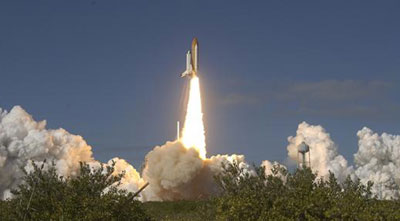 The Columbia accident has called attention to not only problems with the shuttle, but the difficulties faced with giving NASA a new direction and appropriate funding. (credit: NASA/KSC)
Since the attack on 9/11, things have been speeding up all over the world. The War on Terrorism and the changes linked to this have ended all the wishful thinking that had become commonplace since the Berlin Wall came down in 1989. America’s holiday from history is over.
The Columbia disaster has had a similar effect on the US space program. Before February 1, 2003, America was, for all intents and purposes, stuck in low Earth orbit (LEO). Sure, there was a thriving robotic exploration program, but the major part of NASA’s spaceflight budget was being spent on the ISS and the Shuttle that serviced it. While there were plenty of ideas to expand human presence in the solar system, there was no commitment by either the Congress or the Administration to do so.
https://www.thespacereview.com/article/76/146/XII 2003 [77-78]77)
Scaled Composites’ SpaceShipOne: stunt plane or new road to the stars?by Taylor Dinerman Monday, December 29, 2003
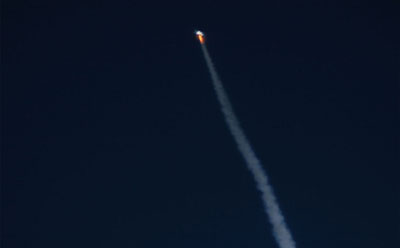 SpaceShipOne breaks the sound barrier during its first powered flight on December 17, 2003. (credit: Scaled Composites)
The first privately-financed flying machine ever to go faster than Mach 1 fired its engine for the first time on December 17, 2003, the hundredth anniversary of the Wright Brothers’ first flight. At the same time it was revealed that Paul Allen, the co-founder of Microsoft, financed the development of both SpaceShipOne and its White Knight carrier aircraft. It was suitably symbolic that someone who made his money in our current information age should have financed this new step. It was the prosperity caused by the information systems developments of early 20th century, specifically National Cash Register (NCR) headquartered in Dayton, that created enough surplus wealth that trickled down to the Wright’s bike shop.
https://www.thespacereview.com/article/77/178)
A year-end reality checkby Jeff Foust Monday, December 29, 2003
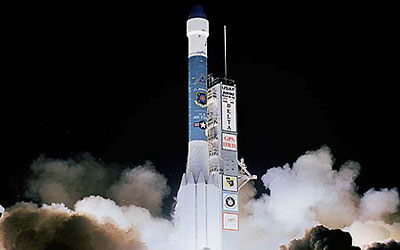 A Delta 2 lifts off early December 21 on the 60th launch of 2003. Does such a level of launch activity represent a “blistering pace” or an industry with deep institutional problems? (credit: Boeing)
On a busier day I might not ever have noticed it. On the afternoon of the Friday before Christmas, the January issue of SpaceWatch, the newsletter of the Space Foundation, arrived in my email inbox. Normally I quickly scan through such organizational newsletters, looking for the highlights, and then set them aside to be read later—if ever. However, that Friday afternoon was a little slow and, with a few spare minutes available, I took the time to read the newsletter a little more closely.
https://www.thespacereview.com/article/78/1
 Wątek: The Space Review (Przeczytany 182994 razy)