Autor Wątek: The Space Review  (Przeczytany 176788 razy)

0 użytkowników i 2 Gości przegląda ten wątek.

Online Orionid

  • Weteran
  • *****
  • Wiadomości: 29596
  • Very easy - Harrison Schmitt
The Space Review
« dnia: Czerwca 06, 2020, 07:24 »
The Space Review jest tygodnikiem kosmicznym założonym przez Jeffa Fousta po katastrofie Columbii. Od tamtego czasu ukazało się już 3957 artykułów i recenzji. Co tydzień publikowanych jest 5 tekstów. Założyciel internetowego tygodnika swoje credo przedstawił we wstępnym artykule.
Crew Dragon jest jedną z odpowiedzi na utratę załogi 17 lat temu i pierwszy jego lot załogowy zbiega się z zainicjowaniem cyklicznego zaistnienia TSR na Forum.
https://en.wikipedia.org/wiki/The_Space_Review

https://www.thespacereview.com/archive.html
« Ostatnia zmiana: Maja 15, 2024, 16:16 wysłana przez Orionid »

Online Orionid

  • Weteran
  • *****
  • Wiadomości: 29596
  • Very easy - Harrison Schmitt
Odp: The Space Review
« Odpowiedź #1 dnia: Czerwca 06, 2020, 07:24 »
2004

012 01.2004 (1)


2003

001 02.2003 (2)
002 03.2003
003 04.2003
004 05.2003
005 06.2003
006 07.2003
007 08.2003
008 09.2003
009 10.2003
010 11.2003
011 12.2003
« Ostatnia zmiana: Lipca 25, 2026, 12:27 wysłana przez Orionid »

Online Orionid

  • Weteran
  • *****
  • Wiadomości: 29596
  • Very easy - Harrison Schmitt
Odp: The Space Review
« Odpowiedź #2 dnia: Czerwca 06, 2020, 07:28 »
2019

192 01.2019 (4)
193 02.2019 (4)
194 03.2019 (4)
195 04.2019 (5)
196 05.2019 (4)
197 06.2019 (4)
198 07.2019 (5)
199 08.2019 (3)
200 09.2019 (4)
201 10.2019 (4)
202 11.2019 (4)
203 12.2019 (4)

2020

204 01.2020 (4)
205 02.2020 (4)
206 03.2020 (5)
207 04.2020 (4)
208 05.2020 (4)
209 06.2020 (5)
210 07.2020 (4)
211 08.2020 (4)
212 09.2020 (4)
213 10.2020 (4)
214 11.2020 (5)
215 12.2020 (3)

2021

216 01.2021 (4)
217 02.2021 (4)
218 03.2021 (5)
219 04.2021 (4)
220 05.2021 (4)
221 06.2021 (5)
222 07.2021 (4)
223 08.2021 (3)

224 09.2021 (4)

225 10.2021 (8 )
226 11.2021 (5)
227 12.2021 (3)

2022

228 01.2022 (5)
229 02.2022 (4)
230 03.2022 (3)
231 04.2022 (1)
232 05.2022 (1)
233 06.2022 (1)
234 07.2022 (1)
235 08.2022 (1)
236 09.2022 (1)
237 10.2022 (1)
238 11.2022 (1)
239 12.2022 (1)

2023

240 01.2023 (1)
241 02.2023 (1)
242 03.2023 (1)
243 04.2023 (1)
244 05.2023 (1)
245 06.2023 (1)
246 07.2023 (1)
247 08.2023 (1)
248 09.2023 (1)
249 10.2023 (1)
250 11.2023 (1)
251 12.2023 (1)

2024

252 01.2024 (1)
253 02.2024 (1)
254 03.2024 (1)
255 04.2024 (1)
256 05.2024 (1)
257 06.2024 (1)
258 07.2024 (1)
259 08.2024 (1)
260 09.2024 (1)
261 10.2024 (1)
262 11.2024 (1)
263 12.2024 (1)

2024

264 01.2025 (1)
« Ostatnia zmiana: Lipca 22, 2026, 10:59 wysłana przez Orionid »

Online Orionid

  • Weteran
  • *****
  • Wiadomości: 29596
  • Very easy - Harrison Schmitt
Odp: The Space Review
« Odpowiedź #3 dnia: Czerwca 06, 2020, 07:28 »
Time to ask the big questions
Is Columbia the most tragic example of the failure of the space exploration paradigm?
by Jeff Foust Tuesday, February 11, 2003

Anyone with more than a passing knowledge of the history of space has a few dates etched into their brains: October 4, 1957; April 12, 1961; July 20, 1969. Also there, sadly, are January 27, 1967; January 28, 1986, and now, February 1, 2003. The Space Age has given us its share of triumphs and tragedies, and while the tragedies are relatively modest when put into a global perspective — 21 deaths in just under 42 years of human spaceflight — it makes them no less painful.

Despite these tragedies, the US space program has forged ahead. After Apollo 1 NASA quickly worked to determine the cause of the accident, fix that and other problems with the Apollo spacecraft, and was flying again in time land on the Moon before 1970, as President Kennedy had asked. The interregnum after Challenger was longer — there was no space race with the Soviets then — but in time a revamped shuttle fleet was flying again. In both cases there was broad public support for maintaining a slightly modified status quo.

Today, there has been a desire expressed by many people inside and outside of NASA to quickly determine what happened to Columbia, fix the problem, and start flying again. Even if there wasn’t pressure to get the shuttle flying again so that it can support the International Space Station, this desire is an understandable one, even a noble one: a refusal to give up in the face of adversity, just as in the case with past tragedies. As the saying goes, if you get thrown off a horse, you need to get right back on it — presumably, after figuring out why you got thrown off in the first place.

The danger in this approach is that this gives NASA, or the space community in general, little time to reflect on the current state of space exploration and development. The situation in 2003 is different than 1967, when the space program’s goals were clear cut, or even 1986. Even before the Columbia tragedy, it was clear that the space activities in general worldwide — commercial, civil government, and military — were dysfunctional, if not downright broken. Space access, both manned and unmanned, is still too expensive to support more than a few applications. The reliability of space transportation is also a problem, from numerous launch delays to catastrophic failures, such as the recent failures of a Proton/Block DM and an Ariane 5 ECA. There are too many launch vehicles chasing too few payloads, with, paradoxically, even more expendable vehicles under development. Human space flight relies today on only two vehicles: the Space Shuttle, an expensive vehicle that has now suffered two catastrophic failures in 113 flights; and Russia’s Soyuz, which is chronically underfunded. This puts at risk the tens of billions of dollars invested to date in the International Space Station, a project years behind schedule that has yet to live up to even basic expectations.

Space transportation is not the only focus of problems. The commercial space industry is suffering from an overall glut of supply: from launch vehicles to satellite manufacturers to on-orbit communications capacity. The remote sensing business has failed to materialize, and many of the existing companies are now heavily reliant on government business for their survival. The failures of several satellite communications ventures garnered enough publicity that “Iridium” became synonymous in the business world for any hugely expensive failure.

Government space programs are no better than their commercial brethren. While much has been said about NASA’s continual battles for more funding, it is in far better shape than other programs around the world, which must either beg for a tiny fraction of NASA’s budget or, particularly in ESA’s case, endure internecine battles among its member nations regarding even modest programs. While these agencies are pursuing a number of excellent projects, none of them have the goals or the vision to capture the interest and enthusiasm of the general public. Those proposals that seem to have the best prospects of resonating with the general public — notably, human exploration of Mars — are considered either too expensive or too far in the future to be officially adopted by these agencies.

All of these issues are symptoms of fundamental problems with how we approach space today. Many of these problems are rooted in decisions made years, if not decades, ago. Exploring these decisions can be useful, if only to best understand the process that led to those decisions. However, we are forced to cope with the consequences of those past decisions today. If this is the best we can do to explore and develop the final frontier, we may be stuck on Earth for the foreseeable future.

As stated above, there is a temptation to quickly patch the problem that caused the loss of Columbia and press on. Yet it’s clear that the way we approach space today is filled with problems and pitfalls; Columbia is not the only evidence of this, merely the most visible and the most unfortunate. Rather than get right back on that horse, perhaps its time to ask some more fundamental questions. How fast should we be riding? Where should we be going? And should we even be riding a horse?

That is what The Space Review is about: exploring the fundamental issues and the fundamental problems related to the exploration and development of space. The Space Review is not another news publication — there are already plenty of those available online — but instead an online magazine devoted to the past, present, and future of space exploration. In particular, there will be an emphasis on where we should go from here: the goals organizations should set in space, the destinations we should explore, the technologies we need to make it happen, the policies that help or hinder us, and so on.

What should you do, gentle reader? First of all, please come by every week and check out our latest articles: we plan to publish from one to three articles a week, ranging from in-depth studies of specific topics to short essays and book reviews. Give us feedback, about both the articles and the site: everything here is currently “in beta”, to borrow the jargon of the software industry, so your suggestions can be easily incorporated into the site in the coming weeks. If you have an article or essay you’d like to contribute to the site, please send an email to jeff@thespacereview.com. Oh, yes: be sure to tell your friends and colleagues about us too.

It is my hope that The Space Review can become an effective forum for discussing and debating our future in space. Recent events have made it as clear as ever that if we are truly interested in exploring and developing space, we need to reexamine why and how to best do it. We owe that to the crew of the Columbia and the others who have paid the ultimate price in the exploration of the final frontier.

https://www.thespacereview.com/article/1/1
https://www.thespacereview.com/article/1/2
« Ostatnia zmiana: Maja 15, 2024, 16:18 wysłana przez Orionid »

Polskie Forum Astronautyczne

Odp: The Space Review
« Odpowiedź #3 dnia: Czerwca 06, 2020, 07:28 »

Online Orionid

  • Weteran
  • *****
  • Wiadomości: 29596
  • Very easy - Harrison Schmitt
Odp: The Space Review
« Odpowiedź #4 dnia: Czerwca 06, 2020, 07:29 »
2/II 2003 [2-3]

2) Columbia lost, but not a nation
by S. Alan Stern Monday, February 17, 2003


The Earth and crescent moon photographed during the STS-107 shuttle mission. (credit: NASA)

The sudden and sad demise of the space shuttle Columbia and her crew on the frontier of space this month provided a sharp reminder of the risks of spaceflight. Simultaneously, the heartfelt national reaction to the accident reminded us of the intimate connection that Americans have with frontiers in general, and space exploration in particular.
https://www.thespacereview.com/article/2/1

3) Main engine cutoff
by Jeff Foust Monday, February 17, 2003

Is the American rocket propulsion industry in danger of extinction?


A Rocketdyne XRS-2200 engine, developed for the X-33, runs during a test firing at NASA’s Stennis Space Center in mid-2001. (credit: NASA)

It has been commonplace in recent years to talk about the problems facing the launch industry as if the industry was a monolithic entity. While the launch industry in general does face serious problems, it is not monolithic. Launch vehicles are made of a variety of components, which in many cases are provided by subcontractors. The health of each of those segments of the industry is critical to the future of the overall launch industry. Some segments of the industry, as it turns out, may be hurting more than others.
https://www.thespacereview.com/article/3/1

3/II 2003 [4-5]

4) A “Grand Challenge” for NASA
by Jeff Foust Monday, February 24, 2003


As NASA moves beyond spacecraft like Mars Exploration Rover (above), the agency will need to invest in autonomous navigation and other technologies. (credit: NASA)

It’s unusual for a story about a road race from Los Angeles to Las Vegas to make the front page of the Los Angeles Times, unless there’s great tragedy—and/or famous celebrities—involved. Yet there it was, in the bottom-left corner of the front page of the Times’ Friday, February 21 issue: a story about a vehicle race between the two cities that is not scheduled to take place for over a year.
https://www.thespacereview.com/article/4/1

5) The Mars train wreck
by Donald F. Robertson Monday, February 24, 2003


In their search for evidence of life, could future astronauts on Mars do more harm than good? (credit: Pat Rawlings/SAIC for NASA)

Before it even gets underway, human Mars exploration is headed for a political train wreck. The likelihood of trouble is so great that advocates for human exploration of the Solar System probably should look elsewhere—toward a return to Earth’s Moon or asteroid mining expeditions. The problem is life, especially if we find it, but even if we don’t.
https://www.thespacereview.com/article/5/1
« Ostatnia zmiana: Maja 15, 2024, 16:27 wysłana przez Orionid »

Online Orionid

  • Weteran
  • *****
  • Wiadomości: 29596
  • Very easy - Harrison Schmitt
Odp: The Space Review
« Odpowiedź #5 dnia: Czerwca 06, 2020, 07:29 »
4/III 2003 [6-7]

6) The silver lining that is the Space Age
by Larry Klaes Monday, March 3, 2003


The SPACEHAB research module in Columbia’s cargo bay was home to dozens of experiments. (credit: NASA)

When one contemplates the tragic loss of the Space Shuttle Columbia and its crew of seven astronauts, it is often hard for many of us to separate our emotions from the reasons why we send human beings into space and why those people willingly accept these daring and dangerous missions into a realm that can quickly end life from only a few missteps.
https://www.thespacereview.com/article/6/1

7) Columbia and the media: a one-month report card
by Jeff Foust Monday, March 3, 2003

How have the print and electronic media handled the Columbia tragedy?


NASA administrator Sean O’Keefe has been at the center of the media coverage surrounding the Columbia investigation. (credit: NASA)

The month of February 2003 will not be remembered fondly by most people. A plane crash in Iran killed over 270 people. A subway fire in South Korea killed more than 130. In Chicago, 21 people died trying to escape a nightclub, while a few days later nearly 100 perished in a Rhode Island nightclub blaze. A powerful winter storm dumped over half a meter of snow from Washington DC to Boston, while another deposited a glaze of ice in the south-central US. Terrorist alerts prompted runs on plastic sheeting and duct tape throughout America, as the drums of war beat ever louder in Iraq and North Korea became an increasingly-worrisome nuclear wild card.
https://www.thespacereview.com/article/7/1
https://www.thespacereview.com/article/7/2

5/III 2003 [8]

8 ) Space entrepreneurship, buy the book
by Jeff Foust Monday, March 10, 2003


The rollout of Rotary Rocket's Roton ATV prototype in March 1999. (credit: Rotary Rocket Company)

They All Laughed at Christopher Columbus: An Incurable Dreamer Builds the First Civilian Spaceship
By Elizabeth Weil
Bantam Books, 2002
Hardcover, 230 pp.
ISBN 0-553-10886-7
US$24.95/C$37.95
https://www.amazon.com/exec/obidos/ASIN/0553108867/spaceviews

Making Space Happen: Private Space Ventures and the Visionaries Behind Them
By Paula Berinstein
Medford Press, 2002
Softcover, 490pp.
ISBN 0-9666748-3-9
US$24.95/C$37.95
https://www.amazon.com/exec/obidos/ASIN/0966674839/spaceviews

The late 1990s have become synonymous with the “dot-com” era, when many tens of billions of dollars in venture capital were poured into thousands of startup companies, each promising to use the Internet in general, and the Web in particular, to generate bounties of riches in vast assortment of ways. What most of these companies lacked, though, were valid business plans that showed how those investments would generate revenues and, eventually, profits. Instead, dot-com startups used bizarre currencies of mindshare, eyeballs, and stickiness. When the stream of VC funding tried up at the turn of the century, the startups realized how worthless their currencies were; most are now defunct.
https://www.thespacereview.com/article/8/1

6/III 2003 [9-10]

9) The dangers of “creeping determinism”
by Jeff Foust Monday, March 17, 2003


Debris recovered from the space shuttle Columbia is stored in a hangar at the Kennedy Space Center for analysis. (credit: NASA/KSC)

It seems so obvious now, many people observing the Columbia investigation are saying. Foam from the external tank hit the leading edge of the left wing during launch, causing one of the reinforced carbon-carbon tiles there to either fall off or become so damaged it could not prevent hot plasma from getting through 16 days later during reentry. That damage eventually led to the structural failure of the wing and the loss of the orbiter. The images, the paper trail of memos and emails, all seem to show concern among engineers that such an incident during the launch could have caused an accident just like the one that befell Columbia on February 1.
https://www.thespacereview.com/article/9/1

10) The launch industry depression: when will it end?
by Jeff Foust Monday, March 17, 2003


A Boeing Delta 4 Medium lifts off from Cape Canaveral on March 10. (credit: Boeing)

Unless you’ve been living in blissful ignorance the last few years, you’re probably painfully aware of the problems the commercial launch industry has been facing. The boom in launch demand in the late 1990s, primarily by geosynchronous (GSO) and nongeosynchronous (NGSO) communications satellites, has gone bust, undone by overcapacity from existing GSO satellites and the stunning business failures of companies like Iridium and Globalstar. The launch vehicle companies, trapped in a cycle of price wars in an effort to capture the few customers available today, are losing money and looking to governments to keep them alive.
https://www.thespacereview.com/article/10/1

7/III 2003 [11-12]

11) The Gene and Jack show
by Jeff Foust Monday, March 24, 2003

The last two men to walk on the Moon discuss the past and future


Gene Cernan, Jan Evans (widow of Ron Evans), and Harrison Schmitt at the National Air and Space Museum on March 18. (credit: J. Foust)

It’s been over 30 years since Eugene Cernan and Harrison “Jack” Schmitt became the eleventh and twelfth—and, to date, last—humans to set foot on the moon. One would think that, over time, public interest in their feat would have waned. Yet, several hundred people turned out at the Smithsonian Institution’s National Air and Space Museum March 18 for the museum’s annual Werner von Braun lecture by the two former astronauts.
https://www.thespacereview.com/article/11/1

12) The million man and woman march to space
by Clark S. Lindsey Monday, March 24, 2003


Relatively small groups can have a major influence on policies. (credit: J. Foust)

Imagine the following press release: “Citing the need to unify the nation as it once was, space advocacy groups announce a campaign to press the television industry to restore the variety show, offer at least three Westerns in prime time everyday, and reduce the number of news programs to two half-hour broadcasts each evening.”
https://www.thespacereview.com/article/12/1

8/III 2003 [13]

13) Space tourism: managing expectations in uncertain times
by Jeff Foust Monday, March 31, 2003


The Xerus, by XCOR Aerospace, is a proposed suborbital RLV that could serve the space tourism market in the next several years. (credit: XCOR/Space Adventures)

For the last several years, space tourism has made significant progress as a viable industry that may be critical to the continued commercialization of space. As recently as five years ago space tourism suffered from a “giggle factor” as both mainstream society and even some within the aerospace industry and commercial space community dismissed tourism as unrealistic. Events since then, most notably the flights of Dennis Tito in April 2001 and Mark Shuttleworth one year later, have altered those perceptions. Almost no one is laughing at space tourism now; indeed, with the decline of other commercial space markets, such as the launch of telecommunications satellites, space tourism is now seen as perhaps the most viable emerging commercial market for the foreseeable future.
https://www.thespacereview.com/article/13/1
« Ostatnia zmiana: Listopada 17, 2024, 17:51 wysłana przez Orionid »

Online Orionid

  • Weteran
  • *****
  • Wiadomości: 29596
  • Very easy - Harrison Schmitt
Odp: The Space Review
« Odpowiedź #6 dnia: Czerwca 06, 2020, 07:29 »
9/IV 2003 [14]

The search for water: picking landing sites for NASA’s Mars rovers
by Henry Bortman Monday, April 7, 2003
[Editor’s Note: This article originally appeared as a pair of articles published last month by Astrobiology Magazine, and is reprinted here with the kind permission of Astrobiology Magazine.]


Illustration of a Mars Exploration Rover on the surface of Mars. (credit: NASA/JPL)

“Follow the water” is the mantra for NASA’s Mars exploration program. But present-day Mars is so cold, and its atmosphere so thin, that liquid water cannot exist on the planet’s surface. What NASA can look for, though, is evidence that water was present and active on Mars in the distant past. There are strong indications, in images taken by cameras aboard orbiting spacecraft, that features of the Martian landscape have been carved by water. But some scientists argue that these features could have been caused by short-lived torrents of water—flash floods.
https://www.thespacereview.com/article/14/1

10/IV 2003 [15-16]

15) John Young’s shuttle secret
by Jeff Foust Monday, April 14, 2003

The commander of STS-1 reveals a little-known incident with present-day implications


John Young speaking at the National Air and Space Museum in Washington DC on April 11. (credit: J. Foust)

Most of the people in attendance at the National Air and Space Museum last Friday night for a talk by John Young—paying $15-20 a ticket for the privilege—were already quite familiar with the astronaut’s exploits from Gemini through Apollo to the shuttle program. Yet Young managed to surprise most if not all of them by offhandedly discussing an incident with the first shuttle mission that has connections with the current Columbia accident investigation.
https://www.thespacereview.com/article/15/1

16) Suborbital’s ascending trajectory
by Jeff Foust Monday, April 14, 2003

Once dismissed as a dead end, reusable suborbital spacecraft are finally getting respect


An illustration of TGV Rockets' Michelle-B suborbital vehicle being prepared for launch at a remote mobile site. (credit: TGV Rockets)

It’s one thing for entrepreneurs and space activists to tout the benefits of a particular mode of commercial space transportation. When outside experts and the occasional bureaucrat express support for the idea, its credibility grows. However, you know the idea is finally gaining wide acceptance when a leading elected official, speaking on the record, endorses the concept. Commercial suborbital spaceflight achieved that milestone earlier this year.
https://www.thespacereview.com/article/16/1

11/IV 2003 [17]

17) Photo Gallery: SpaceShipOne Rollout
SpaceShipOne suborbital spacecraft on April 18, 2003
https://www.thespacereview.com/gallery/1

Rutan aims for space: A look at SpaceShipOne
by Jeff Foust Monday, April 21, 2003


SpaceShipOne mounted under the fuselage of the White Knight aircraft. (credit: J. Foust)

There is little in Mojave, California, to recommend to the casual tourist. A town of less than 5,000 people in the windswept high desert 150 kilometers north of Los Angeles, near the foothills of the Tehachapi Mountains, Mojave appears at first glance to be little more than a string of gas stations, fast food restaurants, and motels lining Routes 14 and 58. Yet, in aerospace circles, Mojave is well-known, in part because its airport is home to many dozens of commercial jetliners placed into long-term storage. It’s also the home of Burt Rutan and his company, Scaled Composites, which have developed a number of innovative aircraft from the globe-circling Voyager to the high-altitude Proteus.
https://www.thespacereview.com/article/17/1

12/IV 2003 [18]

18) RLV regulation: licensing vs. certification
by Jeff Foust Monday, April 28, 2003


SpaceShipOne, unveiled earlier this month, will not be flown commercially because of perceived high regulatory costs. (credit: J. Foust)

When Burt Rutan rolled out the SpaceShipOne suborbital spacecraft earlier this month (see “Rutan aims for space: A look at SpaceShipOne”, April 21, 2003), one of the biggest surprises had nothing to do with the vehicle’s unique design or flight profile. Instead, despite the fact that the vehicle seemed ideal to win the X Prize and usher in the era of suborbital space tourism, Rutan made it clear there were no plans to put the vehicle into commercial service. SpaceShipOne would fly under an “experimental research and development glider” license on a series of flights to determine what the operating costs of the vehicle would be.
https://www.thespacereview.com/article/18/1
« Ostatnia zmiana: Listopada 17, 2024, 18:08 wysłana przez Orionid »

Online Orionid

  • Weteran
  • *****
  • Wiadomości: 29596
  • Very easy - Harrison Schmitt
Odp: The Space Review
« Odpowiedź #7 dnia: Czerwca 09, 2020, 00:26 »
13/V 2003 [19]

19) Orbital Space Plane: Back to Apollo?
by Jeff Foust Monday, May 5, 2003


Illustration of an Apollo spacecraft approaching the docking adaptor used for ASTP. Will a direct descendant of Apollo perform similar docking with the International Space Station? (credit: NASA)

When NASA first announced plans to develop the Orbital Space Plane (OSP) last year, most people assumed it would be exactly that: a winged, reusable vehicle—in essence a mini-shuttle—that could serve as both a crew return vehicle (CRV) and crew transfer vehicle (CTV) for the International Space Station. Many of the vehicle designs presented to the public by companies like Boeing and Orbital Sciences Corporation in recent months have indeed been either winged or lifting body vehicles, direct descendants of recent experimental designs like the X-37 or older concepts like the HL-20 and X-24.
https://www.thespacereview.com/article/19/1

14/V 2003 [20]

20) The fifth stage of the RLV grieving process
by Jeff Foust Tuesday, May 13, 2003


Vehicles like the Roton (above) were designed to serve a launch market that since dried up. (credit: XCOR Aerospace)

Nearly 35 years ago Swiss-American psychiatrist Elisabeth Kubler-Ross wrote On Death and Dying, a book that reshaped how society viewed death and the reactions to it. The book is perhaps best known for its elucidation of the five stages of grief people go through after the death of a friend or loved one. After an initial stage of denial, a person reacts with anger to the loss, then attempts to bargain with God or nature to reverse the loss. This is followed by depression, after which the person finally comes to terms with the loss and presses on.
https://www.thespacereview.com/article/20/1

15/V 2003 [21-22]

21) Dave Weldon speaks about space policy
by Dave Weldon Tuesday, May 20, 2003


Congressman Dave Weldon speaks with the media earlier this year. (credit: Office of Congressman Weldon)

[Editor’s Note: It is rare to get a member of Congress to devote more than a few sound bite-worthy words about space policy. One exception is Congressman Dave Weldon, a Florida Republican whose district includes Cape Canaveral. Weldon spoke last month on a variety of civil, commercial, and military space issues at the 40th Space Congress at Cape Canaveral. An excerpt of his speech is provided below; a complete copy is available on Congressman Weldon’s web site.]

I want to say how impressed I have been with the level of professionalism and dedication everyone at NASA and the contractor community has exhibited since February 1. I am anxious to review the Gehman Report when it is released later this summer. The Congress stands ready to work with NASA to get the Shuttles flying again and to complete ISS.
https://www.thespacereview.com/article/21/1

22) The young rocketeer’s guide to range safety
by Jeff Foust Tuesday, May 20, 2003


A student-built model rocket lifts off during the Team America Rocketry Challenge on May 10. (credit: J. Foust)

The launch started like any other that day. The public address announcer intoned the final seconds of the countdown: “Five, four, three, two, one, ignition!” There was silence for a few seconds, just long enough to make those of us standing nearby wonder if something had gone wrong. Just as those thoughts surfaced, though, the tail of the rocket belched smoke and flame, and an instant later we heard a distinctive whoosh as the rocket soared off the pad.
https://www.thespacereview.com/article/22/1
« Ostatnia zmiana: Listopada 18, 2024, 12:45 wysłana przez Orionid »

Online Orionid

  • Weteran
  • *****
  • Wiadomości: 29596
  • Very easy - Harrison Schmitt
Odp: The Space Review
« Odpowiedź #8 dnia: Czerwca 09, 2020, 00:26 »
16/VI 2003 [23]

23) Why is Mars so hard?
by Jeff Foust Monday, June 2, 2003


NASA’s twin Mars Exploration Rovers are two of the most complex science spacecraft ever developed. (credit: NASA)

This June will see the beginning of the most ambitious exploration of the Red Planet in a quarter-century. If all goes well, three launch vehicles—one Soyuz and two Delta—will lift off this month, placing four spacecraft on trajectories that will bring them to Mars by this December and January. Those spacecraft include the first European Mars orbiter, Mars Express; Beagle 2, the British lander built with a mix of public and private funding; and NASA’s twin Mars Exploration Rovers, perhaps the most advanced Mars spacecraft even built. They will be joined at Mars by Nozomi, a Japanese-built Mars mission launched in 1998 and forced to take the long road to Mars because of thruster problems.
https://www.thespacereview.com/article/23/1

17/VI 2003 [24-25]

24) Is NASA’s brain drain a myth?
by A.J. Mackenzie Monday, June 9, 2003


Congressman Sherwood Boehlert (above) has introduced legislation to help NASA solve what some perceive to be serious problems the agency has hiring and retaining scientists and engineers. (credit: J. Foust)

“One of the greatest problems NASA faces is a huge retirement bulge. Within five years, a quarter of the NASA workforce will be eligible to retire.”
Rep. Sherwood Boehlert, chairman, House Science Committee, March 6, 2003

For years NASA and its friends in Congress and elsewhere have been beating the drums about problems with the agency’s workforce. Indeed, it’s accepted as a given now that the agency’s technical staff is getting old. If one believes the dire predictions of some, a torrent of workers will soon escape from their cubicles for retirement homes in Florida and Arizona, depriving the agency of its best and brightest at its most critical time.
https://www.thespacereview.com/article/24/1

25) The phony space race
by Jeff Foust Monday, June 9, 2003


An illustration of China’s Shenzhou spacecraft in orbit. (credit: CAST)

If all goes as expected, some time late this year—perhaps November—a Long March 2F booster will lift off from the Jiuquan Satellite Launch Center in northwestern China. Atop this booster will be a Shenzhou spacecraft, similar in design to four previous Shenzhou spacecraft launched between 1999 and 2002. This Shenzhou, though, will be carrying a different payload than the previous four: one or more humans, who are expected to spend anywhere from a day to a week in orbit before returning to Earth. This flight will make China only the third nation, after the United States and the former Soviet Union, to send humans into space.
https://www.thespacereview.com/article/25/1

18/VI 2003 [26-27]

26) Review: do we need another book about Apollo?
Monday, June 16, 2003


Apollo: The Epic Journey to the Moon
By David West Reynolds
Harcourt, 2002
Hardcover, 272 pp.
ISBN: 0151009643
US$35
https://www.amazon.com/exec/obidos/ASIN/0151009643/spaceviews

The Apollo program is easily the most chronicled project in the short history of human spaceflight. Published works about Apollo range from chintzy coffee-table books to comprehensive, elegant tomes like Andrew Chaikin’s A Man on the Moon to astronaut autobiographies. These books have provided all types of perspectives on this program, from technology to policy to its lasting effect on those who traveled to the Moon. Apollo has been covered from almost every angle.
https://www.thespacereview.com/article/26/1

27) Watching the CAIB at work
by Jeff Foust Monday, June 16, 2003


A sparse crowd attends the June 12 CAIB public hearing in Washington. (credit: J. Foust)

Like most people, I have been following the Columbia investigation from a distance, relying on media reports as well as the occasional televised or webcast public hearing and press conference as the Columbia Accident Investigation Board (CAIB) carried out its work in Houston and Cape Canaveral. However, with the investigation phase of the board’s work winding down, the CAIB has shifted operations from Houston to the Washington DC area as it prepares to complete its report, still scheduled for release in late July.
https://www.thespacereview.com/article/27/1

19/VI 2003 [28]

28) The coming space race with China
by Mark R. Whittington Monday, June 23, 2003


An illustration of China’s Shenzhou spacecraft in orbit. (credit: CAST)

This fall, barring any last minute hitch, China will launch its Shenzhou spacecraft with people inside, thus joining the very exclusive club of nations that have sent humans into space. Chinese government officials have openly spoken of breathtaking ambitions for their country’s nascent space effort. Beyond putting people into low Earth orbit, Chinese officials speak openly of first exploring, then settling the Moon in order to exploit its natural resources.
https://www.thespacereview.com/article/28/1

20/VI 2003 [29-30]

29) Review: seeking the ultimate space commercialization guide
Monday, June 30, 2003

Two books take different approaches, but fall short


Space: The Free-Market Frontier
By Edward L. Hudgins (editor)
Cato Institute, 2002
Softcover, 260pp.
ISBN 1-930865-19-8
US$15
https://www.amazon.com/exec/obidos/ASIN/1930865198/spaceviews

Made In Space: Space Investor’s Guide To The Next Revolution
By Kenneth Schweitzer
1stBooks, 2003
Softcover, 248pp.
ISBN 1-4107-1245-1
US$19.95
https://www.amazon.com/exec/obidos/ASIN/1410712451/spaceviews

For years space entrepreneurs and enthusiasts alike have been seeking what could be called the “ultimate space commercialization guide”: a description of the benefits and opportunities of commercial space ventures that is so clear and compelling that it convinces investors, regulators, and the media. Writing such a guide, it turns out, has proven as difficult as developing viable commercial space ventures—an obvious conclusion given the current moribund state of many sectors of the industry. This, though, hasn’t stopped people from trying to write such a book, by people both unknown and overexposed. Two recent books approach the problem from opposite directions, but while making valiant attempts to describe the potential of space commercialization, come up short of the mark.
https://www.thespacereview.com/article/29/1

30) The promise of amateur suborbital spaceflight

Homebuilt spacecraft could soon take to the skies
by Andrew Case Monday, June 30, 2003


Illustration of SpaceCub, a proposed homebuilt suborbital spacecraft. (credit: D. Burkhead)

As we approach the 100th anniversary of the Wright Brothers’ flight at Kitty Hawk, many people are looking at the early history of aviation as a model for the development of spaceflight. One often-mentioned fact about is that within ten years of the Wright Brothers’ flight hundreds of airplanes had been built and thousands of people had flown. It’s not often noted, though, that many of those airplanes were built by private individuals or groups of private individuals who were seeking nothing more (or less) than the thrill of flight and the challenge of an ambitious project. Companies were springing up all over the landscape, but alongside these companies were clubs dedicated to designing and building airplanes for purely personal use. This observation suggests that we could perhaps see the development of spacecraft built by hobbyists and clubs alongside commercial spacecraft.
https://www.thespacereview.com/article/30/1
« Ostatnia zmiana: Listopada 18, 2024, 13:06 wysłana przez Orionid »

Online Orionid

  • Weteran
  • *****
  • Wiadomości: 29596
  • Very easy - Harrison Schmitt
Odp: The Space Review
« Odpowiedź #9 dnia: Czerwca 09, 2020, 00:26 »
21/VII 2003 [31-32]

31) Review: the aftermath of the Space Age
Monday, July 7, 2003


Rocket Dreams: How the Space Age Shaped Our Vision of a World Beyond
By Marina Benjamin
Free Press, 2003
Hardcover, 242 pp.
ISBN 0-7432-3343-3
US$24/C$38
https://www.amazon.com/exec/obidos/ASIN/0743233433/spaceviews

Countless volumes have been written about the history of the Space Race: the competition between the United States and the Soviet Union to achieve any number of firsts in space, from Sputnik to Apollo 11. Many other books have focused on what has happened in space since then, from the space shuttle to the unmanned exploration of the solar system. Far fewer books, though, have explored the sociological effects of the fast start, and sharp post-Apollo decline, of the Space Age. Marina Benjamin provides such an examination in Rocket Dreams, offering a wide-ranging look at what happened to humanity’s dreams of exploring and settling the space frontier.
https://www.thespacereview.com/article/31/1

32) Space science gets big at NASA

The future of NASA’s planetary exploration plans may rest on larger missions and nuclear technologies
by Jeff Foust Monday, July 7, 2003


Artist’s rendition of the nuclear-powered Jupiter Icy Moons Orbiter, a flagship mission of Project Prometheus planned for next decade. (credit: NASA/JPL)

For most of the 1990s—at least from 1992, when Dan Goldin became administrator—the guiding phrase for NASA’s space science programs was the now-famous “faster, better, cheaper.” After a disastrous drought of missions in the 1980s, when NASA focused its energies, and its limited funding, on a few large missions like Magellan and Galileo, the agency changed course and began to support a larger number of smaller missions. The 1990s brought us the Discovery program of planetary science missions, like NEAR and Mars Pathfinder; the Small and Medium-class Explorer programs, including IMAGE and FUSE; and the New Millennium program of technology-demonstration missions, most notably Deep Space One. The Nineties were not without large missions—Cassini was launched in 1997—but that mission dated back to the 1980s, and looked out of place among the fleets of smaller missions.
https://www.thespacereview.com/article/32/1

22/VII 2003 [33-34]

33) Deconstructing the “Top 100”
by A.J. Mackenzie Monday, July 14, 2003


One of the mysteries of the top 100 results is why von Braun (left) was ranked near the top while his Russian counterpart, Korolev (right), ranked near the bottom. (credit: NASA/Intl. Space Hall of Fame)

At the Paris Air Show last month, Aviation Week magazine unveiled its list of the top 100 “stars” of aviation and aerospace. The list, timed to coincide with the centennial of the Wright Brothers’ historic flight, was intended to highlight the leading contributors to aviation in the last century (although the list includes a few people whose contributions predate the Wrights, going as far back as da Vinci.)

The 100 people named came from a group of 760 nominees, selected by the magazine. A select group of people—primarily members of professional societies like the AIAA as well as Aviation Week subscribers—then voted online to cull the list to the 100 announced in Paris. The restricted voting was designed to “ensure the credibility and professional caliber of the Top 100 results”: evidently the AvWeek people learned their lesson from previous open online voting efforts, like the Time “Man of the Century” vote that was nearly won by Kemal Ataturk.
https://www.thespacereview.com/article/33/1

34) What is the “space industry”?
by Jeff Foust Monday, July 14, 2003


Companies that build and launch satellites like the Boeing 702 (above) are obviously part of the space industry; should companies that simply use these satellites also be included? (credit: Boeing)

There is no shortage of articles that discuss the current state of (and usually the problems with) the space industry. Yet, most often, these articles make little effort to define exactly what the “space industry” really means. The term is used so widely, and so loosely, that one wonders if the term has any real meaning. The usual problem with the phrase “space industry” is that it is too inclusive: it encompasses any number of companies for whom space may not necessarily be at the core of their business, in an effort to make the industry look as large, and thus as prominent, as possible.
https://www.thespacereview.com/article/34/1


23/VII 2003 [35-36]

35) Review: FBC examined
Monday, July 21, 2003

Faster, Better, Cheaper: Low-Cost Innovation in the U.S. Space Program
By Howard E. McCurdy
The Johns Hopkins University Press, 2001
Hardcover, 174 pp.
ISBN 0-8018-6720-7
US$34.95
https://www.thespacereview.com/article/35/1

If a single phrase can be used to identify NASA in the 1990s, it would almost certainly be “faster, better, cheaper”. NASA administrator Dan Goldin pushed the idea of doing science missions on shorter schedules and smaller budgets than the massive flagship missions like Galileo and Cassini throughout his record tenure at NASA. The result were a number of tremendous successes, such as Mars Pathfinder and Deep Space One, as well as embarrassing failures like Mars Polar Lander and Mars Climate Orbiter. How the faster-better-cheaper (FBC) philosophy came into being at NASA and the mixed bag of results during the decade is the subject of Howard McCurdy’s monograph Faster, Better, Cheaper.
https://www.thespacereview.com/article/35/1

36) Weighing the risks of human spaceflight
by Jeff Foust Monday, July 21, 2003


The launch of Columbia on STS-107 in January. (credit: NASA/KSC)

Society’s approach to the risk of injury and death often appears contradictory. In some respects, we have become increasingly risk-averse, taking steps to reduce or otherwise mitigate the dangers posed by everything from automobiles to household appliances. The litigious nature of contemporary American society has certainly played a role in this, as lawyers seek to place blame and seek compensation for even minor accidents. The fact that nearly every cup of coffee purchased today carries a disclaimer printed on the side that “the beverage you are about to enjoy is extremely hot” is testament to this trend.
https://www.thespacereview.com/article/36/1

24/VII 2003 [37]

37) The regulatory hurdles to commercial human spaceflight
by Jeff Foust Monday, July 28, 2003


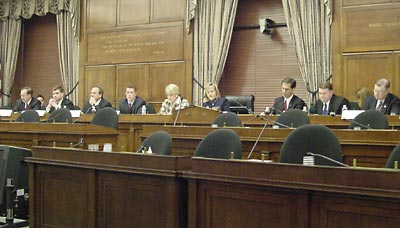
Congressmen gather in a hearing room in the Hart Senate Office Building to listen to expert testimony on commercial human spaceflight. (credit: J. Foust)

Entrepreneurs seeking to develop new launch vehicles—expendable or reusable, manned or unmanned—have typically faced three classes of obstacles. The first, and the one most commonly associated with launch vehicle development, is technical: namely, the challenges involved with developing a vehicle that can carry payloads, be they satellites or people, less expensively, more frequently, or otherwise differently than existing vehicles. The second class of obstacles is financial, as entrepreneurs seek to convince investors that there is a sufficiently large market for their vehicle to warrant funding. Most of the companies that have tried, and failed, to develop new commercial launch vehicles have been tripped up by intractable technical issues, financing problems, or a combination of both.
https://www.thespacereview.com/article/37/1
« Ostatnia zmiana: Czerwca 24, 2026, 10:28 wysłana przez Orionid »

Online Orionid

  • Weteran
  • *****
  • Wiadomości: 29596
  • Very easy - Harrison Schmitt
Odp: The Space Review
« Odpowiedź #10 dnia: Czerwca 09, 2020, 00:27 »
25/VIII 2003 [38]

38) Two directions for OSP
by Jeff Foust Monday, August 4, 2003


Capsules and winged vehicles are the two leading concepts for the Orbital Space Plane. (credit: NASA/MSFC)

When NASA officially announced the Orbital Space Plane (OSP) project late last year, it seemed like a relatively distant, long-term project. NASA didn’t plan to have the OSP ready as a crew return vehicle (CRV) for the International Space Station (ISS) until 2010, and as a crew transfer vehicle (CTV) launched atop an expendable vehicle until 2012. This schedule would presumably give NASA enough time to determine exactly what it wanted the OSP to do—or change its mind and start over again.

The post-Columbia environment has changed that mindset. The loss of the shuttle and its effect on the ISS has given the project new urgency. NASA officials have recently announced that they are planning to move the schedule for the OSP up by two years, with a CRV version ready by 2008; the agency has yet to decide, though, whether to move the introduction date of the CTV up to 2010. Some have even argued for a more aggressive development schedule, noting that Russian guarantees to provide Soyuz spacecraft for the station expire in 2006.
https://www.thespacereview.com/article/38/1

26/VIII 2003 [39]

39) Considering the fate of Hubble
by Jeff Foust Monday, August 11, 2003


The Hubble Space Telescope seen after the completion of the SM3B servicing mission in 2002. (credit: NASA)

The Hubble Space Telescope is arguably the most famous scientific instrument in history. Launched in 1990 after decades of deliberation and delay, it immediately made it onto the front pages of newspapers and the top of nightly newscasts, in the worst possible way. The flawed mirror that made the telescope the butt of comedians and cartoonists initially diminished its science, but a successful repair mission in 1993 put it back into the public limelight in a positive way. Since then, the telescope has observed phenomena ranging from disintegrating comets in our solar system to the most distant, oldest galaxies ever seen. Its data have reshaped numerous fields of astronomy, and its images have become popular with people around the world.
https://www.thespacereview.com/article/39/1

27/VIII 2003 [40-41]

40) Considering Hubble’s fate: a followup
by Jeff Foust Monday, August 18, 2003


The Hubble Space Telescope seen after the completion of the SM3B servicing mission in 2002. (credit: NASA)

When the HST-JWST Transition Plan Review Panel, an independent group of six astronomers commissioned by NASA to study the fate of the Hubble Space Telescope, held a public hearing in late July, they planned to issue their final report to NASA around October 1. (See “Considering the fate of Hubble”, August 11, 2003.) However, in a surprising move, the panel completed its report within a week of the July 31 public hearing, and NASA published the report on August 14.

“A lot of astronomers and NASA officials were astonished when we said our report was ready just one week after our public meeting,” said John Bahcall, the chairman of the review panel. “This was possible because we reached unanimous agreement on our conclusions very quickly; remarkable when you consider there were six independent-minded scientists on the panel. Our secret is we did our homework very thoroughly. Many people helped to educate us.”
https://www.thespacereview.com/article/40/1

41) The gaps in NASA’s support
by Jeff Foust Monday, August 18, 2003


Some segments of the American population are less supportive of the shuttle program, and NASA in general, than others, according to a recent poll. (credit: NASA/KSC)

It’s long been assumed that support for NASA in the United States is widespread. From a political standpoint, NASA enjoys a degree of bipartisan support (or, perhaps more accurately at times, bipartisan neglect) not seen in many other government agencies. A typical NASA program is less likely to become a political football for one party or the other than programs at the Defense Department, EPA, or even the Department of Education.

Along the same lines, NASA appears to have widespread support from the American people as a whole. While there is a fraction of the public is always critical of the space agency (a fraction that tends to fluctuate depending on NASA’s publicized successes or failures), it’s never seemed obvious that this opposition to NASA is polarized along political, racial, income, or other lines.
https://www.thespacereview.com/article/41/1

28/VIII 2003 [42-43]

42) Can the OECD figure out commercial space?
by Jeff Foust Monday, August 25, 2003


Can a multinational organization chart a successful course for the commercial space industry? (credit: Boeing)

There has been no shortage of discussion and debate about the current downturn in the commercial space industry worldwide. The causes of the downturn are fairly well understood: overcapacity among existing communications satellites, the initial failure of ventures like Iridium and Globalstar, and a corresponding lack of demand for launch services that have driven some companies out of the market altogether and forced the rest to seek government support in one fashion or another to remain active. Those issues, coupled with a lack of additional markets requiring satellite and launch services, have put space companies in the US, Europe, and elsewhere in the doldrums for the last few years.
https://www.thespacereview.com/article/42/1

43) Cleaning up after Martian exploration
by Jeff Foust Monday, August 25, 2003

What happens if we find life on Mars? Pick up our trash, says one scientist


Even the cleanest spacecraft, like the Viking landers (above), are contaminated with terrestrial microorganisms. (credit: NASA/JPL)

Mars 2. Mars 3. Mars 6. Viking 1. Viking 2. Mars Pathfinder and Sojourner. Mars Polar Lander. Deep Space 2. All these spacecraft have landed—or crash-landed—on Mars since the early 1970s. In a few months, they will be joined by Spirit, Opportunity, and Beagle 2. All have brought scientific instruments seeking to understand the nature of planet Mars, and if the planet once or currently harbors life. They also all brought with them terrestrial bacteria.
https://www.thespacereview.com/article/43/1
« Ostatnia zmiana: Czerwca 24, 2026, 10:43 wysłana przez Orionid »

Online Orionid

  • Weteran
  • *****
  • Wiadomości: 29596
  • Very easy - Harrison Schmitt
Odp: The Space Review
« Odpowiedź #11 dnia: Czerwca 09, 2020, 00:27 »
29/IX 2003 [44]

44) Is there a business case for RLVs?
by Jeff Foust Tuesday, September 2, 2003
[Note: an edited version of this article appeared in the August 15 issue of SpaceEquity.com.]


The VentureStar RLV was supposed to revolutionize space transportation, but its high development cost as well as X-33 technology development problems doomed the concept. (credit: Lockheed Martin)

The history of development of reusable launch vehicles (RLVs) is littered with carcasses like some foreboding desert trail. In the last two decades we have seen NASP, Delta Clipper, X-33, X-34, VentureStar, Roton, and others come and go, leaving behind, at best, bits and pieces of hardware. The only successful RLV ever developed has been the Space Shuttle, and even there the word “successful” must be qualified. Thirty years after the Shuttle started, we have only now, in the wake of the Columbia accident, come to the realization that the Shuttle always was, and almost certainly always will be, an experimental, not an operational, vehicle.
https://www.thespacereview.com/article/44/1

30/IX 2003 [45-46]

45) Asteroids are probably a threat. Maybe?
by Fraser Cain Tuesday, September 9, 2003


Large impacts like these have happened in the last and inevitably will happen in the future; determining when they will next happen is the biggest challenge. (credit: NASA)

Well, you can all breath a sigh of relief, asteroid 2003 QQ47 isn’t going to smash into Earth on March 21, 2014 and cause widespread death and destruction. But then, if you’ve been a regular follower of space news, you’re probably not really surprised. Astronomers release a warning almost every year that a space rock has some outside chance of striking the Earth, and then revise their estimates shortly afterwards thanks to more observations.
https://www.thespacereview.com/article/45/1

46) Spied satellites
by Jeff Foust Tuesday, September 9, 2003

Is the inspection and servicing of spacecraft the killer app for smallsats?


XSS-10 took this image of the Delta 2 second stage that launched it during its brief mission in late January. (credit: Boeing)

Until recently it was easy to dismiss small satellites—those typically weighing no more than about 100 kilograms—as spacecraft of little practical interest. Work on small satellites was limited largely to amateur radio hobbyists as well as university students looking for thesis topics. The satellites typically had limited capabilities, assuming that the spacecraft actually made it out of the lab and into orbit. Improvements in and miniaturization of technology has changed that, though: groups around the world have built and launched a number of “picosatellites”, weighing as little as one kilogram but with all the critical functions of larger spacecraft.
https://www.thespacereview.com/article/46/1

31/IX 2003 [47]

47) The space elevator: going up? (part 1)
by Jeff Foust Monday, September 15, 2003

First in a two-part report.


Illustration of a climber vehicle going up a space elevator. (credit: HighLift Systems/ISR)

Chemical rockets have proven to be an expedient, but not necessarily efficient, means of accessing space. While such rockets have enabled the launch of satellites and people for nearly a half-century, their high cost, as well as a myriad of technical and reliability concerns, have hindered expanded exploration and exploitation of space. Since even before the beginning of the Space Age, scientists and engineers have been trying to devise alternative methods of accessing space, ranging from nuclear rockets to scramjets to laser launch systems.
https://www.thespacereview.com/article/47/1

32/IX 2003 [48]

48) The space elevator: going up? (part 2)
by Jeff Foust Monday, September 22, 2003

Note: second in a two-part series. Part one was published last week.


Conference attendees watch Arthur C. Clarke discuss the space elevator from Sri Lanka. (credit: J. Foust)

In the last several years the concept of the space elevator has migrated from science fiction to at least science possible. A new approach to the concept, coupled with recent technological developments, has made the elevator at least look feasible. The technology needed to develop an elevator is still years away, at the very least, but the promise the space elevator holds at reducing the costs of putting payloads into orbit has encouraged people to further refine the concept and work on the needed technologies.
https://www.thespacereview.com/article/48/1

33/IX 2003 [49]

49) SpaceShipOne: A progress report
by Jeff Foust Monday, September 29, 2003


Burt Rutan speaks about the SpaceShipOne project during the annual symposium of the Society of Experimental Test Pilots in Los Angeles on September 26. (credit: J. Foust)

One of the most exciting recent developments in the space industry has been Burt Rutan’s efforts to win the X Prize. While Rutan’s company, Scaled Composites, is just one of two dozen competitors for the $10 million prize, his bid is widely considered a, if not the, frontrunner. His public unveiling in April of the SpaceShipOne and the White Knight carrier aircraft attracted worldwide attention, ending up on the covers of magazines like Wired and Popular Science. (See “Rutan aims for space: A look at SpaceShipOne”, April 21, 2003.)
https://www.thespacereview.com/article/49/1
« Ostatnia zmiana: Lipca 23, 2026, 08:15 wysłana przez Orionid »

Online Orionid

  • Weteran
  • *****
  • Wiadomości: 29596
  • Very easy - Harrison Schmitt
Odp: The Space Review
« Odpowiedź #12 dnia: Czerwca 16, 2020, 09:13 »
34/X 2003 [50]

50) An alternative to the Heinlein Prize
by Jeff Foust Monday, October 6, 2003

Rather than reward past accomplishments, why not stimulate future ones?


The Heinlein Prize will award $500,000 to someone who has advanced space commercialization. Is this the best incentive? (credit: Heinlein Prize)

One of the favorite science fiction authors of my youth was Robert A. Heinlein. Growing up I read a number of his novels and short story collections (although I had to abandon my first attempt at Stranger in a Strange Land when it started going over my grade-school head; that book had to wait until high school.) Certainly one of the attractions to his work was his vision of a future (which in some cases was in the past by the time I read his stories) where space travel, commercial space travel in particular, was relatively commonplace.
https://www.thespacereview.com/article/50/1

35/X 2003 [51-52]

51) Enter the Liberator
by Jeff Foust Monday, October 13, 2003

A new team is making a late bid to win the X Prize


An illustration of the Liberator rocket (left) and its passenger capsule (right), as presented at the Space Frontier Conference in Los Angeles on October 11. (credit: J. Foust)

For the last several months, most of the discussion surrounding the X Prize has consisted of handicapping the existing teams. Would Scaled Composites’ SpaceShipOne, the perceived frontrunner, win the prize before it expires by the end of 2004? Does another team, like Armadillo Aerospace, Canadian Arrow, The da Vinci Project, or American Astronautics, have a chance to move ahead of Scaled and win the prize? The unstated assumption in this speculation is that the winner will come from one of the existing teams, and that it is too late for a new team to come in and make a serious run at the award.
https://www.thespacereview.com/article/51/1

52) Operationally Responsive Spacelift: A solution seeking a problem?
by Jeff Foust Monday, October 13, 2003


The Taurus was an earlier version of an operationally responsive launch vehicle, but has flown only six times since its introduction in 1994. (credit: Orbital Sciences Corporation)

The latest buzzword that has swept the launch industry has been “operationally responsive spacelift.” This mouthful of a phrase emerged earlier this year courtesy, not surprisingly, of the Defense Department. Peter Teets, the Air Force Undersecretary for Space and head of the National Reconnaissance Office, promoted the concept because he felt that current launch vehicles took too long to prepare for launch. Instead of waiting weeks to months to carry out a launch, Teets wanted a small launch vehicle that could launch in days, if not hours.
https://www.thespacereview.com/article/52/1

36/X 2003 [53]

53) China, Shenzhou, and the ISS
by Jeff Foust Monday, October 20, 2003


A Long March 2F lifts off from Jiuquan on October 15 carrying the Shenzhou 5 spacecraft. Does this launch signal a new opportunity to bring China into the International Space Station project? (credit: Xinhua)

After months, if not years, of anticipation and expectation, China finally became last week the third nation to place a human in orbit. Shenzhou 5 was a minimal manned mission, with one person spending less than 24 hours in orbit, but it was a milestone nonetheless. Indeed, it was almost anticlimactic: unlike Sputnik or Vostok 1, the Shenzhou 5 launch was hardly a surprise, with even the Chinese government acknowledging the impending launch several days before liftoff.
https://www.thespacereview.com/article/53/1

37/X 2003 [54-55]

54) Space technology and the developing world
by Jeff Foust Monday, October 27, 2003


Space technology applications of GPS, provided by existing satellites like the one above, may be better for developing nations that building their own spacecraft. (credit: Boeing)

When a Kosmos-3M booster lifted off from the Plesetsk Cosmodrome in northern Russia last month, most of the media attention surrounding the launch focused on just one of the six small satellites the rocket boosted into low Earth orbit. NigeriaSat-1 is a relatively ordinary microsatellite, weighing in at under 100 kilograms, virtually identical to two other satellites, the Turkish BilSat-1 and the British UK-DMC, also placed into orbit by the same rocket. However, NigeriaSat-1 was the first satellite paid for by the populous but poor African nation of Nigeria, and that fact propelled the satellite into the world headlines.
https://www.thespacereview.com/article/54/1

55) The poor man’s space program
by L. Paul Verhage Monday, October 27, 2003

How amateurs are designing and building functioning models of satellites and launching them into a space-like environment


A balloon carrying a “near spacecraft” lifts off. (credit: L. Paul Verhage)

About 100 amateurs in a dozen groups across the United States are designing and launching “near spacecraft”. These groups do not let the high cost of spacecraft construction and launch deter them. Instead, by using off-the-shelf components and simple machining techniques, these amateurs operate their own space program. Altitudes in excess of 30 kilometers are possible on these amateur near-space flights. While the costs of materials and launch are kept low, the results returned are priceless. Where else can one return images of the inky blackness of space and the curvature of the Earth’s horizon at a thousandth the cost of launching a comparable satellite into Earth orbit?
https://www.thespacereview.com/article/55/1
« Ostatnia zmiana: Lipca 23, 2026, 08:27 wysłana przez Orionid »

Online Orionid

  • Weteran
  • *****
  • Wiadomości: 29596
  • Very easy - Harrison Schmitt
Odp: The Space Review
« Odpowiedź #13 dnia: Czerwca 16, 2020, 09:13 »
38/XI 2003 [56-57]

56) Review: Satellites, Rockets, and Eisenhower
Review by Taylor Dinerman Monday, November 3, 2003


Secret Empire: Eisenhower, the CIA, and the Hidden Story of America’s Space Espionage
By Philip Taubman
Simon & Schuster, 2003
Hardcover, 454 pages
ISBN 0-68485699-9
US$27.00
https://www.amazon.com/exec/obidos/ASIN/0684856999/spaceviews

Until something more scholarly and definitive comes out, Secret Empire is the best and most readable work yet on America’s first spy satellites. The title is a bit misleading. Given everything that has already been published, the story can hardly be called “hidden.”
https://www.thespacereview.com/article/56/1

57) Easing regulatory uncertainty
by Jeff Foust Monday, November 3, 2003


So-called “hybrid” suborbital vehicles like SpaceShipOne (above, with the White Knight carrier aircraft), with characteristics of both aircraft and launch vehicles, had created uncertainty within industry for months regarding how such vehicles would be regulated. (credit: J. Foust)

“We can lick gravity, but sometimes the paperwork is overwhelming,” Wernher von Braun is quoted as saying 45 years ago. “When the weight of the paperwork equals the weight of the plane, the plane will fly,” Donald Douglas said even earlier. As these well-known quotes attest, aerospace pioneers are no strangers to the effort required making sure all the necessary reports are filed and all required permits are obtained.
https://www.thespacereview.com/article/57/1

39/XI 2003 [58-59]

58) Can NASA go back to the Moon, or anywhere else?
by Taylor Dinerman Monday, November 10, 2003

Editor’s Note: Taylor Dinerman’s “Monday Analysis” column, previously on SpaceEquity.com, will now be appearing on The Space Review.


Can the International Space Station be converted into a platform that can be used for future human exploration beyond Earth orbit? (credit: NASA)

Can NASA be reformed? As an institution, it has been given any number of chances to reform itself and, until recently, it has failed—not through lack of trying. Dan Goldin did everything but transform himself into a Klingon prison guard to try and push the agency into fixing itself. He made some marginal progress with the basic “Faster, Better, Cheaper” (FBC) idea. NASA now sends a wide variety of small and medium-sized spacecraft on missions as different as mapping the Earth’s ice fields, or out to the asteroids and Mars. FBC may not have worked perfectly, but it did shake the agency out of the mindset of doing only billion-dollar science missions.
https://www.thespacereview.com/article/58/1

59) The vision thing
by Jeff Foust Monday, November 10, 2003


President George H.W. Bush proposed a grand space vision, the Space Exploration Initiative in 1989, but it went nowhere; will his son be more successful in developing a compelling space vision? (credit: NASA)

One word has gripped the (admittedly small) space policy community in Washington in recent weeks: vision. There’s hardly a speech, Congressional hearing, or op-ed piece dealing in space that doesn’t discuss, in one manner or another, the current lack of vision in US space policy and the importance of developing one. Indeed, the headline on the front page of last week’s issue of Space News, the space industry’s paper of record, invoked the v-word: “Legislators Want Clear Vision for NASA, Human Spaceflight Program.”
https://www.thespacereview.com/article/59/1

40/XI 2003 [60-61]

60) New ways to fund space ventures
by Jeff Foust Monday, November 17, 2003


Can innovative private means of raising money help fund, in part or in total, future human missions to Mars? (credit: NASA)

What is the ultimate rocket fuel? Asking this question in a room full of aerospace engineers is like dropping a mote of dust into a supersaturated solution: lines of argument immediately crystallize. Some will argue in favor of the performance of cryogenic propellants like liquid oxygen and hydrogen, while others will promote the advantages of kerosene and hydrogen peroxide. Some will push the efficiency of ion propulsion, and a few may hype fusion, antimatter, and other alternatives still on the drawing boards. (A pedant or two might ask if you really mean rocket propellants when you say rocket fuel.)
https://www.thespacereview.com/article/60/1

61) China in space: The US response
by Taylor Dinerman Monday, November 17, 2003


How should the US respond to China’s first manned spaceflight and its other space plans? (credit: Xinhua)

The first Chinese manned orbital flight has not had the galvanizing effect on the US space program that some people expected, but neither has it been received with total indifference. Instead, many Americans, who had little or no interest in space, have now realized, in a nagging and disturbing way, that space is important. The flight of the “taikonaut” has changed the way people in this country think about space, not in any dramatic way, but enough to change their hierarchy of worries.
https://www.thespacereview.com/article/61/1

41/XI 2003 [62-64]

62) Space and other advanced technology and the war in Iraq
by Taylor Dinerman Monday, November 24, 2003


Space assets proved essential in the invasion of Iraq; can space technology play a greater role there now? (credit: US Air Force)

Since President Bush declared major combat operations over on May 1, 2003, the new war in Iraq has developed into a counter-insurgency/counter-terrorist type of low-intensity conflict that the US military has traditionally tried to avoid. It is a highly political war that requires political sensitivities that Americans, let alone American soldiers, have never really had. So they are doing what Americans do best—they are improvising, they are adapting, and they are learning.
https://www.thespacereview.com/article/62/1

63) Public space travel and a national space vision
by Derek Webber Monday, November 24, 2003

An open letter to NASA Administrator Sean O’Keefe


NASA Administrator Sean O’Keefe speaks during a forum on a national space vision on November 18th. (credit: J. Foust)

Dear Mr. O’Keefe,

I listened in some anguish Tuesday, November 18th, as you struggled in a Capitol Hill forum with the requirements of the oft-toted “new space vision” for the US. I want to help, and I must say at the outset that I can understand your difficulty. Everyone shouts impossible ideas at you, each one delivered with strident firm conviction. Yet you know that at a time when Congress signs off $87 billion for Iraq and Afghanistan, NASA’s total annual funding is unlikely to increase to much more than its current level of $15 billion, so any new vision must be promulgated within realistic financial constraints. The general public, after all, has not signed off on spending much more. Furthermore, you have pointed out that you have the problems of an aging workforce and insufficient young people wanting to come on board. How are you supposed to pull this off, when your predecessors have stumbled?
https://www.thespacereview.com/article/63/1

64) A closer look at the Liberator
by Jeff Foust Monday, November 24, 2003


The Liberator capsule (center) stands at the HARC test facility outside Huntsville, along with test stands (left) and a single-engine booster (right). (credit: J. Foust)

Huntsville, Alabama, bills itself as the “Rocket City”, and the city doesn’t miss an opportunity to remind visitors of that. Visitors arriving at the city’s airport are greeted in the terminal with a bevy of ads that play on the Rocket City name or have a space theme. There’s also the large model of the International Space Station (at assembly complete) suspended over the check-in counters in the terminal. Even if one ignores those, it’s impossible to miss the full-scale replica of the Saturn 5 rocket at the US Space and Rocket Center, towering over the freeway leading into the city.
https://www.thespacereview.com/article/64/1

Photo Gallery: HARC Liberator demonstration
https://www.thespacereview.com/gallery/2
« Ostatnia zmiana: Lipca 23, 2026, 08:49 wysłana przez Orionid »

Online Orionid

  • Weteran
  • *****
  • Wiadomości: 29596
  • Very easy - Harrison Schmitt
Odp: The Space Review
« Odpowiedź #14 dnia: Czerwca 16, 2020, 09:13 »
42/XII 2003 [65-67]

65) Some thoughts on Mars Direct
by David Boswell Monday, December 1, 2003
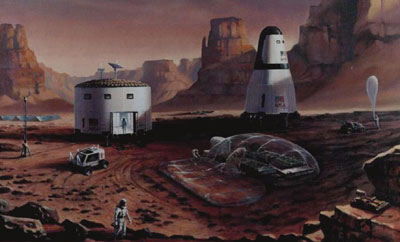

Mars Direct has emerged as the leading architecture for human missions to Mars. However, that doesn’t mean that there’s no room for improvement. (credit: Mars Society)

If one or more nations decide to go to Mars within our lifetime, I believe that they will use Robert Zubrin’s Mars Direct plan as the blueprint for the mission. His plan provides a realistic scenario for sending a crew to Mars for an investment of time and money similar to what was spent on the Apollo program. The Case for Mars, first published in 1996, explains this plan in detail.
https://www.thespacereview.com/article/65/1

66) Missile defense, RLVs, and the future of American spacepower
by Taylor Dinerman Monday, December 1, 2003
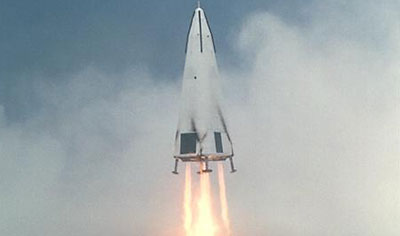

The genesis of the DC-X program (shown here in its NASA-funded DC-XA version) was a desire to reduce launch costs to support a missile defense program. (credit: NASA)

“We know from history that every medium—air, land and sea—has seen conflict. Reality indicates that space will be no different. Given this virtual certainty, the U.S. must develop the means to both deter and to defend against hostile acts in and from space.”
—Rumsfeld Commission Report, January 2001

In the 1980s, the opponents of “Star Wars” often claimed that “the effective protection of a nation against nuclear attack had never been a serious prospect (and in the view of most scientists, is not today).” The naysayers’ argument was more with Isaac Newton and with Earth’s gravity field than it was with Ronald Reagan or Edward Teller and the others who wanted to defend America and its allies against ballistic missiles.
https://www.thespacereview.com/article/66/1

67) There are plenty of ideas, but no consensus, on the future of US space policy. Does this mean nothing will change?
by Jeff Foust Monday, December 1, 2003


Speakers at the ASA’s forum in the House Science Committee’s hearing room on Capitol Hill. (credit: J. Foust)
Vision revision


A lot has been said and written in recent weeks about the desire, if not the necessity, for an overarching new policy, or vision, for US space efforts (see “The vision thing”, The Space Review, November 10, 2003). A lot of people, in Congress and elsewhere, have spoken of the need to give NASA in particular a bold new goal that can give the space agency a focus during a time when many perceive the agency to be without direction. The fact that the Bush Administration is currently carrying out a secretive internal space policy review, with results that could be announced within weeks, has emboldened those calling for a new space vision.
https://www.thespacereview.com/article/67/1

43/XII 2003 [68-70]

68) The necessity of launch range upgrades
by Winston W. Gardner, Jr. Monday, December 8, 2003


A view of the Cape Canaveral Spaceport from orbit. (credit: USGS)

The Air Force’s Eastern Range, extending from the Cape Canaveral Spaceport over the Atlantic and into space, is a complex system of equipment and people designed to ensure the safety of launches from the spaceport. The range has done its job with great success, but over the years has earned a reputation for excessive complexity and cost. Designed around the needs of mature, operational, largely government-supported launch programs (Atlas, Delta, Titan, Shuttle), the range is becoming too expensive and inflexible for new launch programs.
https://www.thespacereview.com/article/68/1

69) How important is the Moon?
by Taylor Dinerman Monday, December 8, 2003
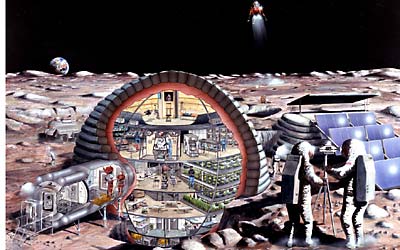

A 1980s-era illustration of what a future moonbase might look like. (credit: NASA)

The last week has seen renewed speculation over whether or not the President will announce a new space policy, one that will take America back to the Moon to stay. The debate over why we should or should not go naturally will intensify.

Of course there are lots of good, basic reasons why we should build a sustainable moonbase. They have been laid out over the years by the space advocacy community. The scientific and technological knowledge to be gained by building such a base is huge. The moon is an ideal point from which to launch missions to Mars and beyond. Mineral and energy resources, for example, helium-3, are there to be exploited.
https://www.thespacereview.com/article/69/1

70) The Falcon and the showman
by Jeff Foust Monday, December 8, 2003


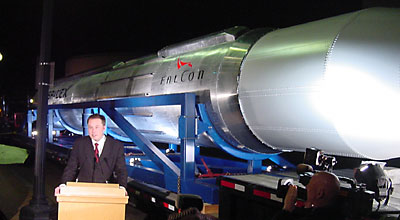
Elon Musk talks about the Falcon and SpaceX’s plans for the future outside the National Air and Space Museum in Washington. (credit: J. Foust)

The National Mall, and the streets surrounding it in downtown Washington, has been home to a wide range of events. It has seen parades, demonstrations, rallies, festivals, fireworks, and, three months ago, a concert to kick off the NFL season, featuring an increasingly overexposed (in multiple senses of the term) Britney Spears. The area can now add one more event to its history: the unveiling of a new commercial rocket.
https://www.thespacereview.com/article/70/1

Photo Gallery: Falcon unveiling
https://www.thespacereview.com/gallery/3

44/XII 2003 [71-73]

71) To Mars, to Mars
by Taylor Dinerman Monday, December 15, 2003
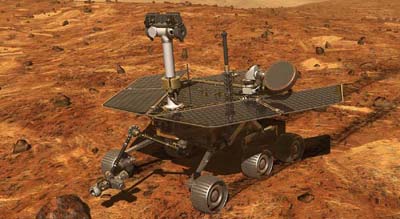

With any luck NASA’s twin Mars Exploration Rovers will soon be rolling across the terrain of the Red Planet, looking for evidence of water and life. (credit: NASA)

Many, if not most, space enthusiasts are familiar the refrain from Elaine Walker’s song : “To Mars, to Mars, it’s halfway to the stars.” If not astronomically correct, it does have a certain poetic power. Sending people to Mars is by far the most difficult of the conceivable manned missions that the US or anyone else could hope to carry out within the next forty or fifty years. Realistically no US President is going to decide to send people to Mars anytime soon. Going to the Moon or to L-1 seems the best we can hope for.
https://www.thespacereview.com/article/71/1

72) A new hangar for the nation’s attic
by Jeff Foust Monday, December 15, 2003
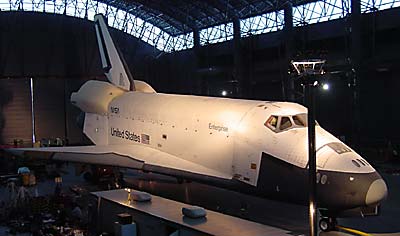

The space shuttle Enterprise is one of the highlights of the new Udvar-Hazy Center, but viewing of the orbiter will be limited for the next several months. (credit: J. Foust)

The Smithsonian’s National Air and Space Museum (NASM) is an impressive facility. Spanning nearly two blocks along the National Mall in downtown Washington, it is home to some of the most important artifacts in the history of aviation and spaceflight, from the Wright Flyer and the Spirit of St. Louis to the X-15 and the Apollo 11 command module. With an average attendance of nine million people a year (10.8 million in fiscal year 2003, a year that saw attendance decreases at other Washington-area museums because of the recession and continued 9/11 aftermath), the museum bills itself as the most popular on the planet.
https://www.thespacereview.com/article/72/1

Photo Gallery: NASM Udvar-Hazy Center
https://www.thespacereview.com/gallery/4

73) Suborbital spaceflight: a road to orbit or a dead end?
by Clark S. Lindsey Monday, December 15, 2003
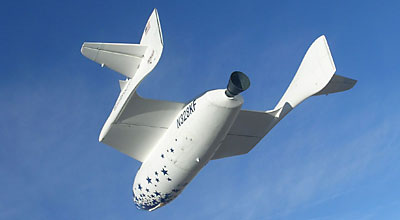

Scaled Composites’ SpaceShipOne, seen above during a glide test earlier this month, is one of the best known planned suborbital RLVs. However, is it a dead end on the path to orbital RLVs? (credit: Scaled Composites)

When Burt Rutan introduced the SpaceShipOne (SS1) to the world last spring, the debut attracted tremendous publicity to the X Prize competition and boosted the credibility of the promise for routine passenger flights on reusable suborbital space vehicles. Space activists hailed it as a major milestone on the long uphill climb to a commercial human spaceflight industry.
https://www.thespacereview.com/article/73/1

45/XII 2003 [74-76]

74) Letters: Europe’s space science program
by David Parker Monday, December 22, 2003
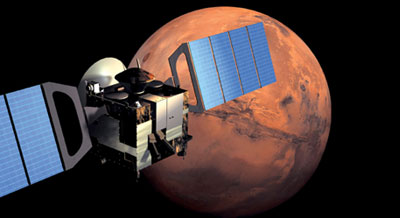

ESA’s Mars Express mission is far from the last of the agency’s science missions, accordingf to Parker. (credit: ESA)

As a European citizen involved in the space science program over here, I find the Space Review interesting and stimulating. However, it does sometimes reflect a rather Americo-centric view of the world, and the article entitled “To Mars, to Mars” by Taylor Dinerman dated Monday, December 15, 2003 has driven me to correct the significant errors in this paragraph:

The European Mars Express/Beagle 2 mission is a first for ESA and is one of the few missions they are doing that conforms to their declared science and exploration role. In fact, given the cuts in space science this may be (along with Rosetta) one of the last classic European space missions. As ESA becomes more of a quasi-military organization and less of a scientific one probes such as these will be less common while their money and effort will go into projects such as Galileo and GMES.
https://www.thespacereview.com/article/74/1

75) Review: recalling Sojourner
Monday, December 22, 2003


Sojourner: An Insider’s View of the Mars Pathfinder Mission
By Andrew Mishkin
Berkley Books, 2004
Hardcover, 334pp., illus.
ISBN 0-425-19199-0
US$21.95/C$33.00
https://www.amazon.com/exec/obidos/ASIN/0425191990/spaceviews

Next month NASA’s twin Mars Exploration Rovers, dubbed Spirit and Opportunity, will, if all goes well, spend several weeks moving around their widely-separated landing sites, collecting data on the composition of the rocks and soils there. A successful mission could help scientists understand the early history of the Red Planet, including how much water it had and where that water went, and could generate momentum for future robotic and even human exploration of the planet. The Mars Exploration Rovers will also draw comparisons with another, although very different, rover mission: the Sojourner rover on Mars Pathfinder.
https://www.thespacereview.com/article/75/1

76) (Space) history accelerates
by Taylor Dinerman Monday, December 22, 2003
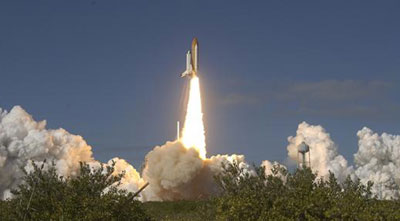

The Columbia accident has called attention to not only problems with the shuttle, but the difficulties faced with giving NASA a new direction and appropriate funding. (credit: NASA/KSC)

Since the attack on 9/11, things have been speeding up all over the world. The War on Terrorism and the changes linked to this have ended all the wishful thinking that had become commonplace since the Berlin Wall came down in 1989. America’s holiday from history is over.

The Columbia disaster has had a similar effect on the US space program. Before February 1, 2003, America was, for all intents and purposes, stuck in low Earth orbit (LEO). Sure, there was a thriving robotic exploration program, but the major part of NASA’s spaceflight budget was being spent on the ISS and the Shuttle that serviced it. While there were plenty of ideas to expand human presence in the solar system, there was no commitment by either the Congress or the Administration to do so.
https://www.thespacereview.com/article/76/1

46/XII 2003 [77-78]

77) Scaled Composites’ SpaceShipOne: stunt plane or new road to the stars?
by Taylor Dinerman Monday, December 29, 2003

SpaceShipOne breaks the sound barrier during its first powered flight on December 17, 2003. (credit: Scaled Composites)

The first privately-financed flying machine ever to go faster than Mach 1 fired its engine for the first time on December 17, 2003, the hundredth anniversary of the Wright Brothers’ first flight. At the same time it was revealed that Paul Allen, the co-founder of Microsoft, financed the development of both SpaceShipOne and its White Knight carrier aircraft. It was suitably symbolic that someone who made his money in our current information age should have financed this new step. It was the prosperity caused by the information systems developments of early 20th century, specifically National Cash Register (NCR) headquartered in Dayton, that created enough surplus wealth that trickled down to the Wright’s bike shop.
https://www.thespacereview.com/article/77/1

78) A year-end reality check
by Jeff Foust Monday, December 29, 2003
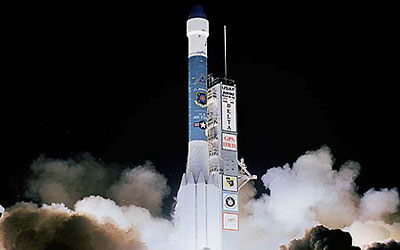

A Delta 2 lifts off early December 21 on the 60th launch of 2003. Does such a level of launch activity represent a “blistering pace” or an industry with deep institutional problems? (credit: Boeing)

On a busier day I might not ever have noticed it. On the afternoon of the Friday before Christmas, the January issue of SpaceWatch, the newsletter of the Space Foundation, arrived in my email inbox. Normally I quickly scan through such organizational newsletters, looking for the highlights, and then set them aside to be read later—if ever. However, that Friday afternoon was a little slow and, with a few spare minutes available, I took the time to read the newsletter a little more closely.
https://www.thespacereview.com/article/78/1
« Ostatnia zmiana: Lipca 25, 2026, 12:12 wysłana przez Orionid »

Polskie Forum Astronautyczne

Odp: The Space Review
« Odpowiedź #14 dnia: Czerwca 16, 2020, 09:13 »