Autor Wątek: The Space Review  (Przeczytany 134851 razy)

0 użytkowników i 1 Gość przegląda ten wątek.

Online Orionid

  • Weteran
  • *****
  • Wiadomości: 28845
  • Very easy - Harrison Schmitt
Odp: The Space Review
« Odpowiedź #90 dnia: Października 08, 2020, 07:46 »
Mars ain’t the kind of place to take your kid: Netflix’s “Away”
by Dwayne A. Day Monday, October 5, 2020


Netflix’s “Away” is about a crew on a journey to Mars, but much of the story takes place on Earth and feels no different than a typical suburban melodrama on basic cable.

How do we measure what is in the popular culture, what occupies the zeitgeist? Certainly some things are obvious. But what about the subjects that do not overwhelm popular discussion, but nevertheless occasionally rise up above the din? Subjects like Mars. Where is Mars in our popular culture today? (...)
https://www.thespacereview.com/article/4041/1

Online Orionid

  • Weteran
  • *****
  • Wiadomości: 28845
  • Very easy - Harrison Schmitt
Odp: The Space Review
« Odpowiedź #91 dnia: Października 13, 2020, 17:59 »
Review: Neutron Stars
by Jeff Foust Monday, October 12, 2020


Neutron Stars: The Quest to Understand the Zombies of the Cosmos
by Katia Moskvitch
Harvard Univ. Press, 2020
hardcover, 304 pp., illus.
ISBN 978-0-674-91935-8
US$29.95
https://www.amazon.com/exec/obidos/ASIN/0674919351/spaceviews

There’s too much gold in the universe. That’s the conclusion of a recent study that compared the abundances of gold measured in our solar system with the known mechanisms for producing gold. The primary way to create it, astronomers believe, is when two neutron stars collide (supernovae don’t help, since any star massive enough to produce gold through fusion will end up as a black hole, trapping the gold within it.) But, the study’s authors noted, neutron star collisions don’t appear to be frequent enough to produce the gold we do see. Either another process creates gold, or neutron star collisions create more gold than astronomers expect. (...)
https://www.thespacereview.com/article/4042/1

Online Orionid

  • Weteran
  • *****
  • Wiadomości: 28845
  • Very easy - Harrison Schmitt
Odp: The Space Review
« Odpowiedź #92 dnia: Października 13, 2020, 17:59 »
Space entrepreneurs need to look to the stars but keep their feet on the ground
by Nicholas Borroz Monday, October 12, 2020


Many get into the space industry seeking to pursue interesting technologies, like reusable rockets; a sustainable business plan is only a secondary concern. (credit: SpaceX)

The space sector is one where technological marvels are widely celebrated. As private firms become more influential in the sector, there has been a veritable explosion of exciting plans for employing next-generation technologies. This creativity is inspiring, but it also has drawbacks. Entrepreneurs should continue pursuing their visions, but they should also make sure to ground their enterprises in reality. They should clearly understand how their activities benefit others. (...)
https://www.thespacereview.com/article/4043/1

Online Orionid

  • Weteran
  • *****
  • Wiadomości: 28845
  • Very easy - Harrison Schmitt
Odp: The Space Review
« Odpowiedź #93 dnia: Października 13, 2020, 17:59 »
In the paler moonlight: the future’s past in “For All Mankind”
by Dwayne A. Day Monday, October 12, 2020

Note: This article contains spoilers for the first and second seasons of For All Mankind.


“For All Mankind’s” first season ended with an American base on the Moon. In season 2, set in the 1980s, the base has expanded, and become the focus of the Cold War struggle with the Soviet Union.

The second season of Apple TV+’s “For All Mankind” was filming when reality intervened, halting production after eight episodes had been shot, although production resumed late in the summer. For a show about world events to be derailed by a world event is perhaps overly ironic, but despite the delay, the producers did release a trailer for season two, and it indicates that things are heating up on the Moon. (...)
https://www.thespacereview.com/article/4044/1

Polskie Forum Astronautyczne

Odp: The Space Review
« Odpowiedź #93 dnia: Października 13, 2020, 17:59 »

Online Orionid

  • Weteran
  • *****
  • Wiadomości: 28845
  • Very easy - Harrison Schmitt
Odp: The Space Review
« Odpowiedź #94 dnia: Października 13, 2020, 17:59 »
The three administrators
by Jeff Foust Monday, October 12, 2020


Former NASA administrator Charlie Bolden, seen here at a 2019 conference, joined two of his predecessors in the Aviation Week webinar last week. (credit: NASA/Aubrey Gemignani)

NASA administrators get plenty of advice, solicited and unsolicited, while on the job. Politicians, executives, scientists, and others are more than willing to weigh in on what the agency’s leader should do. The best advice, though, might come from the people who previously held the job—if they’re willing to give it. (...)
https://www.thespacereview.com/article/4045/1

Online Orionid

  • Weteran
  • *****
  • Wiadomości: 28845
  • Very easy - Harrison Schmitt
Odp: The Space Review
« Odpowiedź #95 dnia: Października 13, 2020, 18:00 »
Semantics in lexicon: Moving away from the term “salvage” in outer space
by Michael J. Listner Monday, October 12, 2020


As more efforts get started to repair and revive derelict satellites, the space industry needs to reconsider its use of “salvage” when describing such operations. (credit: Northrop Grumman)

The idea of salvage in outer space is one that evokes fervent discussions about space debris and recovering defunct satellites for possession. The idea of salvage in outer space is misunderstood and mischaracterized by private space enthusiasts, and is one I’ve discussed here before (see “Taking salvage in outer space from fiction to fact”, The Space Review, March 20, 2017). Moreover, I suggested that a form of salvage, akin to contract salvage in the maritime domain, might be an appropriate model for outer space and that a precedent has already laid the groundwork with the recovery of the Palpa B and Weststar VI satellites by NASA and the Space Shuttle.[1] The successful rendezvous and servicing operation performed on Intelsat 901 by the SpaceLogistics Mission Extension Vehicle 1 (MEV-1) earlier this year and a follow-on mission by MEV-2 with the Intelsat 10-02 next year lays the groundwork for opportunities for more of these activities in outer space. (...)
https://www.thespacereview.com/article/4046/1

Online Orionid

  • Weteran
  • *****
  • Wiadomości: 28845
  • Very easy - Harrison Schmitt
Odp: The Space Review
« Odpowiedź #96 dnia: Października 20, 2020, 15:53 »
Review: Canadarm and Collaboration
by Jeff Foust Monday, October 19, 2020


Canadarm and Collaboration: How Canada’s Astronauts and Space Robots Explore New Worlds
by Elizabeth Howell
ECW Press, 2020
paperback, 240 pp.
ISBN 978-1-77041-442-6
US$19.95
https://www.amazon.com/exec/obidos/ASIN/1770414428/spaceviews

For most people in the space field, the first thing that comes to mind when thinking about Canada’s space program is its series of robotic arms (with the possible recent exception of former astronaut/social media personality Chris Hadfield.) Over the last four decades, Canada has become synonymous with those systems, first with the Canadarm on the shuttle and then Canadarm2 and the Dextre manipulator on the space station. The back of the Canadian five-dollar bill includes an illustration of Canadarm2, while a model of a robotic manipulator was visible in the office of new Canadian Space Agency president Lisa Campbell last week when she participated in a virtual signing ceremony for the NASA-led Artemis Accords. (...)
https://www.thespacereview.com/article/4047/1

Online Orionid

  • Weteran
  • *****
  • Wiadomości: 28845
  • Very easy - Harrison Schmitt
Odp: The Space Review
« Odpowiedź #97 dnia: Października 20, 2020, 15:54 »
Is the New Zealand commercial space success story a model for other countries?
by Marçal Sanmartí Monday, October 19, 2020


New Zealand’s Cook Strait viewed from the International Space Station. (credit: NASA)

These remotely located group of islands in the South Pacific with a population of just five million people has a tradition of punching above its weight. New Zealand is a primary industries powerhouse; probably hosts the best known and successful rugby team on Earth, the All Blacks; and is seen internationally as a champion in the fight against COVID-19. The space sector is emerging as another such area—ironic, considering that locals refer themselves as kiwis, the name of a local flightless bird! (...)
https://www.thespacereview.com/article/4048/1

Online Orionid

  • Weteran
  • *****
  • Wiadomości: 28845
  • Very easy - Harrison Schmitt
Odp: The Space Review
« Odpowiedź #98 dnia: Października 20, 2020, 15:54 »
Rock-solid (Blue) Cube: Galileo and the 1989 Loma Prieta earthquake
by Joseph T. Page II Monday, October 19, 2020


The US Air Force Satellite Control Facility circa 1984, located near Sunnyvale, California.

Thirty-one years ago, the United States space program placed a mark in the “win” column amidst a terrible terrestrial tragedy. On October 18, 1989, the shuttle Atlantis lifted off from Cape Canaveral’s Launch Complex 39B, carrying the Jupiter-bound Galileo space probe atop its Inertial Upper Stage (IUS) booster. While the Galileo saga included many epic twists and turns over the decades since its conception, one of the most inspiring stories came from the unlikeliest of places: a non-descript blue building in Sunnyvale, California less than 24 hours before the launch. (...)
https://www.thespacereview.com/article/4049/1

Online Orionid

  • Weteran
  • *****
  • Wiadomości: 28845
  • Very easy - Harrison Schmitt
Odp: The Space Review
« Odpowiedź #99 dnia: Października 20, 2020, 15:54 »
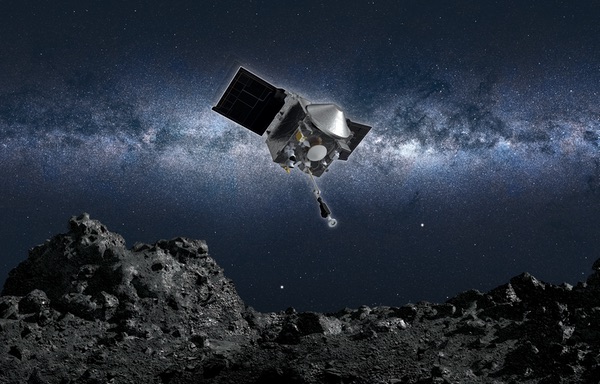
TAG, Bennu, you’re it
by Jeff Foust Monday, October 19, 2020


An illustration of OSIRIS-REx, its sample gathering arm extended, approaching the surface of the asteroid Bennu. (credit: NASA/Goddard/University of Arizona)

Some call it a fist bump. Others, a “boop.” But the formal name is “touch and go,” or TAG, which clearly illustrates what NASA will attempt to do Tuesday.

The Origins, Spectral Interpretation, Resource Identification, Security-Regolith Explorer (OSIRIS-REx) spacecraft—one of the more convoluted acronyms in NASA’s history—has been orbiting the asteroid Bennu since late 2018, studying the asteroid while scouting for a landing site. On Tuesday, the spacecraft will descend towards the selected site, dubbed Nightingale, extending a robotic arm with a sampling mechanism, called TAGSAM, on the end. If all goes well, that mechanism will touch down on the surface, collect at least 60 grams, and perhaps up to two kilograms, of material, in just five to ten seconds, before the spacecraft pulls away: touch and go. (...)
https://www.thespacereview.com/article/4050/1

Online Orionid

  • Weteran
  • *****
  • Wiadomości: 28845
  • Very easy - Harrison Schmitt
Odp: The Space Review
« Odpowiedź #100 dnia: Października 20, 2020, 15:54 »
Applied witchcraft: American communications intelligence satellites during the 1960s
by Dwayne A. Day Monday, October 19, 2020


A TOPHAT communications intelligence satellite launched in 1970. This satellite was about the size of a small refrigerator and gathered up Soviet communications from low Earth orbit. (credit: NRO)

During the Battle of Midway in June 1942, Admiral Chester Nimitz, Commander in Chief of the US Pacific Fleet, monitored the battle from his command center in Pearl Harbor, picking up snippets of radio traffic from both American and Japanese forces. After hearing that American planes had spotted the Japanese carriers and started their attack, Nimitz and his officers heard nothing more from the Japanese carriers for a long period, but then intercepted a message from the Japanese force seeking the location of the American fleet. After another long silence, the Americans intercepted a coded Japanese message. The call sign on the message was Vice Admiral Chuichi Nagumo, whose flagship was the carrier Akagi. But one of the American naval officers present had become an expert at identifying the styles of the Japanese operators who tapped out coded messages. This message was not tapped out by the Akagi’s heavy-handed warrant officer, but instead by the chief radioman in the cruiser Nagara. The Americans concluded from this small bit of evidence that the Akagi had been damaged too heavily to serve as flagship, and Nagumo had shifted his command to the cruiser. In fact, Akagi was in flames, Nagumo had barely escaped alive by climbing down a rope from the ship’s bridge, and the carrier, which had participated in the attack on Pearl Harbor, would sink within the day. (...)
https://www.thespacereview.com/article/4051/1

Online Orionid

  • Weteran
  • *****
  • Wiadomości: 28845
  • Very easy - Harrison Schmitt
Odp: The Space Review
« Odpowiedź #101 dnia: Października 27, 2020, 14:48 »
If we are going forward to the Moon, don’t go back to Apollo
by Christopher Cokinos Monday, October 26, 2020


Aristarchus crater might be a better alternative landing site for the first Artemis missions than an Apollo site, if the south pole of the Moon is ruled out. (credit: NASA/GSFC/Arizona State University)

NASA Administrator James Bridenstine recently surprised the space community by suggesting that the first crewed Artemis surface mission to the Moon, slated for 2024, might not land at the south pole as previously discussed but instead could revisit one of the Apollo landing sites in the easier-to-reach lunar equatorial regions. (...)
https://www.thespacereview.com/article/4052/1

Online Orionid

  • Weteran
  • *****
  • Wiadomości: 28845
  • Very easy - Harrison Schmitt
Odp: The Space Review
« Odpowiedź #102 dnia: Października 27, 2020, 14:48 »
From the Truman Proclamation to the Artemis Accords: steps toward establishing a bottom-up framework for governance in space
by Alfred B. Anzaldúa and Cristin Finnigan Monday, October 26, 2020


Should lunar governance for future exploration and other activities be done in a bottom-up or top-down way? (credit: NASA)

Humanity stands at the doorway of an astounding societal transformation. While many people worldwide pass time attending to urgent personal matters or frivolous entertainments, nation states and private parties harbor serious plans to launch missions to the Moon, Mars, and beyond to establish permanent outposts and communities. Such extraterrestrial activity offers vast potential to unleash “infinite opportunity, boundless freedom, and unfettered creativity.”[1] (...)
https://www.thespacereview.com/article/4053/1

Online Orionid

  • Weteran
  • *****
  • Wiadomości: 28845
  • Very easy - Harrison Schmitt
Odp: The Space Review
« Odpowiedź #103 dnia: Października 27, 2020, 14:49 »
The Artemis Accords take shape
by Jeff Foust Monday, October 26, 2020


Representatives of the US and seven other nations signed the Artemis Accords in a virtual ceremony October 13. (credit: NASA)

It was a signing ceremony for the Zoom era. On the screens of attendees of the virtual International Astronautical Congress October 13, as well as anyone who tuned in to NASA TV, was a three-by-three array of screens, a fancy version of video chats that have become commonplace. In each window, a government official put pen to paper; some matter-of-factly, others proudly showing off the document they signed. (...)
https://www.thespacereview.com/article/4054/1

Online Orionid

  • Weteran
  • *****
  • Wiadomości: 28845
  • Very easy - Harrison Schmitt
Odp: The Space Review
« Odpowiedź #104 dnia: Października 27, 2020, 14:49 »
Swords into plowshares: the top secret PERCHERON project
by Dwayne A. Day Monday, October 26, 2020


One of the last KH-7 GAMBIT-1 reconnaissance satellites was launched in early 1967. General Electric proposed using the successful spacecraft for NASA missions, but ran headlong into secrecy issues, angering officials at the National Reconnaissance Office, which procured and operated GAMBIT. (credit: Peter Hunter Collection)

In the 1960s, NASA had the coolest stuff. They had Mars probes and lunar landers, Gemini spacecraft and spacesuits and the coolest of the cool, the Saturn V rocket. But NASA didn’t have everything. The top secret National Reconnaissance Office, with a budget that was probably only 15% as big as NASA’s, had some powerful camera systems, large high-quality optical mirrors inside spacecraft that the NRO routinely launched into low Earth orbit. NASA had fledgling astrophysics and Earth observation programs that could benefit from the NRO’s technology, but there were policy and secrecy requirements that prevented NASA from acquiring them. Nevertheless, companies that built this equipment for the NRO looked at NASA as another potential customer and sought out ways to sell it to them. And sometimes those efforts went badly. PERCHERON is one of those stories. (...)
https://www.thespacereview.com/article/4055/1

Polskie Forum Astronautyczne

Odp: The Space Review
« Odpowiedź #104 dnia: Października 27, 2020, 14:49 »