3/I 2019 [11-15]11)
A bad start to a great yearby A.J. Mackenzie Monday, January 21, 2019
 Just days after Stratolaunch completed a taxi text of its giant aircraft that appeared to signal it was ready for its first flight, the company cancelled work on the launch vehicles it was going to carry. (credit: Stratolaunch)
When 2019 started a few weeks ago, there were optimism about the year ahead. Blue Origin and Virgin Galactic would soon start flying people, many predicted, especially given Virgin’s successful SpaceShipTwo flight last month. Then there’s Boeing and SpaceX, who are scheduled to make their commercial crew test flights this year—just in time for NASA, since the clock is running out on access to Russia’s Soyuz. And then there are all the companies planning small launch vehicles that expect to make their first launches this year.
https://www.thespacereview.com/article/3641/112)
Beyond UNISPACE: It’s time for the Moon Treatyby Dennis C. O’Brien Monday, January 21, 2019
 While critics of the Moon Treaty have argued that it would hinder commercial space activities, like asteroid mining, with the proper implementing agreement it could in fact enable them. (credit: Brian Versteeg/Deep Space Industries)
In 1968, the United Nations convened UNISPACE, the United Nations Conference on the Exploration and Peaceful Uses of Outer Space. It was the first of a series of UN-sponsored conferences intended to create an international framework of laws to guide humanity’s departure from the home planet. Alas, the effort has failed. The Moon Treaty, along with an Implementation Agreement, now appears to be the best hope for moving humanity forward.
https://www.thespacereview.com/article/3642/113)
Mars: Bringer of ennui (part 1)by Dwayne A. Day Monday, January 21, 2019
 The second season of Mars features a clash between a scientific base and commercial prospectors, but one that doesn’t really come together. (credit: National Geographic Channel)
Two years ago, the National Geographic Channel debuted its first scripted television show. Mars had an unusual structure for TV, alternating between documentary segments, expert talking heads, and dramatic segments set during the first human mission to Mars in 2033. (See: “Red Planet blues: popular entertainment and the settlement of Mars, part 2,” The Space Review, December 5, 2016, and “Red zeitgeist: popular entertainment and the settlement of Mars, part 3,” The Space Review, January 16, 2017.) The first season, consisting of six episodes, featured some excellent and insightful documentary segments and commentary, but the drama segments, which were closely tied to the documentary stories, were grim and depressing. Now, two years later, season two has aired. Unfortunately, that same dynamic was repeated: often stunning documentary segments and intelligent commentary interspersed with tedious and uninspiring drama. If National Geographic has a message about the human exploration of Mars, it is that nobody will have any fun.
https://www.thespacereview.com/article/3643/114)
Selecting the next great space observatoryby Jeff Foust Monday, January 21, 2019
 The Lynx x-ray observatory is one of the four large strategic, or flagship, astrophysics missions being studied for consideration by the 2020 decadal survey. (credit: NASA)The great space telescope race is on.
In the next few months, the next decadal survey for astronomy and astrophysics—usually called just “Astro2020” by scientists and others involved—will get underway. In late November the National Academies announced the selection of the two co-chairs of the once-every-ten-years study of astronomy research priorities, Fiona Harrison of Caltech and Robert Kennicutt Jr. of the University of Arizona and Texas A&M University. The rest of the committee overseeing the study will be selected by this spring (nominations are open through January 22, but could be extended because of the ongoing partial government shutdown.)
https://www.thespacereview.com/article/3644/115)
There is no space raceby Roger Handberg Monday, January 21, 2019
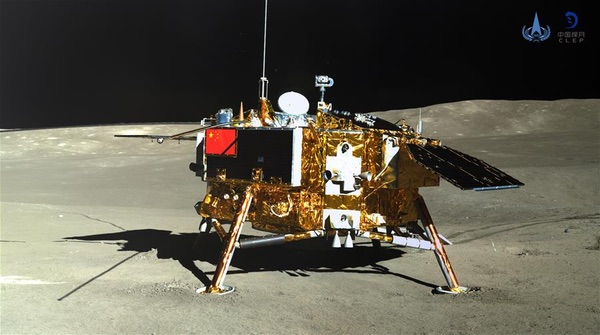 The Chang’e-4 lunar lander, seen by the Yutu-2 rover, after landing on the Moon earlier this month. (credit: CNSA)
The landing of Chang’e-4 on the far side of the Moon is a triumph for Chinese space exploration, reflecting technological sophistication in launching a communications satellite to orbit the Moon so that Chang’e-4 could communicate back to Earth. China provided the location of its spacecraft to NASA so that its Lunar Reconnaissance Orbiter could produce images of exact location where the lunar lander and its rover landed. That exchange, while no big deal technically, was symbolic of the reality that many are unwilling to accept for different reasons: there is no space race.
https://www.thespacereview.com/article/3645/1
 Wątek: The Space Review (Przeczytany 195167 razy)