Autor Wątek: The Space Review  (Przeczytany 183100 razy)

0 użytkowników i 1 Gość przegląda ten wątek.

Offline Orionid

  • Weteran
  • *****
  • Wiadomości: 29849
  • Very easy - Harrison Schmitt
Odp: The Space Review
« Odpowiedź #105 dnia: Października 27, 2020, 14:49 »
14/IV 2004 [42-45]

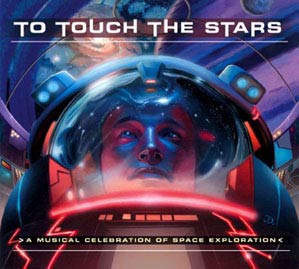
42) Review: To Touch the Stars
by Jeff Foust Monday, April 5, 2004


Several months back, while browsing through a dusty stack of old CDs at home, I ran across an album from a little-known Boston-based group called Tribe, a band that was performing alternative rock back before alternative rock became mainstream. In 1993 they released an album called “Sleeper” that included a track titled “Supercollider” that was about, believe it or not, the Superconducting Supercollider (SSC) then under development in Texas. The song got some airplay on some Boston radio stations, which is how I first heard the song; that led me to eventually buy the CD. (Who can resist lyrics like “Goodbye Princeton/Goodbye CERN/He’s off to Texas/To watch the holy fire burn”?) Sadly, Tribe broke up not long after Sleeper came out, around the time the SSC itself met its demise.

43) American strategy for space: comments on a French perspective
by Taylor Dinerman Monday, April 5, 2004


While it may appear to Europeans that the White House has crafted a grand space strategy, in fact there is “an ongoing and very intense debate” on space issues. (credit: J. Foust)

In the chapter on “The Baffling Americans,” which ended his wonderful 1983 book, The Europeans, the late Luigi Barzini described how one Italian statesman figured out what the US government’s plan of action was because “General X made a speech, he enumerated, the New York Times had published an editorial, Columnist Y had leaked a secret, the Secretary of State had issued a communiqué, the President had answered a particular question at a press conference, Senator Z, had given an interview, the Italian Ambassador had had a hunch… He had connected all these declarations, statements, hunches, leaks and articles and come up with a tidy answer. ‘This is their grand design.’… When he saw the look of incredulity on my face, ‘Don’t you believe it?’ he asked. I explained that, yes, he could be right, but he could also be entirely wrong…”
https://www.thespacereview.com/article/125/1

44) NASA, the Air Force, and space transportation: room for cooperation?
by Jeff Foust Monday, April 5, 2004


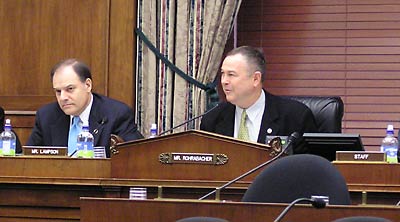
Congressmen Nick Lampson (left) and Dana Rohrabacher question witnesses on the benefits and drawbacks of closer space transportation cooperation during the March 18 hearing. (credit: J. Foust)

At first glance it would seem like NASA and the US Air Force would have a lot in common in space transportation—both have pressing needs to place payloads in space reliably—that would lend itself to cooperation. In practice that hasn’t been the case: the different requirements and cultures of the two agencies have largely precluded any significant cooperation. When they have cooperated the results have often been disappointing, as was the case most infamously with the space shuttle.
https://www.thespacereview.com/article/126/1

45) Lunar rovers past and future
by Anthony Young Monday, April 5, 2004


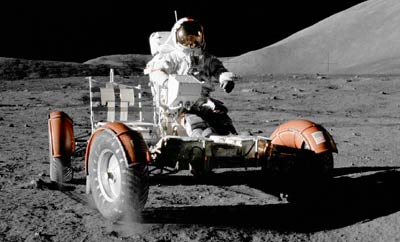
The lunar rover developed for the Apollo program provides a good starting point for planning future vehicles. (credit: NASA)

In his January 14, 2004 speech at NASA Headquarters proclaiming a new vision of United States space exploration, President Bush announced a return to the Moon by 2020 with a renewed commitment of lunar exploration. Notwithstanding the political (read: funding) minefields that await, future astronauts returning to the moon will most certainly have a lunar rover to fulfill their tasks. How different would it really be from the 1972 model? To get the answer, a bit of history is in order first.
https://www.thespacereview.com/article/127/1

15/IV 2004 [46-48]

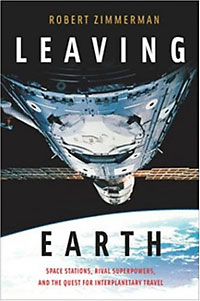
46) Review: Leaving Earth
by Jeff Foust Monday, April 12, 2004


Leaving Earth: Space Stations, Rival Superpowers, and the Quest for Interplanetary Travel
by Robert Zimmerman
Joseph Henry Press, 2003
Hardcover, 528pp., illus.
ISBN 0-309-08548-9
US$27.95/C$37.95
https://www.amazon.pl/s?k=Leaving+Earth%3A+Space+Stations%2C+Rival+Superpowers%2C+and

Why build a space station? Since the beginning of the Space Age the stations that have flown have fallen short of the ideals of space advocates and science fiction writers, who foresaw orbiting hubs of transportation and commerce—the giant spinning station from 2001: A Space Odyssey, complete with Pan Am shuttles and a Hilton hotel, being perhaps the best-known example. Instead, the space stations that have been built have been, at best, modest conglomerations of modules and solar arrays, serving as cramped homes for two or three people who spend much of their time simply keeping their station operating. The justification for such facilities has been rooted primarily in geopolitics—first Cold War competition, now international cooperation—coated with a thin veneer of science.
https://www.thespacereview.com/article/128/1

47) Future British military space policy
by Taylor Dinerman Monday, April 12, 2004
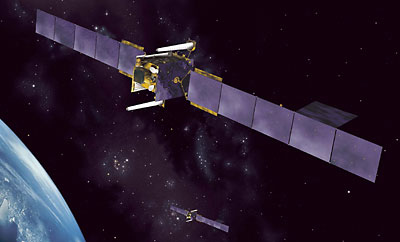

The Skynet 5 military communications satellites could prove vulnerable to attack unless the UK develops countermeasures—and perhaps space weapons of its own. (credit: EADS)

No, this is not a joke. The UK does have a variety of military space systems and is developing more. It is inconceivable that any British government would ever willingly give up its status as a first-rank, medium-sized military power. Thus, they will have to develop a far more sophisticated and comprehensive approach to military operations in orbit than they have up to now. The Blair government was the first to have anything remotely resembling a civil space policy. The next British government, whether Labour or Conservative, will have to think about the military aspects of outer space.
https://www.thespacereview.com/article/129/1

48) The feminization of American space policy
by Dwayne A. Day Monday, April 12, 2004
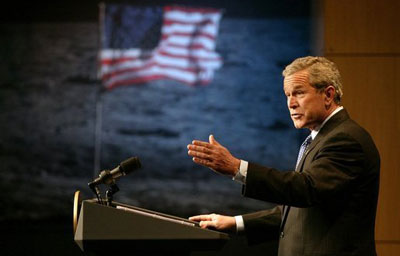

When President Bush spoke at NASA Headquarters three months ago, one key aspect was missing from his speech: any mention of American “leadership” in space. (credit: White House)

When President George W. Bush announced a new civilian space policy at NASA Headquarters on January 14 he used much of the language typical of such speeches. He talked of vision and the bravery of explorers like Lewis and Clark, who traveled far and opened new frontiers. He cracked a couple of small jokes and spoke of the pioneering spirit that was part of America’s heritage.
https://www.thespacereview.com/article/130/1

16/IV 2004 [49-51]

49) Review: future space technologies
by Taylor Dinerman Monday, April 19, 2004



Advanced Space System Concepts and Technologies: 2010-2030+
by Ivan Bekey
Aerospace Corporation/AIAA, 2003
Softcover, 293 pp., illus.
ISBN 1-884989-12-8
US$34.95
https://www.amazon.pl/s?k=Advanced+Space+System+Concepts+and+Technologies

Broadly speaking, there are two kinds of visionaries. There are those who mostly study history and derive their lessons from what has gone before, and there are those who study science and technology and base their ideas on what is possible. Both types are needed in any forward-looking society. Alvin Toffler is a good example of the former and Ivan Bekey is an excellent example of the latter.
https://www.thespacereview.com/article/131/1

50) Levity and gravity: behind the story of Gravity Probe-B
by Dwayne A. Day Monday, April 19, 2004
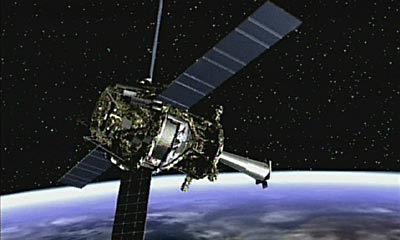

The concept behind Gravity Probe-B dates back more than 40 years, but the technology required to build it delayed its launch until now. s(credit: NASA)

Just about every space scientist will agree that Gravity Probe-B is a survivor. Scheduled for launch from Vandenberg Air Force Base on Monday atop a Delta 2 rocket, it will orbit 400 miles over the Earth’s poles and test Einstein’s General Theory of Relativity. However, it already has cost $700 million—$300 million more than originally estimated and nearly as much as both of NASA’s Mars rovers combined—and is four years late. The stubborn little spacecraft has survived numerous hardware setbacks and delays and congressional scrutiny that should have killed it years ago. One astronomer on a different NASA space science program—who for obvious reasons wishes to remain anonymous—has joked that the Stanford University scientists who built the probe’s instruments either have amazing political skills, or are somehow blackmailing members of Congress, because they have miraculously survived significant problems and cost overruns.
https://www.thespacereview.com/article/132/1

51) Utilizing ET wealth: building a new world
by Gregory Anderson Monday, April 19, 2004
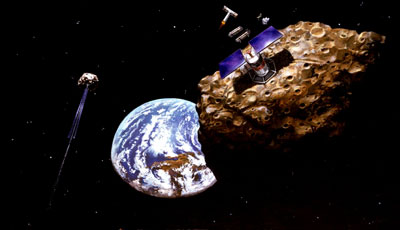

Cataloging and utilizing the vast resources of near Earth asteroids may be the solution to the economic woes of the planet. (credit: NASA)

Fifty years from now, according to UN projections, the human population will have increased by half. Also, according to projections, the gap between rich nation and poor will have widened, and the rate of separation will have begun a dramatic acceleration as the rich nations continue to develop technology-based economies while the poor are left with commodity-based ones, often tied to one commodity. Terrorists will thrive in the desperately poor urban areas of many megacities in the developing world, using the social conditions there to justify their actions. They will also have access to weapons of mass destruction, according to The New Terrorism, a 1999 book by Walter Laquer, a leading expert on terrorism and strategic affairs. The attacks on the World Trade Center and the Pentagon, while monstrous, are only mild tastes of what terrorists in the future could do.
https://www.thespacereview.com/article/133/1

17/IV 2004 [52-55]

52) Review: the quest for SSTO
by Jeff Foust Monday, April 26, 2004


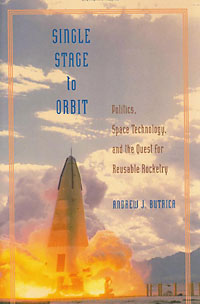
Single Stage to Orbit: Politics, Space Technology, and the Quest for Reusable Rocketry
by Andrew Butrica
Johns Hopkins Press, 2003
Hardcover, 266pp., illus.
ISBN 0-8018-7338-X
US$45
https://www.amazon.pl/s?k=Single+Stage+to+Orbit%3A+Politics%2C+Space+Technology%2C+and+the

At this weekend’s Space Access ’04 conference in Phoenix, Pat Bahn, CEO of suborbital RLV company TGV Rockets, started his presentation by showing an old McDonnell Douglas video from around mid-1996 about the DC-X program. The video recounted the history of the program and the then-recent series of test flights of the modified DC-XA funded by NASA. The video no doubt brought back good memories for many attendees, but Bahn brought them back to the present with his assessment of the program. “The DC-X was a wonderful technical success, but a programmatic failure,” he said. “There are no VTVL [vertical takeoff, vertical landing] vehicles operating, providing services based upon the technology developed.”
https://www.thespacereview.com/article/134/1

53) Heavy lifting for the new millennium
by Anthony Young Monday, April 26, 2004
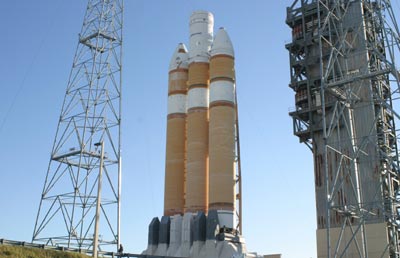

The first Delta 4 Heavy is rolled out to the launch pad for tests in December 2003. (credit: Boeing)

At Space Launch Complex 37, Pad B at Cape Canaveral Air Force Station sits America’s latest EELV, (Evolved Expendable Launch Vehicle): the Boeing Delta 4 Heavy. It is currently undergoing checkout in preparation for its inaugural flight in July. It looks like no Delta ever launched, resembling instead the larger Titan 4, but there the comparison ends. The only thing it has in common with the first Delta launched in 1960 is the name. Much is riding on the launch of the Delta 4 Heavy this summer. The U.S. Air force looks to the Delta 4 Heavy to replace the Titan 4 and NASA is looking to it as a potential booster for its CEV and other payloads.
https://www.thespacereview.com/article/135/1

54) Lunar Reconnaissance Orbiter: the cornerstone of the vision
by Taylor Dinerman Monday, April 26, 2004
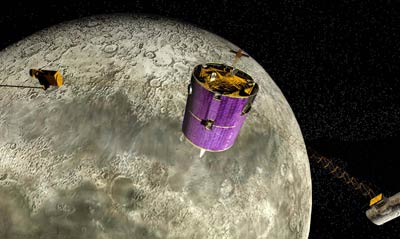

The Lunar Reconnaissance Orbiter will be far more ambitious—and far larger—than recent missions to the Moon, like Lunar Prospector (above). (credit: NASA Ames)

Scheduled to be launched sometime in 2008, the Lunar Reconnaissance Orbiter (LRO) project is quickly approaching the point where some basic decisions have to be made. Given the time it takes for missions such as the LRO to be designed, built, tested, and certified, the need to get the requirements right, and to do so fast, is an early test of Code T and Admiral Steidle’s ability to change the way things get done at NASA.
https://www.thespacereview.com/article/136/1

55) The benefits of a new space race
by Dwayne A. Day Monday, April 26, 2004
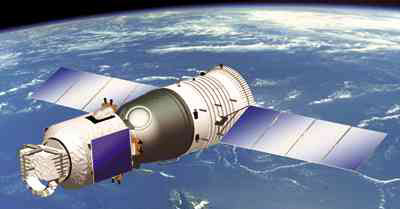

Putting a greater emphasis on manned spaceflight, like the Shenzhou spacecraft (above), forces China to divert resources away from military programs. (credit: CAST)

In October 2003 China became only the third nation to launch a human into space aboard its own rocket. Colonel Yang Liwei, China’s first taikonaut, orbited the Earth for barely a day before returning, slightly shaken, to a landing in Mongolia. It was a significant technical achievement for a country that has been struggling to modernize its economy and its technology, and the Chinese government trumpeted it to its people and the world.
https://www.thespacereview.com/article/137/1
« Ostatnia zmiana: Sierpnia 14, 2026, 06:38 wysłana przez Orionid »

Offline Orionid

  • Weteran
  • *****
  • Wiadomości: 29849
  • Very easy - Harrison Schmitt
Odp: The Space Review
« Odpowiedź #106 dnia: Listopada 03, 2020, 03:29 »
18/V 2004 [56-57]

56) No sex (or any other human activities) in space, please: we’re British!
by Taylor Dinerman Monday, May 3, 2004


Projects like the HOTOL spaceplane have been rare exceptions to British disinterest in human spaceflight. (credit: British Aerospace)

On Wednesday, April 28th, the Drudge Report connected to a story in the left-wing British paper, The Independent, titled “Sex, the final frontier: NASA acts to ensure that astronauts don’t follow their urges,” written by their technology editor, Charles Arthur. As usual, when this subject comes up, one does not know whether to laugh, or to laugh hysterically.
https://www.thespacereview.com/article/138/1

57) The trials and tribulations of licensing
by Jeff Foust Monday, May 3, 2004


XCOR Aerospace CEO Jeff Greason (left) shakes hands with FAA/AST deputy associate administrator George Nield as XCOR’s Randall Clague looks on after the company received its launch license during the Space Access ’04 conference April 23. (credit: J. Foust)

Steve Jobs, the charismatic CEO of Apple Computer, is known for finishing a keynote address, then hastily saying something to the effect of “oh, one more thing,” and then unveiling a new product that is actually the highlight of the speech. On April 23, George Nield, the deputy associate administrator of the FAA’s Office of Commercial Space Transportation (AST), followed in Jobs’ footsteps. After wrapping up a straightforward talk about AST’s activities at the Space Access ’04 conference in Phoenix, he shuffled his papers and was about ready to take questions from the audience.
https://www.thespacereview.com/article/139/1

19/V 2004 [58-60]

58) Bush’s exploration vision: the real cost
by Taylor Dinerman Monday, May 10, 2004


The challenge facing Sean O’Keefe, as well as the Aldridge Commission, is to reshape NASA so that it can carry out the exploration vision. (credit: J. Foust)

In his presentation to the Aldridge Commission on May 4th in New York City, Joel Greenberg of Princeton Synergetics posed the question, “What else could we do with this investment?” He suggested that an alternative use might be to seek “energy independence.” Good point. Regardless of the virtues of going to the Moon and, eventually, to Mars, moving from a transportation economy that depends on oil to one that depends on hydrogen is, most emphatically, in the US national interest.
https://www.thespacereview.com/article/140/1

59) Property rights and space commercialization
by Sam Dinkin Monday, May 10, 2004


Effective commercialization of asteroids and other solar system bodies requires the creation of some kind of a property rights regime. (credit: NASA)

It’s time to start thinking about commercialization and colonization of the Moon and Mars. Fifty years after the Wright Brothers, we had global airlines. Fifty years after the invention of the integrated circuit we have a trillion-dollar-a-year industry. Cell phones alone account for tens of billions of dollars of government auction revenue. We need to make the regulatory environment for 50 years after Apollo now. An American private property regime and capitalist economic system can encourage space commercialization and colonization. A utopian property regime and a communitarian economic system will keep out commercialization and leave colonization and exploration in the realm of governments.
https://www.thespacereview.com/article/141/1

60) Lunar science missions: the smallsat alternative
by Jeff Foust Monday, May 10, 2004


Lunar Reconnaissance Orbiter will be one of the largest and most sophisticated lunar orbiters in history. It may also be the wrong approach to lunar exploration. (credit: NASA)

When President George W. Bush announced the new national space exploration plan in January, he described two near-term milestones that would, in addition to the shuttle and ISS, be the immediate focus of the space agency. The first was the development of a new human-rated spacecraft, the Crew Exploration Vehicle, with the intent to “develop and test” it by 2008. The second near-term milestone was “a series of robotic missions to the lunar surface to research and prepare for future human exploration” that would begin “no later than 2008.” Other than those brief mentions—a single sentence in the case of the robotic lunar missions—President Bush offered no other details about either project in his speech.
https://www.thespacereview.com/article/142/1

20/V 2004 [61-64]

61) Restoring the wonder
by Anthony Young Monday, May 17, 2004


A Saturn 5, restored and placed in a museum at the Kennedy Space Center, inspires awe even today. (credit: J. Foust)

There is a general spirit of optimism with regards to the future of human space exploration as a result of the Presidential announcement in January and the actions that have taken place since. The recommendations of the President’s Commission on Implementation of U.S. Space Exploration Policy will be released soon and this will further define the direction America should take in the decades ahead. In his April 12 column, Dwayne A. Day stated the shift in rhetoric from “leadership” to “exploration”. (See “The feminization of American space policy”, The Space Review, April 12, 2004) Absent of any geopolitical imperative like the space race with the Soviets during the 1960s, exploration is indeed appropriate.
https://www.thespacereview.com/article/143/1

62) Space as entertainment
by Sam Dinkin Monday, May 17, 2004


Video production in space, one of the original proposed uses of SPACEHAB’s Enterprise module, may be a key commercial market in the years to come. (credit: SPACEHAB)

The Mars Pathfinder was pretty popular attracting the attention of tens of millions of people to its website on the first day. Hundreds of millions watched Neil Armstrong’s first broadcast from the Moon. People are intrigued by space and are entertained by it. Will this be the most valuable export space has to offer and open the way for space commercialization?
https://www.thespacereview.com/article/144/1

63) Privatizing the ISS: international complications
by Taylor Dinerman Monday, May 17, 2004


While building the ISS has involved many challenges, determining its future involves a very different set of issues.(credit: NASA)

Russia has announced that they want to join the European Space Agency. This is the logical result of the Europeans’ wooing of the Russians over the last twenty or thirty years. Remember, the first Frenchman in space went there on a Soviet rocket. Now that the Red Army is no longer a threat to Western Europe, the case for Russia as a full member is a strong one. It does, however, create some interesting dilemmas for ESA and for their masters in Paris, Brussels and elsewhere.
https://www.thespacereview.com/article/145/1

64) The myth of heavy lift
by Jeff Foust Monday, May 17, 2004


Recreating a heavy-lift launch capapbility, like what the venerable Saturn 5 once provided, may be a step in the wrong direction for the space initiative. (credit: NASA)

In the pantheon of rocketry arguably no rocket is more revered than the Saturn 5. It is, after all, the rocket that took humans to the vicinity of the Moon nine times between 1968 and 1972, including six missions that landed twelve people on the lunar surface. The giant rocket successfully carried our every mission assigned to it, a remarkable feat given its massive size, rapid development, and relative immaturity of launch vehicle design at the time. The Saturn 5 and its designer, the late Wernher von Braun, have been canonized by space advocates the world over.
https://www.thespacereview.com/article/146/1

21/V 2004 [65-67]

65) The price of privation
by Sam Dinkin Monday, May 24, 2004


SpaceShipOne test pilot Mike Melvill (right) said he would be willing to pay a million dollars to fly that vehicle. What kinds of unusual economic tradeoffs will future suborbital and orbital spacecraft create? (credit: Scaled Composites)

Would you take a job where you have all your time free, you just have to sit in a tiny chair? What if it paid $750,000 a year? Well, I just priced a flight from Austin to London in coach and it cost about $3,000 less each way than Austin to London in business class ($2,000 vs. $8,000 round trip). If you work 250 days at $3,000 a day and all you have to do is sit in a small seat instead of a large seat, that would come out to $750,000 a year. For some reason, travelers are unable to arbitrage the price of privation. If my boss is willing to pay $3,000 per flight to someone else in order for me to be comfortable, why won’t he pay me $1,500 directly and I will just be uncomfortable.
https://www.thespacereview.com/article/147/1

66) A few words with Craig Steidle
by Jeff Foust Monday, May 24, 2004


NASA Associate Administrator Craig Steidle (center) observes the launch of a student-built rocket at the Team America Rocketry Challenge on May 22. (credit: J. Foust)

One of the central figures in the new space initiative at NASA is Craig Steidle, the Associate Administrator for the Office of Exploration Systems. A retired rear admiral in the Navy, Steidle had little experience in space programs before coming over to NASA, having focused his career on naval aviation, including flying combat missions during the Vietnam War. However, he does have extensive experience in the development and procurement of big projects, most notably a stint as the director of the Joint Strike Fighter program. Given the critical importance of proper procurement and management strategies to the exploration vision—not to mention NASA’s lackluster performance on this issues in recent years in programs like the International Space Station—Steidle’s experience in those areas may far outweigh any inexperience in space issues.
https://www.thespacereview.com/article/148/1

67) Moon-Mars initiative: where do things stand now?
by Taylor Dinerman Monday, May 24, 2004


The lack of visible Presidential outreach in support of the exploration vision has been seen as a bad sign for its future, but that may change in the next few months. (credit: White House)

A few knowledgeable observers seem to feel that the Bush Moon-Mars initiative is dead in the water. They feel that it has lost momentum; that the President has failed to even mention it since his January speech at NASA Headquarters is seen as a bad sign. The surprising resistance to the project inside the US House of Representatives, which is where all federal spending programs begin, would suggest that NASA will fail to get enough of an increase in its top line budget to start serious work. So far, they have not even gotten a go-ahead to spend $6 million on initial studies. If this is so, then NASA will probably have to delay or revise not only the Moon-Mars initiative but will probably have to radically revise the planned Shuttle return-to-flight and the Space Station assembly schedules.
https://www.thespacereview.com/article/149/1
« Ostatnia zmiana: Dzisiaj o 03:31 wysłana przez Orionid »

Offline Orionid

  • Weteran
  • *****
  • Wiadomości: 29849
  • Very easy - Harrison Schmitt
Odp: The Space Review
« Odpowiedź #107 dnia: Listopada 03, 2020, 03:29 »
22/VI 2004 [68-71]

68) The cost of medium lift
by Michael K. Robel Tuesday, June 1, 2004


An argument can be made for the effectiveness of a shuttle-derived heavy-lift booster like Ares. (credit: Encyclopedia Astronautica)

The recent article “The myth of heavy lift” asserts the US does not need a heavy-lift launch vehicle because of their expense and that the capabilities of existing medium-lift vehicles are sufficient for our current needs.

In order to sustain a manned space flight program, the US needs to pursue a balanced program with a family of vehicles providing several capabilities, a built-in modernization program, and not committing itself to a start and stop method of development that results in several non-compatible types of vehicles and spacecraft (Mercury, Gemini, Apollo, and Shuttle) that do not directly build on the strengths of the predecessor programs. Just as the Air Force does not limit itself to a single fighter or bomber, NASA should not limit itself to a single booster to support manned space flight.
https://www.thespacereview.com/article/150/1

69) Floating to space
by Jeff Foust Tuesday, June 1, 2004

JP Aerospace unveils a unique way of getting into orbit


An illustration of a giant airship that would travel from a station in the upper atmosphere to orbit. (credit: JP Aerospace)

In the entrepreneurial space arena, JP Aerospace has always stood out a bit. More than just a group of amateurs, yet not quite a full-fledged company, the volunteer-based organization bills itself as “America’s OTHER Space Program”. Since its formation over 20 years ago by John Powell, the organization has dabbled in a wide range of projects, from high-altitude balloon-borne structures to rockets, including a balloon-launched vehicle that vied unsuccessfully for the Cheap Access to Space (CATS) Prize several years ago.
https://www.thespacereview.com/article/151/1

70) Is space equity poised for a boom?
by Sam Dinkin Tuesday, June 1, 2004


While SpaceShipOne has proven itself from a technical standpoint, do Burt Rutan and Paul Allen have what it takes to be a commercial success? (credit: J. Foust)

Many of the great booms were transportation or communication related. There was a South Seas shipping boom, a railroad boom, an automobile boom, a personal computer boom, a fiber optics boom, a cell phone boom and an Internet boom.

The Ansari X Prize and the FAA’s Office of Commercial Space Transportation (AST) have been doing a high-profile job of promoting space. Billionaires Paul Allen, Elon Musk, and Jeff Bezos—who are some excellent names from a couple of the last booms—have been investing in space.
https://www.thespacereview.com/article/152/1

71) America’s RLV industry in 2004
by Taylor Dinerman Tuesday, June 1, 2004


With the failure of efforts like the X-33, NASA is getting out of thr RLV development business. However, the military and the private sector are pressing ahead. (credit: NASA)

The bad news is NASA is getting out of the RLV business. The good news is NASA is getting out of the RLV business. Whatever the reasons, the failed X-30, X-33, X-34, 2nd generation RLV, OSP, and NGLT programs indicate that there is little sustained interest in the NASA culture for building Earth-to-orbit vehicles. The best thing for everyone involved is for NASA, in the future, to stick to its own exploration knitting and leave rocket science to those who are really interested in it.
https://www.thespacereview.com/article/153/1

23/VI 2004 [72-75]

72)

73)

74)

75)

24/VI 2004 [76-79]

76)

77)

78)

79)

25/VI 2004 [80-84]

80)

81)

82)

83)

84)

26/VI 2004 [85]

85)

27/VI 2004 [86-92]

86)

87)

88)

89)

90)

91)

92)


28/VII 2004 [93-97]
« Ostatnia zmiana: Dzisiaj o 03:45 wysłana przez Orionid »

Offline Orionid

  • Weteran
  • *****
  • Wiadomości: 29849
  • Very easy - Harrison Schmitt
Odp: The Space Review
« Odpowiedź #108 dnia: Listopada 03, 2020, 03:29 »
US space missions require bipartisan support for optimal long-term success
by Namrata Goswami Monday, November 2, 2020


If elected, a Biden Administration should press forward with many space initiatives, like a return to the Moon, to keep pace with China’s space ambitions. (credit: NASA)

Missions to explore and develop outer space necessitate long-term resource commitment and policy focus. This kind of long-term strategy formulation and identification of “decades out” space policy goals (2020–2049) and resource commitment is evident in China’s space program. Soon after China landed on the far side of the Moon in January 2019, the China National Space Administration (CNSA) announced plans to establish a permanent lunar research base by 2036. In February, China’s Tianwen-1 Mars mission, launched July 23 of this year, will attempt to enter into Martian orbit, and later land on the Martian surface and release a rover to carry out a survey of Mars’ surface to include its soil composition. According to Chinese media, the scientific goals of China’s Mars mission are:

Mapping the morphology and geological structure, investigating surface soil characteristics and water-ice distribution, analyzing the surface material composition, measuring the ionosphere and the characteristics of the Martian climate and environment at the surface, and perceiving the physical fields and internal structure of Mars. (...)
https://www.thespacereview.com/article/4059/1

Polskie Forum Astronautyczne

Odp: The Space Review
« Odpowiedź #108 dnia: Listopada 03, 2020, 03:29 »

Offline Orionid

  • Weteran
  • *****
  • Wiadomości: 29849
  • Very easy - Harrison Schmitt
Odp: The Space Review
« Odpowiedź #109 dnia: Listopada 03, 2020, 03:29 »
Russia gears up for electronic warfare in space (part 2)
by Bart Hendrickx Monday, November 2, 2020 [Part 1 was published last week]


A signals intelligence site (code-named 1511/2) under construction near Pionerskiy is intended to intercept signals from foreign satellites (Google Earth image taken on May 22, 2020).

Space-based electronic warfare

Russia may also be working on a capability to perform electronic warfare (EW) from space. Interest in this arose back in the 1980s as part of a large-scale effort to develop countermeasures against America’s Strategic Defense Initiative (SDI), which was aimed at forming a space-based shield against incoming Soviet missiles. One of many projects proposed at the time was a space-based EW system called OREST-02 (an unknown acronym), which is seen in a list of space-based systems intended to attack targets on land, in the oceans and in the air.[1] There are no indications that OREST-02 ever went beyond the proposal stage and the plans were likely shelved after the collapse of the Soviet Union. (...)
https://www.thespacereview.com/article/4060/1

Offline Orionid

  • Weteran
  • *****
  • Wiadomości: 29849
  • Very easy - Harrison Schmitt
Odp: The Space Review
« Odpowiedź #110 dnia: Listopada 03, 2020, 03:29 »
A dynamic ISS prepares for its future, and its end
by Jeff Foust Monday, November 2, 2020


The International Space Station will gain a set of commercial modules later this decade, a precursor for both commercial space stations and the end of the ISS itself. (credit: Axiom Space)

Twenty years ago today, the crew of Expedition 1—Bill Shepherd, Yuri Gidzenko, and Sergei Krikalev—arrived at the International Space Station, kicking off occupation of the station that has continued uninterrupted to this day. NASA and its partners have been celebrating this impending milestone for months, regularly remining the public that there is now a whole generation of people who have no memories of a time when there were not people in orbit. (...)
https://www.thespacereview.com/article/4061/1

Offline Orionid

  • Weteran
  • *****
  • Wiadomości: 29849
  • Very easy - Harrison Schmitt
Odp: The Space Review
« Odpowiedź #111 dnia: Listopada 10, 2020, 21:09 »
Review: Luna Cognita
by Joseph T. Page II Monday, November 9, 2020


Luna Cognita: A Comprehensive Observer’s Handbook of the Known Moon 1st ed. 2020 Edition
by Robert A. Garfinkle
Springer Nature, 2020
hardcover, 1680 pp., illus. (three volume set)
ISBN 978-1-4939-1663-4
US$89.99
https://www.amazon.com/exec/obidos/ASIN/1493916637/spaceviews

As the closest celestial object in our skies, the Moon has an amazing body of literature surrounding it. Primitive humans looked up into the sky and saw the mysterious orb appear and disappear in a timely (and predictable) manner. As civilization developed, the Moon became a natural target of attention. For the romantics among us, it invokes poetry and mythological lore about supernatural effects on both human and beasts. For scientists, the Moon is a literal playground for chemical and geologic processes that hold clues to our own Earth’s origins. Over the past few centuries, especially since the human exploration missions, the Moon has had a lot written about it. One might wonder, “Is another book about the Moon really needed?” (...)
https://www.thespacereview.com/article/4062/1

Offline Orionid

  • Weteran
  • *****
  • Wiadomości: 29849
  • Very easy - Harrison Schmitt
Odp: The Space Review
« Odpowiedź #112 dnia: Listopada 10, 2020, 21:10 »
Russia looks for actress to steal Tom Cruise space movie thunder
by Tony Quine Monday, November 9, 2020


An illustration for the movie Vyzov, which will include scenes filmed on the ISS involving an actress selected as part of a competition. (credit: Roscosmos)

Russia’s not-too-subtle effort to upstage Tom Cruise’s plans to film the first ever feature film in Earth orbit have taken a major step forward, with more details announced jointly by the Russian space agency Roscosmos and Channel One TV, from Moscow.

Vague details released in September have now been fleshed out, with the headline grabbing news being the decision to base the Russian movie plot around a woman, meaning that the filmmakers will need to find an actress willing to fly on a Soyuz rocket in October next year. (...)
https://www.thespacereview.com/article/4063/1

Offline Orionid

  • Weteran
  • *****
  • Wiadomości: 29849
  • Very easy - Harrison Schmitt
Odp: The Space Review
« Odpowiedź #113 dnia: Listopada 10, 2020, 21:10 »
How ISRO handled the pandemic
by Ajey Lele Monday, November 9, 2020


An Indian PSLV lifts off November 7 on the first launch by ISRO since last December. (credit: ISRO)

On November 7, the Indian Space Research Organisation (ISRO) successfully undertook a ten-satellite launch. ISRO’s Polar Satellite Launch Vehicle, in its 51st flight (PSLV-C49), successfully launched EOS-01 along with nine international customer satellites. This was the first launch for ISRO this year. EOS-01 is an Earth observation satellite, intended for applications in agriculture, forestry and disaster management support, and should become operational in the coming days. (...)
https://www.thespacereview.com/article/4064/1

Offline Orionid

  • Weteran
  • *****
  • Wiadomości: 29849
  • Very easy - Harrison Schmitt
Odp: The Space Review
« Odpowiedź #114 dnia: Listopada 10, 2020, 21:10 »
Closing the business case
by Robert G. Oler Monday, November 9, 2020


President-elect Joe Biden faces tough questions about what NASA’s future direction in human spaceflight should be. (credit: Adam Schultz/Biden for President)

The American people have spoken. At noon on January 20, 2021, the Biden-Harris Administration will end four years of chaos passing for governance. The new administration’s underlying goal must be making government work again.

Key to that goal is to regain social trust with both the citizenry of the United States and other governments of the world. Social trust forms when people and organizations accomplish the things that are proposed. In government it means organizations succeeding in making the lives of the people who pay the bills measurably better. (...)
https://www.thespacereview.com/article/4065/1

Offline Orionid

  • Weteran
  • *****
  • Wiadomości: 29849
  • Very easy - Harrison Schmitt
Odp: The Space Review
« Odpowiedź #115 dnia: Listopada 10, 2020, 21:11 »
Moon 2020-something
by Jeff Foust Monday, November 9, 2020


A 2024 human lunar landing, a goal many in the industry treated skeptically even before the election, may now be out of reach. (credit: NASA)

It can be hard to believe, in this era where the pandemic has warped our sense of time, that the centerpiece of NASA’s human space exploration plans isn’t that new. It was only in March 2019, a little more than 18 months ago, that Vice President Mike Pence announced that he was calling on NASA to return humans to the Moon by 2024. Prior to his speech, NASA was working towards a human landing in 2028, after first assembling the lunar Gateway. (...)
https://www.thespacereview.com/article/4066/1

Offline Orionid

  • Weteran
  • *****
  • Wiadomości: 29849
  • Very easy - Harrison Schmitt
Odp: The Space Review
« Odpowiedź #116 dnia: Listopada 18, 2020, 10:08 »
George Low made the hard choices on Apollo: a review of “The Ultimate Engineer”
by Emily Carney and Dwayne A. Day Monday, November 16, 2020


The Ultimate Engineer: The Remarkable Life of NASA’s Visionary Leader George M. Low
by Richard Jurek
University of Nebraska Press, 2019
hardcover: 344 pages, illus.
ISBN 978-0-8032-9955-9
US$32.95
https://www.amazon.com/exec/obidos/ASIN/0803299559/spaceviews

The Apollo program was an immensely complicated project that some estimates indicate involved nearly 400,000 people working on different aspects of it, spread all across the country. Despite the hundreds of books written about Apollo in the past half century, surprisingly, a number of key officials and aspects of the program have been, if not entirely overlooked, certainly not given the attention they are due. One of these people is George Low, a senior NASA official who made numerous key decisions in the program while based in Houston but frequently traveling to NASA headquarters in Washington, DC. Low has often been relegated to the background in Apollo histories that focus on astronauts and rockets, despite playing a major role in keeping Apollo focused on its goal of beating the Russians to the Moon. Low, for instance, was the main driver of the gutsy decision to send Apollo 8 around the Moon in December 1968. Now, Richard Jurek has written a book focused on Low that gives him his due. (...)
https://www.thespacereview.com/article/4067/1

Offline Orionid

  • Weteran
  • *****
  • Wiadomości: 29849
  • Very easy - Harrison Schmitt
Odp: The Space Review
« Odpowiedź #117 dnia: Listopada 18, 2020, 10:08 »
The need for US leadership in remediating space debris
by Jessica Duronio Monday, November 16, 2020


The US can take the lead in establishing rules for orbital debris remediation, setting a standard for other countries to follow. (credit: ESA)

Some 150 million pieces of debris litter Earth orbit, and outer space is getting more crowded. Discarded rocket bodies, defunct satellites, lost instruments, even chips of paint circle the Earth at up to 25,000 kilometers per hour. They are capable of causing incredible damage.

So far, the international community has failed to address the problem of space junk. There are no rules for the remediation, or removal, of orbital debris, thereby leaving vital US space assets vulnerable to potential accident. The US should promote and uphold the safety and sustainability of outer space by establishing regulatory rules for the remediation of space debris. Those rules should be modeled after the United States Government Orbital Debris Mitigation Standard Practices. (...)
https://www.thespacereview.com/article/4068/1

Offline Orionid

  • Weteran
  • *****
  • Wiadomości: 29849
  • Very easy - Harrison Schmitt
Odp: The Space Review
« Odpowiedź #118 dnia: Listopada 18, 2020, 10:08 »
Lunar commerce: a question of semantics?
by Derek Webber Monday, November 16, 2020


Can some lunar development activities, such as resource extraction, ever be considered a true commercial venture? And if so, when? (credit: Caterpillar)

Many planning professionals are working all over the globe on aspects of returning to the Moon, with an expressed focus this time on sustainability and commercial developments. Most are carrying out the design and development work for the necessary science and engineering technologies. Others are investing considerable thought to the issues of governance and international regulatory protocols. I want to consider here the commercial element, move toward some way of characterizing it, and thereby seek to provide a firm and stable basis for attempting to quantify the elements. We need to reach an understanding of the likely combination, scale, and timing of commercial contributions in developing the Moon. Such an understanding is important in coming to decisions about design, sizing, and costs of various infrastructure elements. There is a direct link between demand forecasts, design architectures, and overall costs. So, even though at present it is difficult to quantify, we must attempt to provide at least a basis for forecasting and budgeting. (...)
https://www.thespacereview.com/article/4069/1

Offline Orionid

  • Weteran
  • *****
  • Wiadomości: 29849
  • Very easy - Harrison Schmitt
Odp: The Space Review
« Odpowiedź #119 dnia: Listopada 18, 2020, 10:08 »
Spooks and satellites: the role of intelligence in Cold War American space policy
by Aaron Bateman Monday, November 16, 2020


A 1985 test of an anti-satellite missile released from an F-15 fighter. Intelligence on Soviet ASAT activities played a role in policy decisions in the 1970s and 1980s that led to the development of this ASAT weapon as well as support for SDI. (credit: USAF)

In 1978, Director of Central Intelligence (DCI) Admiral Stansfield Turner declared that the “Russians can kill us in space.” Shortly thereafter, President Carter approved the Pentagon’s request to test an anti-satellite (ASAT) weapon to place greater pressure on the USSR over ASAT arms control. Reagan Administration officials regularly invoked intelligence on Soviet space activities to justify both the Strategic Defense Initiative (SDI) and the Miniature Homing Vehicle (MHV) ASAT program. The declassified intelligence record reveals that the US Intelligence Community was less alarmist in its assessments of Soviet military space capabilities than some public statements suggested. Intelligence did, nevertheless, play a direct role in the decisions to develop US ASATs, and later to justify space-based missile defense. Perhaps most interestingly, the Reagan administration systematically released sanitized intelligence on Soviet military capabilities in the publication Soviet Military Power to garner greater support for SDI. Now, with the declassification of relevant national security documents on Soviet space activity, it is possible to better understand the role of intelligence in shaping American space policy during the Cold War. (...)
https://www.thespacereview.com/article/4070/1

Polskie Forum Astronautyczne

Odp: The Space Review
« Odpowiedź #119 dnia: Listopada 18, 2020, 10:08 »