14/IV 2004 [42-45]42)
Review: To Touch the Starsby Jeff Foust Monday, April 5, 2004

Several months back, while browsing through a dusty stack of old CDs at home, I ran across an album from a little-known Boston-based group called Tribe, a band that was performing alternative rock back before alternative rock became mainstream. In 1993 they released an album called “Sleeper” that included a track titled “Supercollider” that was about, believe it or not, the Superconducting Supercollider (SSC) then under development in Texas. The song got some airplay on some Boston radio stations, which is how I first heard the song; that led me to eventually buy the CD. (Who can resist lyrics like “Goodbye Princeton/Goodbye CERN/He’s off to Texas/To watch the holy fire burn”?) Sadly, Tribe broke up not long after Sleeper came out, around the time the SSC itself met its demise.
43)
American strategy for space: comments on a French perspectiveby Taylor Dinerman Monday, April 5, 2004
 While it may appear to Europeans that the White House has crafted a grand space strategy, in fact there is “an ongoing and very intense debate” on space issues. (credit: J. Foust)
In the chapter on “The Baffling Americans,” which ended his wonderful 1983 book, The Europeans, the late Luigi Barzini described how one Italian statesman figured out what the US government’s plan of action was because “General X made a speech, he enumerated, the New York Times had published an editorial, Columnist Y had leaked a secret, the Secretary of State had issued a communiqué, the President had answered a particular question at a press conference, Senator Z, had given an interview, the Italian Ambassador had had a hunch… He had connected all these declarations, statements, hunches, leaks and articles and come up with a tidy answer. ‘This is their grand design.’… When he saw the look of incredulity on my face, ‘Don’t you believe it?’ he asked. I explained that, yes, he could be right, but he could also be entirely wrong…”
https://www.thespacereview.com/article/125/144)
NASA, the Air Force, and space transportation: room for cooperation?by Jeff Foust Monday, April 5, 2004
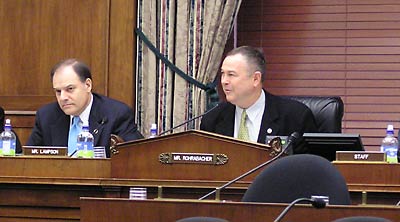 Congressmen Nick Lampson (left) and Dana Rohrabacher question witnesses on the benefits and drawbacks of closer space transportation cooperation during the March 18 hearing. (credit: J. Foust)
At first glance it would seem like NASA and the US Air Force would have a lot in common in space transportation—both have pressing needs to place payloads in space reliably—that would lend itself to cooperation. In practice that hasn’t been the case: the different requirements and cultures of the two agencies have largely precluded any significant cooperation. When they have cooperated the results have often been disappointing, as was the case most infamously with the space shuttle.
https://www.thespacereview.com/article/126/145)
Lunar rovers past and futureby Anthony Young Monday, April 5, 2004
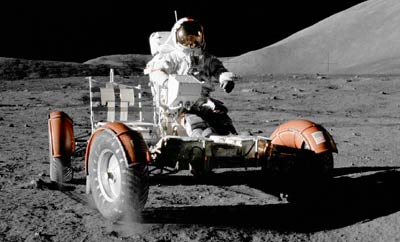 The lunar rover developed for the Apollo program provides a good starting point for planning future vehicles. (credit: NASA)
In his January 14, 2004 speech at NASA Headquarters proclaiming a new vision of United States space exploration, President Bush announced a return to the Moon by 2020 with a renewed commitment of lunar exploration. Notwithstanding the political (read: funding) minefields that await, future astronauts returning to the moon will most certainly have a lunar rover to fulfill their tasks. How different would it really be from the 1972 model? To get the answer, a bit of history is in order first.
https://www.thespacereview.com/article/127/115/IV 2004 [46-48]46)
Review: Leaving Earthby Jeff Foust Monday, April 12, 2004
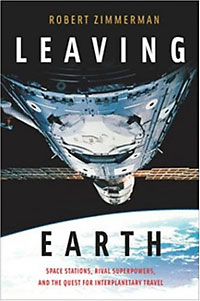 Leaving Earth: Space Stations, Rival Superpowers, and the Quest for Interplanetary Travel
by Robert Zimmerman
Joseph Henry Press, 2003
Hardcover, 528pp., illus.
ISBN 0-309-08548-9
US$27.95/C$37.95
https://www.amazon.pl/s?k=Leaving+Earth%3A+Space+Stations%2C+Rival+Superpowers%2C+andWhy build a space station? Since the beginning of the Space Age the stations that have flown have fallen short of the ideals of space advocates and science fiction writers, who foresaw orbiting hubs of transportation and commerce—the giant spinning station from 2001: A Space Odyssey, complete with Pan Am shuttles and a Hilton hotel, being perhaps the best-known example. Instead, the space stations that have been built have been, at best, modest conglomerations of modules and solar arrays, serving as cramped homes for two or three people who spend much of their time simply keeping their station operating. The justification for such facilities has been rooted primarily in geopolitics—first Cold War competition, now international cooperation—coated with a thin veneer of science.
https://www.thespacereview.com/article/128/147)
Future British military space policyby Taylor Dinerman Monday, April 12, 2004
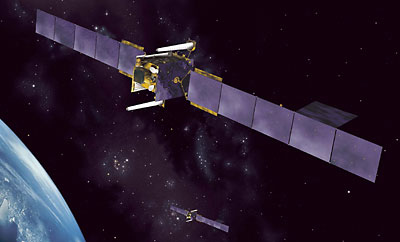 The Skynet 5 military communications satellites could prove vulnerable to attack unless the UK develops countermeasures—and perhaps space weapons of its own. (credit: EADS)
No, this is not a joke. The UK does have a variety of military space systems and is developing more. It is inconceivable that any British government would ever willingly give up its status as a first-rank, medium-sized military power. Thus, they will have to develop a far more sophisticated and comprehensive approach to military operations in orbit than they have up to now. The Blair government was the first to have anything remotely resembling a civil space policy. The next British government, whether Labour or Conservative, will have to think about the military aspects of outer space.
https://www.thespacereview.com/article/129/148)
The feminization of American space policyby Dwayne A. Day Monday, April 12, 2004
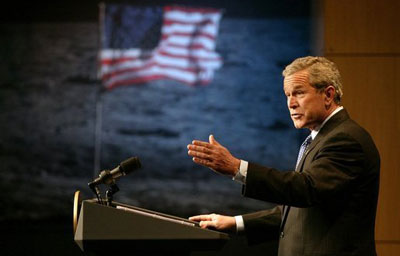 When President Bush spoke at NASA Headquarters three months ago, one key aspect was missing from his speech: any mention of American “leadership” in space. (credit: White House)
When President George W. Bush announced a new civilian space policy at NASA Headquarters on January 14 he used much of the language typical of such speeches. He talked of vision and the bravery of explorers like Lewis and Clark, who traveled far and opened new frontiers. He cracked a couple of small jokes and spoke of the pioneering spirit that was part of America’s heritage.
https://www.thespacereview.com/article/130/116/IV 2004 [49-51]49)
Review: future space technologiesby Taylor Dinerman Monday, April 19, 2004
 Advanced Space System Concepts and Technologies: 2010-2030+
by Ivan Bekey
Aerospace Corporation/AIAA, 2003
Softcover, 293 pp., illus.
ISBN 1-884989-12-8
US$34.95
https://www.amazon.pl/s?k=Advanced+Space+System+Concepts+and+TechnologiesBroadly speaking, there are two kinds of visionaries. There are those who mostly study history and derive their lessons from what has gone before, and there are those who study science and technology and base their ideas on what is possible. Both types are needed in any forward-looking society. Alvin Toffler is a good example of the former and Ivan Bekey is an excellent example of the latter.
https://www.thespacereview.com/article/131/150)
Levity and gravity: behind the story of Gravity Probe-Bby Dwayne A. Day Monday, April 19, 2004
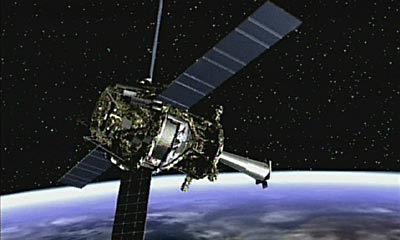 The concept behind Gravity Probe-B dates back more than 40 years, but the technology required to build it delayed its launch until now. s(credit: NASA)
Just about every space scientist will agree that Gravity Probe-B is a survivor. Scheduled for launch from Vandenberg Air Force Base on Monday atop a Delta 2 rocket, it will orbit 400 miles over the Earth’s poles and test Einstein’s General Theory of Relativity. However, it already has cost $700 million—$300 million more than originally estimated and nearly as much as both of NASA’s Mars rovers combined—and is four years late. The stubborn little spacecraft has survived numerous hardware setbacks and delays and congressional scrutiny that should have killed it years ago. One astronomer on a different NASA space science program—who for obvious reasons wishes to remain anonymous—has joked that the Stanford University scientists who built the probe’s instruments either have amazing political skills, or are somehow blackmailing members of Congress, because they have miraculously survived significant problems and cost overruns.
https://www.thespacereview.com/article/132/151)
Utilizing ET wealth: building a new worldby Gregory Anderson Monday, April 19, 2004
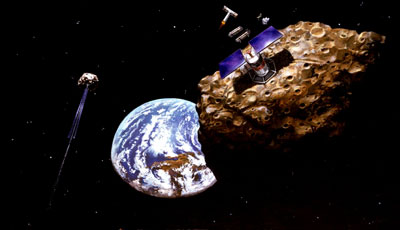 Cataloging and utilizing the vast resources of near Earth asteroids may be the solution to the economic woes of the planet. (credit: NASA)
Fifty years from now, according to UN projections, the human population will have increased by half. Also, according to projections, the gap between rich nation and poor will have widened, and the rate of separation will have begun a dramatic acceleration as the rich nations continue to develop technology-based economies while the poor are left with commodity-based ones, often tied to one commodity. Terrorists will thrive in the desperately poor urban areas of many megacities in the developing world, using the social conditions there to justify their actions. They will also have access to weapons of mass destruction, according to The New Terrorism, a 1999 book by Walter Laquer, a leading expert on terrorism and strategic affairs. The attacks on the World Trade Center and the Pentagon, while monstrous, are only mild tastes of what terrorists in the future could do.
https://www.thespacereview.com/article/133/117/IV 2004 [52-55]52)
Review: the quest for SSTOby Jeff Foust Monday, April 26, 2004
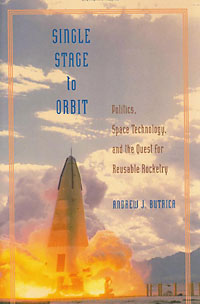 Single Stage to Orbit: Politics, Space Technology, and the Quest for Reusable Rocketry
by Andrew Butrica
Johns Hopkins Press, 2003
Hardcover, 266pp., illus.
ISBN 0-8018-7338-X
US$45
https://www.amazon.pl/s?k=Single+Stage+to+Orbit%3A+Politics%2C+Space+Technology%2C+and+theAt this weekend’s Space Access ’04 conference in Phoenix, Pat Bahn, CEO of suborbital RLV company TGV Rockets, started his presentation by showing an old McDonnell Douglas video from around mid-1996 about the DC-X program. The video recounted the history of the program and the then-recent series of test flights of the modified DC-XA funded by NASA. The video no doubt brought back good memories for many attendees, but Bahn brought them back to the present with his assessment of the program. “The DC-X was a wonderful technical success, but a programmatic failure,” he said. “There are no VTVL [vertical takeoff, vertical landing] vehicles operating, providing services based upon the technology developed.”
https://www.thespacereview.com/article/134/153)
Heavy lifting for the new millenniumby Anthony Young Monday, April 26, 2004
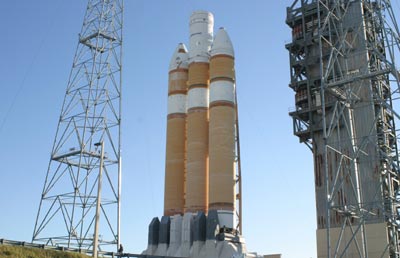 The first Delta 4 Heavy is rolled out to the launch pad for tests in December 2003. (credit: Boeing)
At Space Launch Complex 37, Pad B at Cape Canaveral Air Force Station sits America’s latest EELV, (Evolved Expendable Launch Vehicle): the Boeing Delta 4 Heavy. It is currently undergoing checkout in preparation for its inaugural flight in July. It looks like no Delta ever launched, resembling instead the larger Titan 4, but there the comparison ends. The only thing it has in common with the first Delta launched in 1960 is the name. Much is riding on the launch of the Delta 4 Heavy this summer. The U.S. Air force looks to the Delta 4 Heavy to replace the Titan 4 and NASA is looking to it as a potential booster for its CEV and other payloads.
https://www.thespacereview.com/article/135/154)
Lunar Reconnaissance Orbiter: the cornerstone of the visionby Taylor Dinerman Monday, April 26, 2004
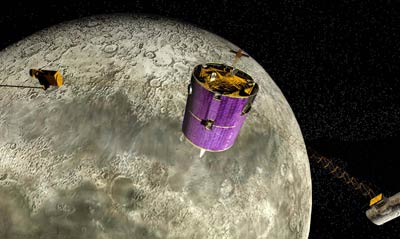 The Lunar Reconnaissance Orbiter will be far more ambitious—and far larger—than recent missions to the Moon, like Lunar Prospector (above). (credit: NASA Ames)
Scheduled to be launched sometime in 2008, the Lunar Reconnaissance Orbiter (LRO) project is quickly approaching the point where some basic decisions have to be made. Given the time it takes for missions such as the LRO to be designed, built, tested, and certified, the need to get the requirements right, and to do so fast, is an early test of Code T and Admiral Steidle’s ability to change the way things get done at NASA.
https://www.thespacereview.com/article/136/155)
The benefits of a new space raceby Dwayne A. Day Monday, April 26, 2004
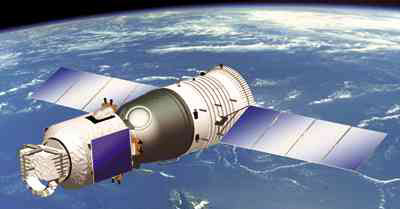 Putting a greater emphasis on manned spaceflight, like the Shenzhou spacecraft (above), forces China to divert resources away from military programs. (credit: CAST)
In October 2003 China became only the third nation to launch a human into space aboard its own rocket. Colonel Yang Liwei, China’s first taikonaut, orbited the Earth for barely a day before returning, slightly shaken, to a landing in Mongolia. It was a significant technical achievement for a country that has been struggling to modernize its economy and its technology, and the Chinese government trumpeted it to its people and the world.
https://www.thespacereview.com/article/137/1
 Wątek: The Space Review (Przeczytany 183116 razy)